


We Know Football and Dementia Are Linked. so What Will the Game Do About It?

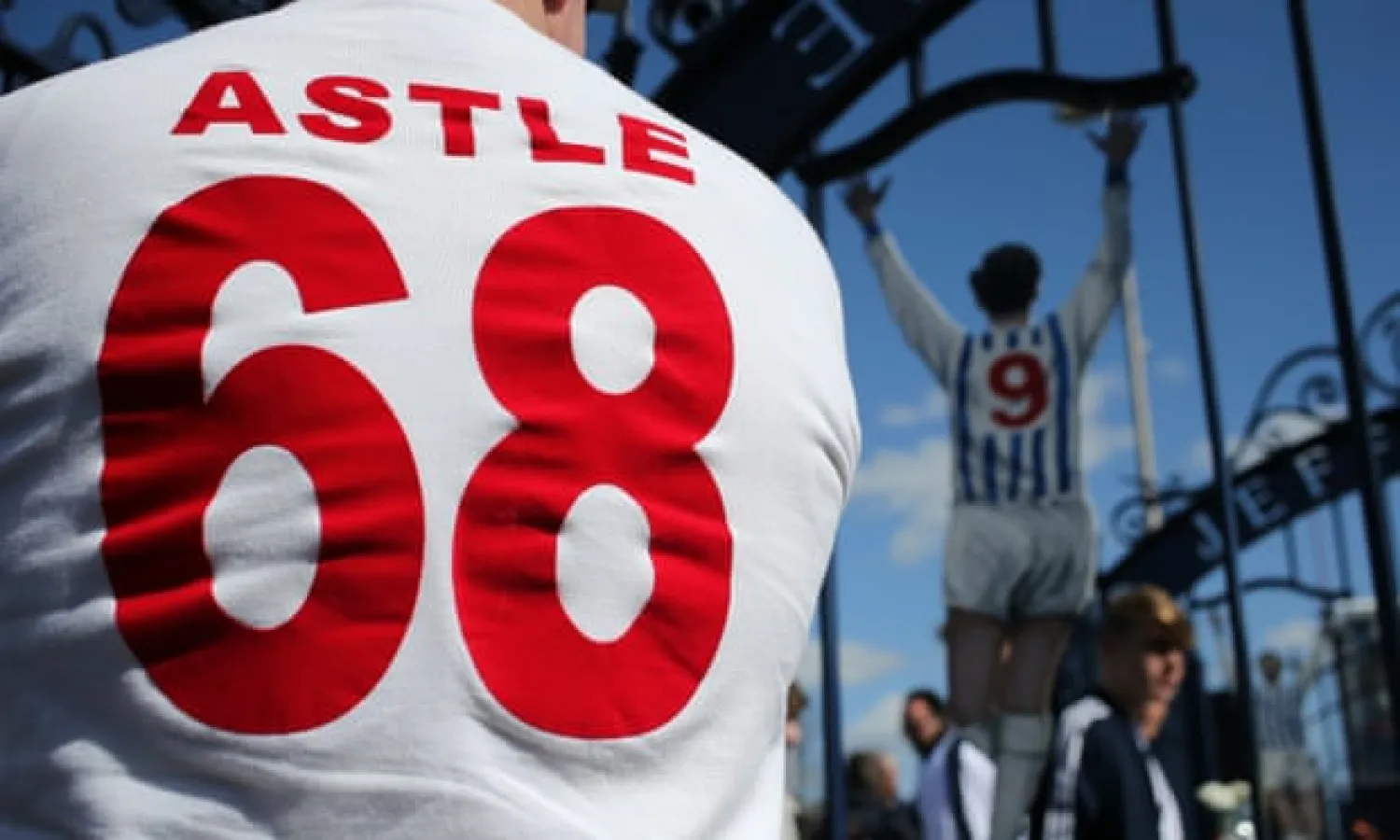
 A fan at the Jeff Astle gates at the Hawthorns in a shirt honouring the FA Cup won in 1968 by the striker and his West Brom teammates. Photograph: Matthew Ashton/Corbis via Getty Images
A fan at the Jeff Astle gates at the Hawthorns in a shirt honouring the FA Cup won in 1968 by the striker and his West Brom teammates. Photograph: Matthew Ashton/Corbis via Getty Images
TT

We Know Football and Dementia Are Linked. so What Will the Game Do About It?

 A fan at the Jeff Astle gates at the Hawthorns in a shirt honouring the FA Cup won in 1968 by the striker and his West Brom teammates. Photograph: Matthew Ashton/Corbis via Getty Images
A fan at the Jeff Astle gates at the Hawthorns in a shirt honouring the FA Cup won in 1968 by the striker and his West Brom teammates. Photograph: Matthew Ashton/Corbis via Getty Images

So now we know. Revealed last week, the results of a landmark study into the relationship between football and brain damage confirmed what many in and outside the game have long suspected: former professionals are significantly more likely to suffer from dementia and other serious neurological diseases in their later years. Three-and-a-half times more likely, to be precise. The research project, conducted over nearly two years by the University of Glasgow’s Brain Injury Group also discovered a five-fold increase in the risk of Alzheimer’s, a four-fold increase in motor neurone disease and a two-fold increase in Parkinson’s. What football – those who play, coach and govern the sport – decides to do with this crucial information remains to be seen but recent history suggests any real progress in the field of player safety will be made at a glacial pace.

Dawn Astle spent time on the night of her 34th birthday alone with her father, who had just died after choking during a family dinner. Frantic efforts by relatives and paramedics had failed to save Jeff, the former West Brom and England legend who, at 54, had first begun to show symptoms of the brain damage that would eventually lead to his death. Diagnosed with early-onset Alzheimer’s, his descent into utter helplessness was swift and before his death five years later he was incontinent, barely able to feed himself and had no idea who he or anyone around him was. In Michael Calvin’s book State of Play, Dawn tells the author that as her father’s body lay in repose she swore an oath on his behalf. “If football has done this to you, Dad,” she said. “I promise you I’ll make sure the whole world knows and I’ll get justice for you.”

That was in January 2002 and at the initial inquest the coroner, Andrew Haigh, found football had indeed done this to Jeff. Due in no small part to his daughter’s tireless campaigning in the intervening years, it has been well documented that he died from “an industrial disease” brought on by the repeated trauma of heading the ball. Called on to give a response, the Football Association and Professional Footballers’ Association announced a 10-year study into the relationship between football and brain diseases which was later shelved. Calvin writes that Dawn later found herself in the position of having to respond to the PFA chief executive, Gordon Taylor. “My mother’s got dementia,” he said. “And she’s never headed a ball.”

It would be another 12 years before an examination of Jeff’s brain proved he had suffered from chronic traumatic encephalopathy (CTE), the degenerative disease also suffered by Chris Sutton’s father, Mike, a former professional with Norwich City and one of an alarming number of former professional footballers who suffer – or have died – from the illness. Happy at times to play the contrarian in his work as a football pundit, there is nothing pantomime about the fury felt by Chris at the neglect of football’s governors and the PFA when the awful plight of his dad is brought up. “The PFA – led by Gordon Taylor – had a duty of care to their members,” he said last week. “They let them down and, in my opinion, their chief executive has blood on his hands.” Changing his tune in a reverse-ferret that was better 17 years late than never, the chief executive in question agreed it was “incumbent on football globally to come together to address this issue in a comprehensive and united manner”.

Sutton, it should be noted, was quick to add that he is not interested in removing heading from the game, but pointed out that if he had been forewarned about the potential dangers of doing so, he might have devoted less time in training to a skill few were better at. “There is already a ban on kids heading footballs in the United States,” he said. “Maybe it is time to bring that to these shores. A Premier League centre back will head the ball hundreds of times a week in training sessions. Do we limit that, too? I’m not saying we ban heading in football but at least this study now gives every youngster a choice. Any kids in academies, you now know the dangers.”

So, over to you football. Now that you have learned how dangerous you can be, what will you do about it? As recently as 2017 Fifa was clinging to the fact that, because there was no absolute causal link between heading footballs and degenerative brain diseases, there could be “no true evidence” of any connection. Given the lip service administrators and many coaching and medical staff appear to grudgingly pay players suffering from short-term brain traumas such as concussions, the smart money would have to go on the collective football head being buried in the sand.

Four years after Germany’s Christoph Kramer, dazed and confused after a collision with an opponent, interrupted the 2014 World Cup final to ask the referee if he was playing in a World Cup final, viewers watching Morocco take on Iran at Russia 2018 were treated to the grisly spectacle of Nordin Amrabat being slapped around the chops by medical staff eager to get him back into action after he’d been knocked out following a clash of heads. Their efforts were unsuccessful, but Amrabat was back on the pitch within five days wearing a protective skull cap he discarded early in the game.

These are just two of many, many high-profile examples of football playing fast and loose with player welfare as far as concussions are concerned and one doesn’t have to travel as far afield as Brazil or Russia to witness similar borderline-criminal neglect. If so little concern is shown to those with obvious head trauma out on the field of play, what possible hope is there for those whose symptoms may not become apparent until long after the final whistle has blown?

The Guardian Sport


Owono Does Not Deserve 12-Match Ban Over De Miguel Death, Says Andorra Owner Pique

Equatorial Guinea's goalkeeper #01 Jesus Owono leaves the pitch at half time during the Africa Cup of Nations (CAN) Group E football match between Equatorial Guinea and Algeria at Moulay Hassan Stadium in Rabat on December 31, 2025. (AFP)
TT

Owono Does Not Deserve 12-Match Ban Over De Miguel Death, Says Andorra Owner Pique

Equatorial Guinea's goalkeeper #01 Jesus Owono leaves the pitch at half time during the Africa Cup of Nations (CAN) Group E football match between Equatorial Guinea and Algeria at Moulay Hassan Stadium in Rabat on December 31, 2025. (AFP)

FC Andorra owner Gerard ‌Pique said goalkeeper Jesus Owono did not deserve the 12-match suspension he received following the challenge that led to the death of Tenerife forward Jesus de Miguel.

Owono and De Miguel collided during a Spanish second-tier match on November 2. De Miguel was taken to intensive care and died the following day.

The disciplinary committee of the Spanish football federation (RFEF) banned Owono for violent conduct which resulted in serious ‌injury last week.

"Players, ‌former players, coaches, goalkeepers, everyone has ‌called ⁠it an accident," ⁠Pique said in a video posted on social media late on Monday.

"I truly believe that imposing the maximum sanction on Jesus for this action puts him in a situation he does not deserve, because he is not to blame for all of ⁠this having happened."

Former Barcelona player Pique ‌pointed to the three-match ‌ban handed to Albacete's Jose Corpas for accidentally kicking Sabadell ‌player Quadri Liameed in the head during a ‌recent match in Spain.

"Fortunately Quadri is fine, the consequences in this case were not fatal, and the committee decided to sanction Corpas with three matches," Pique added.

"With ‌all this, my reflection is: what is being sanctioned, the action or the ⁠consequences?"

The RFEF ⁠did not immediately respond to a request for comment outside regular business hours in Spain.

Owono, 25, has withdrawn from Equatorial Guinea's squad for Africa Cup of Nations qualifiers against Zimbabwe this month and Pique said it was unlikely the goalkeeper would return to action as soon as his suspension is up.

"Jesus is going to need far more than 12 matches before he is available and able to compete," he added. "No sanction is going to bring Demi (De Miguel) back to us."


Alcaraz Says Experience Helped Him Crack Indoor Code after Back-to-back Title Wins

Tennis - ATP Finals - Palasport Olimpico, Turin, Italy - November 16, 2026  Spain's Carlos Alcaraz in action during his group stage match against Francis Tiafoe of the US. REUTERS/Guglielmo Mangiapane
Tennis - ATP Finals - Palasport Olimpico, Turin, Italy - November 16, 2026 Spain's Carlos Alcaraz in action during his group stage match against Francis Tiafoe of the US. REUTERS/Guglielmo Mangiapane
TT

Alcaraz Says Experience Helped Him Crack Indoor Code after Back-to-back Title Wins

Tennis - ATP Finals - Palasport Olimpico, Turin, Italy - November 16, 2026  Spain's Carlos Alcaraz in action during his group stage match against Francis Tiafoe of the US. REUTERS/Guglielmo Mangiapane
Tennis - ATP Finals - Palasport Olimpico, Turin, Italy - November 16, 2026 Spain's Carlos Alcaraz in action during his group stage match against Francis Tiafoe of the US. REUTERS/Guglielmo Mangiapane

Carlos Alcaraz said experience has finally taught him how to get the best out of his game on indoor courts, with the world number three carrying his title-winning form from Vienna and Paris into this week's ATP Finals in Turin.

Only three of his 29 career titles have come on indoor hard courts, with his first coming in Rotterdam last year.

The 23-year-old has enjoyed a strong run of form since ⁠returning to the ⁠tour in August after nearly five months out with a right wrist injury.

His 6-2 6-2 win over Frances Tiafoe in his opening match at the ATP Finals on Monday showed he could be a real force at ⁠the season finale.

"I've always said that I'm not bad on indoor courts," the seven-times Grand Slam champion told reporters. "I just feel like others are a little bit better than me.

"It was about time, it was about getting more experience and it was about understanding how I should play on indoor courts,” Reuters quoted him as saying.

The faster conditions can mean Alcaraz has less time to ⁠impose ⁠his game, but he said he was confident of going toe-to-toe with the big servers and flatter hitters.

Tiafoe was in no doubt about Alcaraz's current level.

"He has moments where he's definitely Superman and he's playing pretty insane," Tiafoe said.

"But again, it's one of those things, you've got to appreciate greatness."

Alcaraz continues his campaign for a first ATP Finals crown when he takes on former champion Daniil Medvedev on Wednesday.


Goalkeeper Martinez Set for Argentina Return After Jaw Injury

Football - International Friendly - Argentina v Uruguay - Estadio La Bombonera, Buenos Aires, Argentina - November 13, 2026 Argentina's Emiliano Martinez during the warm up before the match. (Reuters)
TT

Goalkeeper Martinez Set for Argentina Return After Jaw Injury

Football - International Friendly - Argentina v Uruguay - Estadio La Bombonera, Buenos Aires, Argentina - November 13, 2026 Argentina's Emiliano Martinez during the warm up before the match. (Reuters)

Argentina ‌coach Lionel Scaloni said goalkeeper Emiliano Martinez will feature in Tuesday's friendly against Costa Rica after he recovered from a jaw fracture.

Martinez underwent surgery after colliding with Everton defender Jarrad Branthwaite in ‌Chelsea's 2-0 ‌victory last month.

He returned ⁠to Chelsea training ⁠earlier this month and was called up by Scaloni despite not having played for the Premier League club since ⁠the Everton game.

Martinez, ‌34, ‌did not feature in Argentina's 2-1 ‌loss to Uruguay on ‌Friday.

"Emiliano is going to play in goal, he'll be there," Scaloni told reporters on ‌Monday, ahead of the friendly match in Cordoba.

"Maybe ⁠he ⁠was fit for the previous match, but it was a risk, and since we trust Gero (Geronimo Rulli), Juan (Musso) and Santi (Santiago Beltran), we chose to look after him. An extra three days was a prudent choice."
