


Albanian Boy Freed from ISIS Camp on Way Home to Italy

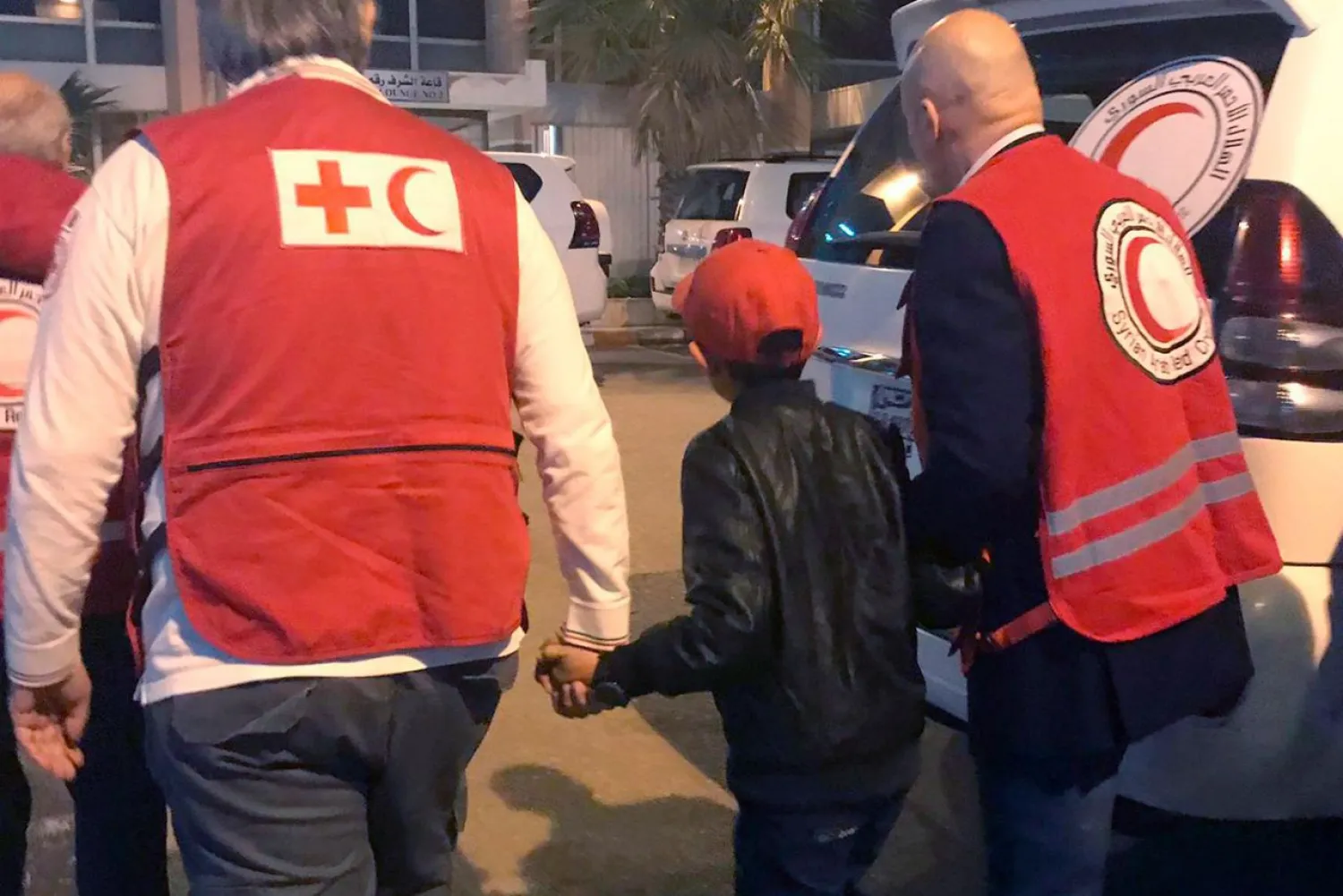
In this Nov. 6, 2019, Alvin, an Albanian boy who was taken to Syria by his mother when she joined the ISIS group, is accompanied to Damascus airport by Red Cross and Red Crescent officials. (AP)
TT

Albanian Boy Freed from ISIS Camp on Way Home to Italy

In this Nov. 6, 2019, Alvin, an Albanian boy who was taken to Syria by his mother when she joined the ISIS group, is accompanied to Damascus airport by Red Cross and Red Crescent officials. (AP)

An Albanian boy who was taken to Syria by his mother when she joined the ISIS group has been freed from a crowded detention camp in northeastern Syria and is on track to return home to Italy with his father, Red Cross and Red Crescent officials said Thursday.

The story of 11-year-old Alvin, who found himself with no family at the al-Hol camp after his mother died amid fighting in northeast Syria, has captivated public attention in Italy after a glitzy TV news show reported on his father's agonized efforts to bring him home.

The evacuation also comes amid the shifting strategic landscape in Syria's northeast. The Kurdish-led forces that run al-Hol camp have recently aligned themselves with the Syrian regime, after they were effectively abandoned by the US after years of fighting ISIS together.

The Kurds' pivot to Damascus paved the way for the boy's release Wednesday and his flight under Red Crescent escort from the northeastern city of Qamishli to the Syrian capital, Damascus, instead of through northern Iraq.

Video snippets provided to The Associated Press showed Alvin at the airport in Damascus late Wednesday, walking under escort from Red Crescent staff with a limp because of an injury reportedly sustained in the same violence that took his mother's life.

Syria's State-run news agency SANA said Syrian Deputy Foreign Minister Faisal Mekdad handed over Alvin to IFRC President Francesco Rocca and said it was ready to provide all necessary facilities to help child victims of extremist groups in Syria. It criticized Western countries, saying they "claim to respect (humanitarian) laws but shirk their commitments."

Alvin arrived in Lebanon on Thursday afternoon. In Beirut, Albania's Interior Minister Sander Lleshaj met with Alvin at the Italian Embassy to deliver the boy's personal documentation, Albanian Prime Minister Edi Rama said on social media.

"He comes from hell, in an aggravated physical and psychological situation. He is, however, good and healthy ... It's good news that he speaks Albanian, though he has been among Arabian language for many years," said Albanian Interior Minister Sander Lleshaj in a telephone interview with Top Channel private television station.

Some 70,000 people now reside in al-Hol camp, mostly women and children including about 11,000 foreigners. The site has been the largest holding facility for people linked to ISIS. A few other detainees have been returned home to countries like France, Russia and Australia. But Alvin's release was the first case to be facilitated by the International Federation of Red Cross and Red Crescent Societies.

"I hope that this will bring some peace and the prospect of healing to his family," said IFRC President Francesco Rocca, who personally participated in Alvin's case. "What we can and should be focusing on is the fact that there are still over 68,000 people — two-thirds of which are children — living in the al-Hol camp."

"This morning's news is positive news, but it is barely a drop of relief in an ocean of suffering," he added.

Five years ago, Alvin's mother joined ISIS and took him with her into territories that the extremist group controlled. After she was killed, word got out confidentially through the Red Cross and Red Crescents' "Restoring Family Links" program.

Through that program, the father, identified as Afrim Berisha on the Italian TV show "Le Iene," got a message from his son: Alvin was alive, alone at al-Hol, and asking to be brought home. Today, the only language Alvin can speak fluently is Arabic.

Alvin's father reached out the Italian Red Cross, and after a negotiation with the Italian and Albanian authorities, the boy now has an Albanian passport and a permit to stay in Italy with his family.

The case got a jolt from the flashy, fast-paced Italian TV news magazine and satire program, which trekked to al-Hol with the father for a teary-eyed reunion with the boy weeks ago.

However, he wasn't allowed to leave with his son. According to the report, the Kurdish authorities refused to hand over the boy because no Albanian official was present. So the father returned empty-handed to Italy, where he has permanent residence.

Social media and public opinion then kicked in to shift political will. Mounting pressure in the Lombardy region, where the boy was raised, led the regional council to pass a resolution to bring the boy home.

The Red Cross and Red Crescent opened up a negotiation with Italian and Albanian authorities to arrange the necessary paperwork and authorizations. On Wednesday, the boy spent the night in a room with a psychologist, and was taken to the Syrian Foreign Ministry on Thursday.

A number of European countries have been reluctant to let former members of ISIS or their relatives return — but the groundswell of public attention appears to have made an exception of Alvin's case.

"I fully appreciate that the situation in al-Hol is complex. There is no simple solution, and there are legitimate concerns that have been raised by governments," said Rocca, the IFRC president. "But those concerns must be balanced with the need to treat people humanely."



Trump to Attend Ceremony to Witness Return of US Personnel Killed in Syria

US President Donald Trump speaks to the media - Reuters
TT

Trump to Attend Ceremony to Witness Return of US Personnel Killed in Syria

US President Donald Trump speaks to the media - Reuters

US President Donald Trump and first lady Melania Trump will attend a ceremony on Wednesday to honor US personnel killed in Syria over the weekend by a suspected ISIS attacker.

Trump and his wife will travel to Dover Air Force Base in Delaware to be present for what the Air Force calls the "dignified transfer" of the bodies from overseas back into the United States in the presence of their families. The ceremony is scheduled to take place at 1:15 p.m. EST (1815 GMT), Reuters reported.

Two US Army soldiers and a civilian interpreter were killed on Saturday in the central Syrian town of Palmyra by an attacker who targeted a convoy of American and Syrian forces before being shot dead, according to the U.S. military.

Trump called the incident terrible, vowed retaliation and referred to the three that were slain as "great patriots."

Three US soldiers were also wounded in the attack.

US presidents, vice presidents and dignitaries regularly attend the solemn transfer ceremonies at Dover during times of war or conflict that result in the deaths of US troops. Flag-draped transfer cases are brought off of a military plane with the bodies of the fallen and put with precision in an awaiting vehicle as officials and family members watch and often weep.


Putin Says Russia will Achieve War Goals, Keep Expanding 'Buffer Zone'

Russian President Vladimir Putin attends a meeting with Kazbek Kokov, head of the North Caucasus region of Kabardino-Balkaria, in Moscow, Russia December 16, 2025. Sputnik/Mikhail Metzel/Pool via REUTERS
TT

Putin Says Russia will Achieve War Goals, Keep Expanding 'Buffer Zone'

Russian President Vladimir Putin attends a meeting with Kazbek Kokov, head of the North Caucasus region of Kabardino-Balkaria, in Moscow, Russia December 16, 2025. Sputnik/Mikhail Metzel/Pool via REUTERS

President Vladimir Putin said on Wednesday that Russia would achieve its goals in Ukraine by diplomatic or military means, and would seek to expand a "security buffer zone" there.

"First, the goals of the special military operation will undoubtedly be achieved. We would prefer to do this and address the root causes of the conflict through diplomacy," Putin said.

"If the opposing side and their foreign patrons refuse to engage in substantive discussions, Russia will achieve the liberation of its historical lands by military means. The task of creating and expanding a security buffer zone will also be consistently addressed."

Of the regions of Ukraine that Russia has claimed as its own territory, it currently controls Crimea, around 90% of the Donbas region and 75% of Kherson and Zaporizhzhia, Reuters reported.

In addition, Russia holds some territory in the adjoining regions of Kharkiv, Sumy, Dnipropetrovsk and Mykolaiv. Putin's comments signalled that Moscow would seek further gains on some of these fronts.

With the war at a key juncture as US President Donald Trump pushes hard for a quick peace agreement, Putin said Russia was advancing on all fronts.

But his defense minister, Andrei Belousov, acknowledged that Ukrainian forces were trying to take back control of the northeastern town of Kupiansk - an effort he said was not succeeding.

Ukraine said on Wednesday it had taken 90% of the town, which Russia said it had captured in November.

Putin said people in Europe were being indoctrinated with fears of a war with Russia, and accused their leaders of whipping up hysteria.

"I have repeatedly stated: this is a lie, nonsense, pure nonsense about some imaginary Russian threat to European countries. But this is being done quite deliberately," he said.

Putin has said Russia is not seeking war with Europe, but is ready for war if that is Europe's choice.


Pakistan Says ‘Hostile Countries’ behind False Online Claims Linking it to Australia Shootings

A man waves Pakistan's flag as he along with others gather in support of Pakistan Army, day after the ceasefire announcement between India and Pakistan, in Islamabad, Pakistan, May 11, 2025. REUTERS/Akhtar Soomro
TT

Pakistan Says ‘Hostile Countries’ behind False Online Claims Linking it to Australia Shootings

A man waves Pakistan's flag as he along with others gather in support of Pakistan Army, day after the ceasefire announcement between India and Pakistan, in Islamabad, Pakistan, May 11, 2025. REUTERS/Akhtar Soomro

Pakistan’s information minister said Wednesday that his country has been the victim of a coordinated online disinformation campaign following the mass shooting at Australia’s Bondi Beach.

Attaullah Tarar accused “hostile countries,” including India, of spreading false claims that one of the two attackers was a Pakistani national.

Speaking at a news conference in Islamabad, Tara said Pakistan's leadership strongly condemned Sunday's attack, which killed 15 people in an antisemitic shooting targeting Jews celebrating Hanukkah, The AP news reported.

The minister said misleading information began circulating almost immediately after the attack, with social media posts falsely identifying one of the suspects as a Pakistani national named Naveed Akram. He said the claims spread rapidly across digital platforms and were repeated by some media outlets without verification.

Tarar said subsequent findings, including confirmation by Indian police, established that one of the attackers, Sajid Akram, was from India, while his 24-year-old son, Naveed Akram — who was also involved — was born in Australia.

The minister said the misinformation appeared to stem from a case of mistaken identity, as a Pakistani man living in Sydney shares the same name as one of the two suspects.

“How do we restore the situation to where it was before the Bondi Beach attack?” Tarar asked, adding that the Pakistani man — also named Naveed Akram — had released a video denying any involvement and urging the public not to associate him with the attack.

Tara said the Pakistani man was “a victim of a malicious and organized campaign” and that the disinformation effort originated in India.

There was no immediate response from Indian officials.

Tarar called on media outlets that published the false reports to issue apologies and said Pakistan had not yet decided whether to pursue legal action.

Pakistan and India, nuclear-armed rivals, have a long history of strained relations and have fought three wars since gaining independence from British rule in 1947, most of them over the disputed Himalayan region of Kashmir. The two sides came close to war in May before US President Donald Trump brokered a ceasefire.