


Preparing Players for Life After Football Should Begin Before the Final Whistle

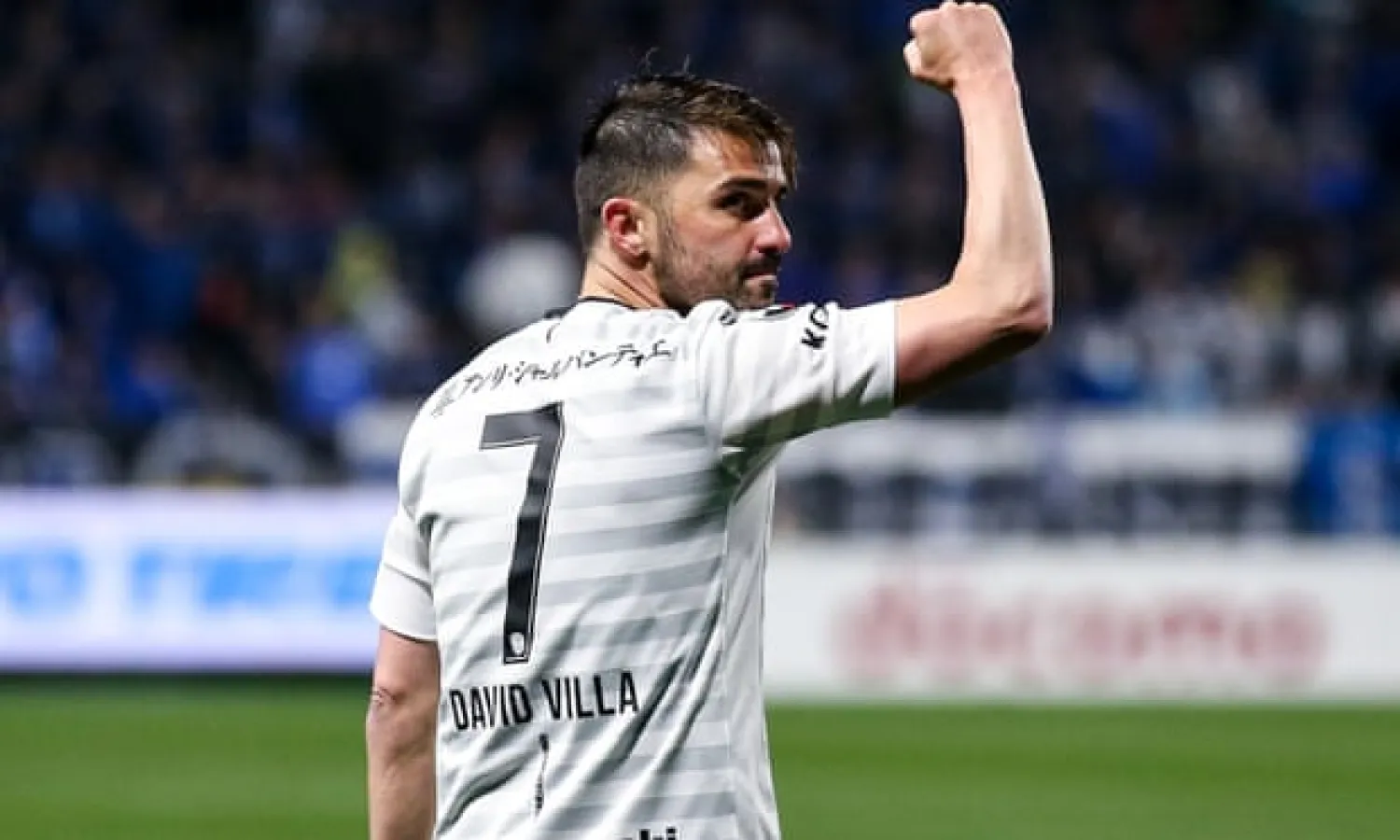
 David Villa is seeing out his last playing days in Japan with Vissel Kobe and will concentrate on a football club he has founded in New York City. Photograph: Zhizhao Wu/Getty Images
David Villa is seeing out his last playing days in Japan with Vissel Kobe and will concentrate on a football club he has founded in New York City. Photograph: Zhizhao Wu/Getty Images
TT

Preparing Players for Life After Football Should Begin Before the Final Whistle

 David Villa is seeing out his last playing days in Japan with Vissel Kobe and will concentrate on a football club he has founded in New York City. Photograph: Zhizhao Wu/Getty Images
David Villa is seeing out his last playing days in Japan with Vissel Kobe and will concentrate on a football club he has founded in New York City. Photograph: Zhizhao Wu/Getty Images

“Iprefer to leave football before football leaves me,” David Villa said this week. Spain’s all-time top scorer once claimed he would play until he was 55 if he could. In the end he will make it to 38. For the past six seasons Villa has signed annual deals, delaying the inevitable, competitive as ever, but no more: he has announced his retirement. Over 19 years he has scored 390 goals and played 716 games; he has four left. Five, if Vissel Kobe reach the Japanese cup final. And then he will lead a new football club, founded in Queens, New York.

Villa has prepared for retirement. “There are things I couldn’t give time to before; I can now,” he said. “It’s going to be fun, that’s the most important thing.” He has things to do for sure. And that, the former player, coach and director Jorge Valdano tells the Observer, is vital. “If I gave one piece of advice to a player retiring tomorrow, I’d say: ‘When you wake up, have something to do,’” he says. “Something, anything. It doesn’t matter what. Anything that helps you feel useful. Because the worst thing is the void.”

Some days Damian Duff would go and play, alone. “I feel a bit of a weirdo doing it [but] I went to the local Astropark for a little five-a-side, a kickabout on my own,” he told Graham Hunter’s Big Interview. “I’ll go and kick the ball against the wall for 10 minutes. Get my dose.” Zinedine Zidane said after retiring: “I miss the adrenaline but not the rest,” yet the advisory role he had was already starting to feel empty, which is why he coached.

Eric Cantona retired at 30. “I was young [enough] to return to play and I didn’t want to,” he says. “To avoid that temptation, I didn’t watch football for years. It’s like a drug and a dealer: if your dealer’s next to you, it’s harder. Sport is a drug. Your body misses the adrenaline. Physiologically it’s difficult to stop, then it becomes psychologically very difficult.” Is there another drug? “Yes, having another passion.”

For Cantona that was acting but it could not be as big as football – “an obsession” – and some never find anything else. “Some players, when they no longer play, feel they don’t exist,” he says.

It is not only football that leaves you; it is everything, a part of you. Valdano says: “Footballers never talk about the end of their careers, for the same reason human beings don’t talk about death: it frightens them."

Retirement from any job can provoke loss, a lack of identity. Elite sport exacerbates that, so complete is the dedication, and unlike many jobs football is one workers love – “you play a game for living, which is a way of prolonging your childhood‚” Valdano says – and which constructs a community perhaps no occupation can match. It is a world in which players do little for themselves, and one that ends early, with years ahead of them. For some it is sudden, a shock. Often they are unprepared.

It is said that sportspeople die twice, the first time on retirement. And that death is the harder, the Brazilian footballer Falcão once remarked, because it is the one you have to live with for the rest of your life.

“I was trying to process the fact that I was never going to play again and I couldn’t,” Clarke Carlisle explains in his documentary on mental health. “Because that was me, I was Clarke The Footballer. I couldn’t see the reason anybody would be proud of me. I’m going to take all these pills and kill myself because now without football they’re going to see me for what I am – and that was nothing. I sat on the bench, popped the pills and waited for it to happen. What a fucking idiot.”

Quite apart from the physical impact – a FifPro study found that 34% of former players over 40 have osteoarthritis – there is a mental issue. A 2018 State of Sport survey found half of former professional athletes have mental wellbeing concerns, retirement bringing a sense of “loss” and “regret”. “It’s not unusual for players to speak of feelings of mourning and grief,” said Simon Taylor from the Professional Players’ Federation.

Other research suggested that two fifths of footballers were bankrupt within five years and a third had divorced inside a year. “There can be a loss of material resources but perhaps hardest are the symbolic resources,” says Dr David Lavallee from Abertay University. “The stronger and more exclusive the identification with the role of footballer, the greater risk of retirement-related problems.”

FifPro has developed a health programme to help players adapt. The PFA has a 24-hour helpline and more than a hundred counsellors and a mental health action plan through which 438 players accessed therapy last year. The PFA welfare officer, Michael Bennett, a former player, says the stats can be shocking. “The perception is of a Premier League player with money, who shouldn’t have issues, but it’s a fallacy,” he says. “There’s a structure they lose and self-identity is the big issue. You leave the game and ask: ‘Who am I?’”

Steve Nicol’s experience tentatively suggests emotional security in economic insecurity. He kept playing, went down the divisions, segued into coaching – because he had to. “I was lucky: I never really left a ‘dressing room’,” he says. Bennett adds: “That community element is big: the thing players always say they miss is team spirit. It’s like you live in a big house with others where you have everything, then one day they kick you out. You don’t know what to do. You’re afraid, alone.”

The shock can be dislocating; it is a whole new world out there, which they have never been prepared for. “The thing that can diminish the impact is to change the paradigm,” Valdano says. “Clubs need to prepare the footballer for retirement before he begins his career, and that means studies. But in football everything can wait except Sunday’s game.”

Bennett adds: “Some clubs are fantastic, some aren’t. At the PFA we run four transitional events each year, inviting players to participate. They write CVs, learn transferable skills, work with companies. Rather than retirement, as such, it’s transition [out of the game]: some transition at 16, 18, 21, 27, later. We do workshops at clubs with the U18s, the U23s and the senior squad. It’s called ‘take control’: it’s down to them, too. If you worked at Zara, would they look after you after they left? They wouldn’t. But football clubs are asked to do that. That’s what the PFA is for.”

Many clubs discreetly assist former footballers. Liverpool have a forum for former players and Spurs employ them throughout the club, guiding them into new lives and providing roles. There is an alma mater ethos at Spurs’ academy aimed at preparing players not only for football but for life after football, echoing Valdano’s idea.

At Madrid Valdano moved youth-teamers into a boarding school, keen to educate them for the “real world”. Now he is setting up an online university course. The first class addresses this issue, one that has long occupied his thoughts, encapsulated in his perception that there are two types of players the game cares too little for: future footballers and former footballers. He is calling the session The Day After. And that day is just the start; thousands more follow. “I’m a bit old for football but I’m young for life,” David Villa said.

The Guardian Sport



Sunderland Worst Hit by Losing Players to African Cup of Nations 

14 December 2025, United Kingdom, London: Sunderland's Habib Diarra (L) and Leeds United's Gabriel Gudmundsson battle for the ball during the English Premier League soccer match between Brentford and Leeds United at the Gtech Community Stadium. (dpa)
TT

Sunderland Worst Hit by Losing Players to African Cup of Nations 

14 December 2025, United Kingdom, London: Sunderland's Habib Diarra (L) and Leeds United's Gabriel Gudmundsson battle for the ball during the English Premier League soccer match between Brentford and Leeds United at the Gtech Community Stadium. (dpa)

Premier League Sunderland will have to do without six players over the next few weeks and are the club worst hit as the Africa Cup of Nations takes its toll on European clubs competing over the holiday season.

Sunderland, eighth in the standings, had four of their African internationals in action when they beat Newcastle United on Sunday, but like 14 other English top-flight clubs will now lose those players to international duty.

The timing of the African championship, kicking off in Morocco on Sunday and running through to January 18, has long been an irritant for coaches, with leagues in Belgium, France, Germany, Italy, Netherlands, Portugal, and Spain also affected.

Hosting the tournament in the middle of the season impacts around 58% of the players at the Cup of Nations, though the Confederation of African Football did try to mitigate the impact by moving the start to before Christmas, so it is completed before the next round of Champions League matches.

The impact on European clubs was also lessened by allowing them to release players seven days, rather than the mandatory 14 days, before the tournament, meaning they could play for their clubs last weekend.

Sunderland's Congolese Arthur Masuaku and Noah Sadiki, plus full back Reinildo (Mozambique), midfielder Habib Diarra (Mali), and attackers Chemsdine Talbi (Morocco) and Bertrand Traore (Burkina Faso) have now departed for Morocco.

Ironically, Mohamed Salah’s absence from Liverpool to play for Egypt should lower the temperature at the club after his recent outburst against manager Arne Slot, but Manchester United will lose three players in Noussair Mazraoui, Bryan Mbeumo and Amad Diallo, who scored in Monday’s 4-4 draw with Bournemouth.

France is again the country with the most players heading to the Cup of Nations, and with 51 from Ligue 1 clubs. But their absence is much less impactful than previously as Ligue 1 broke after the weekend’s fixtures and does not resume until January 2, by which time the Cup of Nations will be into its knockout stage.

There are 21 players from Serie A clubs, 18 from the Bundesliga, and 15 from LaLiga teams among the 24 squads at the tournament in Morocco.


Rodgers Takes Charge of Saudi Team Al-Qadsiah After Departure from Celtic 

Then-Celtic head coach Brendan Rodgers greets supporters after a Europa League soccer match between Red Star and Celtic at Rajko Mitic Stadium in Belgrade, Serbia, Sept. 24, 2025. (AP)
TT

Rodgers Takes Charge of Saudi Team Al-Qadsiah After Departure from Celtic 

Then-Celtic head coach Brendan Rodgers greets supporters after a Europa League soccer match between Red Star and Celtic at Rajko Mitic Stadium in Belgrade, Serbia, Sept. 24, 2025. (AP)

Brendan Rodgers has returned to football as the coach of Saudi Arabian club Al-Qadsiah, six weeks after resigning from Scottish champion Celtic.

Al-Qadsiah, whose squad includes Italian striker Mateo Retegui and former Real Madrid defender Fernandez Nacho, is in fifth place in the Saudi Pro League in its first season after promotion.

Rodgers departed Celtic on Oct. 27 and has opted to continue his managerial career outside Britain for the first time, having previously coached Liverpool, Leicester and Swansea.

In its statement announcing the hiring of Rodgers on Tuesday, Al-Qadsiah described him as a “world-renowned coach” and said his arrival “reflects the club’s ambitious vision and its rapidly growing sporting project.”

Aramco, the state-owned Saudi oil giant, bought Al-Qadsiah in 2023 in a move that has helped to transform the club’s status.

“This is a landmark moment for the club,” Al-Qadsiah chief executive James Bisgrove said. “The caliber of his experience and track record of winning reflects our ambition and long-term vision to establish Al-Qadsiah as one of Asia’s leading clubs.”

Rodgers is coming off winning back-to-back Scottish league titles with Celtic, where he won 11 major trophies across his two spells. He also won the FA Cup with Leicester.

Al-Qadsiah's last two coaches were former Liverpool striker Robbie Fowler and former Spain midfielder Michel.


Portugal to Return to F1 Calendar in 2027 and 2028 

12 July 2025, United Arab Emirates, Abu Dhabi: Red Bull driver Max Verstappen leads into turn one during the Abu Dhabi Grand Prix at the Yas Marina Circuit, Abu Dhabi. (dpa)
TT

Portugal to Return to F1 Calendar in 2027 and 2028 

12 July 2025, United Arab Emirates, Abu Dhabi: Red Bull driver Max Verstappen leads into turn one during the Abu Dhabi Grand Prix at the Yas Marina Circuit, Abu Dhabi. (dpa)

Formula One will return to Portugal's Portimao circuit in 2027 and 2028 after the Dutch Grand Prix at Zandvoort drops off the calendar.

Formula One announced a two-year deal in a statement on Tuesday.

The 4.6-km Algarve International circuit in the country's south last hosted the Portuguese Grand Prix in 2020 and 2021, both seasons impacted by the COVID-19 pandemic with stand-in venues.

In 2020, seven-times world champion Lewis Hamilton took his 92nd career win at Portimao, breaking the record previously held by Michael Schumacher. Hamilton also won in 2021.

"The interest and demand to host a Formula One Grand Prix is the highest that it has ever been," said Formula One chief executive Stefano Domenicali, thanking the Portuguese government and local authorities.

The financial terms of the deal were not announced.

"Hosting the Grand Prix in the Algarve reinforces our regional development strategy, enhancing the value of the territories and creating opportunities for local economies," said Economy Minister Manuel Castro Almeida.

Portugal first hosted a grand prix in Porto in 1958, with subsequent races at Monsanto and Estoril near Lisbon. The late Brazilian great Ayrton Senna took his first grand prix pole and win at the latter circuit in 1985.

Formula One announced last year that Zandvoort, a home race for four-times world champion Max Verstappen, would drop off the calendar after 2026.

The championship already features a record 24 races and Domenicali has spoken of European rounds alternating to allow others to come in.

Belgium's race at Spa-Francorchamps is due to be dropped in 2028 and 2030 as part of a contract extension to 2031 announced last January.