

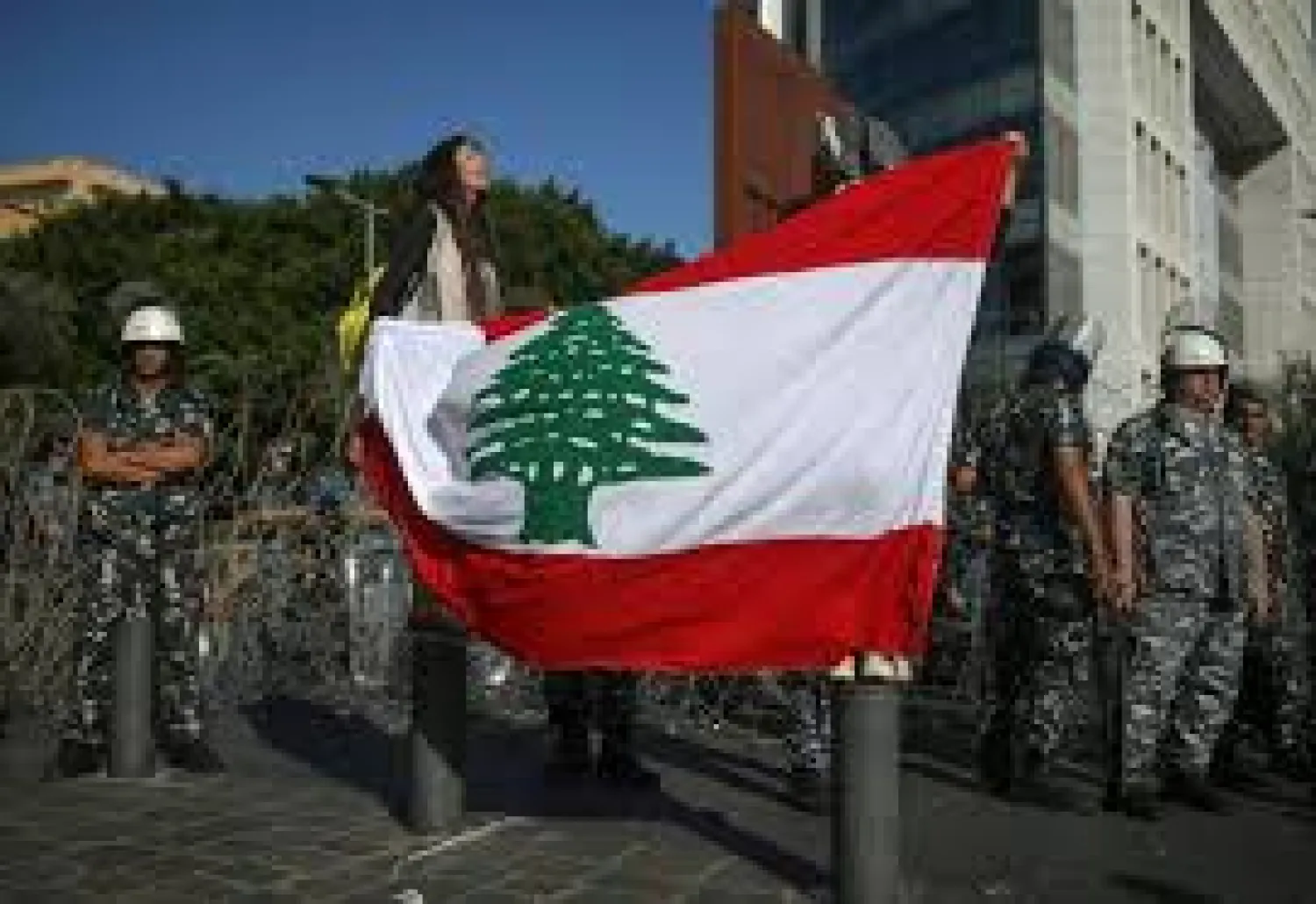

Protesters Say 'Real Independence' Close as Lebanon Turns 76

Lebanese anti-government protesters say their country's "real independence" is close as Lebanon marks its 76th national day | AFP
TT

Protesters Say 'Real Independence' Close as Lebanon Turns 76

Lebanese anti-government protesters say their country's "real independence" is close as Lebanon marks its 76th national day | AFP

Lebanon was marking 76 years of self-rule on Friday, but protesters say that only this year are its people experiencing "real independence".

An unprecedented protest movement has gripped the small Mediterranean country since October 17, demanding the complete overhaul of politicians deemed inept and corrupt.

The demonstrations have brought together people from across sectarian lines, and given them hope that change might finally sweep away a system they say is broken.

"It's the first time Lebanese from all religious communities have protested en masse without a political party calling for it, and against all parties," said 21-year-old university student Tamara.

"That's real independence -- one that's organic".

On November 22, 1943, Lebanon achieved independence after 23 years under a French mandate, following a wave of demonstrations that brought together the country's Christians and Muslims.

But the country was ripped apart in the 1975-1990 civil war.

Two more foreign powers occupied the tiny multi-confessional country -- Israel from 1978 to 2000, and Syria from 1976 to 2005.

A post-war accord sought to share out power between Lebanon's various religious communities, but the country remained deeply divided along sectarian lines.

Wajed, 26, said this year's Independence Day will be different.

"We want to emancipate ourselves from the corrupt people governing us," he told AFP, his beard shaved short and a cap on his head.

"After the French left, others occupied us," he said, alluding to Lebanese politicians, some of whose families have been in power ever since.

In the face of such anger from the street, Lebanese president Michel Aoun again called for dialogue Friday, saying in a televised address that was "the only pertinent path to solving the crisis".

- Revised anthem -

After more than a month of protests, a large military parade along the seafront has been cancelled, and replaced by a smaller event at the defence ministry instead.

Wajed said the changes in state festivities was just the latest "victory" for protesters.

The street movement brought down the government last month, though a new cabinet has yet to be formed.

On Sunday an independent candidate was elected head of the Bar Association, and on Tuesday demonstrators successfully prevented a parliament vote on a controversial amnesty law.

Two people have so far been killed during the protests.

Activists have called for "civil marches" to take place nationwide on Friday as Lebanese of all ages maintain hope they can fix a broken government, draw the country out of endless political deadlocks, and revive its crumbling economy.

On social media, they urged protesters to wave high "the light of the independence" after nightfall -- whether with a candle, lighter, or the torch on their mobile phones.

In the southern city of Sidon, an event has been planned to beam light against "obscurity, theft, corruption, and poverty".

A revised version of the national anthem is making the rounds online to celebrate Lebanese women, many of whom have played a central role in the recent protests.

- 'Independence of mind' -
There have been other large protests in Lebanon in recent decades, but none this big have been spontaneous.

In 2005, a huge street movement managed to end the Syrian occupation.

But that was called for by anti-Syrian political parties after former premier Rafik Hariri was killed in a car bombing they blamed on Damascus.

Dina Abu Dahr, 55, said she felt "different" about the national holiday this year.

"It's the first time independence means something to me," she said.

Near a huge mosque in central Beirut, Youssef el-Gherez agreed.

"This independence is an independence of mind, body and spirit," said the 26-year-old.

"People are starting to change their habits," he said. "They want to change things deeply, all the way to the roots."

Motivated by the protests, some members of Lebanon's huge diaspora have also planned to fly home to take part.

Tracy Saad, 23, said she would be heading back from the Netherlands to "celebrate independence from the warlords and their sectarian regime", referring to politicians who once headed militias during the civil conflict.

The idea of a mass homecoming took life on social media, she said, and then those interested managed to negotiate cheaper air fares for the occasion.

In total, some 600 people are expected to travel in from the Gulf, Europe, North America, and even Australia, and make their way to Beirut's iconic Martyrs' Square.



Egypt’s Prime Minister and FM Head to Washington for Trump Peace Council Meeting

Egyptian Foreign Minister Badr Abdelatty speaks during a joint press conference with Kenyan Prime Cabinet Secretary/Cabinet Secretary for Foreign Diaspora Affairs Musalia Mudavadi in Nairobi, Kenya, Monday, Feb. 16, 2026. (AP)
TT

Egypt’s Prime Minister and FM Head to Washington for Trump Peace Council Meeting

Egyptian Foreign Minister Badr Abdelatty speaks during a joint press conference with Kenyan Prime Cabinet Secretary/Cabinet Secretary for Foreign Diaspora Affairs Musalia Mudavadi in Nairobi, Kenya, Monday, Feb. 16, 2026. (AP)

Egypt's Prime Minister Mostafa Madbouly headed to Washington on Tuesday ‌to ‌participate in ‌the inaugural ⁠meeting of a "Board of Peace" established by US President Donald ⁠Trump, the ‌cabinet ‌said.

Madbouly is ‌attending ‌on behalf of President Abdel ‌Fattah al-Sisi and is accompanied by ⁠Foreign ⁠Minister Badr Abdelatty.

Foreign Minister Gideon Saar will represent Israel at the inaugural meeting, his office said on Tuesday.

Hamas, meanwhile, called on the newly-formed board to pressure Israel to halt what it described as ongoing violations of the ceasefire in Gaza.

The Board of Peace, of which Trump is the chairman, was initially designed to oversee the Gaza truce and the territory's reconstruction after the war between Hamas and Israel.

But its purpose has since morphed into resolving all sorts of international conflicts, triggering fears the US president wants to create a rival to the United Nations.

Saar will first attend a ministerial level UN Security Council meeting in New York on Wednesday, and on Thursday he "will represent Israel at the inaugural session of the board, chaired by Trump in Washington DC, where he will present Israel's position", his office said in a statement.

It was initially reported that Prime Minister Benjamin Netanyahu might attend the gathering, but his office said last week that he would not.

Ahead of the meeting, Hamas spokesman Hazem Qassem told AFP that the Palestinian movement urged the board's members "to take serious action to compel the Israeli occupation to stop its violations in Gaza".

"The war of genocide against the Strip is still ongoing -- through killing, displacement, siege, and starvation -- which have not stopped until this very moment," he added.

He also called for the board to work to support the newly formed Palestinian technocratic committee meant to oversee the day-to-day governance of post-war Gaza "so that relief and reconstruction efforts in Gaza can commence".

Announcing the creation of the board in January, Trump also unveiled plans to establish a "Gaza Executive Board" operating under the body.

The executive board would include Turkish Foreign Minister Hakan Fidan and Qatari diplomat Ali Al-Thawadi.

Netanyahu has strongly objected to their inclusion.

Since Trump launched his "Board of Peace" at the World Economic Forum in Davos in January, at least 19 countries have signed its founding charter.


Palestinian Child Dies After Stepping on Mine in West Bank

Israeli troops conduct a military raid in the village of Al-Yamoun, west of Jenin, West Bank, 17 February 2026. (EPA)
TT

Palestinian Child Dies After Stepping on Mine in West Bank

Israeli troops conduct a military raid in the village of Al-Yamoun, west of Jenin, West Bank, 17 February 2026. (EPA)

A Palestinian child died after stepping on a mine near an Israeli military camp in the occupied West Bank on Tuesday, the Palestinian Red Crescent said, with an Israeli defense ministry source confirming the death.

"Our crews received the body of a 13-year-old child who was killed after a mine exploded in one of the old camps in Jiftlik in the northern Jordan Valley," the Red Crescent said in a statement.

A source at COGAT, the Israeli defense ministry's agency in charge of civilian matters in the Palestinian territories, confirmed the death to AFP and identified the boy as Mohammed Abu Dalah, from the village of Jiftlik.

Israel's military had previously said in a statement that three Palestinians were injured "as a result of playing with unexploded ordnance", without specifying their ages.

It added that the area of the incident, Tirzah, is "a military camp in the area of the Jordan Valley", near Jiftlik and close to the Jordanian border.

"This area is a live-fire zone and entry into it is prohibited," the military said.

Jiftlik village council head Ahmad Ghawanmeh told AFP that three children, the oldest of whom was 16, were collecting herbs near the military base when they detonated a mine.

Jiftlik as well as the nearby Tirzah base are located in the Palestinian territory's Area C, which falls under direct Israeli control.

Israel has occupied the West Bank since 1967.

Much of the area near the border with Jordan -- which Israel signed a peace deal with in 1994 -- remains mined.

In January, Israel's defense ministry said it had begun demining the border area as part of construction works for a new barrier it says aims to stem weapons smuggling.


Hezbollah Rejects Disarmament Plan and Government’s Four-Month Timeline

29 July 2024, Iran, Tehran: Then Hezbollah deputy leader Sheikh Naim Qassem is pictured during a meeting in Tehran. (Iranian Presidency/dpa)
TT

Hezbollah Rejects Disarmament Plan and Government’s Four-Month Timeline

29 July 2024, Iran, Tehran: Then Hezbollah deputy leader Sheikh Naim Qassem is pictured during a meeting in Tehran. (Iranian Presidency/dpa)

Hezbollah rejected on Tuesday the Lebanese government's decision to grant the army at least four months to advance the second phase of a nationwide disarmament plan, saying it would not accept what it sees as a move serving Israel.

Lebanon's cabinet tasked the army in August 2025 with drawing up and beginning to implement a plan to bring all armed groups' weapons under state control, a bid aimed primarily at disarming Hezbollah after its devastating ‌war with ‌Israel in 2024.

In September 2025 the cabinet formally ‌welcomed ⁠the army's plan to ⁠disarm the Iran-backed Shiite party, although it did not set a clear timeframe and cautioned that the military's limited capabilities and ongoing Israeli strikes could hinder progress.

Hezbollah Secretary-General Sheikh Naim Qassem said in a speech on Monday that "what the Lebanese government is doing by focusing on disarmament is a major mistake because this issue serves the goals of Israeli ⁠aggression".

Lebanon's Information Minister Paul Morcos said during a press ‌conference late on Monday after ‌a cabinet meeting that the government had taken note of the army's monthly ‌report on its arms control plan that includes restricting weapons in ‌areas north of the Litani River up to the Awali River in Sidon, and granted it four months.

"The required time frame is four months, renewable depending on available capabilities, Israeli attacks and field obstacles,” he said.

Hezbollah lawmaker Hassan ‌Fadlallah said, "we cannot be lenient," signaling the group's rejection of the timeline and the broader approach to ⁠the issue of ⁠its weapons.

Hezbollah has rejected the disarmament effort as a misstep while Israel continues to target Lebanon, and Shiite ministers walked out of the cabinet session in protest.

Israel has said Hezbollah's disarmament is a security priority, arguing that the group's weapons outside Lebanese state control pose a direct threat to its security.

Israeli officials say any disarmament plan must be fully and effectively implemented, especially in areas close to the border, and that continued Hezbollah military activity constitutes a violation of relevant international resolutions.

Israel has also said it will continue what it describes as action to prevent the entrenchment or arming of hostile actors in Lebanon until cross-border threats are eliminated.