


Tottenham Love to Talk of Glory, but for Daniel Levy Business is Business

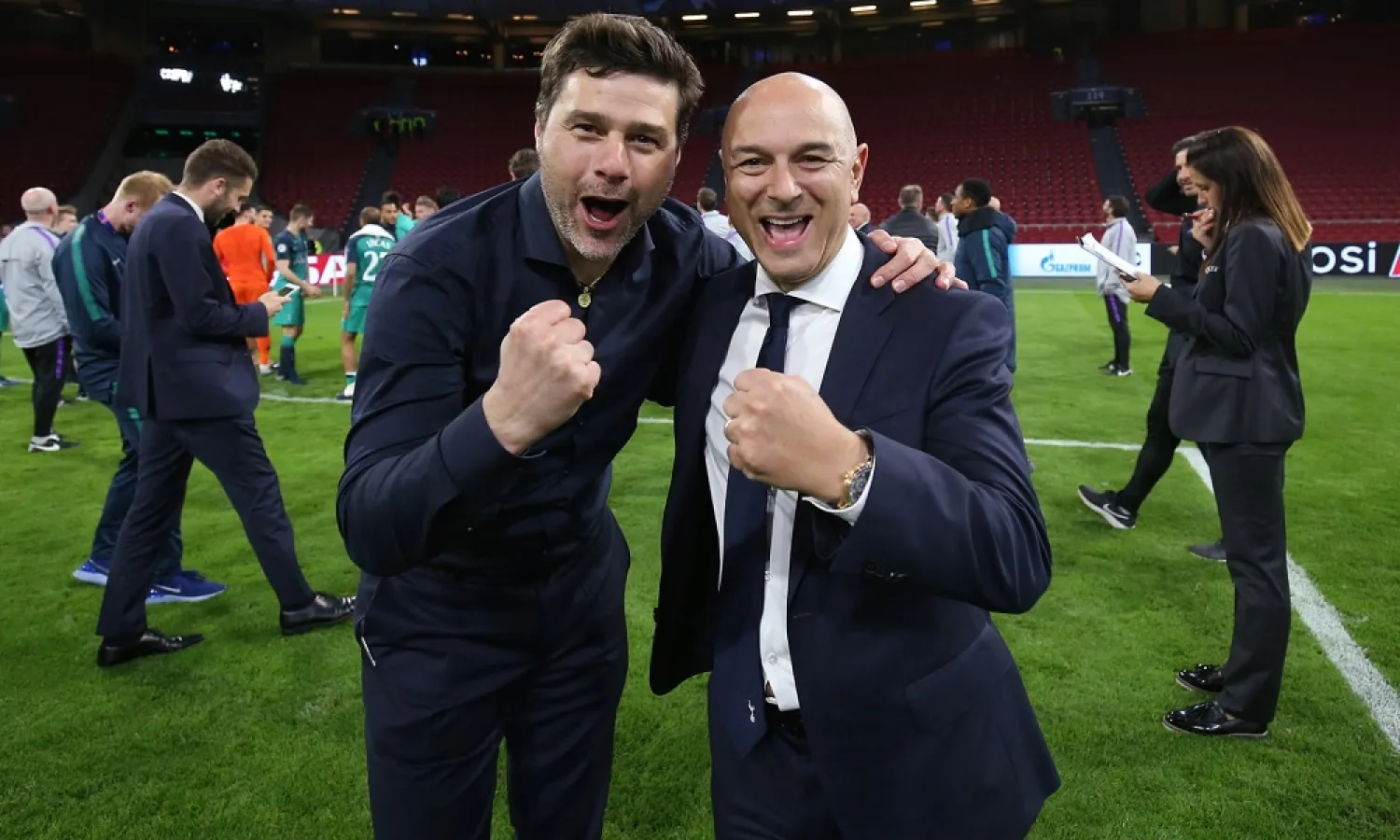
Pochettino and Levy enjoy the moment after Spurs’ miraculous comeback in Amsterdam saw them defeat Ajax to reach the Champions League final. (Getty Images)
TT

Tottenham Love to Talk of Glory, but for Daniel Levy Business is Business

Pochettino and Levy enjoy the moment after Spurs’ miraculous comeback in Amsterdam saw them defeat Ajax to reach the Champions League final. (Getty Images)

The lament that football has traded its soul for money has been associated with a departing manager of Tottenham Hotspur long before Mauricio Pochettino was sacked five months after taking the club to a miraculous Champions League final. The famous quote from Keith Burkinshaw, as he walked away from White Hart Lane in 1984 despite having won the Uefa Cup, was attributed to him by the veteran sportswriter Ken Jones: “There used to be a football club over there.”

Burkinshaw was working at a club which had sought to exploit new money coming into football by becoming the first to float on the stock market, bypassing the game’s century-old restrictions on owners making money out of clubs. Eight years later Alan Sugar had a vote as the Spurs owner to select BSkyB as the exclusive pay-TV broadcaster for the Premier League over free-to-air ITV, at the same time that Sugar’s company Amstrad was making the satellite dishes.

Any remembered feeling that football was once the people’s game with a pure sporting heart is a nostalgic oversimplification, but idealists still cherish the Spurs 1961 Double-winning captain Danny Blanchflower’s paean. “The great fallacy is that the game is first and last about winning,” Blanchflower said. “It is nothing of the kind. The game is about glory, it is about doing things in style and with a flourish.”

Whatever the combined headache of factors that led the Spurs chairman, Daniel Levy, to see Pochettino out of the new stadium door and sweep in José Mourinho’s deadpan unromanticism, it is fair to say he is not signed up to all of Blanchflower’s manifesto. The remarkable ascendancy of Spurs under Pochettino will always be remembered for the Champions League final and those dramatic comeback victories at Manchester City and Ajax on the way, when the coach was overwhelmed by emotion and humility for his achievement. After he had gathered himself, Pochettino tearfully thanked the game of football itself, for its marvelous gifts.

Levy was in the cushioned seats in those stadiums, memorably shown on television in a group of Spurs high-ups, applauding Pochettino as he wept his way around the pitch. But now, so soon after, business is business. Blanchflower, Burkinshaw, perhaps Lord Sugar himself could probably never have envisaged the huge financial architecture with which modern football is now surrounded. Nor how it must be contemplated by Levy, chairman of a club owned by currency trader Joe Lewis via the Bahamas, with the monumental new stadium to pay for.

The sacking of Pochettino so early in the season, to give Mourinho time for his medicine to work, is a reminder of the adamant priority given to Champions League qualification, and the stressful way it operates for England’s football corporations. Put simply, the Premier League has a top six of clubs by earnings and regular performance, but four regular qualification places for the Champions League. Two from six have to miss out, but when they do, they suffer a football and financial hit which is the closest feeling they know to relegation.

Pochettino can be seen partly as a victim of his own over-achievement, as he secured serial Champions League participation with Spurs still at White Hart Lane then temporarily at Wembley, and by some way in sixth place of the Premier League’s top six earning clubs.

Uefa has not yet published the distribution to the clubs of the euro-millions from last season’s Champions League, the first from the increased €4bn TV deals covering 2018-21. Spurs received €61m from Uefa in 2017-18 when they went out of the competition in the first knockout round, and last season’s figures, which Uefa will release in the next few days, must be expected to show that in excess of €80m was paid to Spurs from Pochettino’s run to the final.

Those sums, which help to elevate the Premier League’s top six above their aspirant competitors, are Uefa’s distributions alone. The participating clubs also earn from hosting the big European nights at their stadiums, increased sponsorships and other uplifts, although players are paid some of it in bonuses.

For Spurs the new stadium project has turned Champions League participation from a glad bonus to a target approaching a requirement, with the club having borrowed £637m, which Levy refinanced in September. To make the repayments, fully exploit the commercial benefits of that luxury new stadium in the inner city of London, and maintain Spurs’ place in the moneyed big six, Levy’s patience with a cherished manager has lasted only 12 league matches this season.

There still is a football club over there, but Tottenham Hotspur themselves charted the course from glory game to industry, decades ago.

The Guardian Sport


Shakhtar Boss Pays Ukrainian Racer $200,000 After Games Disqualification

Ukrainian President Volodymyr Zelenskiy holds helmet as he meets with a Ukrainian skeleton racer Vladyslav Heraskevych , who was disqualified from the Olympic skeleton competition over his "helmet of remembrance" depicting athletes killed since Russia's invasion and his father and coach, Mykhailo Heraskevych, amid Russia's attack on Ukraine, in Munich, Germany February 13, 2026. (Ukrainian Presidential Press Service/Handout via Reuters)
TT

Shakhtar Boss Pays Ukrainian Racer $200,000 After Games Disqualification

Ukrainian President Volodymyr Zelenskiy holds helmet as he meets with a Ukrainian skeleton racer Vladyslav Heraskevych , who was disqualified from the Olympic skeleton competition over his "helmet of remembrance" depicting athletes killed since Russia's invasion and his father and coach, Mykhailo Heraskevych, amid Russia's attack on Ukraine, in Munich, Germany February 13, 2026. (Ukrainian Presidential Press Service/Handout via Reuters)

The owner of ‌Ukrainian football club Shakhtar Donetsk has donated more than $200,000 to skeleton racer Vladyslav Heraskevych after the athlete was disqualified from the Milano Cortina Winter Games before competing over the use of a helmet depicting Ukrainian athletes killed in the war with Russia, the club said on Tuesday.

The 27-year-old Heraskevych was disqualified last week when the International Bobsleigh and Skeleton Federation jury ruled that imagery on the helmet — depicting athletes killed since Russia invaded Ukraine in 2022 — breached rules on athletes' expression at ‌the Games.

He ‌then lost an appeal at the Court ‌of ⁠Arbitration for Sport hours ⁠before the final two runs of his competition, having missed the first two runs due to his disqualification.

Heraskevych had been allowed to train with the helmet that displayed the faces of 24 dead Ukrainian athletes for several days in Cortina d'Ampezzo where the sliding center is, but the International Olympic Committee then ⁠warned him a day before his competition ‌started that he could not wear ‌it there.

“Vlad Heraskevych was denied the opportunity to compete for victory ‌at the Olympic Games, yet he returns to Ukraine a ‌true winner," Shakhtar President Rinat Akhmetov said in a club statement.

"The respect and pride he has earned among Ukrainians through his actions are the highest reward. At the same time, I want him to ‌have enough energy and resources to continue his sporting career, as well as to fight ⁠for truth, freedom ⁠and the remembrance of those who gave their lives for Ukraine," he said.

The amount is equal to the prize money Ukraine pays athletes who win a gold medal at the Games.

The case dominated headlines early on at the Olympics, with IOC President Kirsty Coventry meeting Heraskevych on Thursday morning at the sliding venue in a failed last-minute attempt to broker a compromise.

The IOC suggested he wear a black armband and display the helmet before and after the race, but said using it in competition breached rules on keeping politics off fields of play. Heraskevych also earned praise from Ukraine President Volodymyr Zelenskiy.


Speed Skating-Italy Clinch Shock Men’s Team Pursuit Gold, Canada Successfully Defend Women’s Title

 Team Italy with Davide Ghiotto, Andrea Giovannini, Michele Malfatti, celebrate winning the gold medal on the podium of the men's team pursuit speed skating race at the 2026 Winter Olympics, in Milan, Italy, Tuesday, Feb. 17, 2026. (AP)
Team Italy with Davide Ghiotto, Andrea Giovannini, Michele Malfatti, celebrate winning the gold medal on the podium of the men's team pursuit speed skating race at the 2026 Winter Olympics, in Milan, Italy, Tuesday, Feb. 17, 2026. (AP)
TT

Speed Skating-Italy Clinch Shock Men’s Team Pursuit Gold, Canada Successfully Defend Women’s Title

 Team Italy with Davide Ghiotto, Andrea Giovannini, Michele Malfatti, celebrate winning the gold medal on the podium of the men's team pursuit speed skating race at the 2026 Winter Olympics, in Milan, Italy, Tuesday, Feb. 17, 2026. (AP)
Team Italy with Davide Ghiotto, Andrea Giovannini, Michele Malfatti, celebrate winning the gold medal on the podium of the men's team pursuit speed skating race at the 2026 Winter Olympics, in Milan, Italy, Tuesday, Feb. 17, 2026. (AP)

An inspired Italy delighted the home crowd with a stunning victory in the Olympic men's team pursuit final as

Canada's Ivanie Blondin, Valerie Maltais and Isabelle Weidemann delivered another seamless performance to beat the Netherlands in the women's event and retain their title ‌on Tuesday.

Italy's ‌men upset the US who ‌arrived ⁠at the Games ⁠as world champions and gold medal favorites.

Spurred on by double Olympic champion Francesca Lollobrigida, the Italian team of Davide Ghiotto, Andrea Giovannini and Michele Malfatti electrified a frenzied arena as they stormed ⁠to a time of three ‌minutes 39.20 seconds - ‌a commanding 4.51 seconds clear of the ‌Americans with China taking bronze.

The roar inside ‌the venue as Italy powered home was thunderous as the crowd rose to their feet, cheering the host nation to one ‌of their most special golds of a highly successful Games.

Canada's women ⁠crossed ⁠the line 0.96 seconds ahead of the Netherlands, stopping the clock at two minutes 55.81 seconds, and

Japan rounded out the women's podium by beating the US in the Final B.

It was only Canada's third gold medal of the Games, following Mikael Kingsbury's win in men's dual moguls and Megan Oldham's victory in women's freeski big air.


Lindsey Vonn Back in US Following Crash in Olympic Downhill 

Milano Cortina 2026 Olympics - Alpine Skiing - Women's Downhill 3rd Official Training - Tofane Alpine Skiing Centre, Belluno, Italy - February 07, 2026. Lindsey Vonn of United States in action during training. (Reuters)
TT

Lindsey Vonn Back in US Following Crash in Olympic Downhill 

Milano Cortina 2026 Olympics - Alpine Skiing - Women's Downhill 3rd Official Training - Tofane Alpine Skiing Centre, Belluno, Italy - February 07, 2026. Lindsey Vonn of United States in action during training. (Reuters)

Lindsey Vonn is back home in the US following a week of treatment at a hospital in Italy after breaking her left leg in the Olympic downhill at the Milan Cortina Games.

“Haven’t stood on my feet in over a week... been in a hospital bed immobile since my race. And although I’m not yet able to stand, being back on home soil feels amazing,” Vonn posted on X with an American flag emoji. “Huge thank you to everyone in Italy for taking good care of me.”

The 41-year-old Vonn suffered a complex tibia fracture that has already been operated on multiple times following her Feb. 8 crash. She has said she'll need more surgery in the US.

Nine days before her fall in Cortina d'Ampezzo, Italy, Vonn ruptured the ACL in her left knee in another crash in Switzerland.

Even before then, all eyes had been on her as the feel-good story heading into the Olympics for her comeback after nearly six years of retirement.
