


Wilf Mcguinness: ‘I Thought Munich Was the End, That United Were Finished’

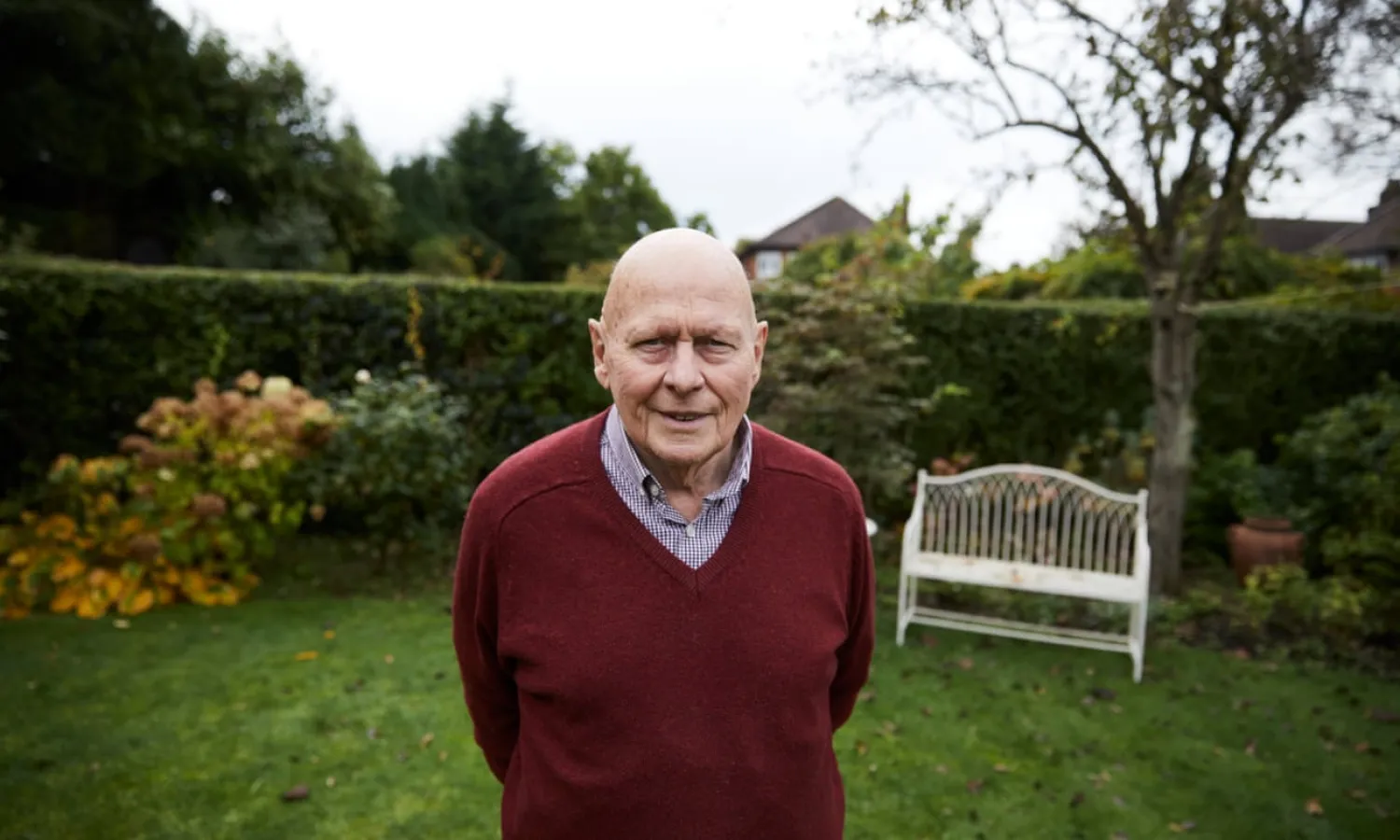
 Wilf McGuinness retired from playing at 22 after breaking his leg but succeeded Sir Matt Busby as Manchester United manager. Photograph: Christopher Thomond/The Guardian
Wilf McGuinness retired from playing at 22 after breaking his leg but succeeded Sir Matt Busby as Manchester United manager. Photograph: Christopher Thomond/The Guardian
TT

Wilf Mcguinness: ‘I Thought Munich Was the End, That United Were Finished’

 Wilf McGuinness retired from playing at 22 after breaking his leg but succeeded Sir Matt Busby as Manchester United manager. Photograph: Christopher Thomond/The Guardian
Wilf McGuinness retired from playing at 22 after breaking his leg but succeeded Sir Matt Busby as Manchester United manager. Photograph: Christopher Thomond/The Guardian

Wilf McGuinness is 82 but his face lights up with vivid memories of the man who had such an impact on his life. “Matt Busby was a god,” McGuinness says simply as he looks up with an expression of gratitude and awe and remembers the football manager who turned Manchester United into one of the world’s greatest clubs. “We used to look up at him when we were growing up. We thought: ‘There he is. That’s the boss.’ That’s what we called him. Boss. He was a wonderful man.”

McGuinness was one of the original Busby Babes, a team of youthful brilliance which was decimated by the Munich disaster of 1958. He was injured and so missed being on the plane which took the lives of many of his best friends and teammates, while scarring those who survived. McGuinness was part of the second wave of Babes with whom Busby created a new team that would eventually become the first English club to win the European Cup in 1968. Another bad injury had ended his career long before then but Busby respected him so much that he persuaded McGuinness to become a coach at Old Trafford.

When he eventually retired for the first time in 1969, Busby chose McGuinness to succeed him. Over the next 18 months, McGuinness did a respectable job but he experienced the difficulties of replacing a legendary figure at a club as big as United. That struggle has been felt again by all the managers who have tried to lead the club in the wake of Sir Alex Ferguson’s long and imposing reign at Old Trafford.

McGuinness is one of the key voices in a poignant new documentary about Busby. It explains the significance of Busby as being the first modern manager in English football who understood the power of the European Cup and who also recognised that the game would soon become big business. But the film is most affecting when charting the pain of Munich and the guilt felt by Busby. He had pushed hard for United to venture into Europe and yet the adventure was devastated by the loss of 23 lives when their plane crashed while trying to leave the tarmac for a third time on a snowy afternoon in Munich.

There is something beautiful yet painful in McGuinness’s words when he says: “Munich will always be in a corner of my mind.” He pauses and adds: “Always. Even now. They were very special people. I wasn’t in their class even though I played a lot in those days. I tried to forget the sad parts about it. But I don’t want to forget the players because they were great. I try not to remember it too much because it was definitely the saddest moment I’ve ever had. It was only because I was injured that I didn’t go on the trip. So I was very fortunate. Eddie Colman and Duncan Edwards were the wing halves but I played in that position too.”

It’s difficult for McGuinness to remember the day he heard the news of the tragedy but his son, Paul, who also used to work as a coach at Manchester United, helps his dad by sitting with us in the family home in Sale. “I think you were in town, weren’t you?” Paul prompts his father, “and you saw the story on the newsstands. I think you went to the Guardian office as the press people were getting the information.”

McGuinness nods. “Yes. I went to the Guardian and they told me what happened. I had lost teammates and friends.”

A long sigh slips from a great old man. “I thought it was the end of the world. I felt that’s it. United are finished now. We can’t carry on. We haven’t got a team. I also thought Matt was on the dying list at that stage. And I knew we had lost Duncan Edwards. What a great, great player he was. They all were. They were tremendous. But, really, Duncan was also like a god to us. He was the best I ever saw.”

In the film there is a shattering moment when, still recovering from his injuries, Busby returns to the training ground to address his squad. But he is so choked up that he can’t talk. Does McGuinness remember that moment? “I can remember him as a great man. I was in the squad then, after Munich. I was in it a bit before but nowhere near as good as some of them. We were just grateful Matt was back. He and Jimmy Murphy [Busby’s assistant and the driver of the club’s youth policy] were brilliant people. I’ve never met anybody with their personality or determination.”

Busby, clearly, was haunted by Munich. McGuinness nods. “It must have stuck in his mind. But he always said: ‘Go out and play well, and play for the fans.’ Not play for you. Play for the fans. We were very fortunate that, under Matt Busby, Man United became a great team. They weren’t a great team until he sorted it all out. He was a tremendous manager.”

The drab nature of life in the postwar years seeps through the archive footage but Busby was determined to bring joy to Manchester through football. “He wanted us to give people something to look forward to,” McGuinness says of Busby, who became United’s manager in 1945. Ten years later, in October 1955, McGuinness made his first team debut at the age of 17. Other gifted teenagers, like Edwards and Bobby Charlton, were also part of the Busby Babes. “£20 a week was the maximum wage. We couldn’t get more. But I was happy getting the bus to training at The Cliff in Salford or to games at Old Trafford.”

Did people get excited when they saw United players on the bus? “Yeah, a lot did. I was hoping the girls did, but they didn’t. It was mainly the lads. But it was good. I was usually with Bobby who was a very close friend. We were the same age and played for England boys together when we were 15. I was his captain at England schoolboys.”

Busby chose McGuinness for United’s first team before he selected Charlton. “That was mainly because my position became available,” McGuinness explains. “Bobby was a wonderful player. We grew up together and so we were good pals. He stayed at our house because I’m a Manchester lad and Bobby came down to United from Northumberland. We stuck together.”

Charlton survived Munich but, like Busby, he was scarred. Did he talk to his friend about the tragedy? “Oh no,” McGuinness says. “That was private.”

Yet, out of such grief and pain, Busby built a team that won the European Cup in 1968. United’s 4-1 defeat of Benfica was the culmination of a long quest for Busby. McGuinness then coached the reserves, having been forced to retire at 22 after breaking his leg, and he was close to Busby and Murphy. He coached George Best in some reserve games before the Belfast wizard broke into the first team and became a dizzying part of that European Cup-winning side.

Did Best stand out immediately as being exceptional? “You knew he was special. Only a blind man wouldn’t know. George was shy until he went to the dance halls. Then he wasn’t so shy. But they were all special. Think of Bobby and Nobby Stiles. And Bill Foulkes and Harry Gregg who survived Munich. Those two were very hard men. Tough as nails. I thought the world of them. We were a club where we thought about each other. That was down to Matt Busby and Jimmy Murphy.

When we finally won the European Cup it meant a great deal. Especially for Matt. It was something we could hold up and say: ‘Look, after everything that happened, we’ve done it. Let’s do it again.”

Busby, however, was exhausted after managing United for 24 years and so, in January 1969, he announced he would step down at the end of that season. He was 60 and he hand-picked his successor – the 31-year-old McGuinness who took over as United manager in June 1969. “I was very proud of that. A bit surprised, but very proud. The press had got hold of the story first but I had a feeling it was going to be me. Matt and Jimmy always lifted me up.”

It must have felt like an impossible job, following Busby? “I didn’t look at it that way. It was a great job and a wonderful life.”

United finished eighth in his one full season in charge. McGuinness was sacked in December 1970 and Busby returned briefly but United finished eighth again that season. “You had five semi-final games, including replays, in the League Cup and FA Cup,” Paul says to his dad “You were a bit unfortunate. You didn’t get the signings you wanted. You took over an older team and you wanted to sign younger players like Malcolm Macdonald, Mick Mills and Colin Todd.” His father smiles. “I was still a learner as a manager – don’t forget that.”

Does he feel empathy for all the United managers who have followed Ferguson? He smiles and looks a little confused. “After all those years with Sir Alex, it was difficult for someone else to come in, wasn’t it, Dad?” Paul says. “I think you felt a bit sorry for David Moyes at the time.”

McGuinness is at his best in the more distant past but I ask him if he still goes to Old Trafford. “Dad watches them on TV,” Paul explains. “Sometimes we go to the ground.”

It must be tough watching United these days compared to the peak Busby and Fergie years? “They’ve got to find the sparks we had in our day,” McGuinness says. “For me there was only one Matt Busby. He was special.”

The documentary is intriguing in explaining how Busby led the way when he persuaded Louis Edwards, then the United chairman, to plan for the installation of corporate boxes. Busby could see into football’s lucrative future even though his roots in a Lanarkshire mining village meant he always valued his players over money. “He went to America, didn’t he?” Paul says of Busby, “and saw some of the great sports stadiums and the boxes. He made sure that Old Trafford got bigger and bigger. He was very forward-thinking.”

For McGuinness no one in football today can compare to giants like Busby and Edwards, Murphy and Charlton who lived through raw and beautiful days. Paul looks at his father. “I think you’ve done quite well today, haven’t you Dad?

“Yeah,” McGuinness says with a contented smile.

I suggest he must feel lucky, too, to have known Busby so well. “Oh yes,” McGuinness says, as his eyes gleam again with light. “He was such a warm man. Yeah. He was just terrific.”

The Guardian Sport


Sports Investment Forum Allocates Third Day to Women's Empowerment to Promote Sustainable Investment in Women’s Sports

Sports Investment Forum Allocates Third Day to Women's Empowerment to Promote Sustainable Investment in Women’s Sports
TT

Sports Investment Forum Allocates Third Day to Women's Empowerment to Promote Sustainable Investment in Women’s Sports

Sports Investment Forum Allocates Third Day to Women's Empowerment to Promote Sustainable Investment in Women’s Sports

The Sports Investment Forum announced that the third day of its 2026 edition will be dedicated to empowering women in the sports sector, in partnership with Princess Nourah bint Abdulrahman University. The move reflects the forum’s commitment to supporting the objectives of Saudi Vision 2030 and enhancing the role of women in the sports industry and sports investment.

This allocation comes as part of the forum’s program, scheduled to take place from April 20 to 22, at The Ritz-Carlton, Riyadh. The third day will feature a series of strategic sessions and specialized workshops focused on sustainable investment in women’s sports, the empowerment of female leadership, the development of inclusive sports cities, and support for research and studies in women’s sports, SPA reported.

Forum organizers emphasized that the partnership with Princess Nourah bint Abdulrahman University, recognized as the largest women’s university in the world, represents a model of integration between the academic and investment sectors. The partnership contributes to building a sustainable knowledge base that supports the growth of women’s sports and enhances investment opportunities at both local and international levels.

The dedicated day will address several strategic themes, including sustainable investment in women’s leagues and events, boosting scalable business models, empowering female leaders within federations, clubs, and sports institutions, and developing inclusive sports cities that ensure women’s participation in line with the highest international standards. It will also include the launch of research initiatives and academic partnerships to support future policies and strategies for the sector.

This approach aims to transform women’s empowerment in sports from a social framework into a sustainable investment and development pathway that enhances women’s contributions to the sports economy and reinforces Saudi Arabia’s position as a leading regional hub for advancing women’s sports.

The day is expected to attract prominent female leaders, decision-makers, investors, and local and international experts, in addition to the signing of several memoranda of understanding and joint initiatives supporting women’s empowerment in the sports sector.

The Sports Investment Forum reiterated that empowering women is a strategic pillar in developing the national sports ecosystem, contributing to economic growth objectives, enhancing quality of life, and building a more inclusive and sustainable sports community.


Liverpool Boss Slot Says Isak in 'Final Stages of Rehab'

Soccer Football -  FA Cup - Fourth Round - Liverpool v Brighton & Hove Albion - Anfield, Liverpool, Britain - February 14, 2026 Liverpool manager Arne Slot celebrates after the match REUTERS/Phil Noble
Soccer Football - FA Cup - Fourth Round - Liverpool v Brighton & Hove Albion - Anfield, Liverpool, Britain - February 14, 2026 Liverpool manager Arne Slot celebrates after the match REUTERS/Phil Noble
TT

Liverpool Boss Slot Says Isak in 'Final Stages of Rehab'

Soccer Football -  FA Cup - Fourth Round - Liverpool v Brighton & Hove Albion - Anfield, Liverpool, Britain - February 14, 2026 Liverpool manager Arne Slot celebrates after the match REUTERS/Phil Noble
Soccer Football - FA Cup - Fourth Round - Liverpool v Brighton & Hove Albion - Anfield, Liverpool, Britain - February 14, 2026 Liverpool manager Arne Slot celebrates after the match REUTERS/Phil Noble

Liverpool manager Arne Slot said on Thursday he believes striker Alexander Isak is in the "final stages of rehab" and could return by the end of next month to bolster the Reds' push for Champions League qualification.

The British record signing has been sidelined since mid-December when he fractured a bone in his lower leg and needed ankle surgery following a sliding tackle from Tottenham's Micky van de Ven.

His injury came just as 26-year-old Sweden international Isak, who joined Premier League champions Liverpool for £125 million ($169 million) from top-flight rivals Newcastle in September, was finding his form at Anfield with two goals in six matches.

"Alex has been on the pitch, not with his football boots but with his running shoes for the first time this week," Slot told reporters, according to AFP.

"The next step is doing work with the ball, which every player likes most, then the next step is to come into the group and then it takes a while before you're ready to play.

"It will be some time around there, end of March, start of April, where he is hopefully back with the group. That is not to say you are ready to play, let alone start a game.

"But it's nice that rehab goes well; that's a compliment to him and our medical staff.

"I think we all know the moment you go on the pitch it doesn't take three months but these final stages of rehab can also make it change."

Isak is one of five Liverpool first-team players currently sidelined, with only Jeremie Frimpong close to a return.

The right-back has been out since the end of last month with a hamstring injury but is expected to be available for next weekend's visit of West Ham.

Liverpool have had a rare week without a match ahead of Sunday's trip to Nottingham Forest.

"It is nice and useful as the players we are having, nine out of 10 go to the national team so for seven, eight, nine months they hardly have a time off," said Dutch boss Slot, who insisted he had no need of a rest himself.

"It was nice but I did not really need it. Last season I felt I needed it more in this period of time. I am enjoying the work I do here."

Liverpool, after a slow start to their title defense -- are now sixth and within three points of the top four with 12 games to go.

They next play three of the bottom four clubs as they look to get themselves into a Champions League position.

Premier League leaders Arsenal were left just five points clear of second-placed Manchester City after blowing a two-goal lead in a shock 2-2 draw away to rock-bottom Wolves on Wednesday.

Slot, however, said: "We didn't need yesterday to know how difficult it is to win a Premier League game. What has made the Premier League nicer this season than three, four, five, six years ago is it's more competitive."


Familiar Face Returns to Marseille where Habib Beye Takes Charge

(FILES) Rennes' French-Senegalese head coach Habib Beye looks on before the French L1 football match between Le Havre AC (HAC) and Rennes at the Oceane Stadium in Le Havre, Northwestern France, on April 13, 2025. (Photo by Lou BENOIST / AFP)
TT

Familiar Face Returns to Marseille where Habib Beye Takes Charge

(FILES) Rennes' French-Senegalese head coach Habib Beye looks on before the French L1 football match between Le Havre AC (HAC) and Rennes at the Oceane Stadium in Le Havre, Northwestern France, on April 13, 2025. (Photo by Lou BENOIST / AFP)

Marseille is looking to reignite its season with a new coach on board.

The nine-time French champion appointed Habib Beye to replace Roberto De Zerbi following a bad patch of form that saw the club exit the Champions League and drop 12 points behind Ligue 1 leader Lens.

Beye, a former Senegal international who played for Marseille, will be in charge of Friday's trip to Brest.

After leading Red Star to promotion to Ligue 2, Beye spent the last year and a half as the Rennes coach. The club sacked Beye this month.

Key matchups Marseille has failed to win its past three league games, badly damaging its title hopes. The results including a 5-0 mauling at PSG have left fans fuming. The club hopes Beye, a disciplinarian advocating ball possession and a strong attacking identity, will produce a jolt.

Beye's hiring "refocuses us on the challenges we still need to tackle between now and the end of the season,” The Associated Press quoted Marseille owner Frank McCourt as saying.

Since McCourt bought Marseille in 2016, the former powerhouse has failed to find any form of stability in a succession of coaches and crises. It hasn’t won the league title since 2010.

PSG abandoned the top spot to Lens after losing to Rennes 3-1 last week. Luis Enrique's team bounced back with a 3-2 win at Monaco in the first leg of their Champions League playoff and hosts last-placed Metz on Saturday. Lens welcomes Monaco the same day.

Third-placed Lyon, on a stunning 13-match winning run, plays at Strasbourg on Sunday.
Players to watch With the World Cup in his country looming, former Arsenal striker Folarin Balogun is hitting form at the right time. The American forward scored twice inside 18 minutes against PSG and has 10 goals and four assists this season.

At PSG, the man in form is Désiré Doué.

After his team quickly fell behind by two goals against Monaco midweek, Doué came to the rescue to turn things around. The France international was relentless and left his mark on the match after coming on as a replacement for Ousmane Dembélé. He first reduced the deficit, played a role in Achraf Hakimi’s equalizer then netted the winner.
Out of action Dembélé is expected to miss PSG's match against Metz because of an injured left calf.

Off the field PSG was sanctioned with the partial closure of the Auteuil stand for two matches and a 10,000 euros ($11,800) fine by the disciplinary committee of the French league following banners displayed and insults directed by supporters during the match against Marseille on Feb. 8. at the Parc des Princes. There were brief discriminatory chants about Marseille at the start of the game and the referee stopped play for about one minute around the 70th.
