


Nobel Winner Mahfouz Lives on in Cairo's Alleyways

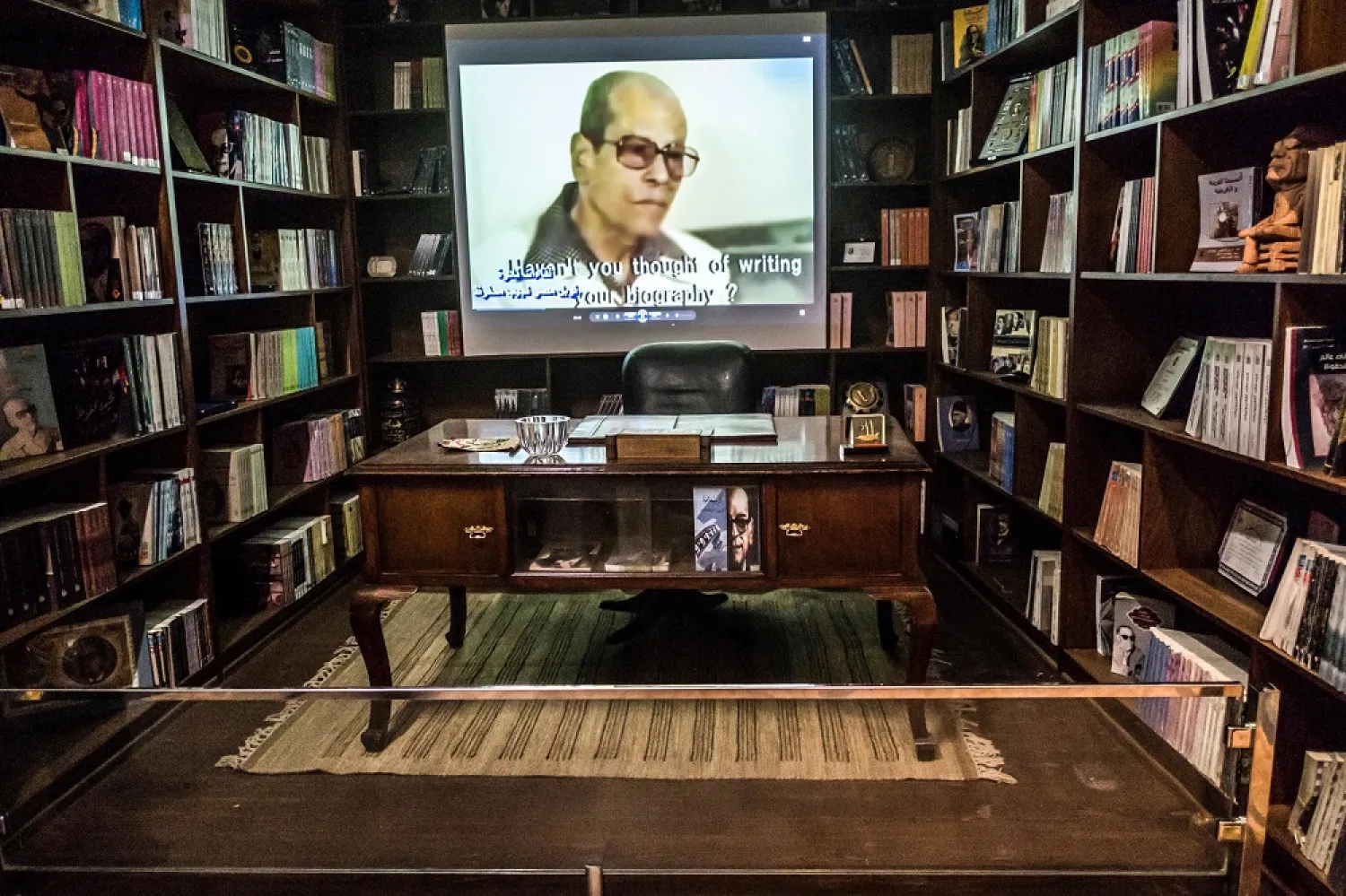
Naguib Mahfouz's desk is just one of the items on display at his museum in the Al-Azhar district of Egypt's capital Cairo. (AFP)
TT

Nobel Winner Mahfouz Lives on in Cairo's Alleyways

Naguib Mahfouz's desk is just one of the items on display at his museum in the Al-Azhar district of Egypt's capital Cairo. (AFP)

The legacy of Islamic Cairo's most famous son Naguib Mahfouz lives on in its winding lanes more than three decades after he became the only Arab to win the Nobel Prize for Literature.

A mosaic of the bespectacled author overlooks a market teeming with children on bikes, waiters balancing trays of hot drinks and shoppers haggling with hawkers over the price of meat.

It could be a scene straight out of a typical Mahfouz novel focusing on the minutiae of life in the Egyptian capital, with its satirically political overtones and timeless characters.

After years in the making, a museum in the writer's honor opened in July this year, reported AFP.

A new translation of previously unpublished Mahfouz work is also in print, underscoring 13 years after his death the mark he made both on world literature and on Egyptians themselves.

In November, young writer Ahmed Mourad sparked controversy in Egypt when he suggested that the quality of Mahfouz's work needed to be adapted to make it more contemporary.

The backlash at this tarnishing of the great man's reputation forced Mourad to go on the popular television talk show circuit to clarify his comments.

Mahfouz is considered to be the father of the modern Arabic novel: he broadened its literary range by pushing through sacred red lines including religious taboos.

And he was nearly killed for doing so. In 1994, a knifeman stabbed him in the neck in an assassination attempt.

The attacker had been acting on a fatwa or religious edict issued by radical Egyptian-American imam Omar Abdel-Rahman, denouncing what he deemed to be the prodigious author's blasphemous prose.

'About Cairo with love'

Mahfouz's daughter Om Kalthoum said he was so deeply enmeshed in the chaotic energy of Cairo that the city itself was a major character in his work.

The writer's routine included walks along the corniche by the Nile to his favorite cafes near Tahrir Square, epicenter of the 2011 revolution, and to cultural salons.

"He wrote about Cairo with true love. He described it in granular detail. Even if he criticized it, it was still full of love," she told AFP.

She and her sister accepted their father's 1988 Nobel Prize on his behalf because of his inability to travel due to his deteriorating eyesight.

Om Kalthoum said: "I remember sometimes we used to go to Al-Hussein (the area around the Al-Hussein mosque in the heart of Islamic Cairo) and we'd sit in the cafe bearing his name," the Naguib Mahfouz Cafe.

"He showed us Midaq Alley -- it was pretty much the size a small room -- and he would tell us great stories about his days as a schoolchild," she recalled.

'Midaq Alley' was one of his most widely read books globally and was adapted into a 1995 film starring Salma Hayek.

The site of the museum dedicated to him is in a beautifully restored Ottoman guesthouse in Islamic Cairo dating to 1774, and was chosen because he spent his early years there.

In the Al-Gamaleya neighborhood the budding writer was surrounded by 10th century walls and a myriad of hiding spots for curious kids.

Om Kalthoum noted that being raised there left an indelible mark on her father's imagination.

Mahfouz's precious belongings including his mahogany desk, honors such as his Nobel certificate and even his last pack of cigarettes are among the items displayed in an exhibition that covers three floors.

A universal writer

Roger Allen, emeritus professor at Penn University in the United States and a prolific translator of Arab writers but especially Mahfouz, told AFP the author was monumental "in the development of Egyptian fiction".

His writings delved into "ancient Egypt, Sufism, politics", Allen said.

"You get glimpses of his many interests. He was working on multiple tracks throughout his career."

Allen translated a collection of his writings into English this year in a work entitled 'The Quarter'.

The collection "reflects what a Cairene quarter looks like" -- much like where the museum dedicated to him is located now.

It is also "a heavily symbolic entity associated with humanity", Allen added.

"His works take on universal themes that show how to organize society and how it can be disrupted by forces," he said.

The new collection is based on a pile of papers that his daughter found years after his death. It was organized and originally published in Arabic by Mohammed Shoair, an editor with the culture journal Akhbar Al-Adab.

He told AFP that "in the years before winning the Nobel, he lost his eyesight so his relationship with reality was almost severed. Writing for him became an obsession."

Shoair has been archiving Mahfouz's papers with Om Kalthoum's help for a multi-volume biography.

He talked about Mahfouz's pioneering role in revolutionizing the Arab novel to the extent that many Arab authors now follow in his footsteps.

Alaa al-Aswany from Egypt, Ahmed Saadawi from Iraq and Algeria's Ahlam Mosteghanemi have all found a global readership with books that have won international awards.

"The main idea behind his work since the 80s was returning to his childhood... his beginnings and the alley," Shoair said of Mahfouz.

"He was talking about his personal life in a way, but through the memories of the past."


Coffee Regions Hit by Extra Days of Extreme Heat, Say Scientists 

17 April 2012, North Rhine-Westphalia, Vluyn: A general view of Arabica Coffee beans. (dpa)
TT

Coffee Regions Hit by Extra Days of Extreme Heat, Say Scientists 

17 April 2012, North Rhine-Westphalia, Vluyn: A general view of Arabica Coffee beans. (dpa)

The world's main coffee-growing regions are roasting under additional days of climate change-driven heat every year, threatening harvests and contributing to higher prices, researchers said Wednesday.

An analysis found that there were 47 extra days of harmful heat per year on average in 25 countries representing nearly all global coffee production between 2021 and 2025, according to independent research group Climate Central.

Brazil, Vietnam, Colombia, Ethiopia and Indonesia -- which supply 75 percent of the world's coffee -- experienced on average 57 additional days of temperatures exceeding the threshold of 30C.

"Climate change is coming for our coffee. Nearly every major coffee-producing country is now experiencing more days of extreme heat that can harm coffee plants, reduce yields, and affect quality," said Kristina Dahl, Climate Central's vice president for science.

"In time, these impacts may ripple outward from farms to consumers, right into the quality and cost of your daily brew," Dahl said in a statement.

US tariffs on imports from Brazil, which supplies a third of coffee consumed in the United States, contributed to higher prices this past year, Climate Central said.

But extreme weather in the world's coffee-growing regions is "at least partly to blame" for the recent surge in prices, it added.

Coffee cultivation needs optimal temperatures and rainfall to thrive.

Temperatures above 30C are "extremely harmful" to arabica coffee plants and "suboptimal" for the robusta variety, Climate Central said. Those two plant species produce the majority of the global coffee supply.

For its analysis, Climate Central estimated how many days each year would have stayed below 30C in a world without carbon pollution but instead exceeded that level in reality -- revealing the number of hot days added by climate change.

The last three years have been the hottest on record, according to climate monitors.


Dog Gives Olympics Organizers Paws for Thought

A dog wanders on the ski trail during the women's team cross country free sprint qualification event of the Milano Cortina 2026 Winter Olympic Games at Tesero Cross-Country Skiing Stadium in Lago di Tesero (Val di Fiemme), on February 18, 2026. (Photo by Anne-Christine POUJOULAT / AFP)
TT

Dog Gives Olympics Organizers Paws for Thought

A dog wanders on the ski trail during the women's team cross country free sprint qualification event of the Milano Cortina 2026 Winter Olympic Games at Tesero Cross-Country Skiing Stadium in Lago di Tesero (Val di Fiemme), on February 18, 2026. (Photo by Anne-Christine POUJOULAT / AFP)

A dog decided he would bid for an unlikely Olympic medal on Wednesday as he joined the women's cross country team free sprint in the Milan-Cortina Games.

The dog ran onto the piste in Tesero in northern Italy and gamely, even without skis, ran behind two of the competitors, Greece's Konstantina Charalampidou and Tena Hadzic of Croatia.

He crossed the finishing line, his moment of glory curtailed as he was collared by the organizers and led away -- his owner no doubt will have a bone to pick with him when they are reunited.


Olives, Opera and a Climate-Neutral Goal: How a Mural in Greece Won ‘Best in the World’ 

A building with the mural entitled “Kalamata” depicting opera legend Maria Callas by artist Kleomenis Kostopoulos is seen in Kalamata town, about 240 kilometers (150 miles) southwest of Athens, Monday, Feb. 9, 2026. (AP) 
TT

Olives, Opera and a Climate-Neutral Goal: How a Mural in Greece Won ‘Best in the World’ 

A building with the mural entitled “Kalamata” depicting opera legend Maria Callas by artist Kleomenis Kostopoulos is seen in Kalamata town, about 240 kilometers (150 miles) southwest of Athens, Monday, Feb. 9, 2026. (AP) 

Long known for its olives and seaside charm, the southern Greek city of Kalamata has found itself in the spotlight thanks to a towering mural that reimagines legendary soprano Maria Callas as an allegory for the city itself.

The massive artwork on the side of a prominent building in the city center has been named 2025’s “Best Mural of the World” by Street Art Cities, a global platform celebrating street art.

Residents of Kalamata, approximately 240 kilometers (150 miles) southwest of Athens, cultivate the world-renowned olives, figs and grapes that feature prominently on the mural.

That was precisely the point.

Vassilis Papaefstathiou, deputy mayor of strategic planning and climate neutrality, explained Kalamata is one of the few Greek cities with the ambitious goal of becoming climate-neutral by 2030. He and other city leaders wanted a way to make abstract concepts, including sustainable development, agri-food initiatives, and local economic growth, more tangible for the city’s nearly 73,000 residents.

That’s how the idea of a massive mural in a public space was born.

“We wanted it to reflect a very clear and distinct message of what sustainable development means for a regional city such as Kalamata,” Papaefstathiou said. “We wanted to create an image that combines the humble products of the land, such as olives and olive oil — which, let’s be honest, are famous all over the world and have put Kalamata on the map — with the high-level art.”

“By bringing together what is very elevated with ... the humbleness of the land, our aim was to empower the people and, in doing so, strengthen their identity. We want them to be proud to be Kalamatians.”

Southern Greece has faced heatwaves, droughts and wildfires in recent years, all of which affect the olive groves on which the region’s economy is hugely dependent.

The image chosen to represent the city was Maria Callas, widely hailed as one of the greatest opera singers of the 20th century and revered in Greece as a national cultural symbol. She may have been born in New York to Greek immigrant parents, but her father came from a village south of Kalamata. For locals, she is one of their own.

This connection is also reflected in practice: the alumni association at Kalamata’s music school is named for Callas, and the cultural center houses an exhibition dedicated to her, which includes letters from her personal archive.

Artist Kleomenis Kostopoulos, 52, said the mural “is not actually called ‘Maria Callas,’ but ‘Kalamata’ and my attempt was to paint Kalamata (the city) allegorically.”

Rather than portraying a stylized image of the diva, Kostopoulos said he aimed for a more grounded and human depiction. He incorporated elements that connect the people to their land: tree branches — which he considers the above-ground extension of roots — birds native to the area, and the well-known agricultural products.

“The dress I create on Maria Callas in ‘Kalamata’ is essentially all of this, all of this bloom, all of this fruition,” he said. “The blessed land that Kalamata itself has ... is where all of these elements of nature come from.”

Creating the mural was no small feat. Kostopoulos said it took around two weeks of actual work spread over a month due to bad weather. He primarily used brushes but also incorporated spray paint and a cherry-picker to reach all edges of the massive wall.

Papaefstathiou, the deputy mayor, said the mural has become a focal point.

“We believe this mural has helped us significantly in many ways, including in strengthening the city’s promotion as a tourist destination,” he said.

Beyond tourism, the mural has sparked conversations about art in public spaces. More building owners in Kalamata have already expressed interest in hosting murals.

“All of us — residents, and I personally — feel immense pride,” said tourism educator Dimitra Kourmouli.

Kostopoulos said he hopes the award will have a wider impact on the art community and make public art more visible in Greece.

“We see that such modern interventions in public space bring tremendous cultural, social, educational and economic benefits to a place,” he said. “These are good springboards to start nice conversations that I hope someday will happen in our country, as well.”
