In Protest-Hit Lebanon, Debate Tents Draw in the Street
Young Lebanese discuss the protest-ridden country's political future in an impromptu debating chamber set up in a tent in second city Tripoli. (AFP)
A secular state, early elections, solving poverty. Every evening, Sarah al-Ghur joins other residents of Lebanon's second city Tripoli to debate how to fix her protest-gripped country.
"I'd rather take part in the discussions than applaud or shout out slogans," says the 32-year-old in the city's al-Nour square, reported AFP.
After years of disillusionment and apathy, a free-falling economy and anti-government protests have spurred Lebanese back into political debate.
Across the Mediterranean country, squares where protesters have denounced mismanagement and corruption have also become centers of spontaneous discussion.
In Tripoli, Ghur walks between debate tents, stopping outside one where dozens of people are discussing a "roadmap for the revolution".
Men and women of all ages sit on the floor, huddle on benches, or stand arms crossed, listening to the latest speaker.
Nearby, protesters revel to the sound of patriotic tunes and techno beats.
"I've discovered laws I knew nothing about," says Ghur, her hair trimmed short and wearing a dress.
"Now I'm more aware of my rights and my duties," she says, in an impoverished city that has emerged at the forefront of the protests.
A young protester takes the microphone to say he thinks the "popular revolution" must evolve towards "political dialogue".
He calls for "early parliamentary elections", as a first step towards an overhaul of the political system.
'They'd lost all trust'
Every evening from 5 pm to 9 pm, Tripoli residents gather under the tents to rebuild their country one idea at a time.
University professors, activists or even economists are often in attendance.
They talk of secularism and sectarianism, in a country whose legacy from a devastating 1975-91 civil war is a political system that seeks to maintain a fragile balance of power between the myriad of religious communities.
They discuss poverty, in a country where around a third of the population are poor, and the World Bank warns that proportion could soon rise to half.
But they also discuss what they view as the questionable independence of the judiciary, corruption, plummeting public funds, and sometimes urban planning.
In Tripoli, half of all residents already live at or below the poverty line.
Some six weeks into the protest movement, demonstrators in the northern city have continued to gather on a daily basis, even as numbers dwindle in other parts of Lebanon.
The government resigned on October 29, but no concrete measures have been taken to form a new cabinet since.
Philosophy professor Hala Amoun says that, before the protests, most Lebanese had long given up on any political activity.
"They'd lost all trust in the political class," she said in classical Arabic.
Lebanese have long complained of endless power cuts, gaping inequality, unemployment, and alleged official graft.
But in October, a proposed tax on calls via free phone applications such as Whatsapp, pushed them over the edge and onto the streets.
'Meaning of a revolution'
"This revolution is people becoming more aware," said the woman, who appeared in her forties, wrapped in a warm red coat.
"But taking to the streets was not enough. They felt they needed to understand, to know more."
Every evening, she heads down to the square to help dissect the "structural problems" of political power in Lebanon.
"Lebanese are hungry for knowledge," she says.
"It's as if they needed to re-examine their economic, social and political reality, to understand how their political and sectarian leader is controlling their life."
Nadim Shakes, a doctor, is one of the proud initiators of the debate evenings, which he calls "awareness raising conferences".
The aim is to "think about the country's future, what will happen after this revolution," says the 47-year-old, wearing a dark blue jacket over a slightly unbuttoned shirt.
Around the tent, young participants sit together in small groups, chatting in hushed tones or raising their voices when they grow excited or want to make a point.
In one corner, students discuss whether or not they should continue an open-ended strike that will make them lose a year of lectures at university.
Noha Raad, a 49-year-old Arabic language teacher, said she was delighted to be learning something new every evening.
"People need to be made aware," she says, dressed in a flowery shirt and blue cardigan.
But mostly, she said, "they made us understand the meaning of a revolution".
Why Iran’s Oil Industry Is Increasingly Threatened by US Blockadehttps://english.aawsat.com/features/5268290-why-iran%E2%80%99s-oil-industry-increasingly-threatened-us-blockade
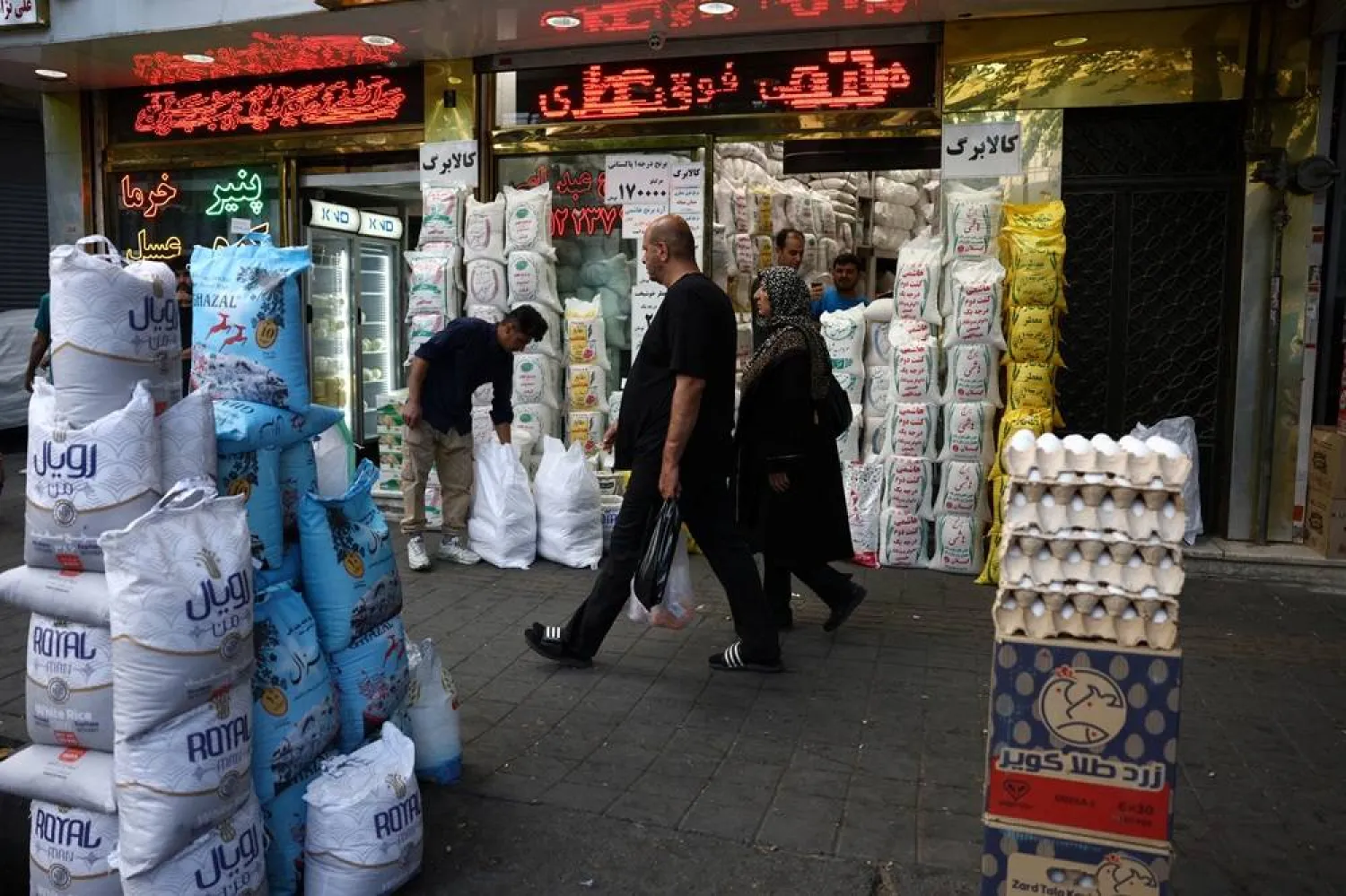
People walk in a local market in Tehran, Iran, April 28, 2026. Majid Asgaripour/WANA (West Asia News Agency) via Reuters
TT
TT
Why Iran’s Oil Industry Is Increasingly Threatened by US Blockade
People walk in a local market in Tehran, Iran, April 28, 2026. Majid Asgaripour/WANA (West Asia News Agency) via Reuters
Even as Iran squeezes world energy supplies with its chokehold on the Strait of Hormuz, its own oil industry is increasingly being threatened by an American blockade.
With no way to export the oil it is pumping out and diminishing room to store it at home, Iran may be forced to dramatically reduce or cease production from some of its wells, perhaps beginning in as little as two weeks, experts say.
The situation likely isn’t as dire as US President Donald Trump recently described, colorfully suggesting pipelines could start exploding within days. But once shut down, production from the aging wells may not be restarted so easily, if at all, undermining Iran’s future oil output. Iran appears to have begun dialing back production already, analysts say, to avert outright shutdowns.
The pressure is building as the US Treasury Department ratchets up sanctions on Iranian oil shipments already at sea. The US military has seized at least two tankers off Asia believed to be carrying Iranian oil.
With its oil trade constrained, Iran is seeing less hard currency flow back into an economy mauled by weeks of war, months of unrest and decades of international sanctions. But with fewer tankers shipping Iranian oil, the effects of the Strait of Hormuz shutdown are only being magnified, leading to shortages of jet fuel and rising gasoline prices around the world.
Iran's leaders “are really resisting” shutting down oil wells because of how painful that would be long-term, said Miad Maleki, a former sanctions expert at the US Treasury who is now a senior fellow at the Washington-based Foundation for Defense of Democracies.
“They’ve been under sanctions, they’ve been isolated for 47 years now. Those oil wells are not maintained well. Their machinery is not maintained well," Maleki said. Once shut off, he added, the wells won't easily “snap back after a few months.”
The squeeze on Iran intensifies
Iran had been pumping over 3 million barrels of crude oil a day before the war, with a little more than half going toward its domestic market. But since the American blockade began on April 13, ships have been filled with oil and unable to get out.
“It looks like there’s been a significant slowdown in production,” said Antoine Halff, the co-founder and chief analyst at Kayrros, an environmental intelligence company that tracks emissions and energy supply chains. He pointed to signs that storage is not filling as fast as usual at Kharg Island, Iran’s main oil export terminal in the Gulf.
Iran is likely storing some of its oil in tankers positioned around Kharg Island, Halff noted.
Kpler, a firm monitoring commodities markets, said it believes Iran has enough capacity left to store about two weeks worth of oil production, even after reducing output.
“While the immediate revenue impact is limited, operational constraints are now forcing production cuts and setting up a delayed but significant financial squeeze,” wrote Homayoun Falakshahi, an analyst at Kpler.
Wood Mackenzie, another oil analysis firm, estimates Iran will run out of storage capacity in about three weeks.
“If the blockade persists, cuts become inevitable,” wrote Alexandre Araman of Wood Mackenzie. Shutdowns of more than a month “risk long-term damage” to Iran’s oil reservoirs, he wrote, adding that recovering older fields “remains uncertain.”
Iran’s oil industry long a shaky lifeline
From the moment it first struck oil in 1908, Iran’s oil industry has been entangled in the region’s politics. A move to nationalize Iran’s oil fields and wrest control from the British sparked the CIA-backed 1953 coup that cemented Shah Mohammad Reza Pahlavi’s rule.
That also lit a long fuse to Iran’s 1979 revolution that toppled the shah. During the revolution, oil workers went on strike and brought production down from 6 million barrels a day to around 1.5 million.
Iran’s oil industry never recovered and faced decades of international sanctions, during which its infrastructure aged and faltered.
In his first term, Trump exerted a “maximum pressure” campaign, hiking sanctions to severely cut Iran’s oil exports. Forced to store oil in tankers at sea, the Iranian government lost tens of billions of dollars in revenues. Still, the pressure failed to push Tehran into reaching a nuclear deal with the US.
Now Iran faces a combination of hiked sanctions and the blockade. Trump on Tuesday claimed that Iran was “in a ‘State of Collapse.’”
US Treasury Secretary Scott Bessent piled on, writing on X, “Iran’s creaking oil industry is starting to shut in production thanks to the US BLOCKADE. Pumping will soon collapse. GASOLINE SHORTAGES IN IRAN NEXT!”
There have been no immediate signs of any gasoline shortages in Iran. However, Iran does seem to be acknowledging some of the pain indirectly.
A segment on state TV, which is run by hard-liners, included journalists discussing the possibility of an oil storage crisis. One noted that if empty tankers get blocked from returning to Iran, “we won’t be able to export.” Oil Minister Mohsen Paknejad on Monday praised oil terminal staff for their “continuous perseverance."
Maleki, the analyst from the Foundation for Defense of Democracies, said that if the blockade continues and production slows further or halts, oil workers could potentially lose their jobs — which could cause new unrest.
“In 1979 when the oil industry was disrupted, in the 1980s war with Iraq ... you can go and look at to see how effective they were in really pressuring the regime,” he said. “It’s really going to affect some of the most strategic provinces in Iran and the most strategic industry.”
Houthi Summer Centers: A 'Mandatory' School Passage to the Front Lineshttps://english.aawsat.com/features/5268210-houthi-summer-centers-mandatory-school-passage-front-lines
Houthi Summer Centers: A 'Mandatory' School Passage to the Front Lines
“School trip” for children at a Houthi-run summer camp in Amran (Asharq Al-Awsat)
In a corner of the courtyard of a public school in Sanaa, a woman dressed in black stands, once used to seeing her son in the morning assembly line. Today, she returns to the same place not as a mother, but as a cleaner trying to keep what remains of her life intact. She wipes the ground in heavy silence, as if whispering to the courtyard gravel: I had a son here. He left a child and came back a corpse.
She sees her son’s face in the student lines, hearing chants and slogans that were once unfamiliar. Quietly, she realizes many of them may follow the same path, but she says nothing. Two years ago, Umm Amer lost her only son. He was 17. He was returned to her a lifeless body, his image raised atop a coffin. They told her: “Ululate, he has attained martyrdom.”
She recalls how he began to change gradually after joining that summer camp. He became quieter, sometimes sharper, shouting and repeating phrases she had never known, about “jihad” and “victory,” as if they were his only path. She did not understand what was happening, but she saw in his eyes a look that was carrying him away from her.
Today, she does nothing but wipe her tears in secret and continue cleaning, in a job she obtained as the “mother of a martyr,” to support her three daughters after losing the family’s provider.
From Summer Activity to Mobilization Apparatus
The Houthi summer centers did not emerge with the group’s takeover of Sanaa in 2014. They are an extension of a historical trajectory tied to the group’s origins. Their beginnings date back to the early 1990s, specifically 1991, when activities were organized under what was known as the “Believing Youth” in Saada. These included youth programs and seasonal courses aimed at transmitting ideological messaging through study circles and summer camps, serving as early tools to build a social and organizational base by combining education with ideological formation.
With the outbreak of the Saada wars in 2004, these activities underwent a qualitative shift. They were no longer limited to religious or educational aspects but became tools of mobilization and recruitment, benefiting from public sympathy during the conflict and expanding their reach among youth.
By 2008, the group began spreading these activities beyond Saada using nontraditional means, including distributing digital materials on SD cards and USB drives. These contained Houthi doctrinal lectures and lessons tied to the summer centers, as well as what is known as the “Malazim” - Houthi doctrinal lectures delivered by the group’s founder, Hussein Badr al-Din al-Houthi, transcribed into booklets.
A supervisor in Sanaa said he received such memory devices in 2008, distributed among selected students. Upon reviewing their contents, he found recordings and Houthi doctrinal lectures by Hussein Badr al-Din al-Houthi, noting that these materials marked a turning point in his adoption of the group’s ideas and support for it.
He attended closed gatherings to listen to these Houthi doctrinal lectures in private meeting spaces with individuals close to the group in Sanaa and nearby areas such as Bani Hushaysh, Khawlan, and Sanhan.
Following the developments of 2011, particularly the February protests and sit-ins and the broader moment of political opening, these activities expanded to a number of provinces. More organized centers and courses appeared outside the group’s main stronghold, with clearer administrative oversight under the appealing slogan “regime change.” They moved beyond narrow circles to fill libraries and kiosks with the Malazim, establishing stalls in multiple locations to distribute booklets, posters, and slogans free of charge, and installing loudspeakers to continuously broadcast chants.
The most significant transformation came after the takeover of Sanaa in 2014, when summer centers shifted from limited activities into a wide-ranging program formally administered through state institutions, within an organizational structure that includes central, technical, and supervisory committees, with the involvement of multiple ministries.
A security source said the group had, in earlier stages, relied on what it called “cultural courses” and religious seminaries to attract youth, gain their sympathy, and integrate them into its project before the current model of summer centers emerged. The source added that these centers “are no longer limited, but have become an institutional program managed within an integrated organizational structure,” noting that they are used as a tool to influence youth orientations, ultimately pushing some toward the front lines.
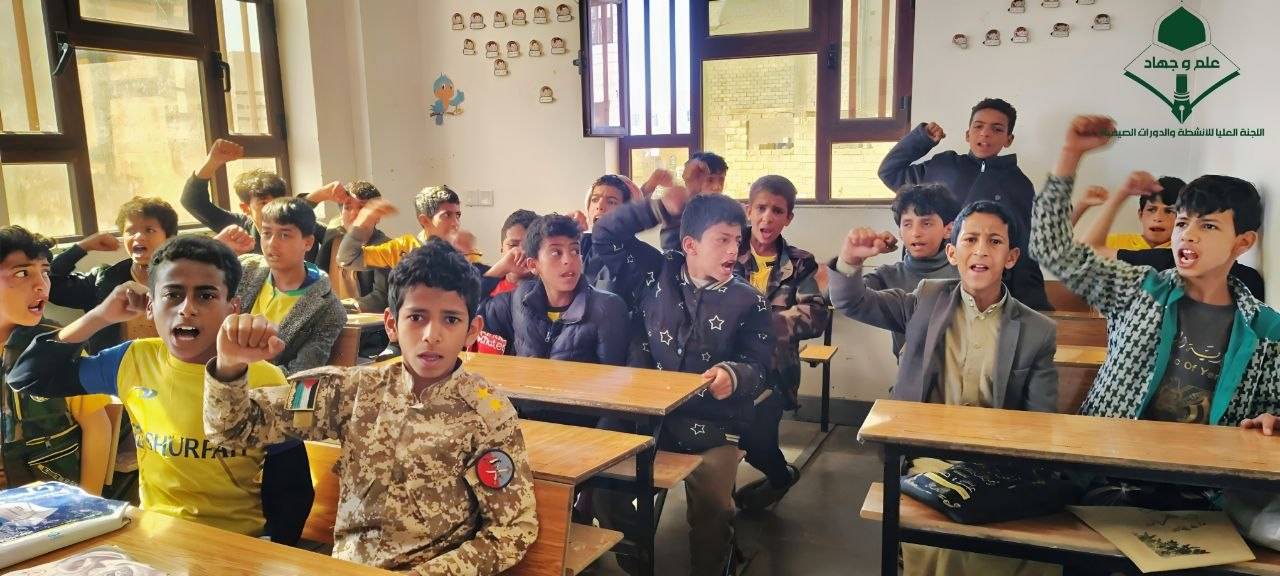
Students in a classroom perform a military salute and chant the Houthi slogan (al-sarkha) (Asharq Al-Awsat)
Types of Summer Camps
According to available information, the group divides these centers or camps into three types: closed, model, and open. Closed camps function as ideological military courses. They are held in military barracks and focus primarily on preparing participants to become fighters within the group. They are trained both militarily and ideologically for this purpose and are considered reserve forces. Once enrolled, their phones are confiscated, contact with their families is cut off, and they are transported at night between training camps that change periodically.
All participants are high school students who have completed weapons dismantling training in schools. Their trainers nominate them for military courses as a reward for excellence and distinction, in addition to some members of school scout groups whose activities have been shifted from scouting to military.
In these camps, participants are trained to use light and medium weapons, RPGs, mortars, grenades, and camouflage and concealment techniques.
Model camps, typically for those over the age of 10, are considered “specialized camps.” Top-performing students in various school activities are recruited to them. These are closed camps where students remain throughout the week, but they are allowed to communicate with their families and their phones are not confiscated. They may return home weekly or every two weeks.
These camps are usually held in provincial capitals, where students receive intensive ideological lectures from senior group leaders, watch films on “jihad,” and study the biographies of the group’s leaders, Hezbollah, and Iran’s Revolutionary Guard. They also receive limited training in dismantling and using certain types of weapons.
Open camps are for children aged 5 to 10. They begin in the morning and end at noon, appearing to the public as Quran memorization centers and summer activities. As a result, the group spreads them across schools and mosques to make them widely accessible. However, children in these camps are taught the “pledge of allegiance,” to chant the Houthi slogan (al-sarkha), and to obey the group’s leader.
Girls are not excluded. There are dedicated centers for females, managed by the General Women’s Cultural Authority, which designs and implements programs, recruits students through field networks, supervises female staff, and prepares unified guidance materials.
These centers are presented as educational and recreational spaces, but they also include intensive religious programs, mobilization-oriented lectures, and group activities that reinforce discipline and belonging.
Embedding a “Conspiracy Theory” Narrative
In its messaging, the group promotes the idea that the summer centers are a fortress against “conspiracies” targeting religion and the nation. They are presented as a means of instilling what it calls “Quranic culture” in younger generations and building a generation armed with knowledge and awareness.
The group also emphasizes that the “battle with the enemy” is not limited to the military dimension but extends to “targeting awareness.” These centers are framed as a safeguard against what is described as “soft war” and “cultural invasion,” and as part of a long intellectual struggle aimed at preparing a generation capable of confrontation.
Alongside this messaging, educational sources indicate that organizers rely on a set of material and moral incentives, such as providing meals, basic supplies, organizing trips, and offering activities, to attract as many students as possible each year.
According to one of the Malazim, a Houthi doctrinal lecture by founder Hussein Badr al-Din al-Houthi titled “Lessons in Knowing God,” delivered at the Believing Youth forum in Saada, the overarching objective is to “develop students’ knowledge of God and entrench doctrine within their souls and consciences, in a way that propels them toward fighting and confronting enemies.”
Lessons Outside the Official Curriculum
In this year’s season, which began on March 28, the group distributed its own curricula for the summer centers, printed in high quality with a distinct visual identity. This reflects the scale of resources allocated to these programs compared to formal education, which continues to suffer from declining support and capacity.
Students are often forced to purchase their official textbooks from the black market, while teachers struggle to obtain their salaries. Each year, as preparations for the summer centers begin, the group’s leader, Abdul-Malik al-Houthi, delivers an annual speech calling for enrollment, a call that has itself evolved significantly over time.
These materials carry no reference to the Republic of Yemen or the Ministry of Education. Instead, they are issued under the title “The Quranic March – General Administration of Summer Courses.”
This extends to the naming of the centers, which are not attributed to the schools hosting them but are instead given symbolic names such as “Al-Hadi,” “Al-Hussein,” “Fatima,” “Martyr Taha al-Madani,” and “Martyr Saleh al-Sammad.”
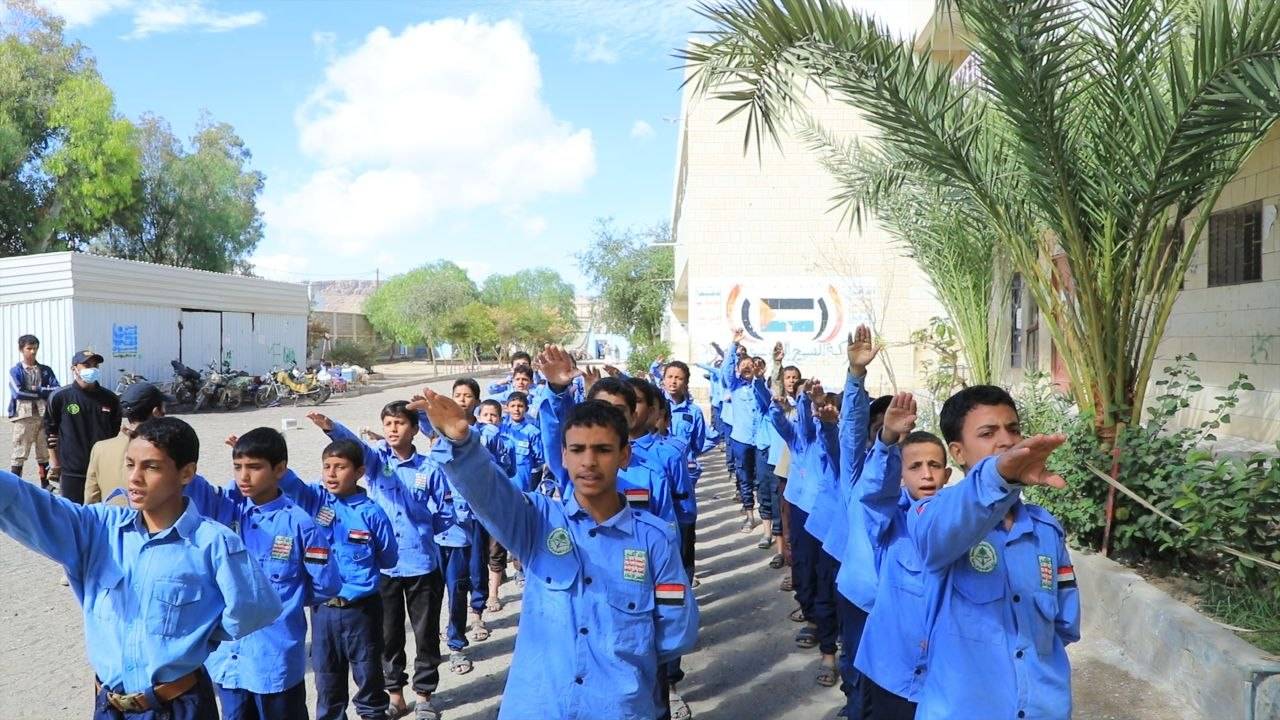
Morning assembly for children in uniform at Houthi summer camps (Asharq Al-Awsat)
Administrative Structure with a Ministerial Character
The administrative structure of the summer courses and activities in areas under Houthi control reflects a multi-level system, led by the Ministries of Education and Youth and Sports, alongside the General Mobilization Authority, which plays a central role in mobilization and guidance, and the Ministry of Endowments, responsible for religious content.
At the executive and technical levels, local authorities in Houthi-controlled provinces oversee field implementation and coordinate activities within districts and centers through education offices and supervisory committees. Daily activities are managed, staff are assigned, and program implementation is monitored, reflecting a system that extends from central leadership down to neighborhoods.
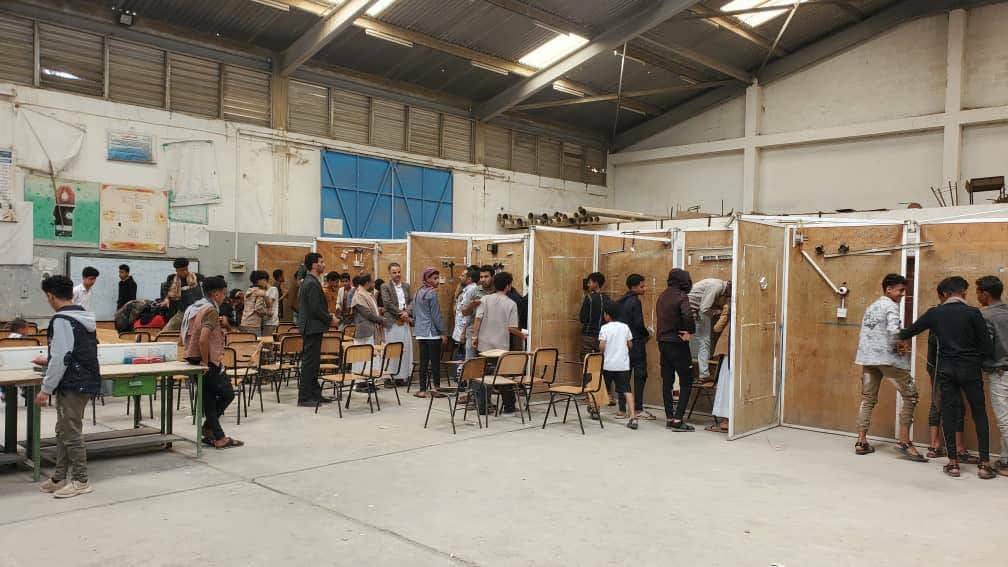
Other ministries participate as technical partners in sectoral programs: the Ministry of Interior runs “Aware Youth... Safe Society,” Agriculture oversees the “Green Army,” Health manages “Health Ambassadors,” the communications sector supervises “Awareness in the Age of Communications,” and Technical Education and Vocational Training oversees “My Profession is My Future.”
The Ministry of Information plays an ongoing supporting role through annual coordination ahead of the launch of the courses, setting the framework for media coverage, including promotion and field reporting, as part of a plan to strengthen the centers’ presence in society.
These centers are managed by the “Supreme Committee for Summer Courses and Activities,” chaired by the prime minister in the Houthi administration, with membership including the ministers of education and youth and sports, a representative of the Endowments Authority, and representatives from the group’s mobilization and cultural apparatus.
Subcommittees are headed by provincial governors, with mobilization officials as deputies, and include directors of education, youth and sports, and endowments offices.
A Turning Point in 2026
While expansion of the summer centers had occurred gradually in previous years, 2026 marks a decisive turning point. Summer schooling is no longer optional; the group has moved to a new phase in which attendance is effectively compulsory. According to testimonies from students, parents, and teachers, a network of direct and indirect pressures is being applied, at times reaching the level of threats, placing families before a stark equation: comply or risk their children’s future.
Although this shift has not been officially announced, it has become a daily reality. Multiple sources confirm that, with preparations for this year’s summer centers underway, the group has escalated practices linking school procedures to participation in these programs.
For example, student results and admission for the next academic year are tied to participation, alongside pressure on school administrations to push students into the camps under threat of penalties. If a student wants their academic record to remain free of marks that could affect their future, including university admission, they must register in these centers.
In some schools, the release of results or acceptance into the following year is tied to a certificate of attendance from the summer center. Messages circulated on communication groups include implicit warnings that absence may negatively affect academic progression.
One message sent by a school administrator to mothers in a WhatsApp group contains a veiled threat that any student who does not attend the summer centers will be denied enrollment next year: “Dear mothers, please be informed that registration will not be accepted without a certificate from the summer center. We ask that students who have not yet registered do so and join the center to benefit.”
In another group, a teacher urged students: “Come early tomorrow, those registered and those not yet registered should register. The administration will not accept them at the start of the school year without the summer center certificate.”
A message attributed to a school principal in northern Ibb indicated that attendance at the summer centers is a condition for receiving exam results, while failing students are enticed with additional marks if they join the courses.
Extracurricular activities titled “My Profession is My Future” at a Houthi-run summer camp (Asharq Al-Awsat)
Declining Participation and Criminalization
According to sources, these measures were introduced out of concern that the summer centers might face declining turnout, as families are increasingly aware of their outcomes. Teacher A. Abdul Karim, who works in these centers, said that despite the group’s efforts to mobilize as many students as possible, participation has recently declined.
He noted that turnout has become very weak, and that recruiting students now requires significant time, sustained persuasion, and financial incentives.
The Yemeni Teachers’ Syndicate warned of the dangers posed by these centers, stating they have become organized tools for sectarian ideological mobilization and the recruitment of children and youth, as part of a systematic targeting of national identity and the education system in Yemen.
In a statement dated Sunday, April 12, 2026, the syndicate said the group has expanded these centers since taking control of Sanaa to attract the largest number of students, using them to instill doctrinal ideas based on concepts of lineage-based selection that conflict with national and religious values and serve a political project threatening Yemen’s security and stability.
Neglected Schools, Flourishing Centers
In its messaging, the group describes the summer centers as an “educational support channel” to compensate for gaps caused by war. However, according to many teachers, this is nothing more than a worse excuse than the offense itself. Schools themselves could serve that role if there were genuine intent to reform education.
Teachers argue that the group’s insistence on these centers reveals that the goal is not education, but the production of a generation prepared for early recruitment and ideological mobilization. They pose a central question: if the group holds full control over formal education and has successfully inserted its ideology into school curricula, why deliberately neglect schools, leaving them in a state of near collapse, without teachers, salaries, or basic educational resources?
This contradiction between stagnating schools during the academic year and their sudden revival in summer raises serious questions.
While significant attention, funding, and effort are directed toward summer centers that quickly turn into active and crowded spaces, formal education remains in a state of severe stagnation and resource deprivation, with thousands of schools lacking even the most basic requirements for learning.
Archaeologist Mohamed Mubarak walks past pyramids standing in the Meroe desert, at one of the archaeological sites of the so-called Island of Meroe on the eastern shore of the Nile River, about 220 km north of Khartoum, on April 22, 2026. (Photo by KHALED DESOUKI / AFP)
Archaeologist Mohamed Mubarak walks past pyramids standing in the Meroe desert, at one of the archaeological sites of the so-called Island of Meroe on the eastern shore of the Nile River, about 220 km north of Khartoum, on April 22, 2026. (Photo by KHALED DESOUKI / AFP)
Mostafa Ahmed Mostafa is the heir to a long line of groundskeepers who have guarded Sudan's ancient pyramids of Meroe. Now, three years into the war between the army and paramilitary forces, he stands near-solitary sentinel over his heritage.
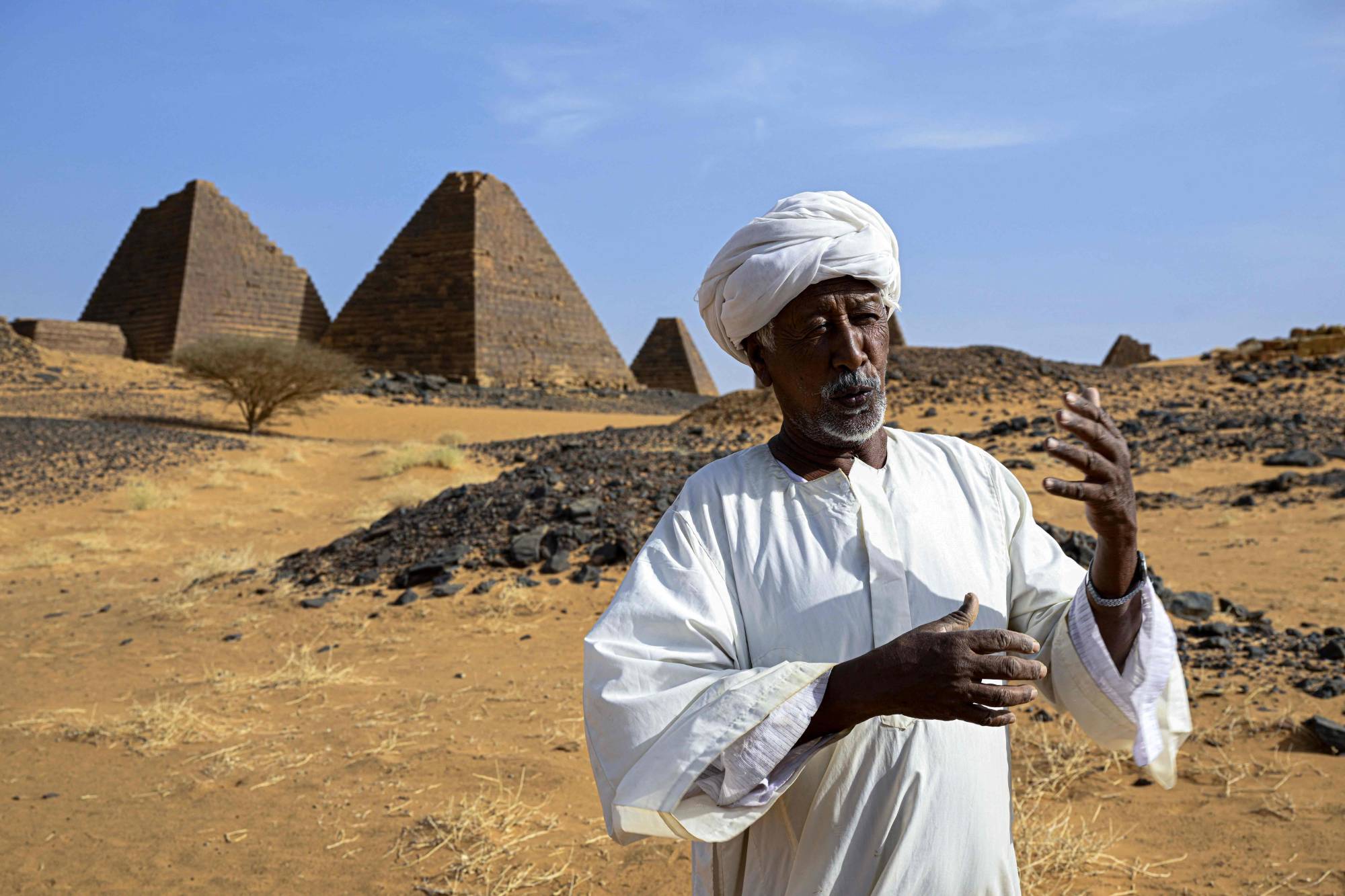
"These pyramids are ours, it's our history, it's who we are," the 65-year-old said, flanked by the dark sandstone structures of the Bajrawiya necropolis, which is part of the Island of Meroe, a UNESCO World Heritage site.
Clad all in white, Mostafa cut a striking figure crossing the 2,400-year-old burial site, which holds 140 pyramids built during the Kingdom of Kush's Meroitic period.
None are intact. Some were decapitated, others reduced to rubble, first in the 1800s by dynamite at the hands of treasure-hunting Europeans, and then by two centuries of sand and rain.
A three-hour drive from the capital Khartoum, it was once Sudan's most visited heritage site. Now three years into the war between Sudan's army and the Rapid Support Forces, only a lone camel's grunt cuts through the silence.
Archaeologist and site director Mahmoud Soliman gave AFP journalists a tour, explaining the Kush kingdom's matrilineal succession, trade routes and relationship with neighboring Egypt.
"It's maybe the fourth time I've shown people around since the war broke out," the scientist said.
Together, he, Mostafa and young archaeologist Mohamed Mubarak man the site, cobbling together resources to keep the erosive rain and sands at bay.
Apart from a short-lived influx of visitors early in the war -- mostly displaced people desperate for something to do -- the site has stood largely abandoned.
It is worlds away from its pre-war days, when there were "regular weekend visits from Khartoum, busloads of 200 people per day", Soliman remembered fondly.
Sudan's heritage sites had experienced a resurgence, he explained, after the uprising of 2018-2019, when young Sudanese protested against Omar al-Bashir.
One chant went: "My grandfather Taharqa, my grandmother Kandaka" -- the former a Kush Pharaoh, the latter the name for ancient queens, and also used to honor the women icons of the revolution.
"Young people were taking more of an interest, they were organizing trips to tourist sites and getting to know their own country," Soliman said.
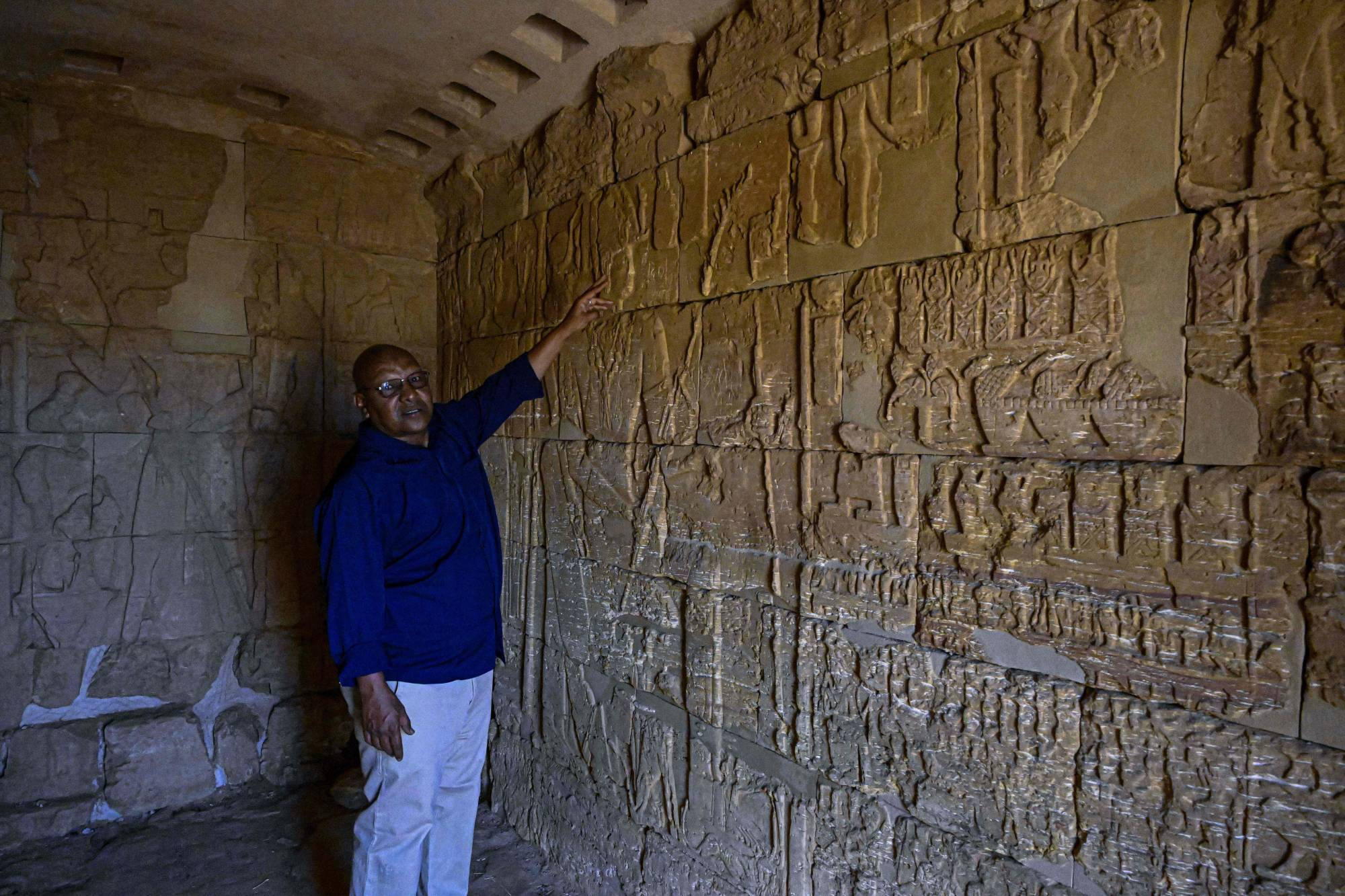
Sudanese site director Mahmoud Soliman gestures inside a tomb beneath a pyramid at one of the archaeological sites of the so-called Island of Meroe, on the eastern shore of the Nile River, about 220 km north of Khartoum, on April 22, 2026. (Photo by KHALED DESOUKI / AFP)
Residents of the nearby Tarabil village -- named after the local word for "pyramids" -- sold souvenirs and rented camels and "were entirely dependent on the site".
On a breezy day in April, Khaled Abdelrazek, 45, rushed to the site as soon as he heard there were visitors. He squatted at the entrance, showed AFP journalists handmade miniature sandstone pyramids and reminisced about when there were "dozens of us selling".
In the months before the war, there were visits from documentary crews, a music festival and "big ideas for right after Eid al-Fitr", said Soliman -- all destroyed when the war broke out in the last days of Ramadan.
"I used to feel like I was teaching people about their culture," said Mubarak, who has worked at the site since 2018.
"Now, everyone's top priority is of course food and water and shelter. But this is also important. We need to protect this for future generations, we can't let it be destroyed or wither away."
Near the site's entrance, the proud pyramids, each fronted by a small mortuary temple, are framed by rolling black sandstone hills.
The vista is breathtaking, but Soliman said his eyes see only danger: Is that crack in that pyramid new? Has that sand mound moved? Does the pipe scaffolding at that burial chamber entrance need to be redone before the rainy season?
"I think if the pyramids had been left in their original state we wouldn't have all these problems," Mubarak said.
The structures are smaller and steeper than their Egyptian neighbors, built to "withstand the sands and sweep away the rainwater, but every fracture creates issues".
Local site guard Mostafa Ahmed speaks in front of pyramids standing in the Meroe desert, at one of the archaeological sites of the so-called Island of Meroe on the eastern shore of the Nile River, about 220 km north of Khartoum, on April 22, 2026. (Photo by KHALED DESOUKI / AFP)
The largest pyramid of the lot -- of Queen Amanishakheto, who reigned around the 1st century AD -- suffered more than just fractures and is now effectively a sandbox, fine sand swirling where her tomb once stood.
In 1834, Italian adventurer Giuseppe Ferlini, who destroyed dozens of pyramids, levelled Amanishakheto's and carted her jewelry off to Europe. It is now exhibited in the Egyptian museums in Berlin and Munich.
The outside of her temple wall still stands, where a larger-than-life carving of the queen shows her standing proud, holding a spear in one hand and smiting enemy captives.
Soliman showed AFP journalists more reliefs: the lion deity Apademak and motifs shared with Egypt, including the gods Amun and Anubis, lotus flowers and hieroglyphics.
He yearns for the day tourists and archeologists will return.
"This is just a distant dream, but I'd really like us to one day be able to do proper restoration on these pyramids," he said, as if he were not really allowing himself to hope.
"This place has so much potential."
لم تشترك بعد
انشئ حساباً خاصاً بك لتحصل على أخبار مخصصة لك ولتتمتع بخاصية حفظ المقالات وتتلقى نشراتنا البريدية المتنوعة