


Lebanon Faces Tough Path to Soft Landing or Deeper Crisis

University students light a torch and wave Lebanese flags during anti-government protest in Beirut, Lebanon, November 6, 2019. (Reuters)
TT

Lebanon Faces Tough Path to Soft Landing or Deeper Crisis

University students light a torch and wave Lebanese flags during anti-government protest in Beirut, Lebanon, November 6, 2019. (Reuters)

Lebanese politicians must agree a new government that can stabilize the economy and attract international support if the country is to stave off even deeper economic crisis.

Assuming such a government can be formed, there is still no easy way forward for a country driven toward economic collapse by years of bad governance, corruption and waste.

The least damaging scenario would be a “soft landing” guided by the International Monetary Fund (IMF), economists say, though IMF support has not been broached in public by Lebanese leaders. The economic crisis is the worst since the 1975-90 civil war.

The following scenarios sketch out what might happen in a situation where Lebanon gets a government with international backing, and in a scenario where deadlock continues.

New government agreed, emergency plan drawn up

Caretaker Prime Minister Saad Hariri and his political foes including the Iran-backed Hezbollah party agree on a government that is either led by Hariri or has his blessing.

The government would engage with Western and Gulf Arab states over emergency support. A donor meeting could be convened, probably by France. The response may well include an injection of billions of dollars into the financial system by wealthy donors.

But given the scale of the crisis, Lebanon would also need an IMF program, economists say. Aid would be tied to implementation of reforms.

“We have to bring in the IMF,” said Marwan Mikhael, head of research at Blominvest Bank. IMF support would be vital to ensuring “an orderly adjustment”, added Capital Economics Senior Economist Jason Tuvey. “At least you would ensure the banking system would not collapse and protect the poorest in society.”

“The IMF would not be able to lend to Lebanese without a debt restructuring, so that would have to happen one way or another. I suspect the IMF would also push for a currency devaluation. They estimate it (is) 50% over-valued,” he said, according to Reuters.

A negotiated debt restructuring could include “a haircut” on large bank deposits, Tuvey said. This would reduce their value while leaving the accounts of smaller depositors untouched so the wealthy would carry the burden.

A senior banker said a deposit haircut could be avoided if a stability strategy was enacted now, but could not rule it in a worst-case scenario. “You have to do a debt restructuring and the sooner the better,” the banker said.

Mikhael said a debt restructuring would lengthen maturities and reduce interest rates but not reduce the debt value.

“In the positive scenario, you might have a parallel market for a few months because the capital controls will remain in place until you see things have started to work,” added Mikhael, who believed the pound’s official value would be maintained.

Political crisis continues

Lebanon remains without a new government.

Dollars continue to leave the banks despite controls. In the near term, this leads banks to block all dollar withdrawals, Mikhael said. “The parallel market will flourish more, you will have higher inflation,” he said.

Starved of capital inflows, a sovereign debt default would become inevitable sooner or later. Tuvey said this could happen as early as March. Mikhael said the central bank had enough reserves to cover maturities for a year. “It can be more but then the forex of the central would be very thin,” he said.

The drain on currency reserves would leave the government with no choice but to devalue the pound, Tuvey said. “In this scenario it could be much messier and the currency could overshoot its fair value,” Tuvey said.

Sovereign debt default “runs the risk of banks suffering large write-downs on their balance sheets”, he said. “This is where you run a risk of the collapse in the banking sector.”

The senior banker said the banks’ fixed assets including property would help to shield them from collapse.

“If you put in place the stability strategy today, you surely don’t have to go into a deposit haircut. But the more you wait, the more painful it will be.”



Riyadh to Host Middle East’s Largest General Aviation Airshow in November 

The AERO Middle East x Sand & Fun 2026 will be held in Riyadh from November 24 to 28. (SPA)
TT

Riyadh to Host Middle East’s Largest General Aviation Airshow in November 

The AERO Middle East x Sand & Fun 2026 will be held in Riyadh from November 24 to 28. (SPA)

The Saudi Aviation Club announced that it will organize the AERO Middle East x Sand & Fun 2026 in Riyadh from November 24 to 28, reported the Saudi Press Agency on Tuesday.

The event is set to be the largest of its kind for general aviation in the Middle East, combining international business, investment, and innovation with live flying displays and interactive public experiences. It is being held in partnership with Messe Frankfurt Saudi Arabia.

Held at Thumamah Airport, the exhibition will bring together leading global companies operating in the general aviation industry, including aircraft and components manufacturers, avionics and navigation systems providers, as well as maintenance, repair, and overhaul (MRO) companies, offering an integrated platform that covers the full value chain of the sector.

The event will also spotlight startups in advanced air mobility (AAM) and innovators of electric vertical take-off and landing (eVTOL) aircraft, showcasing technologies and business models shaping the future of aviation.

General Supervisor of the Saudi Aviation Club Dr. Ahmed Alfahaid stated that AERO Middle East x Sand & Fun 2026 represents a qualitative leap for the Kingdom’s aviation sector and reinforces its positioning as a global hub for general aviation and advanced air mobility.

The partnership with Messe Frankfurt Saudi Arabia goes beyond presenting global innovations to providing a vital platform for international investment and strategic collaboration, he stressed.

Moreover, the event contributes to achieving Saudi Vision 2030 objectives, including the Kingdom’s ambition to rank among the world’s top 10 general aviation markets, he added.


Saudi Arabia, Kazakhstan Agree to Establish Coordination Council

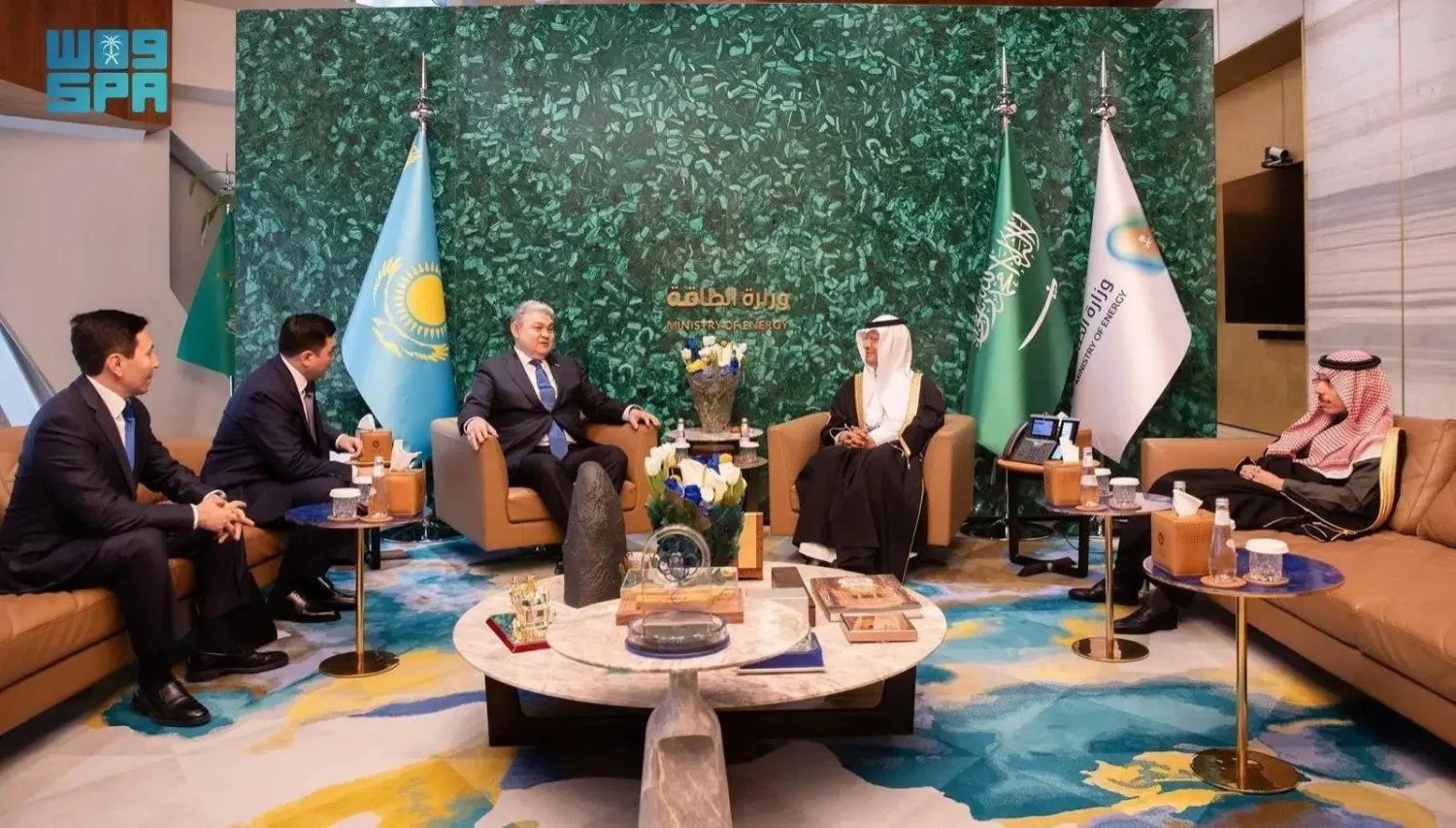
Saudi Minister of Energy Prince Abdulaziz bin Salman bin Abdulaziz receives Kazakhstan’s Foreign Minister Yermek Kosherbayev in Riyadh. (SPA)
TT

Saudi Arabia, Kazakhstan Agree to Establish Coordination Council

Saudi Minister of Energy Prince Abdulaziz bin Salman bin Abdulaziz receives Kazakhstan’s Foreign Minister Yermek Kosherbayev in Riyadh. (SPA)

Saudi Arabia and Kazakhstan agreed to establish a Saudi-Kazakh Coordination Council, reported the Saudi Press Agency on Tuesday.

Saudi Minister of Energy Prince Abdulaziz bin Salman bin Abdulaziz received in Riyadh Kazakhstan’s Foreign Minister Yermek Kosherbayev. Saudi FM Prince Faisal bin Farhan bin Abdullah and Minister of Energy of Kazakhstan Yerlan Akkenzhenov also attended the meeting.

The talks tackled the establishment of the coordination council, which will be chaired by the Saudi minister of energy and Kazakhstan’s foreign minister. The council reflects the two countries’ commitment to strengthening cooperation and expanding their bilateral partnership.

Prince Abdulaziz and Kosherbayev signed an agreement on the establishment of the council, which aims to boost coordination and consultation between the two countries and develop frameworks for cooperation across various sectors of mutual interest, elevating bilateral relations to broader levels.

Prince Abdulaziz and Kosherbayev discussed relations between their countries and ways to develop them further, especially in the energy field. They tackled opportunities for cooperation and investment in renewable energy and energy storage systems and discussed oil market developments.


Saudi-Qatari Partnership Paves Way for Logistics Corridors to Boost Regional Trade Efficiency 

The MoU was signed by Mawani President Eng. Suliman Almazroua and CEO of Qatar Ports Management Company Captain Abdullah Mohammed Al-Khanji. (QNA)
TT

Saudi-Qatari Partnership Paves Way for Logistics Corridors to Boost Regional Trade Efficiency 

The MoU was signed by Mawani President Eng. Suliman Almazroua and CEO of Qatar Ports Management Company Captain Abdullah Mohammed Al-Khanji. (QNA)

The Saudi Ports Authority (Mawani) and Qatar Ports Management Company signed on Tuesday a memorandum of understanding (MoU) aimed at boosting maritime and logistics cooperation between the two sides.

The agreement will contribute to the development of the ports sector, raising operational efficiency, and supporting regional and international trade flows.

The MoU was signed by Mawani President Eng. Suliman Almazroua and CEO of Qatar Ports Management Company Captain Abdullah Mohammed Al-Khanji. Qatari Ambassador to Saudi Arabia Bandar bin Mohammed Al Attiyah attended the signing ceremony.

The agreement reflects Saudi Arabia and Qatar’s commitment to building effective partnerships, exchanging expertise, establishing an organized framework for cooperation management, and developing joint investment opportunities in line with Saudi Vision 2030 and Qatar National Vision 2030.

The MoU outlines eight key areas of cooperation, including the exchange of best practices in port management and operations, and the study of opportunities for direct maritime and land connectivity between the ports of both countries to enhance trade flow efficiency.

It includes collaboration in logistics services, exploring the establishment of joint maritime corridors serving bilateral and regional trade, and assessing the feasibility of creating shared regional distribution centers.

In the fields of digital transformation and artificial intelligence, the two sides agreed to deepen cooperation on developing smart systems, data governance, and the unified maritime window, thereby boosting operational efficiency and keeping pace with technological advancements in the maritime sector.

The MoU places strong emphasis on maritime safety and environmental protection, including exchanging expertise in combating marine pollution and emergency response; developing joint maritime emergency plans; establishing an emergency communication line between the two countries; and cooperating to ensure compliance with international conventions, conduct joint exercises, and develop risk monitoring systems.

The cooperation also covers human capital development through joint training programs and field-exchange of expertise, as well as academic and research collaboration in maritime transport and logistics.

In terms of joint investment, both sides will study local and global investment opportunities in ports and related services and coordinate with the private sector to support these initiatives.

The MoU further includes cooperation in cruise tourism through enhanced maritime connectivity and joint promotion of Gulf cruise routes, as well as international and regional representation by coordinating positions in international maritime organizations and supporting joint initiatives, notably “Green Ports” and “Safe Sea Corridors.”

The agreement reflects the commitment of Mawani and Qatar Ports Management Company to advancing the ports sector and boosting its role as a key driver of trade and economic growth, contributing to Gulf integration and enhancing regional competitiveness in maritime and marine services.