


White Gold: Cyprus' Halloumi Cheese Entangled in Politics

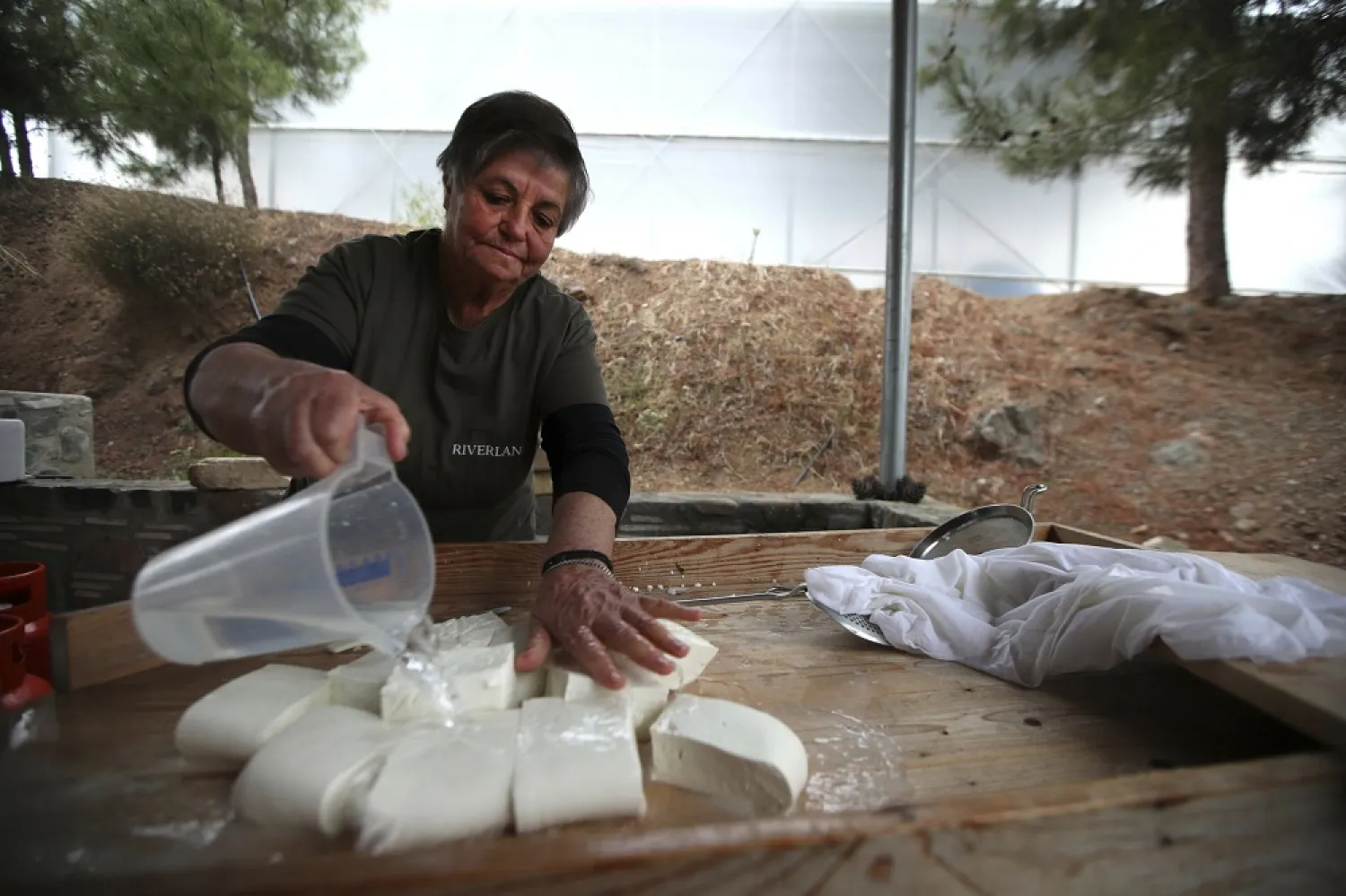
In this photo taken Wednesday Dec. 11, 2019, Aphrodite Philippou, 73, makes Cyprus' halloumi cheese at a farm in Kampia village near Nicosia, Cyprus. (AP)
TT

White Gold: Cyprus' Halloumi Cheese Entangled in Politics

In this photo taken Wednesday Dec. 11, 2019, Aphrodite Philippou, 73, makes Cyprus' halloumi cheese at a farm in Kampia village near Nicosia, Cyprus. (AP)

Dairy farmers on Cyprus refer to halloumi as “white gold.” The salty, rubbery cheese made from goats' and sheep's milk and prized for its ability to withstand a grill without melting is the country's leading export.

Cypriot authorities have spent years trying to get the European Union to recognize halloumi, or hellim in Turkish, as a traditional product of the east Mediterranean island nation. Receiving the EU's top quality mark — the “Protected Designation of Origin” — would mean only halloumi made in Cyprus could be marketed abroad under that name.

The nation's farmers and producers want the Cyprus-specific designation to keep makers of inferior cheeses in other countries from claiming a slice of their market of over 200 million euros ($222 million). Cypriot producers say demand from overseas is projected to hit new highs in the next few years, thanks to heat-tolerant halloumi's growing popularity as a meat alternative, reported The Associated Press.

However, ethnically divided Cyprus' complex politics so far have stymied the bid to protect the halloumi name. The difficulty lies in a dispute over how to lawfully get cheese made in the country's breakaway northern third to foreign markets. The self-declared Turkish Cypriot state is recognized only by Turkey and goods produced there cannot be exported directly.

Cyprus was split along ethnic lines in 1974 when Turkey invaded in the wake of a coup by supporters of union with Greece. The country joined the EU in 2004, but EU rules and regulations only apply to the southern, Greek Cypriot part of the island led by an internationally recognized government.

A European Parliament member from Cyprus has accused the EU's executive commission of letting the PDO application for halloumi grow moldy. The government hopes the new European Commission seated last month will find a way around the quandary.

Halloumi/hellim was put on track for an exclusive geographic designation amid much fanfare in 2015, when relaunched negotiations between the rival Greek Cypriot and Turkish Cypriot leaders brimmed with hope of delivering a deal to reunify the island as a two-zone federation.

A compromise was struck for the Bureau V eritas — a European body that certifies food and agricultural products — to perform checks on halloumi/hellim produced on both sides of the ethnic divide to ensure it met EU health and safety standards.

But the peace talks eventually collapsed, and the application has languished since then.

The Cypriot government says the agreement foresaw the export to European markets of vetted, Turkish Cypriot-produced cheese through EU-recognized ports in the south. Britain, Sweden and Germany currently are the top three markets for Cyprus' halloumi.

But Turkish Cypriot authorities say there was no such understanding. They accuse Greek Cypriots of blocking the European Commission’s effort to enable halloumi/hellim exports from the island's north.

“Turkish Cypriot producers should be able to export PDO-registered hellim/halloumi as they deem viable,” Turkish Cypriot Chamber of Commerce President Turgay Deniz said. “They should not be restricted to trading across (the dividing line) and via the ports in the south.”

According to Deniz, 13 Turkish Cypriot halloumi/hellim producers export around 30 million euros ($33 million) worth of the cheese to Turkey and Gulf countries. The cheese reaches Gulf nations through Turkey.

Cyprus’ Agriculture Ministry says it intends to keep pushing to clinch the exclusive mark and "to solve soon the remaining issues relating to the registration of halloumi/hellim for the benefit of all Cypriot producers.”

The European Commission says it is in contact with the Cypriot government and Turkish Cypriots to “ensure an outcome."

But Cypriot European Parliament member, Costas Mavrides, alleges the Commission is “arbitrarily” stalling its approval for halloumi to get the PDO. He said there is no legal reason for the cheese not to gain the designation and that the only step that is left is the green light from the Commission.

Mavrides is urging the Cypriot government to take the matter to the EU Court of Justice so halloumi/hellim gets the coveted moniker.

Farmers' organizations fully back the government's PDO drive for halloumi. But curiously, a segment of the cheese-making community is voicing its dissent at the cheese clinching the designation amid concerns that this could lead to job losses and shrinking revenue.

For halloumi/hellim to secure the designation, it must conform to a Cyprus government directive that it must contain at least 51% sheep's and goats' milk. That's in line with a traditional Cypriot recipe dating back some 500 years when cows were a rare commodity. Now, the cheese is made with mostly cow's' milk.

But Cheesemakers’ Association President George Petrou warns that more than one-third of the 13,000 Cypriot families in the halloumi/hellim business would find themselves out of a job if they could not use as much cows' milk in their cheese.

Cheese exports would drop by at least half, as production would plummet because of a current shortage of sheep and goat milk, Petrou estimated.

Petrou says cheese-makers instead want authorities to pursue a geographical origin designation whose rules are more flexible on how much cow milk can be used.

“As cheese-makers, we want a solution that won’t reduce exports or lead to job losses,” Petrou told The AP.

Other industry groups see holes in that argument. Rejecting the idea of using less cows' milk loses sight of the long-term benefits that a PDO mark would offer Cypriot halloumi makers, says Michalis Lytras, president of the Pancyprian Farmers’ Union.

The geographic designation would protect local producers from foreign competitors who might use cheaper, possibly government-subsidized cow milk to make halloumi/hellim.

A PDO designation would not preclude finding solutions addressing cheese-makers' concerns, like possibly marketing halloumi/hellim made with mostly cow milk under a different name.

“We can’t sacrifice those long-term benefits for short-term gains,” said Lytras.

Takis Christodoulou, president of the New Farmers’ Movement, says the high sheep and goat milk content appeals to health-conscious European consumers who are helping to fuel halloumi sales.

Christodoulou disputes that revenue from halloumi/hellim exports would drop as steeply as Petrou contends. He said while there may be a dip in cheese exports, PDO-designated halloumi/hellim would command higher prices in foreign markets.

“This is the natural product of Cyprus, and we couldn’t be prouder of it,” said Christodoulou.


17th Century Wreck Reappears from Stockholm Deep

The remains of a 17th century shipwreck is pictured after resurfacing in Stockholm, Sweden, on February 17, 2026. (Photo by Jonathan NACKSTRAND / AFP)
TT

17th Century Wreck Reappears from Stockholm Deep

The remains of a 17th century shipwreck is pictured after resurfacing in Stockholm, Sweden, on February 17, 2026. (Photo by Jonathan NACKSTRAND / AFP)

A 17th century Swedish Navy shipwreck buried underwater in central Stockholm for 400 years has suddenly become visible due to unusually low Baltic Sea levels.

The wooden planks of the ship's well-preserved hull have since early February been peeking out above the surface of the water off the island of Kastellholmen, providing a clear picture of its skeleton.

"We have a shipwreck here, which was sunk on purpose by the Swedish Navy," Jim Hansson, a marine archeologist at Stockholm's Vrak - Museum of Wrecks, told AFP.

Hansson said experts believe that after serving in the navy, the ship was sunk around 1640 to use as a foundation for a new bridge to the island of Kastellholmen.

Archeologists have yet to identify the exact ship, as it is one of five similar wrecks lined up in the same area to form the bridge, all dating from the late 16th and early 17th centuries.

"This is a solution, instead of using new wood you can use the hull itself, which is oak" to build the bridge, Hansson said.

"We don't have shipworm here in the Baltic that eats the wood, so it lasts, as you see, for 400 years," he said, standing in front of the wreck.

Parts of the ship had already broken the surface in 2013, but never before has it been as visible as it is now, as the waters of the Baltic Sea reach their lowest level in about 100 years, according to the archaeologist.

"There has been a really long period of high pressure here around our area in the Nordics. So the water from the Baltic has been pushed out to the North Sea and the Atlantic," Hansson explained.

A research program dubbed "the Lost Navy" is underway to identify and precisely date the large number of Swedish naval shipwrecks lying on the bottom of the Baltic.


China Has Slashed Air Pollution, but the ‘War’ Isn’t Over 

This picture taken on February 11, 2026 shows pedestrians walking along an overpass as traffic snarls in Beijing. (AFP)
TT

China Has Slashed Air Pollution, but the ‘War’ Isn’t Over 

This picture taken on February 11, 2026 shows pedestrians walking along an overpass as traffic snarls in Beijing. (AFP)

Fifteen years ago, Beijing's Liangma riverbanks would have been smog-choked and deserted in winter, but these days they are dotted with families and exercising pensioners most mornings.

The turnaround is the result of a years-long campaign that threw China's state power behind policies like moving factories and electrifying vehicles, to improve some of the world's worst air quality.

Pollution levels in many Chinese cities still top the World Health Organization's (WHO) limits, but they have fallen dramatically since the "airpocalypse" days of the past.

"It used to be really bad," said Zhao, 83, soaking up the sun by the river with friends.

"Back then when there was smog, I wouldn't come out," she told AFP, declining to give her full name.

These days though, the air is "very fresh".

Since 2013, levels of PM2.5 -- small particulate that can enter the lungs and bloodstream -- have fallen 69.8 percent, Beijing municipality said in January.

Particulate pollution fell 41 percent nationwide in the decade from 2014, and average life expectancy has increased 1.8 years, according to the University of Chicago's Air Quality Life Index (AQLI).

China's rapid development and heavy coal use saw air quality decline dramatically by the 2000s, especially when cold winter weather trapped pollutants close to the ground.

There were early attempts to tackle the issue, including installing desulphurization technology at coal power plants, while factory shutdowns and traffic control improved the air quality for events like the 2008 Olympics.

But the impact was short-lived, and the problem worsened.

- Action plan -

Public awareness grew, heightened by factors like the US embassy in Beijing making monitoring data public.

By 2013, several international schools had installed giant inflatable domes around sport facilities to protect students.

That year, multiple episodes of prolonged haze shrouded Chinese cities, with one in October bringing northeastern Harbin to a standstill for days as PM2.5 levels hit 40 times the WHO's then-recommended standard.

The phrase "I'm holding your hand, but I can't see your face" took off online.

Later that year, an eight-year-old became the country's youngest lung cancer patient, with doctors directly blaming pollution.

As concerns mounted, China's ruling Communist Party released a ten-point action plan, declaring "a war against pollution".

It led to expanded monitoring, improved factory technology and the closure or relocation of coal plants and mines.

In big cities, vehicles were restricted and the groundwork was laid for widespread electrification.

For the first time, "quantitative air quality improvement goals for key regions within a clear time limit" were set, a 2016 study noted.

These targets were "the most important measure", said Bluetech Clean Air Alliance director Tonny Xie, whose non-profit worked with the government on the plan.

"At that time, there were a lot of debates about whether we can achieve it, because (they were) very ambitious," he told AFP.

The policy targeted several key regions, where PM2.5 levels fell rapidly between 2013 and 2017, and the approach was expanded nationwide afterwards.

"Everybody, I think, would agree that this is a miracle that was achieved in China," Xie said.

China's success is "entirely" responsible for a decline in global pollution since 2014, AQLI said last summer.

- 'Low-hanging fruits' gone -

Still, in much of China the air remains dangerous to breathe by WHO standards.

This winter, Chinese cities, including financial hub Shanghai, were regularly among the world's twenty most polluted on monitoring site IQAir.

Linda Li, a running coach who has lived in both Beijing and Shanghai, said air quality has improved, but she still loses up to seven running days to pollution in a good month.

A top environment official last year said China aimed to "basically eliminate severe air pollution by 2025", but the government did not respond when AFP asked if that goal had been met.

Official 2025 data found nationwide average PM2.5 concentrations decreased 4.4 percent on-year.

Eighty-eight percent of days featured "good" air quality.

However, China's current definition of "good" is PM2.5 levels of under 35 micrograms per cubic meter, significantly higher than the WHO's recommended five micrograms.

China wants to tighten the standard to 25 by 2035.

The last five years have also seen pollution reduction slow.

The "low-hanging fruits" are gone, said Chengcheng Qiu from the Center for Research on Energy and Clean Air (CREA).

Qiu's research suggests pollution is shifting west as heavy industry relocates to regions like Xinjiang, and that some cities in China have seen double-digit percentage increases in PM2.5 in the last five years.

"They can't just stop all industrial production. They need to find cleaner ways to produce the output," Qiu said.

There is hope for that, given China's status as a renewable energy powerhouse, with coal generation falling in 2025.

"Cleaner air ultimately rests on one clear direction," said Qiu.

"Move beyond fossil fuels and let clean energy power the next stage of development."


Sydney Man Jailed for Mailing Reptiles in Popcorn Bags 

Investigators recovered 101 Australian reptiles from parcels destined for Hong Kong, South Korea, Sri Lanka and Romania. (AFP file)
TT

Sydney Man Jailed for Mailing Reptiles in Popcorn Bags 

Investigators recovered 101 Australian reptiles from parcels destined for Hong Kong, South Korea, Sri Lanka and Romania. (AFP file)

A Sydney man who tried to post native lizards, dragons and other reptiles out of Australia in bags of popcorn and biscuit tins has been sentenced to eight years in jail, authorities said Tuesday.

The eight-year term handed down on Friday was a record for wildlife smuggling, federal environment officials said.

A district court in Sydney gave the man, 61-year-old Neil Simpson, a non-parole period of five years and four months.

Investigators recovered 101 Australian reptiles from seized parcels destined for Hong Kong, South Korea, Sri Lanka and Romania, the officials said in a statement.

The animals -- including shingleback lizards, western blue-tongue lizards, bearded dragons and southern pygmy spiny-tailed skinks -- were posted in 15 packages between 2018 and 2023.

"Lizards, skinks and dragons were secured in calico bags. These bags were concealed in bags of popcorn, biscuit tins and a women's handbag and placed inside cardboard boxes," the statement said.

The smuggler had attempted to get others to post the animals on his behalf but was identified by government investigators and the New South Wales police, it added.

Three other people were convicted for taking part in the crime.

The New South Wales government's environment department said that "the illegal wildlife trade is not a victimless crime", harming conservation and stripping the state "and Australia of its unique biodiversity".
