

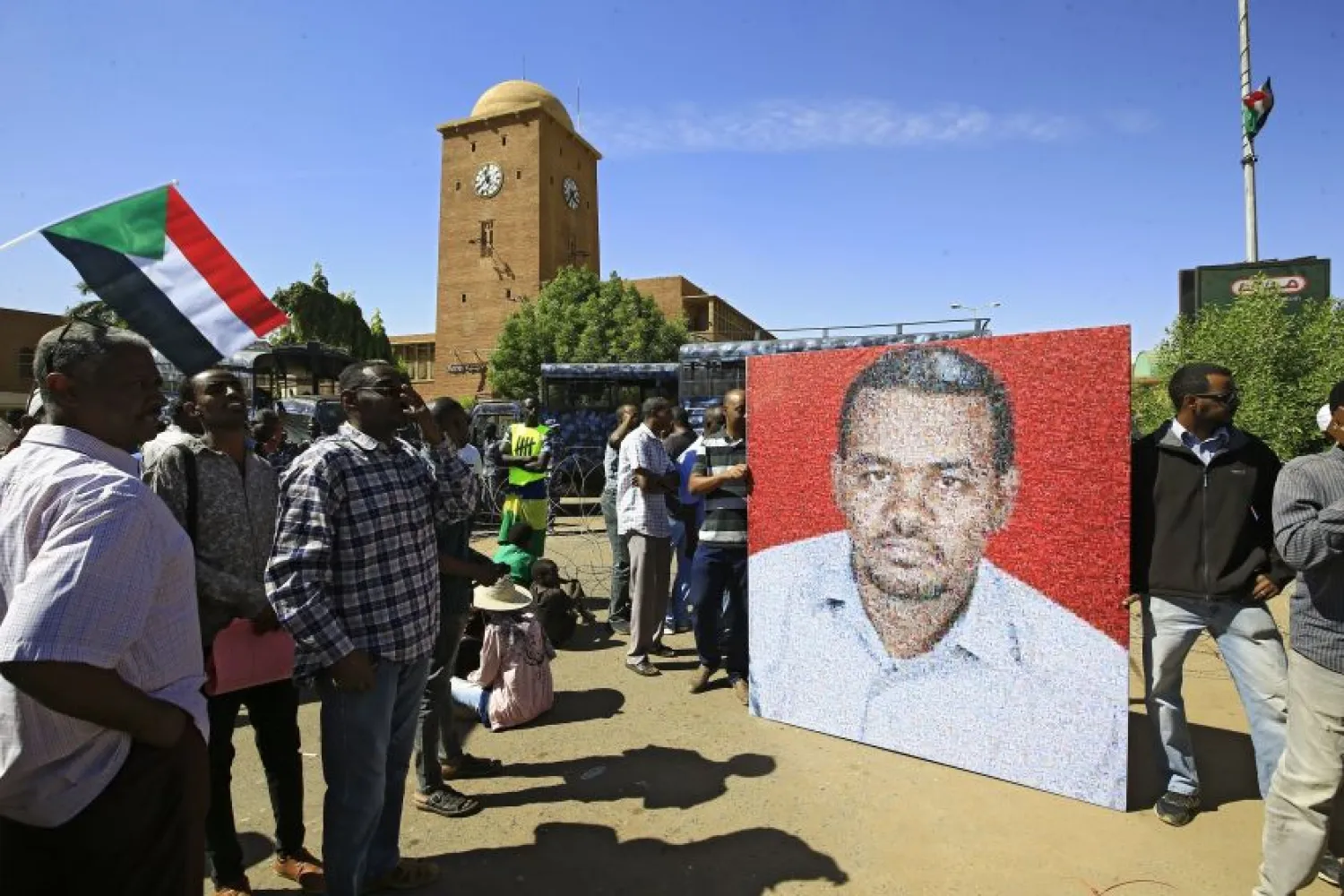

Sudan Sentences 27 Intelligence Officers to Death for Torturing, Killing Protester

People gather in Khartoum, Sudan, on Nov. 19 to celebrate the first anniversary of mass protests that led to the ouster of former President Omar al-Bashir. (Associated Press)
TT

Sudan Sentences 27 Intelligence Officers to Death for Torturing, Killing Protester

People gather in Khartoum, Sudan, on Nov. 19 to celebrate the first anniversary of mass protests that led to the ouster of former President Omar al-Bashir. (Associated Press)

A Sudanese court on Monday sentenced 27 members of the country's security forces to death by hanging for torturing and killing a detained protester during the uprising against longtime autocrat Omar al-Bashir earlier this year.

The verdict, which can be appealed, was the first connected to the killing of more than 200 pro-democracy protesters since the demonstrations began last December.

"We are now sure our revolution is continuing on the right path," said protester Amna Mohammed. She was among a cheering crowd of hundreds that gathered to welcome the verdict's announcement outside the court in Omdurman, the capital Khartoum's twin city.

The death of protester Ahmed al-Khair, a school teacher, while in detention in February was a key point - and a symbol - in the uprising that convulsed the large African country. That led, in April, to the toppling of al-Bashir, and ultimately to the creation of a joint military-civilian Sovereign Council that has committed to rebuilding the country and promises elections in three years.

The anniversary of the uprising this month drew teeming crowds to the streets in several cities and towns across the country, with people singing, dancing and carrying flags. A train packed with exuberant demonstrators, clapping and chanting, arrived in the northern city of Atbara, the birthplace of the uprising, from the capital city.

The Sudanese Professionals Association, an umbrella group of unions that led the protests against al-Bashir, welcomed Monday's verdict. The group vowed to continue pursuing and bringing to justice security officials accused of torture.

Mohammed al-Feki Soliman, a member of the Sovereign Council, said the trial "renews the Sudanese people's trust in their judicial institutions."

Al-Khair was detained on Jan. 31 in his hometown of Kassala and was reported dead two days later. His body was taken to a local hospital where his family said it was covered in bruises. At the time, police denied any police wrongdoing and blamed his death on an "illness," without providing any details.

Judge al-Sadik al-Amin al-Fek, however, said on Monday that the teacher was beaten and tortured while in detention. "His death was an inevitable consequence of the beating and torture," he said.

The court also sentenced three other members of the security forces to three years each in prison, and acquitted seven suspects in the case. All the sentenced were policemen who were working in the jail where al-Khair was held or intelligence agents in the region.

Following a tradition based on Islamic law, or Sharia, the court gave al-Khair's family the opportunity to "forgive" the suspects, which could have led to their pardon, but the offer was declined.

Taj al-Ser Ali al-Hebr, the country´s top prosecutor, welcomed the verdict as a "victory." He called on the government to join the UN Convention Against Torture.

Earlier this month, a court in Khartoum convicted Bashir, who was jailed by the military after he was removed from power, of money laundering and corruption, and sentenced him to two years in a minimum-security lockup. The image of the former dictator in a defendant's cage on live TV sent a strong message for all of Sudan.

However, the deposed ruler is under indictment by the International Criminal Court on far more serious charges of war crimes and genocide linked to his brutal suppression of the insurgency in the western province of Darfur in the early 2000s. The military has refused to extradite him to stand trial in The Hague. Bashir is now awaiting a separate trial, on charges of involvement in the killing of protesters in the months prior to his ouster.

Amnesty International and other rights groups have called on the new government to hold security forces accountable for killing scores of people in their efforts to stifle protests against military rule, especially those behind a deadly crackdown on a huge sit-in outside the military headquarters in Khartoum last June.

The government recently appointed independent judges to oversee investigations into the killings of protesters, a major achievement for the pro-democracy movement.

Sudan is under heavy international and regional pressure to reform. With the economy on the brink, the new government has made it a mission to get Sudan removed from the US list of state sponsors of terrorism so that it can attract badly needed foreign aid.

The Sudanese government is expected to seek a bailout from the International Monetary Fund and the World Bank. That would require it to cut food and fuel subsidies and further devalue the local currency, said the IMF's Daniel Kanda after a visit to Khartoum earlier this month.

But the government on Sunday passed the 2020 budget that dropped proposals to slash food and fuel subsidies.

The pro-democracy movement, the Forces for Declaration of Freedom and Change, fears that the austerity measures could lead to a spike in the inflation rate which increased to 60% in November. The uprising began last December over soaring inflation and Sudan's dire economic conditions.

Sudanese Information Minister Faisal Saleh said the government decided to postpone cutting subsidies until an economic conference the country plans to hold in March.



Egypt’s Prime Minister and FM Head to Washington for Trump Peace Council Meeting

Egyptian Foreign Minister Badr Abdelatty speaks during a joint press conference with Kenyan Prime Cabinet Secretary/Cabinet Secretary for Foreign Diaspora Affairs Musalia Mudavadi in Nairobi, Kenya, Monday, Feb. 16, 2026. (AP)
TT

Egypt’s Prime Minister and FM Head to Washington for Trump Peace Council Meeting

Egyptian Foreign Minister Badr Abdelatty speaks during a joint press conference with Kenyan Prime Cabinet Secretary/Cabinet Secretary for Foreign Diaspora Affairs Musalia Mudavadi in Nairobi, Kenya, Monday, Feb. 16, 2026. (AP)

Egypt's Prime Minister Mostafa Madbouly headed to Washington on Tuesday ‌to ‌participate in ‌the inaugural ⁠meeting of a "Board of Peace" established by US President Donald ⁠Trump, the ‌cabinet ‌said.

Madbouly is ‌attending ‌on behalf of President Abdel ‌Fattah al-Sisi and is accompanied by ⁠Foreign ⁠Minister Badr Abdelatty.

Foreign Minister Gideon Saar will represent Israel at the inaugural meeting, his office said on Tuesday.

Hamas, meanwhile, called on the newly-formed board to pressure Israel to halt what it described as ongoing violations of the ceasefire in Gaza.

The Board of Peace, of which Trump is the chairman, was initially designed to oversee the Gaza truce and the territory's reconstruction after the war between Hamas and Israel.

But its purpose has since morphed into resolving all sorts of international conflicts, triggering fears the US president wants to create a rival to the United Nations.

Saar will first attend a ministerial level UN Security Council meeting in New York on Wednesday, and on Thursday he "will represent Israel at the inaugural session of the board, chaired by Trump in Washington DC, where he will present Israel's position", his office said in a statement.

It was initially reported that Prime Minister Benjamin Netanyahu might attend the gathering, but his office said last week that he would not.

Ahead of the meeting, Hamas spokesman Hazem Qassem told AFP that the Palestinian movement urged the board's members "to take serious action to compel the Israeli occupation to stop its violations in Gaza".

"The war of genocide against the Strip is still ongoing -- through killing, displacement, siege, and starvation -- which have not stopped until this very moment," he added.

He also called for the board to work to support the newly formed Palestinian technocratic committee meant to oversee the day-to-day governance of post-war Gaza "so that relief and reconstruction efforts in Gaza can commence".

Announcing the creation of the board in January, Trump also unveiled plans to establish a "Gaza Executive Board" operating under the body.

The executive board would include Turkish Foreign Minister Hakan Fidan and Qatari diplomat Ali Al-Thawadi.

Netanyahu has strongly objected to their inclusion.

Since Trump launched his "Board of Peace" at the World Economic Forum in Davos in January, at least 19 countries have signed its founding charter.


Palestinian Child Dies After Stepping on Mine in West Bank

Israeli troops conduct a military raid in the village of Al-Yamoun, west of Jenin, West Bank, 17 February 2026. (EPA)
TT

Palestinian Child Dies After Stepping on Mine in West Bank

Israeli troops conduct a military raid in the village of Al-Yamoun, west of Jenin, West Bank, 17 February 2026. (EPA)

A Palestinian child died after stepping on a mine near an Israeli military camp in the occupied West Bank on Tuesday, the Palestinian Red Crescent said, with an Israeli defense ministry source confirming the death.

"Our crews received the body of a 13-year-old child who was killed after a mine exploded in one of the old camps in Jiftlik in the northern Jordan Valley," the Red Crescent said in a statement.

A source at COGAT, the Israeli defense ministry's agency in charge of civilian matters in the Palestinian territories, confirmed the death to AFP and identified the boy as Mohammed Abu Dalah, from the village of Jiftlik.

Israel's military had previously said in a statement that three Palestinians were injured "as a result of playing with unexploded ordnance", without specifying their ages.

It added that the area of the incident, Tirzah, is "a military camp in the area of the Jordan Valley", near Jiftlik and close to the Jordanian border.

"This area is a live-fire zone and entry into it is prohibited," the military said.

Jiftlik village council head Ahmad Ghawanmeh told AFP that three children, the oldest of whom was 16, were collecting herbs near the military base when they detonated a mine.

Jiftlik as well as the nearby Tirzah base are located in the Palestinian territory's Area C, which falls under direct Israeli control.

Israel has occupied the West Bank since 1967.

Much of the area near the border with Jordan -- which Israel signed a peace deal with in 1994 -- remains mined.

In January, Israel's defense ministry said it had begun demining the border area as part of construction works for a new barrier it says aims to stem weapons smuggling.


Hezbollah Rejects Disarmament Plan and Government’s Four-Month Timeline

29 July 2024, Iran, Tehran: Then Hezbollah deputy leader Sheikh Naim Qassem is pictured during a meeting in Tehran. (Iranian Presidency/dpa)
TT

Hezbollah Rejects Disarmament Plan and Government’s Four-Month Timeline

29 July 2024, Iran, Tehran: Then Hezbollah deputy leader Sheikh Naim Qassem is pictured during a meeting in Tehran. (Iranian Presidency/dpa)

Hezbollah rejected on Tuesday the Lebanese government's decision to grant the army at least four months to advance the second phase of a nationwide disarmament plan, saying it would not accept what it sees as a move serving Israel.

Lebanon's cabinet tasked the army in August 2025 with drawing up and beginning to implement a plan to bring all armed groups' weapons under state control, a bid aimed primarily at disarming Hezbollah after its devastating ‌war with ‌Israel in 2024.

In September 2025 the cabinet formally ‌welcomed ⁠the army's plan to ⁠disarm the Iran-backed Shiite party, although it did not set a clear timeframe and cautioned that the military's limited capabilities and ongoing Israeli strikes could hinder progress.

Hezbollah Secretary-General Sheikh Naim Qassem said in a speech on Monday that "what the Lebanese government is doing by focusing on disarmament is a major mistake because this issue serves the goals of Israeli ⁠aggression".

Lebanon's Information Minister Paul Morcos said during a press ‌conference late on Monday after ‌a cabinet meeting that the government had taken note of the army's monthly ‌report on its arms control plan that includes restricting weapons in ‌areas north of the Litani River up to the Awali River in Sidon, and granted it four months.

"The required time frame is four months, renewable depending on available capabilities, Israeli attacks and field obstacles,” he said.

Hezbollah lawmaker Hassan ‌Fadlallah said, "we cannot be lenient," signaling the group's rejection of the timeline and the broader approach to ⁠the issue of ⁠its weapons.

Hezbollah has rejected the disarmament effort as a misstep while Israel continues to target Lebanon, and Shiite ministers walked out of the cabinet session in protest.

Israel has said Hezbollah's disarmament is a security priority, arguing that the group's weapons outside Lebanese state control pose a direct threat to its security.

Israeli officials say any disarmament plan must be fully and effectively implemented, especially in areas close to the border, and that continued Hezbollah military activity constitutes a violation of relevant international resolutions.

Israel has also said it will continue what it describes as action to prevent the entrenchment or arming of hostile actors in Lebanon until cross-border threats are eliminated.