


Women’s Football Has Seen a Decade of Progress but There Is Much More to Do

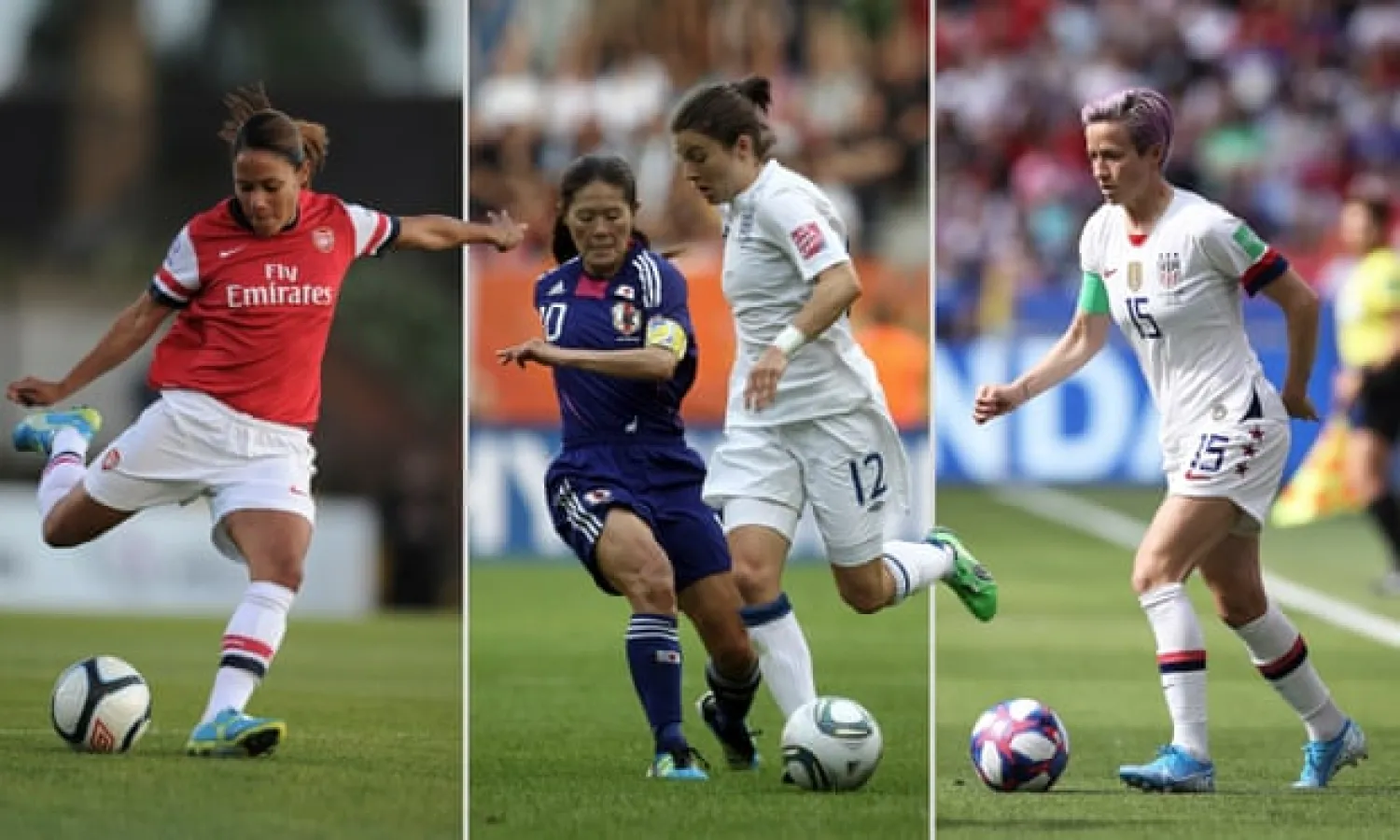
 Arsenal’s Alex Scott in 2012, England’s Karen Carney is challenged by Japan’s Homare Sawa at the 2011 Women’s World Cup, and Megan Rapinoe of the USA in the 2019 Women’s World Cup final. Photograph: Getty Images
Arsenal’s Alex Scott in 2012, England’s Karen Carney is challenged by Japan’s Homare Sawa at the 2011 Women’s World Cup, and Megan Rapinoe of the USA in the 2019 Women’s World Cup final. Photograph: Getty Images
TT

Women’s Football Has Seen a Decade of Progress but There Is Much More to Do

 Arsenal’s Alex Scott in 2012, England’s Karen Carney is challenged by Japan’s Homare Sawa at the 2011 Women’s World Cup, and Megan Rapinoe of the USA in the 2019 Women’s World Cup final. Photograph: Getty Images
Arsenal’s Alex Scott in 2012, England’s Karen Carney is challenged by Japan’s Homare Sawa at the 2011 Women’s World Cup, and Megan Rapinoe of the USA in the 2019 Women’s World Cup final. Photograph: Getty Images

Women’s football has come a very long way in a decade. Ten years ago there existed an indifference towards the few women who chose to persevere in what many viewed a novel and headstrong manner to play the men’s game – because, let’s face it, that is what “the people’s game” actually meant. Now, Chelsea’s Fran Kirby can post photos on social media of her dog sitting in front of a Bentley. It may be a loaned Bentley (the gap hasn’t closed that much) but the England forward does have numerous sponsorship deals, with Nike and Swarovski among others.

If the Noughties was the decade in which players such as Alex Scott edged from washing the shirts and shorts of the Arsenal men’s team towards the possibility of scraping a living from football, then this last decade has been the one that has provided respect and with it professionalism, sponsorship, support and the chance to make a modest living out of the game.

Delayed by a year because of the economic downturn, the Women’s Super League was launched in 2011 with eight teams and not without controversy as 16 teams applied for places. By 2014 it was expanded to include a second tier of 10 teams, with Doncaster Belles relegated to make way for the revamped Manchester City.

In 2017 the Football Association switched the leagues from a summer to a winter schedule to match the men’s calendar, while launching its four-year Gameplan for Growth strategy. By the launch of the 2018-19 season, a full-time professional top tier and semi-professional second division was in place. The changes have been rapid. And they have been forced. The casualties, and there have been many, have been necessary according to the FA’s head of women’s football, Sue Campbell.

“Yes it’s tough on them but, unfortunately, whenever you create these kind of step changes there are casualties,” she told BBC Radio 5 Live in May 2018. “Others have stepped up to the mark. It has to be a commitment from the club to step up and move forward together with us.”

There is an element of truth to that. It could be argued players and staff of teams such as Sunderland and Watford were let down by the lack of ambition and commitment of their clubs as much as the FA. On the other hand Donny Belles, Yeovil, and others who have been long-time investors in the women’s game but were unable to compete with the increased financial demands of the FA, have been sacrificed.

In the meantime, amid all that upheaval, attendances have stagnated. From an average of 728 in 2014 they climbed to 1,128 by 2016 but then dipped as the winter switch took its toll, eventually averaging 996 for the first fully professional season.

Where domestically audiences have stood still, interest has been driven internationally. Viewing figures for the Lionesses at international competitions have steadily climbed. For the 2011 World Cup in Germany a peak match average viewing figure of 1.7m was reached. The 2013 Euros were a bit of a blip, a 1.3m peak match average was prevented from climbing further when England crashed out of their group with one point (ending Hope Powell’s tenure). By 2015 the World Cup in Canada saw a peak of 2.4m watching England’s semi-final defeat to Japan. At the 2017 Euros 4m watched their exit to the Netherlands (a 66% increase on 2015).

Last year, though, felt like a turning point. After a decade, or two even, of somewhat steady growth women’s football took a leap forward. A massive 11.7m watched England’s defeat by USA at the World Cup, a 192.5% increase on their 2017 Netherlands exit.

By mid-November domestic WSL attendances, boosted by big games, were averaging 4,112 (and 1,425 with the showpiece games at Stamford Bridge, Tottenham Hotspur Stadium and elsewhere removed from the equation). The close to £20m investment by Barclays in the top division and grassroots football was the pinnacle of a host of sponsorship deals for clubs, the national team and players.

There is a real optimism in women’s football. The media, the FA, commercial partners, clubs and fans are, broadly speaking, on the same page. There is an ideological belief in the importance of building the game, perhaps a result of the way attitudes have changed around women, women’s bodies and women’s rights more widely, but that is coupled with a much cruder realisation that there are real longer‑term financial and image benefits to backing the women’s game.

Not everything is rosy. The gap between the haves of Arsenal, Chelsea, Manchester City and Manchester United and the have-nots is growing. Lyon face a similar scenario in France, where their investment is almost punished by teams unwilling to play catch-up.

And, while attitudes generally have changed dramatically, there is still a long way to go – within organisations but also more generally in society. The first comment on Twitter in response to Megan Rapinoe being named the 2019 Guardian Footballer of the Year was: “Sure, I agree. Still not watching women’s football though.” Another said: “Lol. Hypocrite look in the mirror and start with yourself. You obnoxious P.O.S.”

Almost every comment on Facebook was negative. There is a vocal minority who are not content to just ignore what they don’t like but feel compelled for some unknown reason to shout it. They find their fuel in the bodies that perpetuate the inequity – the clubs that forced Spanish footballers to strike, Fifa’s decision to let a $370m gap in World Cup prize money grow by $10m despite a doubling of the women’s fund to $60m, US Soccer’s equal-pay dispute with their most successful ever senior team.

There is still so much to do. Women’s football should be swimming with the tide but, unfortunately, there is still much for which to be fought. Here’s hoping this decade sees that change.

The Guardian Sport


Salah Unaffected by Liverpool Turmoil Ahead of AFCON Opener, Says Egypt Coach

Liverpool's Mohamed Salah sits on the bench before the English Premier League soccer match between Liverpool and Brighton and Hove Albion in Liverpool, England, Saturday, Dec. 13, 2025. (AP)
TT

Salah Unaffected by Liverpool Turmoil Ahead of AFCON Opener, Says Egypt Coach

Liverpool's Mohamed Salah sits on the bench before the English Premier League soccer match between Liverpool and Brighton and Hove Albion in Liverpool, England, Saturday, Dec. 13, 2025. (AP)

Mohamed Salah has shown no signs of being distracted by the uncertainty surrounding his future at Liverpool as he prepares to lead Egypt into the Africa Cup of Nations, Pharaohs coach Hossam Hassan said on Sunday.

"Salah's morale in training is very high, as if he were just starting out with the national team, and I believe he will have a great tournament with his country," Hassan told reporters ahead of Egypt's opening AFCON game against Zimbabwe in Agadir on Monday.

"I feel his motivation is very, very strong. Salah is an icon and will remain so. He is one of the best players in the world, and I support him in everything he does," Hassan added.

Salah did not start any of Liverpool's last five games before departing for the Cup of Nations in Morocco and things came to a head following the recent Premier League draw at Leeds United when he claimed he had been "thrown under the bus" by his coach at Anfield, Arne Slot.

That suggested a move away from the troubled Premier League champions during the January transfer window was a real possibility.

"I don't consider what happened to him to be a crisis. These things often happen between players and coaches," Hassan added.

"We've been in contact with him by phone from the beginning, and I met with him when he joined the national team camp. His focus is entirely on the tournament."

Salah, 33, is aiming to lead Egypt to a record-extending eighth AFCON title in Morocco. He has never won the continental title, but ended up on the losing side in final defeats by Cameroon in 2017 and Senegal in 2022.

His goals this year have already helped Egypt qualify for the World Cup.

"Whenever Salah's performances dip with his club, he regains his strength with the national team and becomes even better, whether by contributing to goals or scoring himself. Then he returns to his club even stronger," Hassan added.

"He needs to win the cup by helping us and by helping himself."

Egypt will also face South Africa and Angola in Group B at the Cup of Nations, with all three of their games in the first round being played in Agadir.


Pressure on Morocco to Deliver as Africa Cup of Nations Kicks Off

Morocco's head coach Walid Regragui speaks during a press conference at Prince Moulay Abdellah Stadium in Rabat, Morocco, 20 December 2025. (EPA)
TT

Pressure on Morocco to Deliver as Africa Cup of Nations Kicks Off

Morocco's head coach Walid Regragui speaks during a press conference at Prince Moulay Abdellah Stadium in Rabat, Morocco, 20 December 2025. (EPA)

Morocco carry a huge weight of expectation into their opening game at the Africa Cup of Nations on Sunday as the hosts, with star man Achraf Hakimi returning from injury, aim to see off stiff competition to claim continental glory.

Senegal, reigning champions Ivory Coast, Mohamed Salah's Egypt and a Nigeria side led by Victor Osimhen are among the biggest rivals for Morocco at the AFCON, which runs into the New Year with the final on January 18.

Morocco, Africa's best team in the FIFA rankings in 11th place, kick off the tournament on Sunday at 1900 GMT against minnows Comoros at the new 69,000-seat Prince Moulay Abdellah Stadium in Rabat.

There is huge pressure on the Atlas Lions, semi-finalists at the 2022 World Cup who come into the Cup of Nations on a world-record run of 18 consecutive victories.

"I have always said the objective is to win this AFCON at home in front of our fans," coach Walid Regragui insisted on Saturday.

"The country that will have the most difficulty winning the AFCON is Morocco, because of the expectation on us," he nevertheless warned as they look to claim the title for the first time since 1976.

"The pressure on us is positive, but anything other than victory will be a failure."

Paris Saint-Germain right-back Hakimi, the African player of the year, says he is ready to take part despite not having played since suffering an ankle injury in early November.

"I feel good," said Hakimi, although Regragui admitted that the former Real Madrid man may not play against Comoros with further Group A matches to come against Mali and Zambia.

Hakimi added: "I'm not thinking about me as an individual. If I only play one minute and the team wins, then that's fine."

They have been good at winning of late -- Morocco won the recent Under-20 World Cup and the country's triumph in the FIFA Arab Cup final against Jordan in Doha this week brought fans onto the streets in celebration.

For Morocco, this tournament is also about showcasing some world-class stadiums as it hosts a first AFCON since 1988.

The Prince Moulay Abdellah Stadium, which will also stage the final, is one of four being used in Rabat.

A huge 75,000-seat stadium in Tangier will host a semi-final, while games will also be played in Casablanca, Marrakesh, Agadir and Fez as the country builds towards the 2030 World Cup which it will co-host with Spain and Portugal.

The introduction of FIFA's expanded Club World Cup last June and July forced the Confederation of African Football (CAF) to push back its flagship tournament.

They could not wait until next June because of the World Cup, and they can no longer stage the Cup of Nations in January and February because of the new UEFA Champions League format.

The only solution was to start in December and continue into the New Year, at a time when many European leagues -- where so many African stars play -- take a break.

Confederation of African Football president Patrice Motsepe on Saturday acknowledged the need to address the scheduling problem as he announced a decision to play the Cup of Nations every four years following a planned edition in 2028.

"We want to make sure that there is more synchronization," said Motsepe, and that "the football calendar worldwide is more in harmony".

Morocco are aiming to follow the example of Ivory Coast, who won the last AFCON as hosts in 2024.

North African teams have won four of the last five editions held in the region, including Algeria's triumph in Egypt in 2019.

It remains to be seen whether the doubts surrounding Salah's Liverpool future impact Egypt's chances of winning a record-extending eighth title.

Elsewhere Senegal, winners in 2022 and with a squad featuring Sadio Mane and Iliman Ndiaye, are serious contenders.

Runners-up last year, Nigeria will hope to make amends here for missing out on World Cup qualification.

In contrast, Ghana and Cape Verde are both going to the World Cup, but neither are present in Morocco.

After Sunday's opening game there will be three matches on Monday, including South Africa against Angola and Egypt versus Zimbabwe in Group B.


Isak Injury Leaves Slot Counting Cost of Liverpool Win at Spurs

 Liverpool's Alexander Isak reacts after sustaining an injury during the English Premier League soccer match between Tottenham and Liverpool in London, Saturday, Dec. 20, 2025. (AP)
Liverpool's Alexander Isak reacts after sustaining an injury during the English Premier League soccer match between Tottenham and Liverpool in London, Saturday, Dec. 20, 2025. (AP)
TT

Isak Injury Leaves Slot Counting Cost of Liverpool Win at Spurs

 Liverpool's Alexander Isak reacts after sustaining an injury during the English Premier League soccer match between Tottenham and Liverpool in London, Saturday, Dec. 20, 2025. (AP)
Liverpool's Alexander Isak reacts after sustaining an injury during the English Premier League soccer match between Tottenham and Liverpool in London, Saturday, Dec. 20, 2025. (AP)

Arne Slot was left to count the cost of Liverpool's chaotic 2-1 win at nine-man Tottenham after Alexander Isak's rare goal was followed by a potentially damaging injury.

Isak fired Liverpool into a second-half lead in north London with a clinical finish, only to limp off moments later after being injured by Micky van de Ven's failed attempt to stop him scoring.

The Sweden striker's third goal for Liverpool since his British record £125 million ($166 million) move from Newcastle on transfer deadline day had offered hope that he was finally set to live up to his hefty price tag.

Instead, Reds boss Slot now faces an anxious wait to determine how long the 26-year-old will be sidelined with his ankle problem.

Slot would only say that Isak's injury was "not a good thing".

It could not have come at a worse time for fifth-placed Liverpool after Egypt forward Mohamed Salah's departure to the Africa Cup of Nations and an injury to Dutch winger Cody Gakpo.

Adding to Slot's fitness issues, Isak only came off the bench at half-time after right-back Conor Bradley was injured.

Although Liverpool are unbeaten in their last six games in all competitions -- winning three in a row -- the brief flicker of promise engendered by the sight of Hugo Ekitike, Florian Wirtz and Isak combining for the opening goal was quickly snuffed out.

The trio cost around £300 million to bring to Anfield in the close-season, with only Ekitike, the least expensive of the group, living up to the hype during the Premier League champions' troubled first half of the season.

French striker Ekitike maintained his strong start to life with Liverpool by heading their second goal against Tottenham.

But even then, Liverpool made heavy weather of it as Tottenham, already down to 10 men after Xavi Simons' first-half dismissal for a crude foul on Virgil van Dijk, pulled one back through Richarlison in the closing stages.

Tottenham captain Cristian Romero's stoppage-time dismissal for a needless second booking after he kicked Ibrahima Konate let Liverpool off the hook just as they looked set to blow the lead in a frenzied finale.

Breathing a sigh of relief, Slot said: "A good goal (for Isak), assisted by Florian Wirtz, and I said last week already players are getting better, the team is getting better.

"I thought to be honest with nine, we will probably be able then to keep them away from our goal, but it looked as if we were down to nine and they were on 11 because it was attack after attack after attack.

"Again, it wasn't perfect, especially not in the last 10 minutes but in the meantime, we pick up points and I see the team developing in a way I like to see."

Meanwhile, under-fire Tottenham boss Thomas Frank blasted referee John Brooks.

Frank was furious with Simons' red card -- which was upgraded from a booking after a VAR review -- and the failure to disallow Ekitike's goal for a push on Romero.

"I don't like this as a red card. I think the game is probably too big to say gone, but for me it's not reckless and it's not exceptional force," said Frank, whose side are languishing in 13th place.

"He is chasing Van Dijk. He is trying to put pressure and then he changes direction. Unfortunately, his foot is on Achilles. You can say 'Ah, you need to be smarter, don't do it and all that' but so are we not allowed to have physical contact anymore?

"The second goal is a mistake from the referee. There are two hands in the back. I don't understand how you can do that.

"I think that was the biggest mistake in my opinion and from VAR but apparently that was not enough."
