

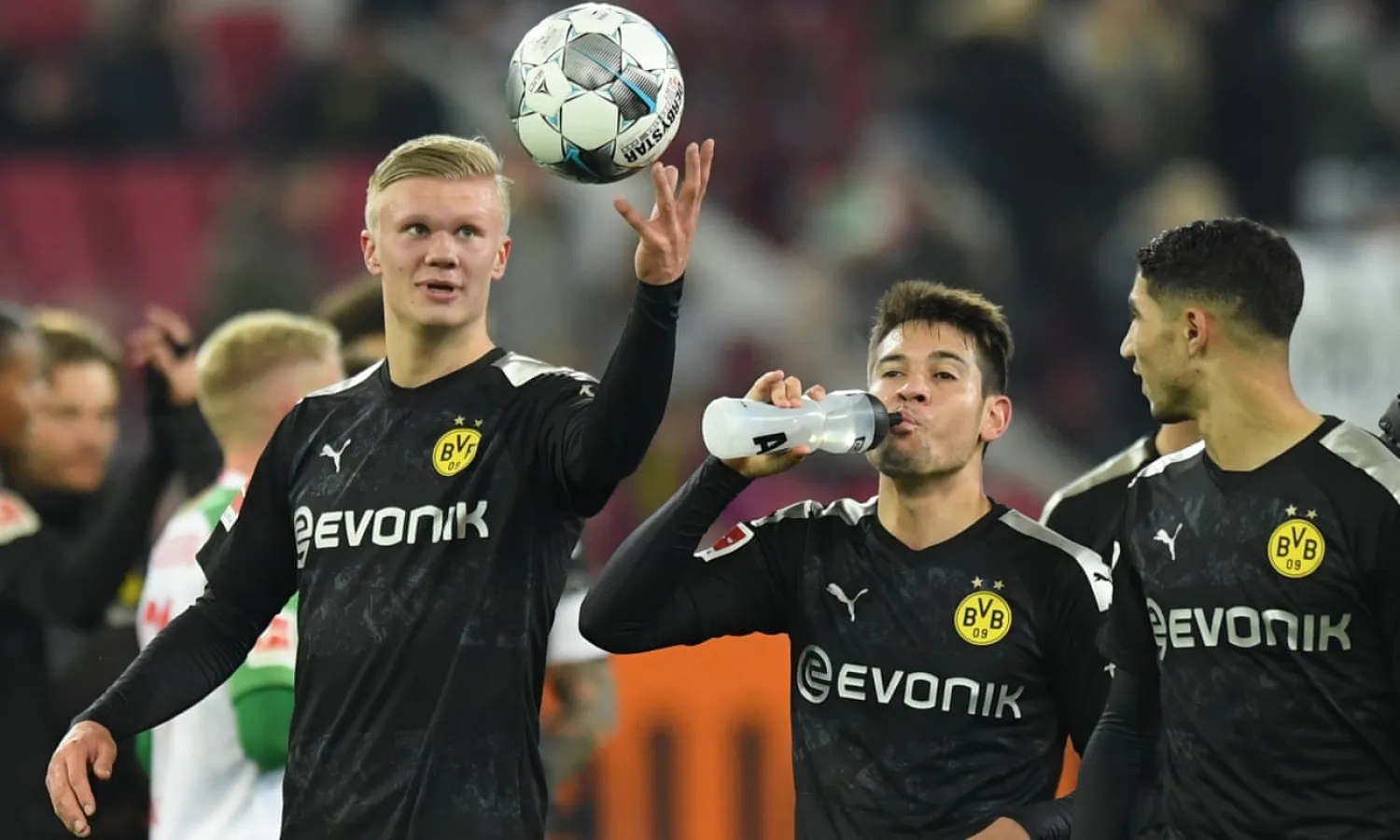

Erling Braut Haaland Gatecrashes Again to Haul Dortmund out of Mire

 Erling Braut Haaland holds the match ball after his debut hat-trick for Dortmund at Augsburg. Photograph: Sebastian Widmann/Bongarts/Getty Images
Erling Braut Haaland holds the match ball after his debut hat-trick for Dortmund at Augsburg. Photograph: Sebastian Widmann/Bongarts/Getty Images
TT

Erling Braut Haaland Gatecrashes Again to Haul Dortmund out of Mire

 Erling Braut Haaland holds the match ball after his debut hat-trick for Dortmund at Augsburg. Photograph: Sebastian Widmann/Bongarts/Getty Images
Erling Braut Haaland holds the match ball after his debut hat-trick for Dortmund at Augsburg. Photograph: Sebastian Widmann/Bongarts/Getty Images

It felt like a regular, gentle Sunday morning in Brackel, the district to the east of the centre where Borussia Dortmund train. The reserve team trained and senior squad strikers Paco Alcácer and Erling Braut Haaland joined them, to get an extra few miles in their legs. Midfielder Julian Weigl, who recently joined Benfica, dropped in to say hello, bringing a gift of his shirt from his new club for his friend Axel Witsel, with the former now wearing the No 28 that the latter also wore in his own spell at Estádio da Luz nine years back.

Just as Weigl had gone from tempest to tranquillity, stepping out of his first Lisbon derby on Friday night, so had his old teammates. Their Sunday morning might have felt like a slightly jarring change of gear, but then again very little about Dortmund’s first game back after the Winterpause made sense.

Saturday’s return had seen Lucien Favre’s best-laid plans fly out of the window as Augsburg picked familiar holes in BVB, and their travelling fans were left to ask why it was all happening again? Why did their coach choose to go into the game with such an uneven back three of Lukasz Piszczek, Mats Hummels and Manuel Akanji, with their varying states of mobility, who ended up playing with about as much cohesion as a unit as those initial fears would suggest?

What they ended up with, 11 minutes into the second half and with Dortmund 3-1 down, was a back four as Haaland replaced Piszczek and any semblance of caution was thrown to the wind. Favre and company were busking it again, after the careless shelling of points from dominant positions in the final week before Christmas left them with plenty of work to do in 2020. It had all been worryingly familiar as they frittered chances aplenty – especially Marco Reus, with the skipper having an off day – while offering them back to the hosts with interest. Marco Richter’s arrow of a strike, the goal of the game which put Augsburg two-up just 19 seconds into the second half, showed that Martin Schmidt’s team weren’t necessarily in need of favours.

What they got afterwards, however, was a whirlwind. Haaland gatecrashed the Bundesliga just as he had done the Champions League with Salzburg back in September. One hundred and eighty-three seconds after coming on he opened his Dortmund account with a precise finish from Jadon Sancho’s pass. After a sublime equaliser from the Englishman there was more from his fellow teenager; a second tapped in after Thorgan Hazard took goalkeeper Tomas Koubek out of the picture, belatedly ratified after it was incorrectly flagged as offside in the first instance, and a third that was all his own, galloping from the halfway line after Reus’s pass released him and refusing to concede as the disobedient ball peeled back towards him off the pitch, carrying on to tuck a composed finish into the corner.

“I don’t think we’ve had that kind of striker since Robert Lewandowski,” Reus had told Sky during the club’s traditional winter training in Mallorca, a quote which had barely left his mouth before it was twisted into the club captain hailing the 19-year-old as the new Lewandowski, trimming off the inconvenience of Reus going on to elaborate on Haaland’s physical profile and out-and-out goalscoring instincts. All of a sudden nobody was arguing, whether they were surveying the quote’s true sentiment or the mischievously reinvented alternative.

The battle now was to find a way of framing such a feat. Haaland was already the second-youngest hat-trick scorer in the Bundesliga, and the first substitute to score three times in the competition. In terms of framing him in Dortmund iconography, he followed Pierre-Emerick Aubameyang in scoring a hat-trick on his debut which, unusually, the now-Arsenal striker also did at Augsburg, on the first day of the 2013-14 season. “If Haaland has the same success,” reflected Reus, “I’d sign up for that right now.”

It was left to the assembled media to gently tease the new hero over whether his fitness was good enough to start against Köln on Friday (“how did it look to you?” the Norwegian replied with an arch grin). Favre has played it smartly thus far with Haaland, recognising a rustiness in his game after a recent muscle injury, but even if he wanted to take it slowly with him, he may not have the option now.

Alcácer, the squad’s one authentic penalty-box presence beyond Haaland, could well be on his way out after a frustrating first half of the season, beset by fitness problems and in a situation now where trust has been gently eroded on both sides of the relationship – he has been frustrated not to play more, and the staff have not been satisfied enough with his efforts in training.

There are plenty of other things to think about. “If BVB want to play for the title,” wrote Ruhr Nachrichten’s Florian Groeger with some understatement, “they must get their defensive weaknesses under control as quickly as possible.” For now, though, it would seem rude not to simply bask in the glow of their new superhero.

The Guardian Sport


Shakhtar Boss Pays Ukrainian Racer $200,000 After Games Disqualification

Ukrainian President Volodymyr Zelenskiy holds helmet as he meets with a Ukrainian skeleton racer Vladyslav Heraskevych , who was disqualified from the Olympic skeleton competition over his "helmet of remembrance" depicting athletes killed since Russia's invasion and his father and coach, Mykhailo Heraskevych, amid Russia's attack on Ukraine, in Munich, Germany February 13, 2026. (Ukrainian Presidential Press Service/Handout via Reuters)
TT

Shakhtar Boss Pays Ukrainian Racer $200,000 After Games Disqualification

Ukrainian President Volodymyr Zelenskiy holds helmet as he meets with a Ukrainian skeleton racer Vladyslav Heraskevych , who was disqualified from the Olympic skeleton competition over his "helmet of remembrance" depicting athletes killed since Russia's invasion and his father and coach, Mykhailo Heraskevych, amid Russia's attack on Ukraine, in Munich, Germany February 13, 2026. (Ukrainian Presidential Press Service/Handout via Reuters)

The owner of ‌Ukrainian football club Shakhtar Donetsk has donated more than $200,000 to skeleton racer Vladyslav Heraskevych after the athlete was disqualified from the Milano Cortina Winter Games before competing over the use of a helmet depicting Ukrainian athletes killed in the war with Russia, the club said on Tuesday.

The 27-year-old Heraskevych was disqualified last week when the International Bobsleigh and Skeleton Federation jury ruled that imagery on the helmet — depicting athletes killed since Russia invaded Ukraine in 2022 — breached rules on athletes' expression at ‌the Games.

He ‌then lost an appeal at the Court ‌of ⁠Arbitration for Sport hours ⁠before the final two runs of his competition, having missed the first two runs due to his disqualification.

Heraskevych had been allowed to train with the helmet that displayed the faces of 24 dead Ukrainian athletes for several days in Cortina d'Ampezzo where the sliding center is, but the International Olympic Committee then ⁠warned him a day before his competition ‌started that he could not wear ‌it there.

“Vlad Heraskevych was denied the opportunity to compete for victory ‌at the Olympic Games, yet he returns to Ukraine a ‌true winner," Shakhtar President Rinat Akhmetov said in a club statement.

"The respect and pride he has earned among Ukrainians through his actions are the highest reward. At the same time, I want him to ‌have enough energy and resources to continue his sporting career, as well as to fight ⁠for truth, freedom ⁠and the remembrance of those who gave their lives for Ukraine," he said.

The amount is equal to the prize money Ukraine pays athletes who win a gold medal at the Games.

The case dominated headlines early on at the Olympics, with IOC President Kirsty Coventry meeting Heraskevych on Thursday morning at the sliding venue in a failed last-minute attempt to broker a compromise.

The IOC suggested he wear a black armband and display the helmet before and after the race, but said using it in competition breached rules on keeping politics off fields of play. Heraskevych also earned praise from Ukraine President Volodymyr Zelenskiy.


Speed Skating-Italy Clinch Shock Men’s Team Pursuit Gold, Canada Successfully Defend Women’s Title

 Team Italy with Davide Ghiotto, Andrea Giovannini, Michele Malfatti, celebrate winning the gold medal on the podium of the men's team pursuit speed skating race at the 2026 Winter Olympics, in Milan, Italy, Tuesday, Feb. 17, 2026. (AP)
Team Italy with Davide Ghiotto, Andrea Giovannini, Michele Malfatti, celebrate winning the gold medal on the podium of the men's team pursuit speed skating race at the 2026 Winter Olympics, in Milan, Italy, Tuesday, Feb. 17, 2026. (AP)
TT

Speed Skating-Italy Clinch Shock Men’s Team Pursuit Gold, Canada Successfully Defend Women’s Title

 Team Italy with Davide Ghiotto, Andrea Giovannini, Michele Malfatti, celebrate winning the gold medal on the podium of the men's team pursuit speed skating race at the 2026 Winter Olympics, in Milan, Italy, Tuesday, Feb. 17, 2026. (AP)
Team Italy with Davide Ghiotto, Andrea Giovannini, Michele Malfatti, celebrate winning the gold medal on the podium of the men's team pursuit speed skating race at the 2026 Winter Olympics, in Milan, Italy, Tuesday, Feb. 17, 2026. (AP)

An inspired Italy delighted the home crowd with a stunning victory in the Olympic men's team pursuit final as

Canada's Ivanie Blondin, Valerie Maltais and Isabelle Weidemann delivered another seamless performance to beat the Netherlands in the women's event and retain their title ‌on Tuesday.

Italy's ‌men upset the US who ‌arrived ⁠at the Games ⁠as world champions and gold medal favorites.

Spurred on by double Olympic champion Francesca Lollobrigida, the Italian team of Davide Ghiotto, Andrea Giovannini and Michele Malfatti electrified a frenzied arena as they stormed ⁠to a time of three ‌minutes 39.20 seconds - ‌a commanding 4.51 seconds clear of the ‌Americans with China taking bronze.

The roar inside ‌the venue as Italy powered home was thunderous as the crowd rose to their feet, cheering the host nation to one ‌of their most special golds of a highly successful Games.

Canada's women ⁠crossed ⁠the line 0.96 seconds ahead of the Netherlands, stopping the clock at two minutes 55.81 seconds, and

Japan rounded out the women's podium by beating the US in the Final B.

It was only Canada's third gold medal of the Games, following Mikael Kingsbury's win in men's dual moguls and Megan Oldham's victory in women's freeski big air.


Lindsey Vonn Back in US Following Crash in Olympic Downhill 

Milano Cortina 2026 Olympics - Alpine Skiing - Women's Downhill 3rd Official Training - Tofane Alpine Skiing Centre, Belluno, Italy - February 07, 2026. Lindsey Vonn of United States in action during training. (Reuters)
TT

Lindsey Vonn Back in US Following Crash in Olympic Downhill 

Milano Cortina 2026 Olympics - Alpine Skiing - Women's Downhill 3rd Official Training - Tofane Alpine Skiing Centre, Belluno, Italy - February 07, 2026. Lindsey Vonn of United States in action during training. (Reuters)

Lindsey Vonn is back home in the US following a week of treatment at a hospital in Italy after breaking her left leg in the Olympic downhill at the Milan Cortina Games.

“Haven’t stood on my feet in over a week... been in a hospital bed immobile since my race. And although I’m not yet able to stand, being back on home soil feels amazing,” Vonn posted on X with an American flag emoji. “Huge thank you to everyone in Italy for taking good care of me.”

The 41-year-old Vonn suffered a complex tibia fracture that has already been operated on multiple times following her Feb. 8 crash. She has said she'll need more surgery in the US.

Nine days before her fall in Cortina d'Ampezzo, Italy, Vonn ruptured the ACL in her left knee in another crash in Switzerland.

Even before then, all eyes had been on her as the feel-good story heading into the Olympics for her comeback after nearly six years of retirement.
