

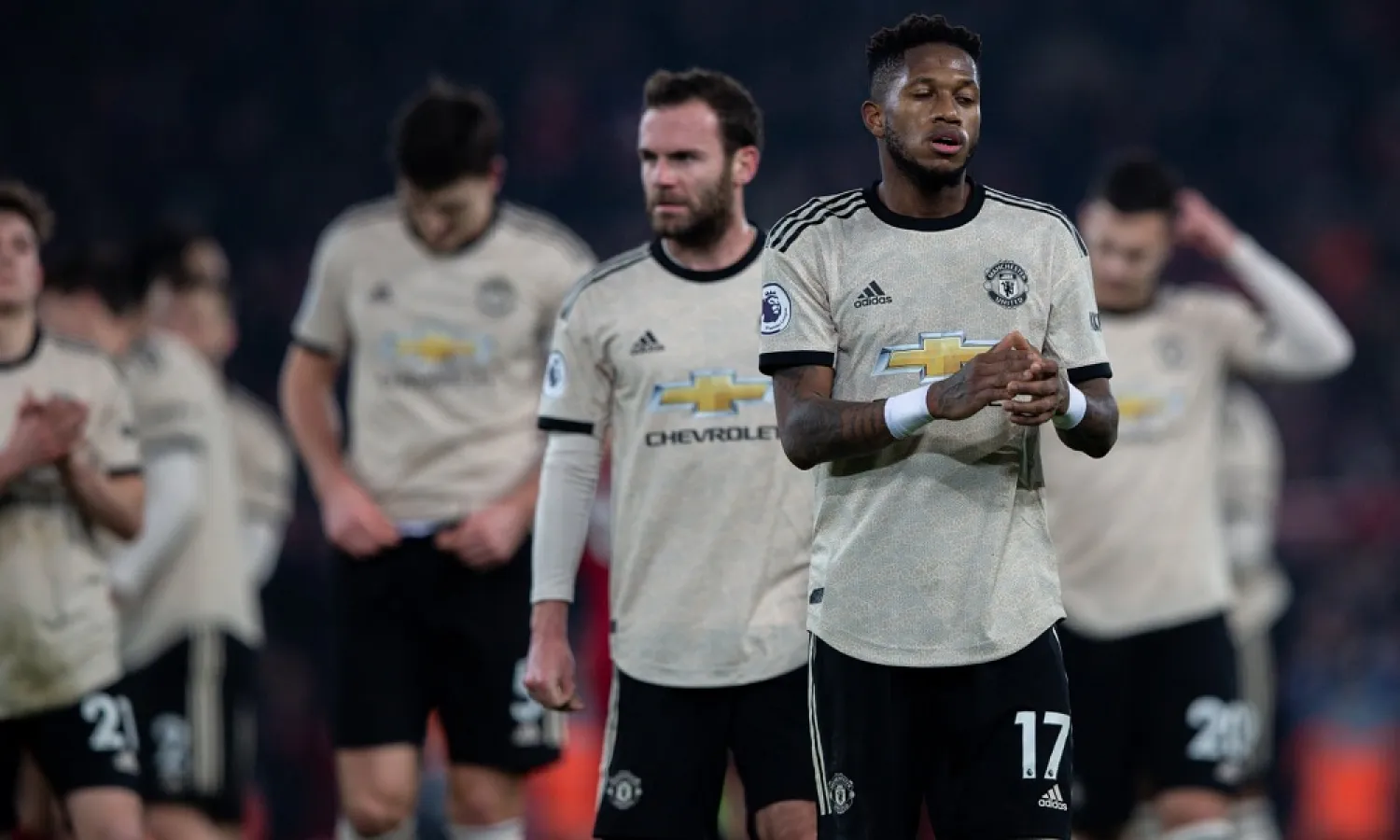

For Manchester United the Gulf to Liverpool is Cause for Major Concern

Manchester United players react after their Premier League defeat at Anfield. (Getty Images)
TT

For Manchester United the Gulf to Liverpool is Cause for Major Concern

Manchester United players react after their Premier League defeat at Anfield. (Getty Images)

Liverpool are brilliant. They are top of the league by 16 points with a game in hand and will probably have the title wrapped up by the end of March. And yet at the same time, while acknowledging how preposterous it is to offer any criticism of a side that has taken 67 points from 23 games this season, there must be a sense that of late they’ve become a little bit sloppy.

In their league games against Tottenham last week and then against Manchester United at Anfield on Sunday, they have come extremely close to drawing games they have dominated almost entirely. Giovani Lo Celso and Anthony Martial both missed extremely presentable chances to make it 1-1. In both games Liverpool ended up under pressure in the final 10 minutes – on Sunday at least until Mohamed Salah added a second on the break deep in injury time. Tottenham they had broadly held at arm’s length, in a performance of great control; United they had pummelled for roughly a third of each half. And yet in each two points could have slipped from their grasp.

Not that it really matters to Liverpool, of course, for anything other than the pursuit of records. At this stage their lead is unassailable and would be even if it were only 12 points. Perhaps that fallibility offers a note of caution before the Champions League knockouts, where a single goal carelessly conceded can have profound consequences. But actually the greater impact of the past two games may be for the losing sides. Those late rallies perhaps conjured the impression that all is not too far awry. But for United in particular, the gulf to Liverpool should be cause for major concern.

This was 2-0 going on 5-1. Liverpool’s opening goal may have come slightly against the run of play but, in the 20 minutes that followed, United were overwhelmed. It was the same story in the 12 minutes of the second half from kick-off to Fred’s chance. In both spells Liverpool were quicker, sharper, stronger and cleverer. In both they could have scored two or three times without it seeming outrageous. There were goals ruled out for marginal decisions, the woodwork was struck and Salah somehow scuffed wide from eight yards with the whole goal at which to aim. Without being anything like the best football they have played this season, that was the level Liverpool can reach when they put their foot down – and it was a level high above United’s capacity.

Injuries do not help, of course. United are without their two best central midfielders and their best forward. That would destabilize any side. But then Liverpool had been without their first-choice holding midfielder from the end of November until eight minutes from time on Sunday – and their response to that has been 11 clean sheets in 15 games (and two of the games when they conceded came within 24 hours of each other). Their first-choice goalkeeper missed 11 games with a calf injury. Good teams with well-constructed squads overcome misfortune; weaker ones wallow in it.

Ole Gunnar Solskjær is becoming a master of discovering filaments of silver lining in the bleakest of clouds. If football management does not work out for him, a job in forensic pathology surely awaits. Here he talked of how well Fred had played, how committed United had been, how they had fought back after the barrage at the beginning of the second half. None of which was untrue – and Fred’s form over the past couple of months is arguably the brightest aspect of this season for United.

But there is a bigger picture. This was not quite taking consolation from Manchester City having sufficient respect for United that they picked a strong team against them in the Carabao Cup but it was rhetoric of the mid-table manager trying to draw positives from an entirely predictable defeat against a much better side.

And that is where United stand – not in terms of resources or stadium or fanbase or cachet, of course, but in terms of form.

They may lie fifth in the Premier League and the gap to fourth and implausible Champions League qualification may be only five points but from their 34 points from 23 games one can extrapolate that to 56 for the season. That would have been enough for fifth in 2003-04 but every other season in the past 20 years it would leave United seventh, eighth or ninth. It is eight points fewer than they got in their first post-Ferguson season, when David Moyes was sacked four games from the end of the season.

There is an understandable willingness for Solskjær to succeed and the manager is not the only problem, perhaps not even the biggest problem, at Old Trafford. Patience, without question, is a rare virtue in football but it does not take much for the search for positives to become a hunt for excuses. United have just been well beaten by a Liverpool side 30 points ahead of them and the message seems to be that they should be grateful it was not worse. United are sleepwalking towards mediocrity: somebody, some time, is going to have to wake them up.

The Guardian Sport


Lebanese Army Chief Faces Labeling Dispute During Washington Visit

Lebanese Army Commander General Rodolphe Haykal during his visit to Washington (Lebanese Army Command)
TT

Lebanese Army Chief Faces Labeling Dispute During Washington Visit

Lebanese Army Commander General Rodolphe Haykal during his visit to Washington (Lebanese Army Command)

What was meant to be a routine visit by Lebanese Army Commander General Rodolphe Haykal to Washington to discuss military support and aid coordination turned into a political flashpoint, after a brief meeting with US Senator Lindsey Graham ignited a dispute over whether the army chief would describe Hezbollah as a “terrorist organization.”

The controversy was sparked by a brief meeting with hardline Republican Senator Lindsey Graham, who publicly said he cut the meeting short after Haykal declined to use the designation in what he called the “context of Lebanon.”

What happened in the Graham meeting

In a post on X, Graham said: “I just had a very brief meeting with the Lebanese Chief of Defense General Rodolphe Haykal. I asked him point blank if he believes Hezbollah is a terrorist organization. He said, “No, not in the context of Lebanon.” With that, I ended the meeting.”

“They are clearly a terrorist organization. Hezbollah has American blood on its hands. Just ask the US Marines,” he added.

“They have been designated as a foreign terrorist organization by both Republican and Democrat administrations since 1997 – for good reason.”

“As long as this attitude exists from the Lebanese Armed Forces, I don’t think we have a reliable partner in them.”

“I am tired of the double speak in the Middle East. Too much is at stake,” Graham concluded.

The reaction went beyond expressions of displeasure. Some US coverage suggested Graham effectively raised questions about the “usefulness” of continuing support for the Lebanese army if such a gap persists between the US position and Lebanon’s official language.

Haykal’s answer raises its cost in Washington

Inside Lebanon, the issue is not limited to the stance on Hezbollah. Still, it extends to the army’s role as a unifying institution in a country whose political balance rests on sectarian arrangements and deep sensitivities.

Adopting an external designation, even a US one, in official language by the head of the military could be interpreted domestically as a move that risks triggering political and sectarian division or drawing the army into confrontation with a component that has organized political and popular representation.

That explains why Lebanese voices, including some critics of Hezbollah, defended the logic that “the state does not adopt this classification.” Therefore, the army commander cannot formally do so.

In other words, Haykal sought to avoid two conflicting languages: Washington’s legal and political framing of Hezbollah, and the Lebanese state’s language, which walks a fine line between the demand for exclusive state control over arms and the avoidance of reproducing internal fractures.

US State Department position

Amid the controversy surrounding the Graham meeting, an official US position emerged on Tuesday through the US Embassy in Beirut, welcoming the visit and focusing on the core US message.

The statement said that “the Lebanese Armed Forces’ ongoing work to disarm non-state actors and reinforce national sovereignty as Lebanon’s security guarantor is more important than ever.”

The wording was notable because it separated two levels: continued US reliance on the army as a state institution, and, in practice, linking that reliance to the issue of disarming non-state actors.

The phrase avoids direct naming but, in the Lebanese context, is widely understood to refer primarily to Hezbollah.

The visit’s broader track

Despite the political awkwardness, Haykal’s visit was not reduced to a single meeting. He held senior-level military talks, including meetings with US Central Command chief Admiral Brad Cooper and Chairman of the Joint Chiefs of Staff General Dan Caine.

According to a statement from a Joint Chiefs spokesperson, the meeting “reaffirmed the importance of enduring US defense relationships in the Middle East.”

The visit coincided with broader discussions in Washington on support for the Lebanese army and plans to extend state authority, as international reports spoke of Lebanon entering new phases of a plan to dismantle illegal weapons structures in the south and north.

The army commander’s visit had initially been delayed for reasons that add another layer to understanding Washington’s sensitivity to the military’s language.

In November 2025, sources quoted the US State Department as saying Washington canceled scheduled meetings with the Lebanese army commander after objecting to an army statement on border tensions with Israel, prompting the visit to be postponed to avoid a pre-emptive political failure.


Egypt Steps Up Efforts to Support Gaza Administration Committee After Entry Stalled

Displaced Palestinians inspect the damage after Israeli aircraft targeted a five floor house last night, in Khan Younis southern Gaza Strip on February 6, 2026. (AFP)
TT

Egypt Steps Up Efforts to Support Gaza Administration Committee After Entry Stalled

Displaced Palestinians inspect the damage after Israeli aircraft targeted a five floor house last night, in Khan Younis southern Gaza Strip on February 6, 2026. (AFP)

Egypt is intensifying efforts to back the National Committee for the Administration of Gaza, hoping it can begin operating inside the enclave to implement commitments under the second phase of the ceasefire agreement, which started about two weeks ago but has yet to take shape on the ground.

Experts told Asharq Al-Awsat that those Egyptian efforts, through phone calls and meetings with international partners, are focused on two main objectives: pushing for the deployment of police forces and an international stabilization force on the one hand, and securing a gradual Israeli withdrawal on the other, increasing pressure on Israel to move the agreement forward.

A member of the administration committee said in a brief phone statement to Asharq Al-Awsat, speaking on condition of anonymity, that there is still no specific date for entering the enclave.

In the Slovenian capital, Ljubljana, Egyptian Foreign Minister Badr Abdelatty stressed Cairo’s full support for the work of the committee headed by Dr. Ali Shaath.

He made the remarks during a dialogue session of the Arab-Islamic committee on Gaza with Slovenian Foreign Minister Tanja Fajon.

The foreign ministers of Saudi Arabia, Jordan, and Bahrain attended the meeting. Abdelatty stressed the importance of the committee’s role in managing the daily affairs of Gaza’s residents and meeting their basic needs during the transitional phase.

He underscored the need to ensure the continued flow of humanitarian and relief aid into the enclave, as well as the formation and deployment of an international stabilization force to monitor the ceasefire.

Abdelatty reiterated his stance during a phone call on Friday with British Foreign Secretary Yvette Cooper.

The Gaza committee, established under the ceasefire agreement, operates under the supervision of the Board of Peace, chaired by US President Donald Trump. The committee has been holding meetings in Cairo since it was announced last month and has yet to enter Gaza.

Ahmed Fouad Anwar, a member of the Egyptian Council for Foreign Affairs and an academic specializing in Israeli affairs, said Egypt is making significant efforts to facilitate the committee’s mission as quickly as possible and enable it to operate.

He said this would limit Israeli obstacles, increase pressure on Israel, and place it under the obligations set out in the plan, particularly withdrawal from Gaza. This would counter intense pressure from Tel Aviv to accelerate the disarmament of Hamas without implementing its Gaza agreement commitments.

Palestinian political analyst Abdel Mahdi Motawea said Israel objected not only to the committee’s work but even to its emblem.

He noted, however, that Israel is not the only party hindering the committee. Hamas and other factions want to impose conditions on the committee’s work.

He warned of serious concerns that the committee could be marginalized, stressing that Egypt’s extensive efforts to support it are crucial at this critical stage of the Gaza agreement.

Hamas announced days ago that it was ready to hand over management of the enclave to the committee, while Israel continues to obstruct it.

Anwar expects the committee to begin operating in the enclave soon if Egypt’s efforts and those of international partners succeed and Washington responds positively.

He warned that the committee's failure would threaten the ceasefire agreement.


Gaza Deal Mediators Have Few Options on Hamas Disarmament

Hamas fighters in Gaza City. (AFP)
TT

Gaza Deal Mediators Have Few Options on Hamas Disarmament

Hamas fighters in Gaza City. (AFP)

Israel’s demand for the disarmament of Hamas has become the top priority since the second phase of the Gaza agreement began 10 days ago.

It exposed deep uncertainty over how such a step could be enforced amid firm resistance from the movement, which says it will not relinquish its weapons unless progress is made toward establishing a Palestinian state.

Analysts speaking to Asharq Al-Awsat said the issue has left mediators with minimal options, ranging from complete disarmament to freezing weapons, either by persuading Hamas or applying pressure.

The demand has become a political pressure tool that Israeli Prime Minister Benjamin Netanyahu and others in Israel are likely to use increasingly in the run-up to elections, they added.

Israeli opposition figure Benny Gantz, who is preparing for elections, called on Thursday in a post on X for the “disarmament of Hamas.”

Israeli Defense Minister Israel Katz said on Wednesday that Israel will dismantle Hamas if it does not agree to lay down its arms.

Netanyahu, following a meeting on Tuesday with US envoy Steve Witkoff, said he was insisting on the non-negotiable demand to disarm Hamas before any step toward rebuilding Gaza.

Military and strategic analyst Brig. Gen. Samir Ragheb said mediators have few options other than reaching understandings or exerting pressure, noting that the demand to disarm Hamas has been echoed by Israel, Washington, the EU, and donors, and has become an obstacle to ending the war and launching reconstruction.

He said Netanyahu and others would use the issue electorally and as a pretext to collapse the agreement at any time, adding that the second phase is filled with “landmines,” particularly those related to the Israeli withdrawal, which Netanyahu does not want to address.

Strategic and military expert Maj. Gen. Samir Farag said available options are now limited, suggesting that freezing weapons may be more likely than complete disarmament, mainly since Hamas’ arsenal does not consist of missiles or drones and could be handed over.

He said there is US and Israeli insistence on implementing the weapons clause, but that it must coincide with an Israeli withdrawal and guarantees to prevent a new war.

By contrast, sources in Hamas told Reuters on Wednesday that the group had agreed to discuss disarmament with other Palestinian factions, but that neither Washington nor regional mediators had presented it with any detailed or concrete proposal on disarmament.

Israel’s Channel 13 reported in late January that the US was preparing a document granting Hamas several weeks to hand over its weapons to multinational forces within a set timeframe. Failure to comply would give Israel the green light to “act as it sees fit,” the channel said.

Farag stressed that Hamas’ room for maneuver is extremely limited and that it must quickly reach understandings with mediators, particularly Egypt, Qatar, and Türkiye, to resolve what he described as the most significant obstacle currently being created by Israel.

Ragheb said Hamas has no option but to implement US President Donald Trump’s Gaza plan and the disarmament clause, warning against delaying or circumventing it, as “every day lost poses a threat to the ceasefire agreement.”

He added that police forces in the enclave would be deployed within days or weeks, along with a possible stabilization force, leaving little space for further maneuvering.
