


Palestinians Protest Trump Plan as Rockets Fired from Gaza and UN Warns of Escalation

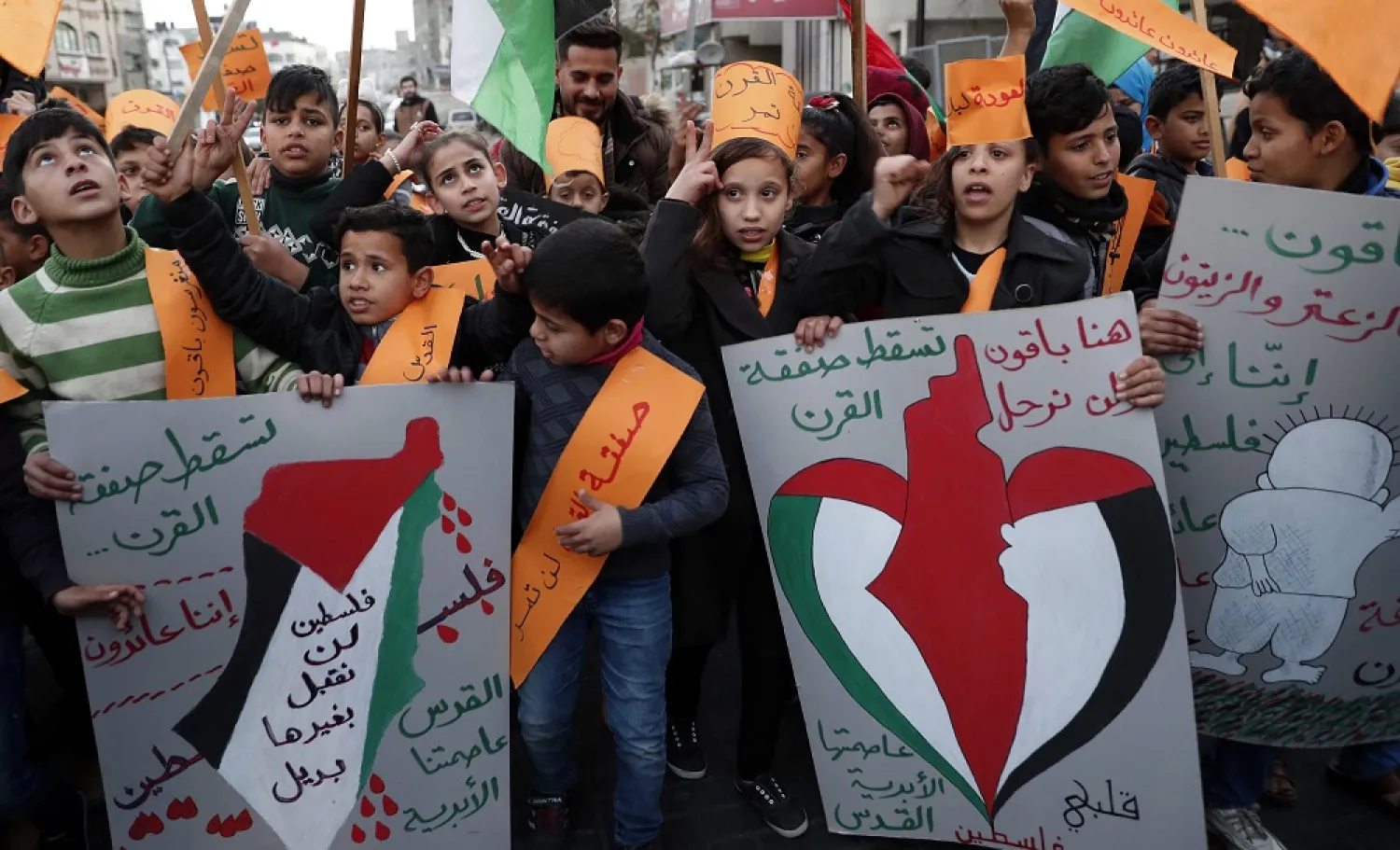
Protesters hold placards as others wave their national flags during a protest against Trump’s Middle East plan, at Jebaliya refugee camp, Gaza Strip, Jan. 30, 2020. (AP)
TT

Palestinians Protest Trump Plan as Rockets Fired from Gaza and UN Warns of Escalation

Protesters hold placards as others wave their national flags during a protest against Trump’s Middle East plan, at Jebaliya refugee camp, Gaza Strip, Jan. 30, 2020. (AP)

Palestinians held demonstrations across the region Friday to protest President Donald Trump's Middle East initiative, while in the Gaza Strip, rockets and mortar rounds were fired at Israel, drawing retaliatory strikes.

The Palestinians have rejected the Trump plan, which heavily favors Israel and would allow it to annex all of its Jewish settlements, along with the Jordan Valley, in the occupied West Bank. The Palestinians were offered limited self-rule in Gaza, parts of the West Bank and some sparsely populated areas of Israel in return for meeting a long list of conditions.

Israel launched airstrikes on targets in Gaza early Friday, shortly after Palestinians fired three rockets into Israel, two of which were intercepted, the military said.

It said Palestinian fighters had also launched “explosive balloons" toward Israel and that a sniper had shot an observational antenna. It said it struck targets linked to the Hamas movement in response, including “underground infrastructure used to manufacture weapons.”

Later on Friday, the military said Gaza fighters fired three mortar rounds. In response, an Israeli tank fired on a Hamas military post.

Hamas rejected the Trump plan and vowed that “all options are open” in responding to the proposal, but the group is not believed to be seeking another war with Israel.

Protests

Thousands of people took to the streets after Friday prayers in neighboring Jordan to protest the plan.

Jordan, a close US ally and key player in previous peace efforts, has warned Israel against annexing territory. Jordan and Egypt are the only two Arab countries to have signed peace agreements with Israel.

The protesters waved Jordanian and Palestinian flags and burned Israeli flags despite the rainy weather. They chanted “Here we are, al-Aqsa,” referring to a Jerusalem mosque on a site sacred to Muslims and Jews.

In Lebanon, dozens of Palestinians gathered in the crowded Bourj al-Barajneh refugee camp after Friday prayers, carrying Palestinian flags and pictures of the al-Aqsa mosque. They chanted “We would die for Palestine to live” and “Revolution until we set Palestine free."

“Palestine is not for sale, even if it were for millions upon millions. If (Trump) gave all of his money we wouldn't sell to him,” said 58-year-old Fatima al-Khatib.

The plan anticipates $50 billion of investment in the future Palestinian state and describes several ambitious development projects, without saying where the money would come from.

Palestinians in the West Bank and Gaza have held small, scattered protests in recent days condemning the Trump initiative, and thousands gathered in Gaza on Friday, where they burned US and Israeli flags and portraits of Trump and Israeli Prime Minister Benjamin Netanyahu.

At least 14 Palestinians were wounded by Israeli gunfire in scattered protests along the security fence surrounding Gaza, according to the Palestinian Red Crescent medical service.

There were concerns that larger demonstrations and clashes would break out at the compound housing the al-Aqsa mosque, but Friday prayers there concluded peacefully. The Islamic trust that manages the site said an estimated 30,000 worshippers attended the weekly prayers.

The site, known to Muslims as the Haram al-Sharif, or Noble Sanctuary, is the third holiest in Islam, after Makkah and Madinah in Saudi Arabia.

Trump's Middle East plan would situate the Palestinian capital on the outskirts of east Jerusalem, beyond the separation barrier built by Israel. The rest of Jerusalem, including the Old City, would remain Israel's capital.

State of shock

“A lot of people are still in a state of shock over the proposal," said Christian Saunders, the acting head of the UN agency for Palestinian refugees, which provides basic services to some 5 million Palestinians scattered across the region.

"What will happen after that shock wears off, I don’t know. We certainly have serious concerns that it will result in an escalation in clashes and in violence. We have contingency plans in place in order to support during such times of unrest.”

Saunders was in Geneva to launch an appeal to donors to fund UNRWA's 2020 budget to the tune of $1.4 billion towards essential services and assistance for 5.6 million Palestinian refugees across the Middle East.

UNRWA has faced a severe funding crunch ever since Trump in 2018 decided to suspend, then yank entirely the US contribution to the agency's budget, robbing it of its top donor.

Trump's administration, along with Israel, accuses UNRWA of perpetuating the Israeli-Palestinian conflict.

The agency disputes that and says the services it provides would otherwise not be available to Palestinians.

After the US withdrew funding, a range of other countries stepped up support and UNRWA actually entered 2019 with a surplus of about $60 million, Saunders said.

"Unfortunately ... this initial support started to wane, and as a result we have been forced to carry over considerable liabilities into 2020," he said.

"We are stretched to our limits."

He lamented that UNRWA was facing a concerted campaign of misinformation by critics trying to convince parliamentarians in Europe especially not to fund the agency.

The agency was set up in the years after more than 700,000 Palestinians were expelled or fled their lands during the 1948 war surrounding the creation of Israel.

It provides schooling and medical services to refugees in Jordan, Lebanon and Syria as well as the Palestinian territories, and employs around 30,000 people, mostly Palestinians.



Lifting of US Sanctions on Syria Could Spur Refugee Returns, Says UN Official

People sit after receiving bread from Ecir Kapici, Turkish humanitarian NGO at Al-Yarmouk Palestinian refugee camp, after Syria's Bashar Al-Assad was ousted, in Damascus, Syria, December 20 , 2024. (Reuters)
TT

Lifting of US Sanctions on Syria Could Spur Refugee Returns, Says UN Official

People sit after receiving bread from Ecir Kapici, Turkish humanitarian NGO at Al-Yarmouk Palestinian refugee camp, after Syria's Bashar Al-Assad was ousted, in Damascus, Syria, December 20 , 2024. (Reuters)

The head of the UN refugee agency in Lebanon said Thursday that the move by the United States to lift sweeping sanctions on Syria could encourage more refugees to return to their country.

The US Senate voted Wednesday to permanently remove the so-called Caesar Act sanctions after the administration of President Donald Trump previously temporarily lifted the penalties by executive order. The vote came as part of the passage of the country's annual defense spending bill. Trump is expected to sign off on the final repeal Thursday.

An estimated 400,000 Syrian refugees have returned from Lebanon since the ouster of former Syrian President Bashar Assad in December 2024 following a nearly 14-year civil war, UNHCR Lebanon Representative Karolina Lindholm Billing said, with around 1 million remaining in the country. Of those, about 636,000 are officially registered with the refugee agency.

The UN refugee agency reports that altogether more than 1 million refugees and nearly 2 million internally displaced Syrians have returned to their homes since Assad’s fall.

Refugees returning from neighboring countries are eligible for cash payments of $600 per family upon their return, but with many coming back to destroyed houses and no work opportunities, the cash does not go far. Without jobs and reconstruction, many may leave again.

The aid provided so far by international organizations to help Syrians begin to rebuild has been on a “relatively small scale compared to the immense needs,” Billing said, but the lifting of US sanctions could “make a big difference.”

The World Bank estimates it will cost $216 billion to rebuild the homes and infrastructure damaged and destroyed in Syria's civil war.

“So what is needed now is big money in terms of reconstruction and private sector investments in Syria that will create jobs,” which the lifting of sanctions could encourage, Billing said.

Lawmakers imposed the wide-reaching Caesar Act sanctions on Syria in 2019 to punish Assad for human rights abuses during the country’s civil war.

Despite the temporary lifting of the sanctions by executive order, there has been little movement on reconstruction. Advocates of a permanent repeal argued that international companies are unlikely to invest in projects needed for the country’s rebuilding as long as there is a threat of sanctions returning.

New refugees face difficulties While there has been a steady flow of returnees over the past year, other Syrians have fled the country since Assad was ousted by Islamist-led insurgents. Many of them are members of religious minorities fearful of being targeted by the new authorities — particularly members of the Alawite sect to which Assad belonged and Shiites fearful of being targeted in revenge attacks because of the support provided to Assad during the war by Iran and the Lebanese militant group Hezbollah.

Hundreds of Alawite civilians were killed in outbreaks of sectarian violence on Syria’s coast in March.

While the situation has calmed since then, Alawites continue to report sporadic sectarian attacks, including incidents of kidnapping and sexual assault of women.

About 112,000 Syrians have fled to Lebanon since Assad’s fall, Billing said. Coming at a time of shrinking international aid, the new refugees have received very little assistance and generally do not have legal status in the country.

“Their main need, one of the things they raise with us all the time, is documentation because they have no paper to prove that they are in Lebanon, which makes it difficult for them to move around,” Billing said.

While some have returned to Syria after the situation calmed in their areas, she said, “Many are very afraid of being returned to Syria because what they fled were very violent events.”


Israel Launches Intense Airstrikes in Lebanon as Deadline Looms to Disarm Hezbollah

TOPSHOT - Smoke rises from the site of a series of Israeli airstrikes that targeted the outskirts of the southern Lebanese village of al-Katrani on December 18, 2025.  (Photo by Rabih DAHER / AFP)
TOPSHOT - Smoke rises from the site of a series of Israeli airstrikes that targeted the outskirts of the southern Lebanese village of al-Katrani on December 18, 2025. (Photo by Rabih DAHER / AFP)
TT

Israel Launches Intense Airstrikes in Lebanon as Deadline Looms to Disarm Hezbollah

TOPSHOT - Smoke rises from the site of a series of Israeli airstrikes that targeted the outskirts of the southern Lebanese village of al-Katrani on December 18, 2025.  (Photo by Rabih DAHER / AFP)
TOPSHOT - Smoke rises from the site of a series of Israeli airstrikes that targeted the outskirts of the southern Lebanese village of al-Katrani on December 18, 2025. (Photo by Rabih DAHER / AFP)

Israel carried out a series of airstrikes on southern and northeastern Lebanon on Thursday as a deadline looms to disarm the militant Hezbollah group along the tense frontier.

The strikes came a day before a meeting of the committee monitoring the enforcement of a US-brokered ceasefire that halted the latest war between Israel and Hezbollah a year ago.

It will be the second meeting of the mechanism after Israel and Lebanon appointed civilian members to a previously military-only committee. The group also includes the US, France and the UN peacekeeping force deployed along the border.

In Paris, Lebanon’s army commander Gen. Rodolphe Haykal is scheduled to meet on Thursday with US, French and Saudi officials to discuss ways of assisting the army in its mission to boost its presence in the border area.

The Lebanese government has said that the army should have cleared all the border area south of the Litani river from Hezbollah’s armed presence by the end of the year.

The Israeli military said the strikes hit Hezbollah infrastructure sites and launching sites in a military compound used by the group to conduct training and courses for its fighters. The Israeli military added that it struck several Hezbollah military structures in which weapons were stored, and from which Hezbollah members operated recently.

Lebanon’s state-run National News Agency said the intense airstrikes stretched from areas in Mount Rihan in the south to the northeastern Hermel region that borders Syria.

Shortly afterward, a drone strike on a car near the southern town of Taybeh inflicted casualties, NNA said.

“This is an Israeli message to the Paris meeting aiming to support the Lebanese army,” Parliament Speaker Nabih Berri said about the strikes.

“The fire belt of Israeli airstrikes is to honor the mechanism’s meeting tomorrow,” Berri added during a parliament meeting in Beirut.

The latest Israel-Hezbollah war began Oct. 8, 2023, a day after Hamas attacked southern Israel, after Hezbollah fired rockets into Israel in solidarity with Hamas. Israel launched a widespread bombardment of Lebanon in September last year that severely weakened Hezbollah, followed by a ground invasion.

Israel has carried out almost daily airstrikes since then, mainly targeting Hezbollah members but also killing 127 civilians, according to the office of the UN High Commissioner for Human Rights.

Over the past weeks, the US has increased pressure on Lebanon to work harder on disarming Hezbollah.


UN: Over 1,000 Civilians Killed in Sudan's Darfur when Paramilitary Group Seized Camp

The Sudanese flag flutters in Omdurman, part of greater Khartoum on December 13, 2025. (AFP)
TT

UN: Over 1,000 Civilians Killed in Sudan's Darfur when Paramilitary Group Seized Camp

The Sudanese flag flutters in Omdurman, part of greater Khartoum on December 13, 2025. (AFP)

Over 1,000 civilians were killed when a Sudanese paramilitary group took over a displacement camp in Sudan's Darfur region in April, including about a third who were summarily executed, according to a report by the UN Human Rights Office on Thursday.

"Such deliberate killing of civilians or persons hors de combat may constitute the war crime of murder,” said the UN High Commissioner for Human Rights Volker Turk in a statement accompanying the 18-page report.

The Zamzam camp in Sudan's western region of Darfur housed around half a million people displaced by the civil war and was taken over by Rapid Support Forces between April 11-13.