


Libyan National Army: Turkey Building Secret Military Base in Tripoli’s Mitiga Airport

A convoy vehicle is seen after reopening of the Mitiga airport in Tripoli, Libya October 29, 2019. (Reuters)
TT

Libyan National Army: Turkey Building Secret Military Base in Tripoli’s Mitiga Airport

A convoy vehicle is seen after reopening of the Mitiga airport in Tripoli, Libya October 29, 2019. (Reuters)

Turkey has started building a military base inside Mitiga International Airport in the Libyan capital, Tripoli, an informed source revealed.

The source told Asharq Al-Awsat that Turkish military and intelligence officials were present at the base.

Mitiga is the only functional airport in western Libya. Fighting forced the closure of Tripoli International Airport in 2014 and it has been shut ever since.

Speaking on condition of anonymity, the source said Ankara is planning to bolster its military presence in Libya through a secret military base. Turkish officers are also assisting at the operations command center affiliated with militias that are loyal to the Government of National Accord (GNA).

The source’s comments coincided with reports that said Turkey was seeking to bring in more mercenaries and fighters from Kenya and Somalia to back the GNA.

Meanwhile, Libyan National Army (LNA) spokesman Ahmed al-Mismari released on Thursday video footage from inside a Turkish vessel that had unloaded modern weapons and military equipment at Tripoli port on Tuesday night.

Mismari deemed the development a Turkish “invasion” that violates all international laws and norms, as well as the ceasefire in the western region.

The spokesman also released photos of the military shipment.

France's Charles de Gaulle aircraft carrier this week spotted a Turkish frigate escorting a cargo ship delivering armored vehicles to Tripoli in defiance of a UN embargo, a French military source said Thursday, according to AFP.

The cargo ship Bana, sailing under a Lebanese flag, docked in Tripoli port on Wednesday, said the source, who asked not to be named.

According to the Marine Traffic specialist website, the vessel was recorded Thursday off the coast of Sicily.

The claim came a day after President Emmanuel Macron accused his Turkish counterpart Recep Tayyip Erdogan of failing "to keep his word" to end meddling in the north African country.

Specifically, Macron said Turkish ships had in recent days been seen taking ships laden with pro-Ankara Syrian mercenaries to Libya.

Meanwhile, United Nations envoy to Libya Ghassan Salame was set to meet with LNA commander Khlifa Haftar in the eastern city of Benghazi to persuade him to join the ten-member committee that would oversee the fragile truce in Libya.

The formation of the committee was agreed during last month’s Berlin conference. It will be comprised of five members from each of the LNA and GNA.

The committee is set to meet in Geneva on Tuesday, but that has been put to doubt over Haftar’s failure to name his candidates to the body.



Al-Alimi Launches ‘Yemen Dawn’ Operation to Retake Sanaa, End Houthi Rule

Yemeni President Rashad al-Alimi addresses the nation in a televised address in Riyadh, Saudi Arabia October 4, 2026. Yemen News Agency/Handout via REUTERS
TT

Al-Alimi Launches ‘Yemen Dawn’ Operation to Retake Sanaa, End Houthi Rule

Yemeni President Rashad al-Alimi addresses the nation in a televised address in Riyadh, Saudi Arabia October 4, 2026. Yemen News Agency/Handout via REUTERS

Yemeni Presidential Leadership Council Chairman Rashad al-Alimi announced on Monday the launch of a military operation dubbed Yemen Dawn aimed at restoring state institutions, retaking the capital Sanaa and ending the Iran-backed Houthi militia’s control.

In a post on X, al-Alimi said the operation would advance with the support of Yemen’s armed forces and military formations, as well as backing from allies and partners. He said Yemen was moving toward a new era of freedom, peace and stability.

The announcement came hours after the Coalition to Support Legitimacy in Yemen said it was providing full operational support to Yemeni forces and would continue backing the government until state institutions were restored and the Houthi militia’s threat to freedom of maritime navigation was ended.

On Sunday, al-Alimi had said that the government had turned to military action after exhausting peace efforts, while stressing that the campaign was not aimed at civilians and that authorities would protect civilians and property and reject retaliation.


Israel Extends ‘Sufa 53’ Project in Southern Quneitra, Seizing Farmland

Israeli soldiers during a reconnaissance operation in the occupied Syrian Golan Heights (File photo - Reuters) 
TT

Israel Extends ‘Sufa 53’ Project in Southern Quneitra, Seizing Farmland

Israeli soldiers during a reconnaissance operation in the occupied Syrian Golan Heights (File photo - Reuters) 

Israeli forces began work Monday on the “Sufa 53” line in the southern countryside of Syria’s Quneitra province, within the Syrian buffer zone bordering the occupied Golan Heights, after completing the project in the northern and central sectors and seizing thousands of dunams of farmland.

The move comes amid an escalation in Israeli attacks, incursions and violations of Syrian territory in Quneitra and Daraa provinces overlooking the ceasefire line. Such operations have intensified and become almost daily since the fall of the former government in late 2024.

A government source in southern Quneitra said Israeli military vehicles began excavation work west of al-Asha village, near al-Rafid, and at what is known as “Point 80,” belonging to the United Nations Disengagement Observer Force (UNDOF), which monitors the ceasefire line with Israel.

The work is part of efforts to complete Sufa 53 project, the source told Asharq Al-Awsat.

The source estimated that implementing the project in southern Quneitra, home to numerous villages including al-Muallaqa, al-Mushayda, al-Zaaroura, al-Ramthaniyah, al-Razaniyah, Abu Madhra, Ain al-Qadi and al-Asha, would result in Israel seizing more than 1,000 dunams of residents’ farmland, cutting off their source of livelihood.

Syria’s Foreign Ministry on Sunday condemned continuing Israeli violations of Syrian territory, most recently the work on Sufa 53, calling it a breach of the 1974 Disengagement of Forces Agreement and international resolutions.

It warned that continued Israeli attacks and ground incursions posed a direct threat to regional security and stability and undermined international law. The ministry called for international measures to halt such actions and reaffirmed Syria’s right to exercise full sovereignty over all its territory.

Sufa 53 project

Work on the Sufa 53 project in southern Quneitra follows Israel’s completion of the project in the province’s northern and central sectors in November 2022.

Local sources said the project resulted in the seizure of 4,000 dunams of residents’ land in Bir Ajam and the villages of Ruwayhinah, Zubayda and Bariqa in central Quneitra, while between 8,000 and 10,000 dunams were seized from Jubata al-Khashab alone in the north.

Mohammed al-Saeed, director of Quneitra’s media directorate, told Asharq Al-Awsat that Israel was seeking through Sufa 53 to impose a new reality and alter the geographical and security features of the Syrian buffer zone bordering the disengagement line.

Al-Saeed said the escalation in southern Syria was “not exceptional,” noting that Israeli incursions and violations had intensified since Syria was freed from the former government nearly two years ago. He suggested the latest escalation could be linked to upcoming Israeli elections, an effort to establish new facts on the ground, or an attempt to change the rules of engagement in order to alter the terms of negotiations and the 1974 agreement.

Israel began implementing Sufa 53 inside the Syrian buffer zone in mid-2022. Running alongside the disengagement line, the 70-kilometer (43-mile) route stretches from the outskirts of Hader through Jubata al-Khashab, al-Hamidiyah, al-Qahtaniyah, Ruwayhinah, Bir Ajam and Bariqa to al-Asha and the Yarmouk Basin in western Daraa.

The project involves an eight-meter-wide road fortified with five-meter-high earthen berms and equipped with observation posts and trenches along its route, ostensibly to prevent potential threats from Iran and its regional proxies, according to Israeli media reports.

A Quneitra-based journalist, who requested anonymity for security reasons, told Asharq Al-Awsat that completing Sufa 53 around al-Rafid was part of Israel’s continuing violations since the fall of the former government and was aimed at increasing pressure on Damascus to sign a security agreement based on Israel’s vision and eventually overlook the issue of the occupied Golan Heights.

The journalist added that the project would also restrict local residents by denying livestock herders access to grazing land and farmers access to their fields, as part of what he described as a policy aimed at depopulating the area.


Egypt Seeks Regional, International Support for Political Solution in Sudan

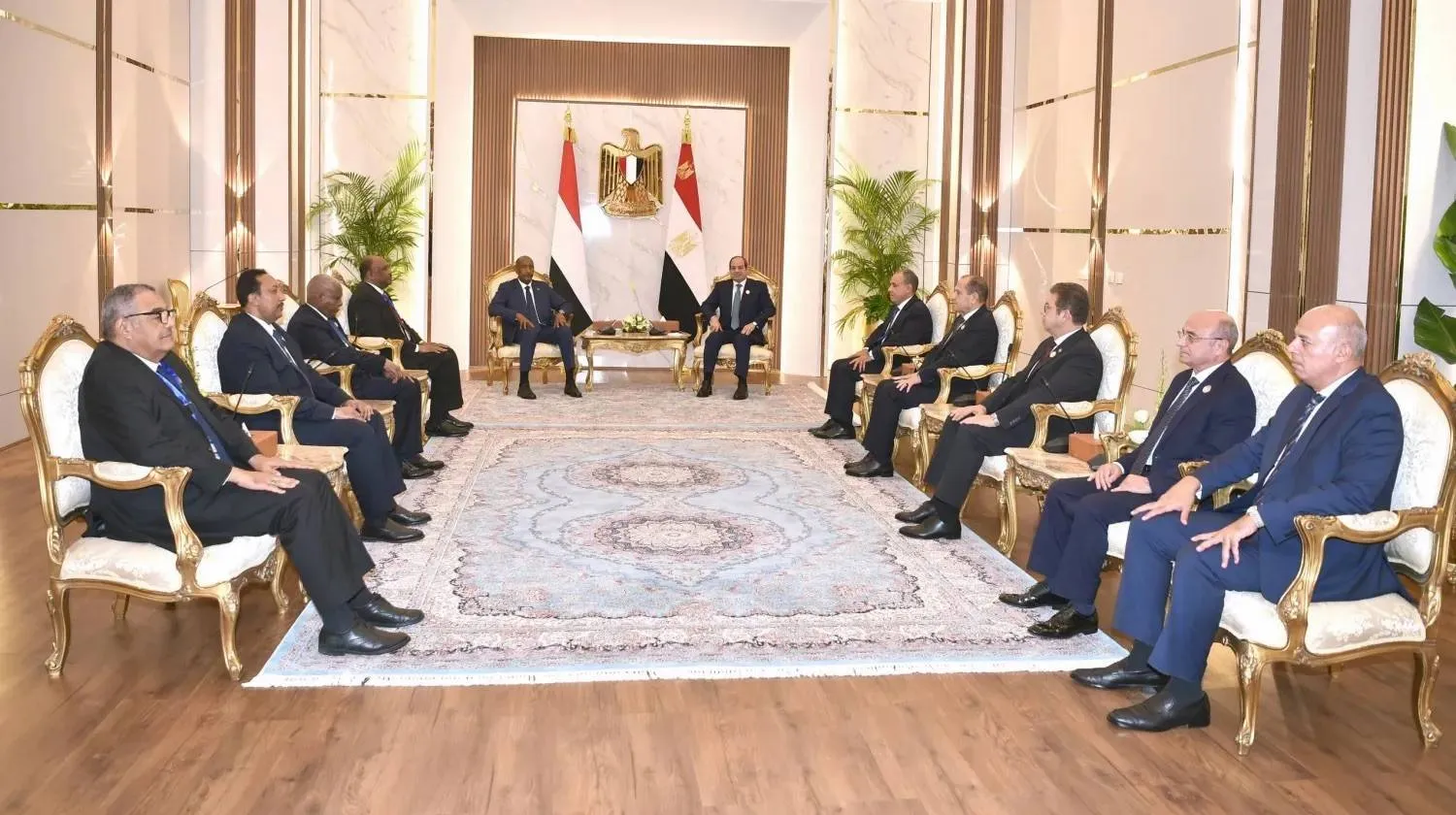
Egyptian President Abdel Fattah al-Sisi meets with Sudanese Sovereign Council Chairman Abdel Fattah al-Burhan in New Alamein. (Egyptian Presidency) 
TT

Egypt Seeks Regional, International Support for Political Solution in Sudan

Egyptian President Abdel Fattah al-Sisi meets with Sudanese Sovereign Council Chairman Abdel Fattah al-Burhan in New Alamein. (Egyptian Presidency) 

Egypt is seeking stronger regional and international efforts to advance a political solution to the war in Sudan, saying an end to the conflict is essential to easing the suffering of the Sudanese people and restoring stability.

Egyptian President Abdel Fattah al-Sisi reiterated that position during talks with General Abdel Fattah al-Burhan, chairman of Sudan’s Transitional Sovereign Council, on the sidelines of the 8th African Union Mid-Year Coordination Meeting.

Al-Sisi stressed the need to “exert all efforts at the regional and international levels to advance a political solution to the internal war,” while reaffirming his country’s longstanding support for Sudan and its people, according to the Egyptian presidency.

Since fighting erupted in mid-April 2023, Cairo has backed Sudan’s legitimate state institutions, foremost among them the army, while pressing for an end to the war and an inclusive political process bringing together the various components of Sudanese society.

During the meeting, al-Sisi pledged to continue Egypt’s regional and international efforts to promote a political settlement that could end the fighting and alleviate the humanitarian crisis. Such a solution, he noted, would allow Sudan to regain security and stability and begin the process of reconstruction and development.

Egypt has been involved in several diplomatic initiatives since the war began. It backed the Jeddah talks between the Sudanese army and the Rapid Support Forces (RSF) and, in July 2023, hosted a summit of Sudan’s neighboring countries aimed at advancing political solutions to the crisis.

A year later, Cairo hosted Sudanese political forces for talks aimed at developing a road map for an intra-Sudanese dialogue and overcoming the country’s internal divisions.

Al-Burhan, for his part, praised Egypt’s support for Sudan, including its political and humanitarian assistance and its hosting of large numbers of Sudanese forced to flee the war.

About 1.2 million Sudanese have fled to Egyptian cities because of the conflict, according to official figures, joining thousands of others who had already been living in the country for years.

Turning to prospects for a political settlement, al-Burhan stressed that Sudan’s legitimate state institutions should not be equated with “rebel militias or parallel entities,” and praised Egypt’s “clear and consistent” position on the issue.

Egypt considers the RSF an “armed militia” and has repeatedly rejected accusations that it is intervening in Sudan’s internal conflict.

The talks also covered bilateral ties, with al-Sisi reaffirming Egypt’s commitment to supporting Sudanese citizens in various fields and expanding cooperation between the two countries to serve their shared interests and development goals.

Cooperation on Sudan’s eventual reconstruction has also featured in recent bilateral discussions.

A joint statement issued after talks between Egyptian Prime Minister Mostafa Madbouly and his Sudanese counterpart Kamil Idris in February said Cairo had welcomed Khartoum’s request to draw on Egyptian expertise in establishing a new administrative city.

The project would be modeled on Egypt’s experience in the field and form part of efforts to support Sudan’s reconstruction, the statement said.