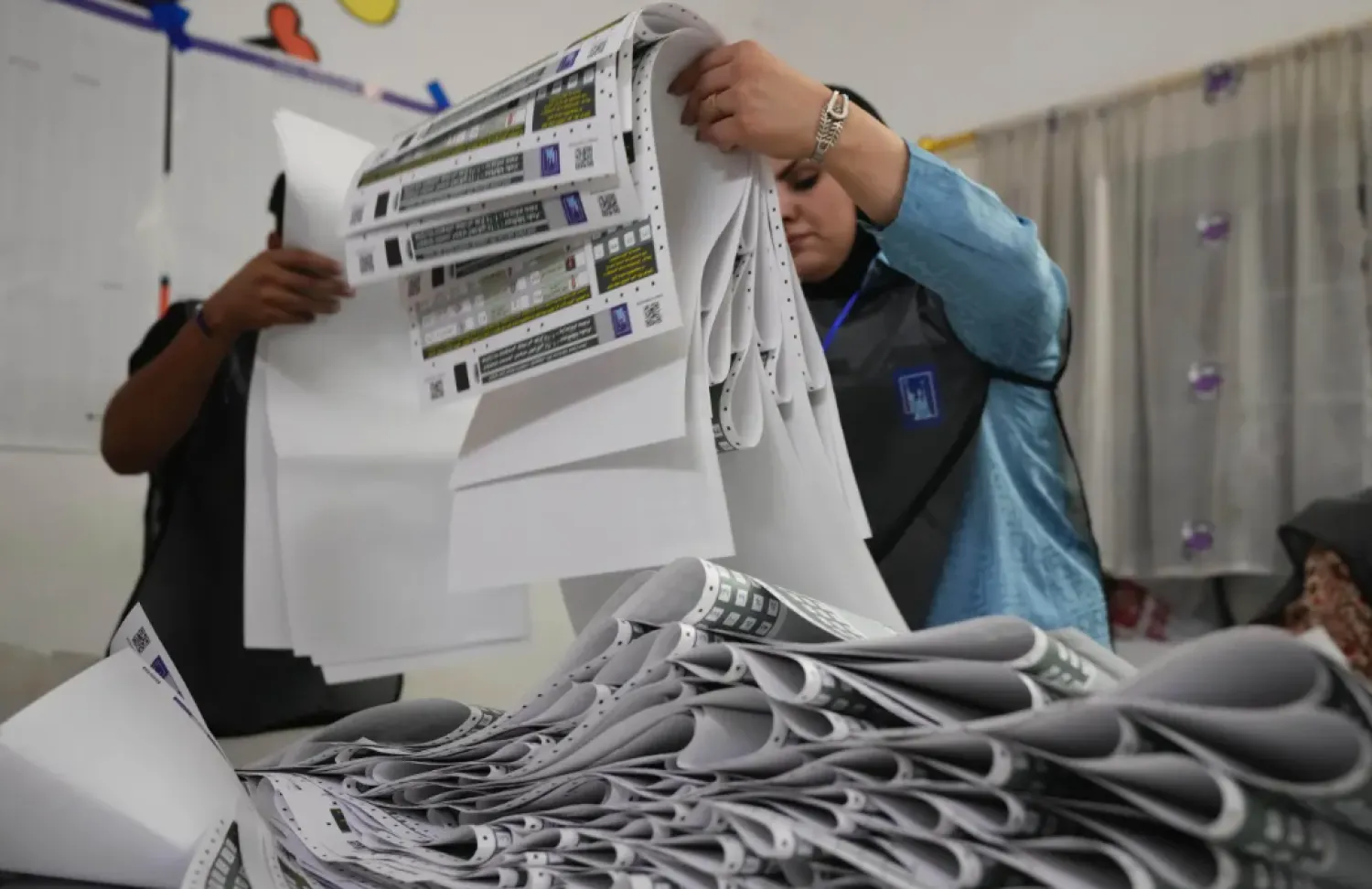
Iraq's Election Result Ratified by Supreme Federal Court as Premiership Remains up for Grabs

Election workers gather parliamentary election ballots after the polls closed in Baghdad, Iraq, Nov. 11, 2025. (AP Photo/Hadi Mizban, File)
TT

Iraq's Election Result Ratified by Supreme Federal Court as Premiership Remains up for Grabs

Election workers gather parliamentary election ballots after the polls closed in Baghdad, Iraq, Nov. 11, 2025. (AP Photo/Hadi Mizban, File)

The result of last month’s parliamentary elections in Iraq was ratified by the Supreme Federal Court on Sunday, confirming that the party of caretaker prime minister Mohammed Shia al-Sudani won the largest number of seats — but not enough to assure him a second term.

The court confirmed that the voting process met all constitutional and legal requirements and had no irregularities affecting its validity.

The Independent High Electoral Commission submitted the final results of the legislative elections to the Supreme Federal Court on Monday for official certification after resolving 853 complaints submitted regarding the election results, according to The AP news.

Al-Sudani's Reconstruction and Development Coalition won 46 seats in the 329-seat parliament. However, in past elections in Iraq, the bloc taking the largest number of seats has often been unable to impose its preferred candidate.

The coalition led by former Prime Minister Nouri al-Maliki won 29 seats, the Sadiqoun Bloc, which is led by the leader of the Asaib Ahl al-Haq militia, Qais al-Khazali, won 28 seats, and the Kurdistan Democratic Party, led by Masoud Barzani, one of the two main Kurdish parties in the country, won 27 seats.

The Taqaddum (Progress) party of ousted former Parliament Speaker Mohammed al-Halbousi also won 27 seats, setting the stage for a contest over the speaker's role.


Will Libya’s Haftar Sever Alleged Association with Sudan’s RSF? 

LNA commander Khalifa Haftar meets with Egypt’s chief of intelligence Hassan Rashad on Sunday. (LNA General Command)
TT

Will Libya’s Haftar Sever Alleged Association with Sudan’s RSF? 

LNA commander Khalifa Haftar meets with Egypt’s chief of intelligence Hassan Rashad on Sunday. (LNA General Command)

Senior Egyptian officials have been flocking to eastern Libya, the stronghold of the Libyan National Army (LNA), in what observers have said was increasing alarm in Cairo over the LNA’s support to Sudan’s paramilitary Rapid Support Forces (RSF).

The officials have sought to persuade LNA commander Khalifa Haftar to end support to the RSF, which is pitted against the Sudanese army in a civil war that erupted in April 2023 over a power struggle during the country’s transition to democratic rule. Egypt is concerned that the fallout of the conflict in Sudan will impact its own national security.

Egyptian intelligence chief Hassan Rashad was the latest official to visit Libya’s Benghazi on Sunday. He was welcomed by Haftar’s son Khaled, who is the LNA chief of staff.

In a brief statement, the LNA said Rashad’s meeting with Haftar “discussed local and regional developments. They underlined the importance of maintaining communication and coordination to serve the common interests of their countries.”

Days earlier, Chief of Staff of the Egyptian Armed Forces Ahmed Khalifa also visited Benghazi.

Cairo has previously said that the violation of Sudan’s unity was a “red line”. Observers say that this red line demands that Khalifa Haftar align his stances with Egypt when it comes to Sudan.

Recent international reports have published satellite images that show noticeable RSF military activity in the southern Libya desert. The LNA has also been accused of providing the RSF with logistic support.

The LNA often dismisses such accusations.

A former military official from western Libya said Haftar needs to sever his ties with the RSF.

Libyan political analyst Hussam Al-Fnish said: “The issue of providing support to the RSF has become a burden given the geo-security vacuum in Libya.”

“The vacuum is being exploited by several parties to pursue their own agendas,” he told Asharq Al-Awsat.

“Greater cooperation and coordination with Haftar and his son” are needed to address the situation, he added.

Khaled Haftar has previously suggested that securing the border should be shouldered by authorities in eastern and western Libya in coordination with the Tripoli-based Government of National Unity, Fnish remarked.

Libyan military expert Adel Abdulkafi said the alleged ties between Haftar and the RSF “definitely harm Egypt’s national security.”

The frequent visits by Egyptian officials to eastern Libya are aimed at pressuring Khalifa Haftar to end his support to the RSF, he told Asharq Al-Awsat.

They are also seeking to greater secure the porous border through which supplies are being sent to the RSF, he added.

Abdelkafi predicted that Haftar will sever his ties with the RSF if he comes under enough Egyptian and Turkish pressure.

Reuters had reported in December that a remote airstrip in southeastern Libya helped “reshape Sudan's civil war by providing a lifeline to the RSF”, according to more than a dozen military, intelligence and diplomatic officials.

“Military supplies sent via the airstrip in Kufrah, about 300 km from Sudan's border, helped the RSF revive its fortunes after the Sudanese army retook the capital Khartoum in March,” the officials said.

“The supply route was central to the RSF’s brutal capture of the city of el-Fashir in October, which allowed the paramilitary group to consolidate its control over Darfur and preceded a series of victories in Sudan’s south,” said the report.

A former eastern Libya military source said the LNA’s backing of the RSF is tied to international interests.

Speaking to Asharq Al-Awsat on condition of anonymity, he stressed that the “LNA has no strategic interest in supporting the RSF against the Sudanese army.”

“Such separatist actions primarily harm Libya’s unity and stability,” he warned.

Justin Lynch, managing director of the Conflict Insights Group analysis firm, said he identified at least 105 cargo plane landings at Kufrah between April 1 and November 1 by correlating satellite images with flight tracking data, continued the Reuters report. Reuters was not able to confirm his figure independently.

Sudan's army has repeatedly accused the RSF of securing military cargoes via Libya and in September submitted a complaint to the United Nations that alleged Colombian mercenaries had traveled via Kufrah to support the RSF.

To determine the scale of the Kufrah operation, Reuters spoke to 18 diplomatic, military, intelligence and other officials from Western and African countries, and 14 experts on regional and military affairs.

The former security source said: “There are international and Arab countries that are pushing the LNA command to deliver supplies to the RSF.”

Since the eruption of the war in Sudan, the LNA has denied involvement in the conflict, saying it stands at an equal distance from all parties, the source told Asharq Al-Awsat.

Egypt and Libya have often had intense military and security coordination, especially with Haftar, aimed at supporting stability in Libya, confronting terrorist threats and cross-border crime and securing their joint border.


Italy Says It Stands Ready to Train Police in Gaza

Italy's Minister for Foreign Affairs Antonio Tajani speaks to the press during the EPP Leaders’ meeting, in Zagreb, Croatia, 30 January 2026. (EPA)
TT

Italy Says It Stands Ready to Train Police in Gaza

Italy's Minister for Foreign Affairs Antonio Tajani speaks to the press during the EPP Leaders’ meeting, in Zagreb, Croatia, 30 January 2026. (EPA)

Italy stands ready to help train police forces in Gaza and elsewhere in the Palestinian territories, its foreign minister said on Monday, as ‌Rome aims to ‌play a ‌role ⁠in stabilizing the ⁠Middle East.

"We are ready to train a new Gaza police force, and we ⁠are also ready to ‌train ‌a Palestinian police ‌force," Foreign Minister Antonio ‌Tajani told a news conference in Rome.

He confirmed that Rome ‌was ready to participate as an observer ⁠in ⁠US President Donald Trump's Board of Peace initiative, and Italy had been invited to attend a meeting of the group this week in Washington.


Lebanon Says Army to Take at Least 4 Months for Next Stage of Hezbollah Disarmament Plan 

A damaged excavator sits on the rubble of a building that was hit in January by an Israeli strike in the southern Lebanese village of Qannarit, on February 16, 2026. (AFP)
TT

Lebanon Says Army to Take at Least 4 Months for Next Stage of Hezbollah Disarmament Plan 

A damaged excavator sits on the rubble of a building that was hit in January by an Israeli strike in the southern Lebanese village of Qannarit, on February 16, 2026. (AFP)

Lebanon's government said Monday that the army would need at least four months to implement the second phase of the military's plan to disarm Hezbollah in the country's south.

Lebanon's government last year committed to disarming Iran-backed Hezbollah, which was badly weakened in a recent war with Israel, and tasked the army with drawing up a plan to do so.

The military said last month said it had completed the first phase of the plan, covering the area between the Litani River and the Israeli border about 30 kilometers (20 miles) farther south.

The second phase concerns the area between the Litani and the Awali rivers, around 40 kilometers south of Beirut.

Information Minister Paul Morcos told a news conference after a cabinet session that the government "took note of the army leadership's presentation" on the second stage of the plan.

"There is a timeframe of four months, extendable depending on available capabilities, Israeli attacks and hindrances on the ground," he said.

Israel, which accuses Hezbollah of rearming, has criticized the army's progress as insufficient, and has kept up regular strikes on Lebanon despite a November 2024 ceasefire that sought to end more than a year of hostilities with the Iran-backed group.

Israel has also kept troops in five south Lebanon areas it deems strategic, while Hezbollah has rejected calls to surrender its weapons north of the Litani.

Lebanon's health ministry said Israeli strikes on Monday on the country's south killed two people, while the Israeli army said it struck Hezbollah operatives.

Also Monday, before the cabinet session, Hezbollah chief Sheikh Naim Qassem said that "what the Lebanese government is doing in focusing on disarmament is a grave sin, because this issue serves the goals of the Israeli aggression".

"Stop all action to restrict weapons," he added in a televised address, saying the government's "successive concessions" were partly to blame for Israel's persistent attacks.