Palestinian Authorities Say Israeli Forces Kill Man Trying to Climb Barrier

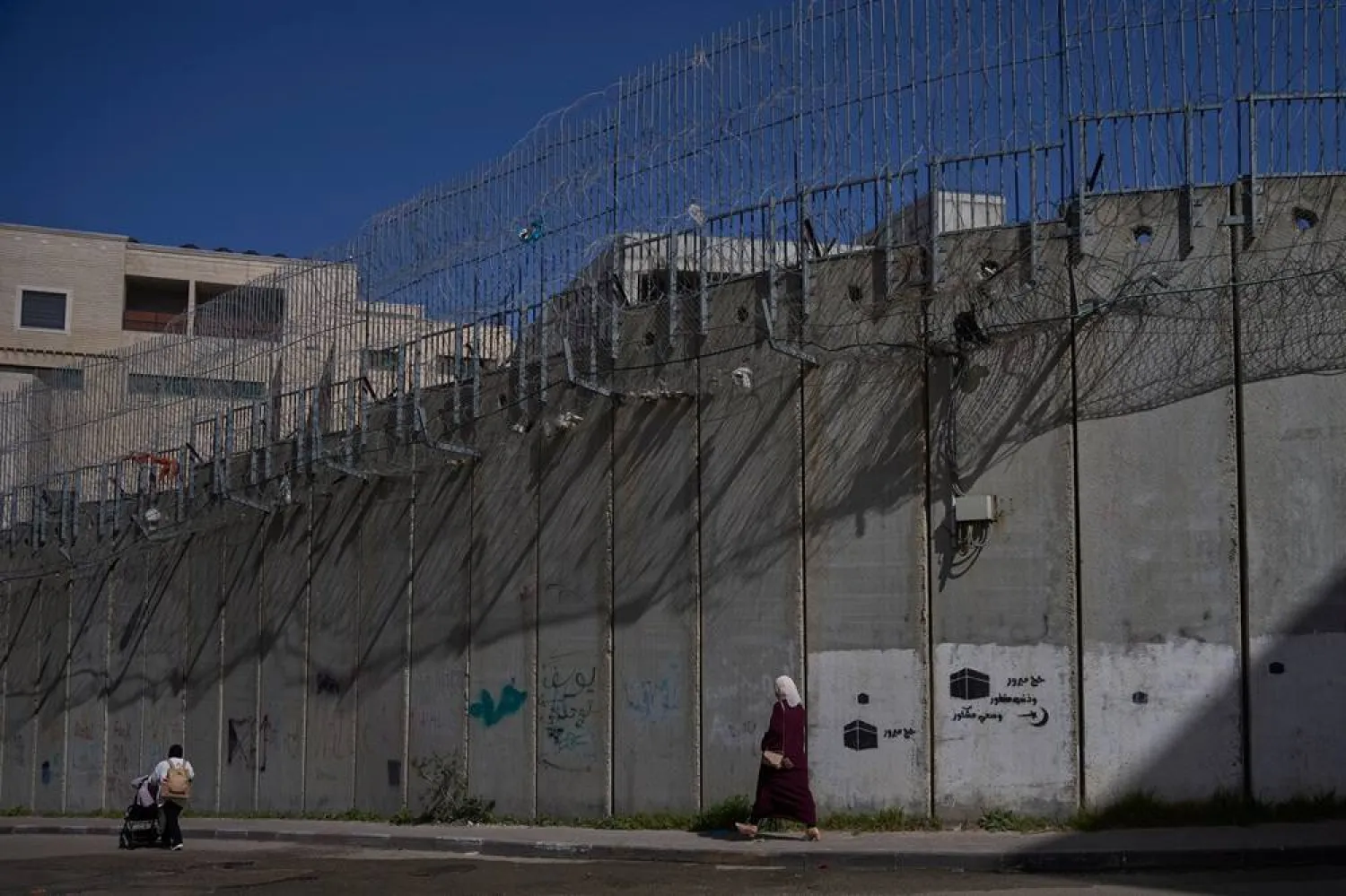
 Palestinians walk along the separation barrier between the West Bank and east Jerusalem neighborhood of Beit Hanina, Sunday Feb. 15, 2026. (AP)
Palestinians walk along the separation barrier between the West Bank and east Jerusalem neighborhood of Beit Hanina, Sunday Feb. 15, 2026. (AP)
TT

Palestinian Authorities Say Israeli Forces Kill Man Trying to Climb Barrier

 Palestinians walk along the separation barrier between the West Bank and east Jerusalem neighborhood of Beit Hanina, Sunday Feb. 15, 2026. (AP)
Palestinians walk along the separation barrier between the West Bank and east Jerusalem neighborhood of Beit Hanina, Sunday Feb. 15, 2026. (AP)

Israeli forces shot dead a Palestinian man Sunday as he attempted to enter Jerusalem by climbing over a barrier separating the city from the occupied West Bank, Palestinian authorities said.

The Palestinian health ministry in Ramallah identified the man as Imad Haroun Ashtiyeh, 26, saying he was killed by Israeli gunfire near the town of Al-Ram, north of Jerusalem.

Ashtiyeh, a construction worker from the village of Salem near Nablus, had attempted to climb the barrier at Al-Ram along with a few other men to make his way to the Israeli city of Tel Aviv for work, said Omer, a relative who gave only his first name.

"But then he was shot while attempting to climb over," Omer told AFP.

An AFP journalist saw Ashtiyeh's corpse shrouded in a Palestinian flag at the Ramallah medical complex, his relatives weeping over his body.

The Palestinian Authority's press office wrote on X that "Israeli occupation forces killed a Palestinian man seeking work while crossing the annexation and apartheid wall".

Al-Ram, located near the Qalandiya checkpoint, is separated from Jerusalem by a section of the barrier reinforced with barbed wire.

The Israeli military and police did not immediately respond to a request for comment.

Israeli security officials say a significant number of Palestinians from the West Bank attempt to enter Israel illegally, often by climbing over the barrier.

They are driven largely by economic hardship and the loss of work permits since the Hamas assault that sparked the Gaza war in October 2023, Palestinian officials say.

Most of them are arrested, while some have died or been injured fleeing from Israeli forces, Palestinian officials say.

Ashtiyeh is the fifth Palestinian killed trying to cross into Israel this year, and the 52nd since October 7, 2023, according to the Palestinian General Federation of Trade Unions.

Israel began building the barrier at the height of the second Palestinian intifada that erupted in 2002, saying it was needed to maintain security amid suicide bombings in Jerusalem and other Israeli cities.

The barrier cuts into many parts of the West Bank, which Israel has occupied since 1967, and Palestinians see it as a land grab and de facto border illegal under international law.

Israel maintains tight restrictions on the movement of the West Bank's roughly three million residents, who require special permits to cross checkpoints into east Jerusalem and Israel.

Violence has sharply escalated in the Palestinian territory since the Gaza war began.

At least 1,075 Palestinians -- both militants and civilians -- have been killed by Israeli forces or settlers in the West Bank since October 2023, according to AFP figures based on Palestinian health ministry data.

In the same period, at least 46 Israelis, including soldiers and civilians, have been killed in attacks or military operations in the West Bank, Israeli official figures show.


Banque Misr in UAE Targeted by US Sanctions

Banque Misr’s main branch in the UAE. (Banque Misr on Instagram)
TT

Banque Misr in UAE Targeted by US Sanctions

Banque Misr’s main branch in the UAE. (Banque Misr on Instagram)

An Egyptian banking source and an economic expert downplayed the impact of the US sanctions against Banque Misr’s UAE branch on the Egyptian banking sector and the broader economy, stressing that its fallout remains limited.

The source confirmed that the impact is confined to certain transactions of the UAE branch and does not extend to Banque Misr's operations within Egypt or its other international branches.

The US Treasury Department had on Friday said that “under Operation Economic Outcast, the US Department of the Treasury’s Financial Crimes Enforcement Network (FinCEN) proposed a rule that would revoke Banque Misr UAE’s correspondent banking access to US financial institutions.”

“We are taking the first step in holding it accountable for its continued, egregious support of the Iranian regime,” said Treasury Secretary Scott Bessent.

An official Egyptian banking source told Asharq Al-Awsat that the decision will prevent the bank's branch from making any US dollar transfers outside the UAE without undergoing financial monitoring in Washington and obtaining its prior approval.

This measure is designed to ensure that funds do not reach individuals or institutions subject to US sanctions or ban orders, he explained.

The source noted that the decision applies strictly to the US dollar and no other currencies, as intercountry dollar transfers between banks are routed through a US intermediary bank or US intermediary transfer companies known as correspondents, allowing US authorities to track the movement of their currency.

He continued: "Previously, these transfers were carried out routinely under the supervision of the US banking sector alone. However, following this decision, they are now subject to the Office of Foreign Assets Control (OFAC) - a department of the US Department of the Treasury, which is the primary US institution that monitors and blocks dollar transfers to entities and individuals listed on sanctions schedules."

The same source stressed that Banque Misr’s UAE branch is an entity independent of the Egyptian banking sector and falls within the scope of the UAE banking sector, though it is fully owned by the state-owned Banque Misr of Egypt.

He noted that "the US decision will not affect any bank inside Egypt in any way," adding that it is a reviewable measure that is highly likely to be canceled following coordination with the US.

Economic expert Abdel Nabi Abdel Muttalib said the US measure will not affect the rating of Banque Misr or the Egyptian banking sector, as the decision was not directed against Banque Misr or its UAE branch directly.

Instead, he explained that the measure targets the "correspondent" service, which is typically provided by US companies or banks to Banque Misr, particularly in countries where the bank does not have direct access to the banking system.

Speaking to Asharq Al-Awsat, Abdel Muttalib said that the ban does not apply to all currencies, but rather strictly to the US dollar.

He added that even dollar transfers cannot be completely halted, as some transactions are carried out, for instance, in UAE dirhams and received on the other end in dollars.

Furthermore, he noted that many transfers are executed in various other currencies but are delivered in other countries in US dollars, given its status as the most widely used and globally available international currency.

He continued: "US authorities frequently implement broad precautionary measures and include institutions as a safeguard; subsequent reviews and audits then prove that certain entities were wrongfully targeted, leading to the cancellation of measures against them."

In a statement on Saturday, Banque Misr said was reviewing the US Treasury notice, adding that its branch in the UAE continued to provide banking services to its customers in line with applicable rules and ⁠procedures.

The bank stressed that the measure is strictly limited to Banque Misr’s UAE branch and does not extend to its operations in Egypt or any other country where it operates.


Berri to Asharq Al-Awsat: UNIFIL Alternative Is Another Force Operating under UN Banner

Lebanese parliament Speaker Nabih Berri during a parliamentary session on August 11, 2026. (EPA)
TT

Berri to Asharq Al-Awsat: UNIFIL Alternative Is Another Force Operating under UN Banner

Lebanese parliament Speaker Nabih Berri during a parliamentary session on August 11, 2026. (EPA)

The United States' persistent refusal to renew the mandate of the United Nations Interim Forces in Lebanon (UNIFIL) demands a search for an alternative UN peacekeeping force that has both European and American backing to operate in southern Lebanon, Lebanese parliament Speaker Nabih Berri told Asharq Al-Awsat.

Berri warned that without such a force, there would be no legal basis to maintain an international presence.

This international role remains essential as the sole framework supporting the Lebanese Army's efforts to deploy and extend state sovereignty over all its territory, which is conditioned on a full Israeli withdrawal to the international borders, he went on to say.

Berri stressed that bilateral agreements between Lebanon and Israel are not an alternative to an international presence in the south, so long as Tel Aviv refuses to implement what the two countries reached under the US-sponsored "Framework Agreement."

This agreement committed to implementing the first "pilot phase" and establishing a mechanism to verify the army's deployment in the covered towns.

Berri noted that despite his rejection of the agreement, he had proposed expanding it by applying it on the district level, based on the administrative divisions of the south, rather than restricting it to the occupied town of Zawtar al-Gharbiyeh and incorporating liberated towns into it.

The December 31 expiration of the UNIFIL mandate in southern Lebanon, driven by Washington's insistence, has raised deep concerns among the Lebanese public regarding the loss of an international presence that can monitor the Israeli withdrawal.

While Israel pushes for bilateral agreements in place of the UN force, an approach broadly rejected in Lebanon, alternative proposals include forming a European force under a UN mandate if the Security Council extension is blocked.

This shifts the responsibility to the United States to consider Lebanon's position, especially since President General Joseph Aoun has called for a UN-backed European force as an alternative if Washington blocks Lebanon's official request to temporarily extend UNIFIL’s mandate.


Baghdad Says Committed to Completing US Troop Withdrawal by End of Sept.

A soldier from the US-led anti-ISIS coalition. (AFP file)
TT

Baghdad Says Committed to Completing US Troop Withdrawal by End of Sept.

A soldier from the US-led anti-ISIS coalition. (AFP file)

Baghdad remains committed to the upcoming September 30 deadline to end the military presence of international coalition forces in Iraq, sources said.

Media reports, meanwhile, said that the United States and its partners intend to scale down their military mission and transition to a bilateral security framework with the Iraqi government instead of a complete withdrawal.

An official Iraqi source told Asharq Al-Awsat that reports about the continued presence of US and foreign forces in Iraq after September "contradict what was agreed upon between the previous Iraqi government and the US administration." However, the source added that "it is premature to comment on press reports that are not based on an official US source."

Reports on Saturday cited an unnamed US official, whose identity or position was not disclosed, stating that the US and its coalition partners will scale down their military missions in Iraq by the upcoming September 30 deadline.

The source said that the move is in execution of directives from President Donald Trump.

According to statements attributed to the official, the reduction of the mission reflects what they described as a shared success in fighting ISIS. The official noted that it represents a transition toward a permanent bilateral security partnership between Baghdad and Washington, in accordance with US interests, the Iraqi constitution, and the Strategic Framework Agreement between the two countries.

The official explained that the move does not mean the end of the international coalition against ISIS, but rather the transition of its military mission into a more traditional format within a bilateral framework.

Coordination between the Iraqi government and coalition member states will continue to ensure a "responsible and smooth" transition, he added.

In September 2024, Iraq and the US announced a plan to end the military mission of the Washington-led international coalition against ISIS in Iraq and to gradually transition to a bilateral security relationship.

Under the plan, the first phase of the mission concluded in September 2025, while forces remained in the Kurdistan region to support counter-ISIS operations in Syria, with the final phase scheduled to end in September 2026.

Sabah al-Numan, the military spokesperson for the Commander-in-Chief of the Armed Forces, said that the upcoming September 30 will be like an "Iraqi celebration," confirming Baghdad's commitment to completing the withdrawal of coalition forces on schedule.

Al-Numan added that the government is also proceeding with regulating weapons, restricting them to the control of the state, and integrating armed factions into legitimate state institutions.

The official Iraqi source told Asharq Al-Awsat that the government "is committed to what was agreed upon between Baghdad and Washington," and that Iraq no longer needs foreign forces on its territory for any purpose.

Baghdad is keen to ensure that a continued US presence, should it occur, does not provide a justification for armed factions to back track on the initiative to restrict weapons to the custody of the state, he stressed.