


Solar Orbiter Launches to Discover Solar Storms

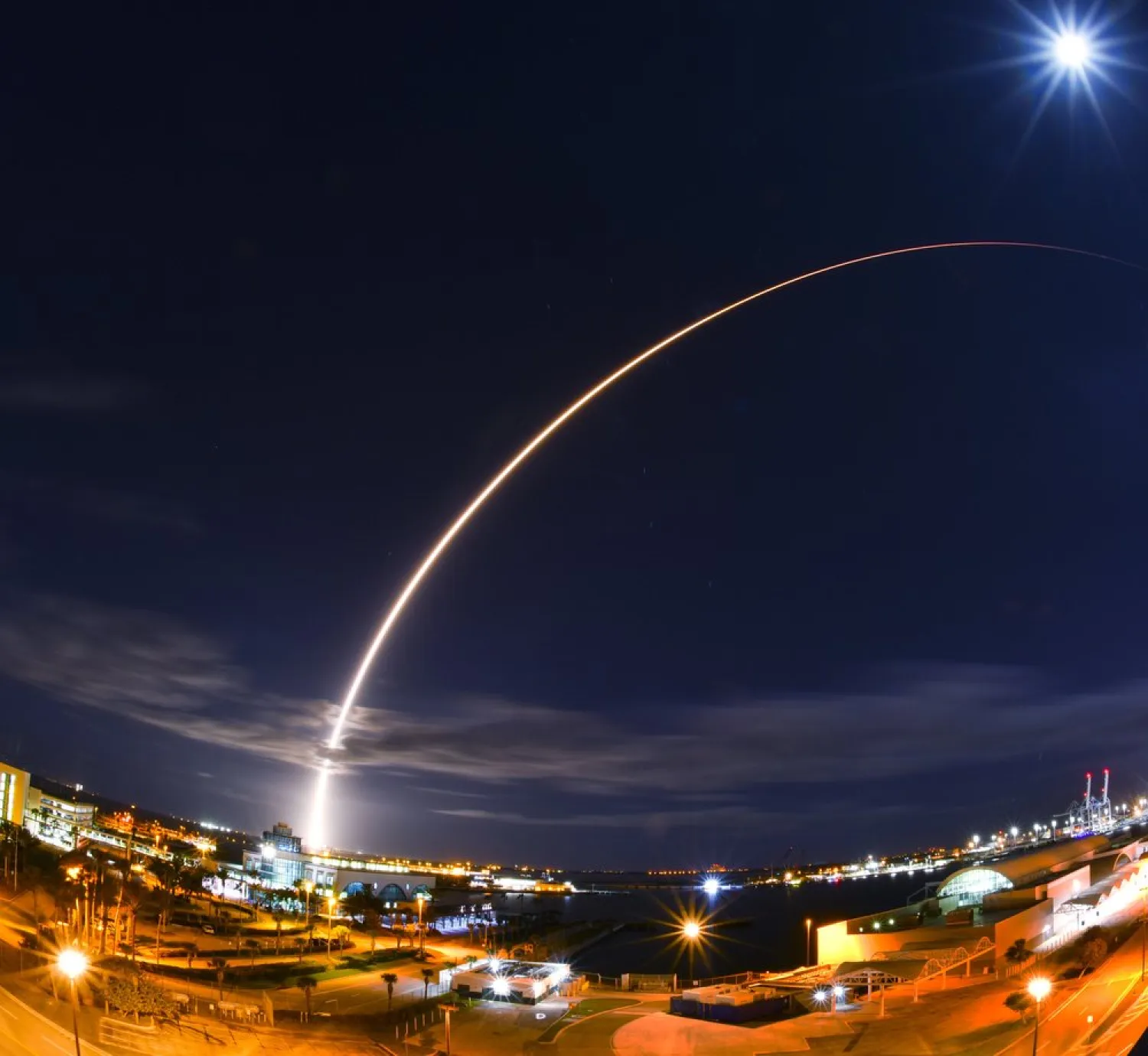
In this wide angle and long exposure shot, United Launch Alliance's Atlas V rocket, lifts off from Launch Complex 41 at Cape Canaveral Air Force Station in in Cape Canaveral, Fla., Sunday night, Feb. 9, 2020. (Malcolm Denemark/Florida Today via AP).
TT

Solar Orbiter Launches to Discover Solar Storms

In this wide angle and long exposure shot, United Launch Alliance's Atlas V rocket, lifts off from Launch Complex 41 at Cape Canaveral Air Force Station in in Cape Canaveral, Fla., Sunday night, Feb. 9, 2020. (Malcolm Denemark/Florida Today via AP).

In a one-decade mission aimed at studying the particle-charged solar storms and their effects on earth, the European-US mission "Solar Orbiter" has launched on Sunday from Florida, as part of partnership between the NASA and ESA (European Space Agency).

The probe was successfully launched from Florida's Cape Canaveral base loaded with 10 scientific instruments that will be used during the mission estimated at 1.5 billion euros. After a fly-by of Venus and Mercury, the probe is set to hit a maximum speed of 245,000 kilometers per hour, approaching the Sun as close as 42 million km - less than a third of the distance between the Earth and the sun.

After the launch, Daniel Muller, ESA project scientist said: "I think it was picture perfect, suddenly you really feel like you're connected to the entire solar system."

For her part, Holly Gilbert, director of NASA's heliophysics science division said: "We have one common goal and that is to get the good science out of this mission. I think we're going to succeed."

"Through this probe, the Solar Orbiter mission will be able to monitor the Sun directly," Matthieu Berthomier, researcher at the Paris-based Plasma Physics Laboratory told AFP.

The probe is encapsulated with a heat shield that will protect it from a surrounding temperature of 600 C. "When approaching the Sun, we have no problem with energy but rather with very high temperatures," said Ian Walters, Airbus' program manager for Solar Orbiter.

The data collected by the new probe will be added to the old data collected by NASA's probe "Parker", which was launched in 2018, and had approached the Sun at a closer distance (7 to 8 million kilometers) but couldn't use direct observation techniques because of high temperatures.

The European probe will use six tools to remotely take pictures of the sun at an unprecedented distance, and this would show the sun's poles for the first time. Another four "field" measuring instruments will be used to probe the environment around the sun. The main objective of the mission is "to understand how the sun forms its atmosphere and controls it," said Anne Pacros, payload manager at ESA. The atmosphere is located in a continuous stream of particles called solar wind, and it is vastly diverse, in a mysterious way.



EU Warns Meta WhatsApp AI Fee Breaches Antitrust Rules, Orders Rollback

FILED - 27 May 2025, Mecklenburg-Western Pomerania, Schwerin: The Facebook, Messenger, Instagram and WhatsApp apps are shown on a smartphone display that reflects the logo of the AI application Meta AI. Photo: Jens Büttner/dpa
TT

EU Warns Meta WhatsApp AI Fee Breaches Antitrust Rules, Orders Rollback

FILED - 27 May 2025, Mecklenburg-Western Pomerania, Schwerin: The Facebook, Messenger, Instagram and WhatsApp apps are shown on a smartphone display that reflects the logo of the AI application Meta AI. Photo: Jens Büttner/dpa

The European Commission said on Wednesday it intended to order Meta Platforms to reinstate rival artificial intelligence assistants on its WhatsApp messaging service after the U.S. tech giant imposed an access fee. "The Commission notified Meta that the revised policy seems to have the same effect of excluding third-party AI assistants from WhatsApp and thus appears at first sight to be in breach of EU competition rules," the EU's executive arm said, Reuters reported.

Interim measures, which the Commission imposes when it has concerns of damage to competition, would remain in place until the end of the investigation, it said.

"To prevent serious and irreparable harm to competition, the Commission intends to order Meta to reinstate access for third-party AI assistants under the same conditions as before 15 October 2025," it added in a statement.

Meta previously informed the Commission in March that it would allow rival AI assistants on WhatsApp for one year, contingent on a fee, after initially planning to ban third-party AI chatbots from WhatsApp Business.

"The European Commission is proposing to use its regulatory powers to enable some of the largest companies in the world to use the paid-for WhatsApp Business product for free," a Meta spokesperson said in an emailed statement.

"This means that a small bakery in France paying to use the service to take croissant orders will be picking up the tab for OpenAI. Small European businesses shouldn't foot OpenAI's bill," the spokesperson added.

The Commission also said that its investigation had been expanded to Italy, where the Italian competition watchdog had opened its own probe last year.


OpenAI to Open First Permanent London Office in 2027

FILE PHOTO: OpenAI logo is seen in this illustration taken May 20, 2024. REUTERS/Dado Ruvic/Illustration/File Photo
TT

OpenAI to Open First Permanent London Office in 2027

FILE PHOTO: OpenAI logo is seen in this illustration taken May 20, 2024. REUTERS/Dado Ruvic/Illustration/File Photo

OpenAI said on Monday it has secured its first permanent office in London, expanding capacity to meet growing demand in the UK and building on the ChatGPT maker's plans to make the city its largest research hub outside the United States.

Here are some details ⁠on the new ⁠London office:

The office is expected to open in 2027, with capacity for 544 team members, Microsoft-backed OpenAI said.

The ⁠space is located at Regent Quarter, spanning Jahn Court and the Brassworks Building in the King's Cross area.

OpenAI currently employs around 200 people in London across research, engineering, customer support, policy, and sales.

Last week, OpenAI said it was ⁠pausing ⁠its main data center project in Britain due to an unfavorable regulatory environment and high energy costs, a move that dealt a blow to the UK government's push to position the country as a global AI hub.


Canada's Cohere, Germany's Aleph Alpha Reportedly in Merger Talks

FILE PHOTO: AI (Artificial Intelligence) letters and robot hand are placed on computer motherboard in this illustration created on June 23, 2023. REUTERS/Dado Ruvic/Illustration/File Photo
TT

Canada's Cohere, Germany's Aleph Alpha Reportedly in Merger Talks

FILE PHOTO: AI (Artificial Intelligence) letters and robot hand are placed on computer motherboard in this illustration created on June 23, 2023. REUTERS/Dado Ruvic/Illustration/File Photo

Artificial intelligence companies Cohere of Canada and Aleph Alpha of Germany are in talks to merge and have Berlin's support for a potential deal, newspaper Handelsblatt reported late on Thursday.

Citing government and industry sources, the paper said the German government would be willing to become a key customer of a combined company, part of a push to provide digital public services.

"If leading AI companies from Canada and Germany were to join forces that would send a very strong signal," German Digital Minister Karsten Wildberger told the ⁠paper.

Germany and Canada ⁠were already collaborating closely in the field, he was also quoted as saying.

Aleph Alpha told Reuters that regular discussions over strategic partnerships were standard practice in the AI industry and that Aleph Alpha had its own independent strategy, declining to comment further.

Cohere said it meets "with companies and institutions ⁠across Germany and Europe and continually evaluates strategic opportunities that support our global growth."

It also pointed Reuters to its international expansion efforts as well as to the Canadian-German Sovereign Technology Alliance agreed this year, but would not comment further.

Germany's research and digital ministries did not immediately respond to requests for comment.

Handelsblatt said merger talks started early this year and had reached an advanced stage, with plans for the new entity to be headquartered in both countries.

Germany has been eager to catch ⁠up with ⁠dominant AI players the US and China in a global race to master a transformational technology and attract high-income jobs. India has also emerged as a contender.

Last month, Berlin unveiled plans to encourage investments to boost AI data processing capacity at least fourfold by 2030.

Microsoft, which is collaborating with Cohere, unveiled $23 billion in AI investments in December, with the bulk earmarked for India and parts for Canada.

That was after Alphabet's Google said it would spend $15 billion over five years on an AI data center in India.