


German Copper Mine Turned into Museum

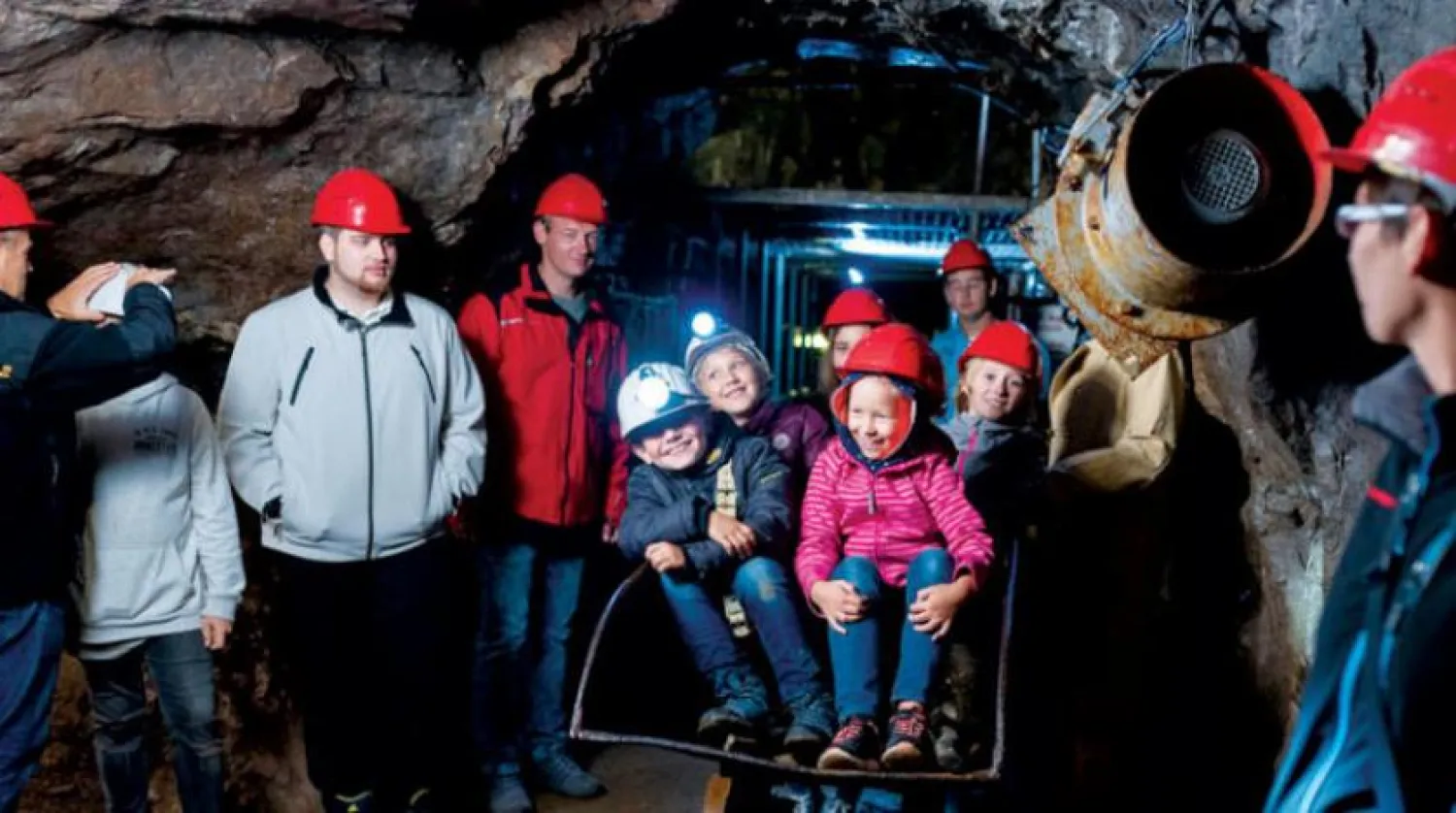
Visitors at the Röhrigschacht copper mine-turned museum in Germany.
TT

German Copper Mine Turned into Museum

Visitors at the Röhrigschacht copper mine-turned museum in Germany.

The lamps hanging on the walls project a dim light while an elevator-like cage glides down the mine's shaft. The cage can accommodate only ten visitors in each tour.

Over the past 20 years, Röhrigschacht - an ancient copper mine based in the Harz Mountains (southern Germany) that has been turned into a museum - has provided underground five-hour tours, the German news agency reported.

At 283 meters underground, tour guide Thomas Wäsche said: "We will use a boat on this trip." Each visitor had to wear a lamp helmet and water repellent pants.

The work of miners was completely different 130 years ago. They used to load copper pieces on flat carriages tied to the legs of 14-year-old beginners, who pulled them through the mine's openings.

"Those young boys had to drag these heavy carriages to loading points 10 to15 times a day," said Wäsche. At the time, the workers' torches were the only lightning source in the mine.

During the tour, the helmets kept hitting the ceiling and the water ran abundantly. The arid walls are covered with unique colors ranging from strong brown tones to white, green, turquoise, blue and black.

Since the mine was abandoned in 1885, the running water has broken down the limestone rocks.

The group now stands in front of an inclined pathway known as "Bremsberg".

"The carriages loaded with copper took this pathway down to the main entrance, while their weight pulled the empty carriages up to the facing route. This was a vehicle-free transport mean," explained Wäsche.

In the next round, the visitors stood in the water, and fortunately, the water repellent pants were useful. Then, the group took four boats that ran along the narrow waterway with the help of pedals and a light stream.

After over 350 meters, as the water pathway narrowed down, the group left the boats to the water.

"If someone believes he can't make it, he can wait here until we return," said the guide.

However, no one wanted to wait. In this part, Wäsche provided the visitors with knee pads. The path was only 60 centimeters high, and everybody had to crawl towards the opening while their backs touched the ceiling. Finally, with the end of the crawling journey, the visitors sat in an empty space for some rest.



Budapest’s Vintage Freight Trams Celebrate 100 Years in Service

 Two century-old freight trams are parked in the Kelenfold tram depot in Budapest, Hungary on Thursday, March 12, 2026. (AP)
Two century-old freight trams are parked in the Kelenfold tram depot in Budapest, Hungary on Thursday, March 12, 2026. (AP)
TT

Budapest’s Vintage Freight Trams Celebrate 100 Years in Service

 Two century-old freight trams are parked in the Kelenfold tram depot in Budapest, Hungary on Thursday, March 12, 2026. (AP)
Two century-old freight trams are parked in the Kelenfold tram depot in Budapest, Hungary on Thursday, March 12, 2026. (AP)

With the toot of a horn, the ring of a bell and the hiss of air brakes, an unusual rail vehicle pulls out of a depot in Budapest to serve the Hungarian capital's public transit system, a job it has done for a century.

The so-called freight trams, known as mukis, run on electricity provided by overhead wires and travel on Budapest's vast tram rail network, one of the busiest in the world. But unlike the hundreds of iconic yellow trams in the passenger fleet, they don’t carry commuters.

Acquired by the city in 1926, the wood-sided trams were initially products of necessity: They brought goods and raw materials to and from Budapest's factories after much of the local freight infrastructure had been destroyed during World War I.

"Engineers at the time designed an electric drive system mainly using parts from vehicles damaged in the war, as well as parts from vehicles that had already been designated for scrapping," said Ádám Zadravecz, the head of tram vehicle development and technology at Budapest's public transit company BKV.

"Their primary purpose was freight transport, but after World War II, these vehicles were also used for removal of the war ruins," he said.

Over time, the mukis' function changed as Hungary recovered. In the 1960s, some of the original 40 trams were equipped with a snowplow, enabling them to clear the city's tram tracks in winter, as they do today.

They also perform nighttime maintenance runs, and transport broken-down trams into depots for repairs.

Various parts on the trams were gradually replaced, resulting in a mishmash of components. By 2018, the mukis were due for a more comprehensive refurbishment.

"When they were manufactured in the 1920s, they were extremely simple, extremely puritanical devices," said Nándor Meixner, head of vehicle maintenance at Budapest's Ferencváros depot. "During the refurbishment, we strove to make our colleagues’ work easier. That is why, for example, a seat was added to the vehicle, so that the driver can at least sit down."

Another addition: The trams were equipped with heating in the cabin.

Despite the changes over the last 100 years, Zadravecz said the trams' overall nature remained the same.

"Their maintenance costs is almost zero because these trams are very easy to maintain. Compared to the complex electronics of today’s vehicles, there is very little in them that can break down," he said. "People say that it can be repaired with a hammer and a file, and that’s absolutely true."

Driving them requires special training, however, as well as what Meixner called a certain "feel" for the vehicle.

"It is not enough to just drive, to know the signs and instructions, you also need to know the vehicle itself," he said.

Of the original fleet of 40 mukis, only six have survived the last 100 years in Budapest, with three in active use.

"The value of these vehicles lies precisely in their simplicity, in the pure fact that they exist and are available to us," Zadravecz said.


Spanish King Acknowledges ‘Much Abuse’ During Conquest

Spain's King Felipe walks through the main square toward the Government Palace during an official visit aimed at strengthening diplomatic ties between Bolivia and Spain, in La Paz, Bolivia, March 12, 2026. (Reuters)
TT

Spanish King Acknowledges ‘Much Abuse’ During Conquest

Spain's King Felipe walks through the main square toward the Government Palace during an official visit aimed at strengthening diplomatic ties between Bolivia and Spain, in La Paz, Bolivia, March 12, 2026. (Reuters)

King Felipe VI on Monday acknowledged "much abuse" during Spain's conquest of the Americas, the latest attempt by a top Spanish official to address Mexico's longstanding historical grievances.

Laws imposed by the Spanish crown in the 16th century to govern its colonies had a "desire to protect" Indigenous peoples, the king said during a visit to an exhibition of Indigenous Mexican art in Madrid.

But "reality later made it impossible to fully enforce, and there was much abuse," he added, according to a video posted by the royal palace on X.

"There are things that later, when we study them and learn about them, you say: 'Well, by today's standards and values, they obviously cannot make us feel proud,'" the king said.

"But we have to understand them in their proper context, not with excessive moral presentism, but with objective and rigorous analysis" in order "to draw lessons," he added.

Relations between Mexico and Spain have been strained since 2019 when Mexico's then president Andres Manuel Lopez Obrador demanded an apology from Spain's monarchy for abuses committed during Spain's 1519-1521 Conquest of Mexico and the ensuing three centuries of colonial rule.

Mexican President Claudia Sheinbaum, Lopez Obrador's political ally and successor, revived the call and excluded the king from her inauguration in October 2024 partly because Spain had not responded to the apology demand.

Spain's Foreign Minister Jose Manuel Albares last year acknowledged the "pain and injustice" inflicted on Indigenous peoples during the Spanish conquest as he inaugurated the exhibition which the king visited on Monday.

Sheinbaum welcomed the comments, saying they were the "first step" by the Spanish government in recognizing the abuses committed.

Shortly after, Spain's Socialist Prime Minister Pedro Sanchez said improving Spain's ties with Mexico is a priority for his government, adding there was "light and shadow" in the two country's shared history.

Mesoamerica, a region that comprised parts of Mexico and Central America, had an estimated population of 15 million to 30 million people when conquistador Hernan Cortes arrived with an army of several hundred men, bringing horses, swords, guns -- and smallpox -- in 1519.

After a century of battles, massacres, and plagues, only an estimated one million to two million Indigenous inhabitants remained.


Snow, Wind Hit Eastern US and Midwest, Blocking Roads and Grounding More than 2,000 Flights

Ogo Akpati and his son Brycson Akpati, 3, braved the strong winds and had fun sliding down a hill in Central Park Sunday, March 15,2026 in Brooklyn Park, MN. (Jerry Holt/Minnesota Star Tribune via AP)
TT

Snow, Wind Hit Eastern US and Midwest, Blocking Roads and Grounding More than 2,000 Flights

Ogo Akpati and his son Brycson Akpati, 3, braved the strong winds and had fun sliding down a hill in Central Park Sunday, March 15,2026 in Brooklyn Park, MN. (Jerry Holt/Minnesota Star Tribune via AP)

Chaotic weather coast to coast in the US — from unusual heat in California to damaging winds around Washington, D.C. — put over 100 million people in the path of extreme conditions on Monday.

Storms across the nation's eastern half forced airlines to cancel more than 2,000 flights nationwide Monday, and many schools closed early in the mid-Atlantic states where high winds and tornadoes were in the forecast.

Blizzards buried parts of Michigan, Wisconsin and Minnesota while torrential rains flooded homes and washed out roads in Hawaii.

In Washington, the House of Representatives postponed votes because of difficulty traveling with inclement weather, The AP news reported.

Airport delays and cancellations could pile up Monday in some of the nation’s largest airports — including those in Washington, New York and Chicago.

“This is what happens in March and April,” said Brian Hurley, a meteorologist with the National Weather Service. “It’s a clash in the air masses. Winter, not wanting to let go from the North, and then obviously the sun’s getting a little stronger, it’s warming up in the South.”

Forecasters warn about line of storms, tornadoes The storm system that dropped snow by the foot in the Midwest is barreling toward the East Coast with dangerously high winds and potential for “producing strong and long track tornadoes,” the weather service warned Monday.

“Today, it’s the wind that’s really the threat,” said Northern Illinois University meteorology professor Victor Gensini.

A stretch from parts of South Carolina to Maryland appeared most likely to experience the greatest damaging winds Monday afternoon, the weather service said. That could include Raleigh, North Carolina; Richmond, Virginia; and the nation’s capital.

North Carolina Gov. Josh Stein urged residents to enable emergency alerts on their phones ahead of expected wind gusts topping 70 mph (112 kph).

Beyond the threat to lives and property, “whether it’s wind gusts from a squall line, blizzard or snow, or just wind because of the storm, you’re looking at several major airports being impacted,“ said AccuWeather senior meteorologist Tyler Roys.

Big snows in Minnesota, Wisconsin, Michigan Blizzard conditions persisted Monday in parts of Wisconsin and Michigan, where the storm brought as much as 2 feet (61 centimeters) of snow by morning. It was still snowing in the region. Additional snowfall of a foot (30 centimeters) to 20 inches (51 centimeters) of snow was expected in upper Michigan, along with gusty winds, on Monday, the National Weather Service said. Schools were closed in a number of communities Monday in both states, including Milwaukee and Marquette, Michigan.

Lower snow accumulations in places such as Chicago and Milwaukee were expected to create trouble for commuters on Monday, Roys said.

Jim Allen, 45, who lives on the Upper Peninsula, said his family stocked up on necessities. “We’re basically prepared to just kind of hunker down for a few days if we need to,” he said.

The thousands of flights canceled nationwide early Monday included more than 350 at Chicago O’Hare International and another 200 at Atlanta’s Hartsfield-Jackson International, according to FlightAware, which tracks flight disruptions. More than 2,500 more flights were delayed nationwide early Monday. Those disruptions came a day after more than 3,200 cancellations on Sunday.

Landslides, rescues, collapsed home on Maui Unrelenting rains triggered landslides and flooded homes and farmland in Hawaii over the weekend.

Some areas of Maui received more than 20 inches (51 centimeters) of rain, Maui County Mayor Richard Bissen said in a social media post.

Resident and real estate broker Jesse Wald, who recorded video of a coastal road’s collapse, said parts of the road were flooded by mud and sediment.

“In the 20 years I’ve been here I’ve never seen this much rain,” he said.

Storm will bring cold into the East Coast Forecasters said the East Coast storms were expected leave sharply colder weather in its wake.

By Tuesday morning, wind chills below freezing were expected to reach the Gulf Coast and the Florida Panhandle with warnings in effect across the Southeast and in part of Arkansas, Oklahoma, Louisiana, and Texas, forecasters warned.

To the north, rain was expected to change over to snow behind the cold front with heavy snow possible in the central Appalachians of West Virginia.