

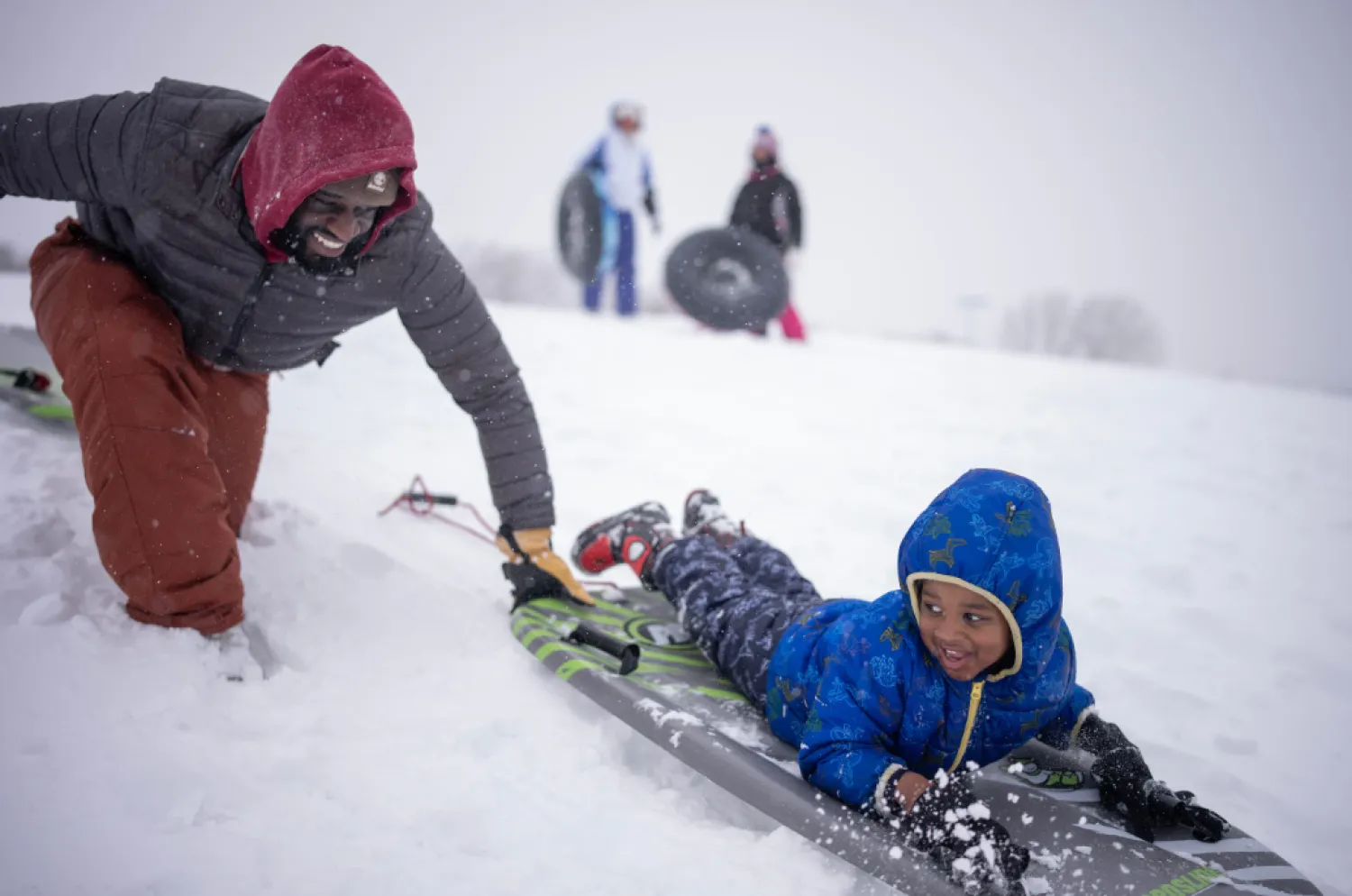

Snow, Wind Hit Eastern US and Midwest, Blocking Roads and Grounding More than 2,000 Flights

Ogo Akpati and his son Brycson Akpati, 3, braved the strong winds and had fun sliding down a hill in Central Park Sunday, March 15,2026 in Brooklyn Park, MN. (Jerry Holt/Minnesota Star Tribune via AP)
TT

Snow, Wind Hit Eastern US and Midwest, Blocking Roads and Grounding More than 2,000 Flights

Ogo Akpati and his son Brycson Akpati, 3, braved the strong winds and had fun sliding down a hill in Central Park Sunday, March 15,2026 in Brooklyn Park, MN. (Jerry Holt/Minnesota Star Tribune via AP)

Chaotic weather coast to coast in the US — from unusual heat in California to damaging winds around Washington, D.C. — put over 100 million people in the path of extreme conditions on Monday.

Storms across the nation's eastern half forced airlines to cancel more than 2,000 flights nationwide Monday, and many schools closed early in the mid-Atlantic states where high winds and tornadoes were in the forecast.

Blizzards buried parts of Michigan, Wisconsin and Minnesota while torrential rains flooded homes and washed out roads in Hawaii.

In Washington, the House of Representatives postponed votes because of difficulty traveling with inclement weather, The AP news reported.

Airport delays and cancellations could pile up Monday in some of the nation’s largest airports — including those in Washington, New York and Chicago.

“This is what happens in March and April,” said Brian Hurley, a meteorologist with the National Weather Service. “It’s a clash in the air masses. Winter, not wanting to let go from the North, and then obviously the sun’s getting a little stronger, it’s warming up in the South.”

Forecasters warn about line of storms, tornadoes The storm system that dropped snow by the foot in the Midwest is barreling toward the East Coast with dangerously high winds and potential for “producing strong and long track tornadoes,” the weather service warned Monday.

“Today, it’s the wind that’s really the threat,” said Northern Illinois University meteorology professor Victor Gensini.

A stretch from parts of South Carolina to Maryland appeared most likely to experience the greatest damaging winds Monday afternoon, the weather service said. That could include Raleigh, North Carolina; Richmond, Virginia; and the nation’s capital.

North Carolina Gov. Josh Stein urged residents to enable emergency alerts on their phones ahead of expected wind gusts topping 70 mph (112 kph).

Beyond the threat to lives and property, “whether it’s wind gusts from a squall line, blizzard or snow, or just wind because of the storm, you’re looking at several major airports being impacted,“ said AccuWeather senior meteorologist Tyler Roys.

Big snows in Minnesota, Wisconsin, Michigan Blizzard conditions persisted Monday in parts of Wisconsin and Michigan, where the storm brought as much as 2 feet (61 centimeters) of snow by morning. It was still snowing in the region. Additional snowfall of a foot (30 centimeters) to 20 inches (51 centimeters) of snow was expected in upper Michigan, along with gusty winds, on Monday, the National Weather Service said. Schools were closed in a number of communities Monday in both states, including Milwaukee and Marquette, Michigan.

Lower snow accumulations in places such as Chicago and Milwaukee were expected to create trouble for commuters on Monday, Roys said.

Jim Allen, 45, who lives on the Upper Peninsula, said his family stocked up on necessities. “We’re basically prepared to just kind of hunker down for a few days if we need to,” he said.

The thousands of flights canceled nationwide early Monday included more than 350 at Chicago O’Hare International and another 200 at Atlanta’s Hartsfield-Jackson International, according to FlightAware, which tracks flight disruptions. More than 2,500 more flights were delayed nationwide early Monday. Those disruptions came a day after more than 3,200 cancellations on Sunday.

Landslides, rescues, collapsed home on Maui Unrelenting rains triggered landslides and flooded homes and farmland in Hawaii over the weekend.

Some areas of Maui received more than 20 inches (51 centimeters) of rain, Maui County Mayor Richard Bissen said in a social media post.

Resident and real estate broker Jesse Wald, who recorded video of a coastal road’s collapse, said parts of the road were flooded by mud and sediment.

“In the 20 years I’ve been here I’ve never seen this much rain,” he said.

Storm will bring cold into the East Coast Forecasters said the East Coast storms were expected leave sharply colder weather in its wake.

By Tuesday morning, wind chills below freezing were expected to reach the Gulf Coast and the Florida Panhandle with warnings in effect across the Southeast and in part of Arkansas, Oklahoma, Louisiana, and Texas, forecasters warned.

To the north, rain was expected to change over to snow behind the cold front with heavy snow possible in the central Appalachians of West Virginia.



Saudi Arabia Reaffirms Commitment to Environmental Action on Saudi Green Initiative Day

One of the mountainous areas located in the south of the Kingdom of Saudi Arabia (Asharq Al-Awsat)
TT

Saudi Arabia Reaffirms Commitment to Environmental Action on Saudi Green Initiative Day

One of the mountainous areas located in the south of the Kingdom of Saudi Arabia (Asharq Al-Awsat)

The Saudi Green Initiative (SGI) Day, observed annually on March 27 following a Cabinet decision, reflects the Kingdom's commitment to establishing a culture of sustainability, enhancing national environmental efforts, and encouraging all sectors to achieve sustainable development goals in line with Vision 2030, SPA reported.

The initiative recently achieved a significant national milestone by rehabilitating one million hectares of degraded land through the National Greening Program, overseen by the National Center for Vegetation Cover Development and Combating Desertification. This objective aims to expand vegetation cover, reduce desertification, improve quality of life, and enhance the natural capacity of local environments to adapt to climate change.

The achievement is an extension of the Kingdom's broader efforts to protect natural resources, reduce emissions, promote reliance on clean energy, and preserve biodiversity, thereby strengthening Saudi Arabia's regional and international standing in environmental action.

Over the past year, the initiative has continued to make tangible progress. More than 159 million trees were planted across the Kingdom, and environmental reserves saw the birth of Arabian oryx calves for the third consecutive year. Furthermore, the National Water Efficiency and Conservation Center currently saves 120,000 cubic meters of water daily, with plans to increase this capacity to 300,000 cubic meters.

These combined efforts align with the objectives of Vision 2030 and contribute to strengthening the Kingdom’s regional and international standing in environmental sustainability.

SGI Day is observed annually to highlight the initiative’s achievements, review its future goals, and encourage broad sector participation in environmental efforts and sustainable development.

These efforts reflect the Kingdom’s approach to environmental and climate action, driven by the Saudi Green Initiative and the Middle East Green Initiative, both launched by Prince Mohammed bin Salman bin Abdulaziz Al Saud, Crown Prince and Prime Minister, underscoring its ongoing commitment to supporting the transition toward a more sustainable development model.


Satellite Observations Offer Insight into a Tsunami’s Early Stages

A person shows a cell phone displaying a message to evacuate to a tsunami safety zone during an evacuation of the coast following a tsunami warning issued by local authorities after an earthquake struck the Kamchatka Peninsula in the far east of Russia, triggering warnings and evacuations across the South Pacific, in Dichato, near Concepcion, Chile, July 30, 2025. (Reuters)
TT

Satellite Observations Offer Insight into a Tsunami’s Early Stages

A person shows a cell phone displaying a message to evacuate to a tsunami safety zone during an evacuation of the coast following a tsunami warning issued by local authorities after an earthquake struck the Kamchatka Peninsula in the far east of Russia, triggering warnings and evacuations across the South Pacific, in Dichato, near Concepcion, Chile, July 30, 2025. (Reuters)

Observations made by a satellite operated by the US and French space agencies shortly after a strong earthquake struck off Russia's Kamchatka Peninsula last year are giving scientists a better understanding of how tsunamis originate and propagate.

The researchers said the findings may help improve understanding of future tsunamis and earthquakes at subduction zones, particularly near the ocean trench where two tectonic plates meet and one slides beneath the other. The strongest tsunamis often are generated by such quakes.

The magnitude 8.8 quake struck on July 29, 2025, triggering a tsunami that spread across the Pacific Ocean. A tsunami - a series of extremely long and powerful ocean waves - is caused by large movements of the seafloor that push water up or down, often during earthquakes or landslides that occur under water.

The NASA-CNES Surface Water and Ocean Topography, or SWOT, satellite ‌made its observations ‌within 70 minutes of the start of the earthquake. It observed not ‌only ⁠the leading wave ⁠of the tsunami, but also a distinct pattern of smaller waves trailing behind it.

Such wave patterns had long been predicted in computer models and theoretical studies, but had been difficult to confirm with real-world observations, the researchers said.

"I believe SWOT represents a new lens for observing and studying tsunamis and their generation," said Ignacio Sepúlveda, a professor of coastal engineering at San Diego State University and lead author of the study published this week in the journal Science.

"It is also likely to improve our understanding of the physical mechanisms that generate tsunamis, including earthquakes," ⁠Sepúlveda added.

Traditional deep-ocean pressure sensors and other satellites have limitations in coverage ‌and measurement, making it difficult to capture the full structure of ‌the waves, especially near the trench, the researchers said.

SWOT scans a wide swath of the ocean, producing two-dimensional maps ‌of sea surface height. This allows scientists to see the shape, direction and spacing of tsunami waves ‌in much greater detail.

Tsunamis are among the strongest and most destructive natural forces, with powerful waves radiating from a point of origin outward in all directions. These waves can cause damaging and deadly coastal flooding.

The tsunami in this study did not cause significant loss of life, but others have caused huge death tolls such as the 2004 Indian Ocean ‌tsunami that killed some 230,000 people.

The July 2025 tsunami originated within about 10 kilometers (six miles) of the trench, the place in the seafloor ⁠where two tectonic plates intersect, ⁠the researchers found. This location could not previously be determined using traditional land-based instruments or sparse sensors on the seafloor alone.

Earth's surface is made up of immense plates that move very gradually in a geological process called plate tectonics.

The researchers found that when earthquake-caused movement extends close to the trench, it can generate shorter waves that travel more slowly and spread out over time, forming a trailing pattern behind the main tsunami front. This behavior means that different parts of the wave move at different speeds, with longer waves moving more quickly and leading, while shorter ones lag behind.

The study also showed that the strength of the trailing waves increases when earthquake movement extends closer to the trench, suggesting these waves are linked to where and how the tsunami was generated near the trench.

"This opens a new window to understand in a better way what happens with earthquakes and tsunamis near the trench," Sepúlveda said, referring to SWOT observations. "In the future, this knowledge will allow us to improve models we use to evaluate tsunami hazards in coastal communities and make them more resilient."


Gabon Battles for Baby Sea Turtles’ Survival

 An olive ridley sea turtle hatchling moves on a beach after emerging from its nest near Libreville on February 15, 2026. (AFP)
An olive ridley sea turtle hatchling moves on a beach after emerging from its nest near Libreville on February 15, 2026. (AFP)
TT

Gabon Battles for Baby Sea Turtles’ Survival

 An olive ridley sea turtle hatchling moves on a beach after emerging from its nest near Libreville on February 15, 2026. (AFP)
An olive ridley sea turtle hatchling moves on a beach after emerging from its nest near Libreville on February 15, 2026. (AFP)

Small enough to fit in the palm of your hand, newly hatched sea turtles emerged on a Gabonese beach to embark on the treacherous 10-meter (33-foot) scramble across the sand to the ocean.

"The survival rate for turtles is one in 1,000," Francois Boussamba, a Gabonese turtle expert and head of the NGO Aventures Sans Frontieres (Adventures Without Borders), told AFP, scouring for nests.

Conservationists from NGOs and the national parks agency patrol Gabon's beaches daily during the nesting season to protect the turtles' nests.

Those under threat are moved to a hatchery, a fenced enclosure near the sea, where the eggs are kept safe until they are ready to hatch.

On Pongara National Park's white sandy beaches, about 30 minutes by boat from the capital Libreville, conditions are optimal for nesting: wild coastline, a favorable equatorial climate and an open ocean beach with gentle slopes, ideal for the females.

But dangers lurk. Nests are threatened by coastal erosion due to encroaching sea levels, or myriad predators such as crabs and birds that prevent the eggs from reaching their 60-day incubation period, Boussamba said.

"The chances of survival are tiny," he said.

- Muscle up -

In Libreville, every morning around 7:00 am, volunteers from the Project Turtles Tahiti Gabon association crisscross the beach and check the nests in the hatchery.

After one has hatched, the baby turtles have to be moved so they can reach the sea -- but they are never put straight into the water.

"They need to build up their muscles so they can swim in the ocean," volunteer Clemence said.

Four species of turtles -- green, olive ridley, hawksbill and leatherback -- come to nest along Gabon's 900 kilometers (560 miles) of coastline from October to April.

It has the highest nesting density on the African continent, according to the US-based NGO Wildlife Conservation Society.

Gabon is the world's leading nesting site for the leatherback turtle, the largest of the species and listed as threatened by the International Union for Conservation of Nature (IUCN).

In addition to predators, sea turtles are also threatened by human activities, from plastic pollution to industrial fishing and poachers.

By watching over the eggs, the rangers in Pongara help ensure "the survival of this species", Edouard Moussavou, Pongara park's deputy director, said.

- Unpaid wages -

Since 2013, Gabon's conservation efforts had received funding from the United States, notably through the US Fish and Wildlife Service, an agency responsible for biodiversity.

"If there are turtles, it means our ecosystem is sound and healthy," Boussamba said.

But since the suspension of grants by the administration of US President Donald Trump, "turtle monitoring activities have stopped or slowed down drastically", Moussavou said.

"There will be fewer staff, less data, and that really creates difficulties for us," he said.

Additionally, there have been delays in paying the staff of the National Agency for National Parks (ANPN), which manages the country's 13 parks, according to Sosthene Ndong Engonga, secretary-general of the National Union of Gabonese Ecoguards.

The around 580 eco-rangers regularly go unpaid.

"Even when there is money, we have to make a big fuss to get our salaries," he said, adding he battled with the treasury last month for back pay.

The eco-rangers, who are crucial for the conservation of Gabon's biodiversity, face having "to give everything up," Engonga warned. "We have expenses we can no longer cover," he said.

On Pongara beach, 40-year-old Alain Banguiya carries out night patrols, hoping to see a leatherback turtle emerge from the water to lay her eggs in the sand.

An eco-ranger since 2015, he has not been paid for two months but says that giving up is out of the question.

"We have a duty to fight to the end, to keep our spirits up," he said. "Despite the obstacles, we stay the course: conservation."