


Guterres Rings Alarm on 250 Million Children in Conflict-Stricken Nations

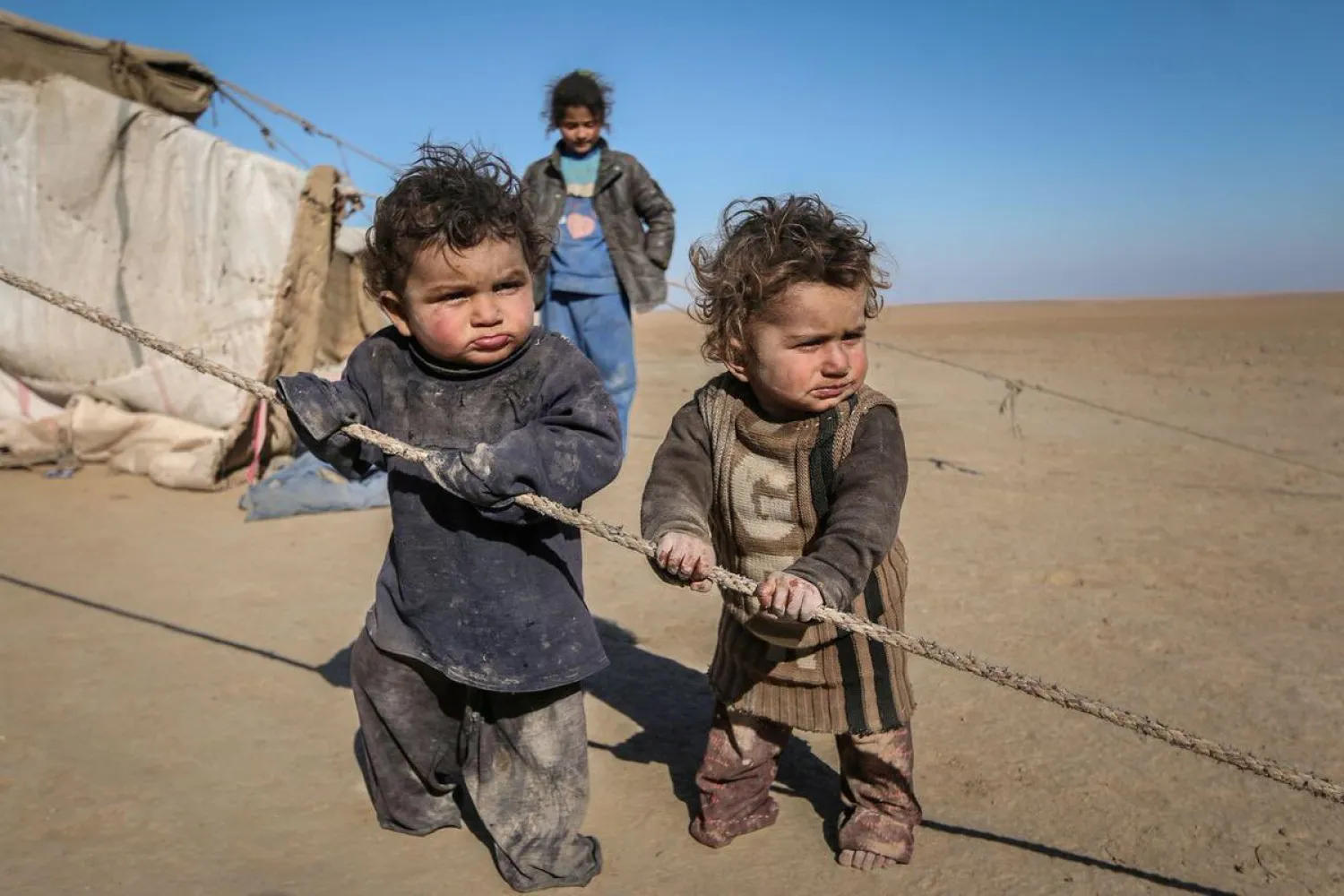
Internally displaced Syrian children who fled Raqqa city stand near their tent in Ras al-Ain province, Syria, January 22, 2017. REUTERS/Rodi Said//File Photo
TT

Guterres Rings Alarm on 250 Million Children in Conflict-Stricken Nations

Internally displaced Syrian children who fled Raqqa city stand near their tent in Ras al-Ain province, Syria, January 22, 2017. REUTERS/Rodi Said//File Photo

Some 250 million children live in countries affected by conflict, Secretary-General Antonio Guterres told the UN Security Council on Wednesday.

And he said 2018 saw more than 12,000 children killed or injured as a result of those conflicts, the highest number since 1996.

Speaking on the International Day against the Use of Child Soldiers, the UN chief said children below age 18 "constitute more than 50% of the population of most countries affected by war, and are among the most vulnerable, unable to protect themselves from its impact."

Guterres said more than 24,000 violations against children were documented and verified in 2018, up from 21,000 in 2017.

He said global campaigns, including "Children, Not Soldiers" and the new "Act to Protect" have helped get out the message that children should never be used in conflict, but the figures continue to rise.

"Greater awareness and better monitoring do not account for this increase," he said. "It is the result of ongoing and worsening hostilities, and a shameful disregard for civilian lives."

The secretary-general urged all countries to take "concrete actions" to make the protection of children affected by conflict a priority.

The Security Council approved a presidential statement launching new guidance for mediators that aims to ensure that children´s needs and rights are considered during all phases of conflict - from prevention to mediation, peace negotiations and post-conflict recovery.

The briefing was organized by Belgium, which holds the council presidency this month.

In a rare appearance at the Security Council by a monarch, Belgian King Philippe said he was speaking on an issue that one of his predecessors, King Baudouin, addressed world leaders about 30 years ago when the Convention on the Rights of the Child entered into force.

Philippe said the vulnerability of children has been "an over-arching priority" in Belgium´s foreign policy and a cause his wife, Queen Mathilde, who sat in the council chamber, has championed.

"This is an issue that remains acutely urgent at a time when geopolitical tensions are at their highest level since the beginning of the century," the king said. "Today, one of five children worldwide endures the adverse repercussions of armed conflict. This cannot leave us unmoved."

Philippe said the world has a duty to help conflict-affected children recover, thrive, reintegrate into society and get an education - but this requires political will and "human and financial resources."

Jo Becker, addressing the council on behalf of the Watchlist on Children and Armed Conflict, which is a global network of organizations devoted to protecting and promoting the rights of these children, said that "in reality, peace agreements that address child protection are still rare."

She said the Watchlist conducted an analysis of cease-fire and peace agreements going back to 1999, and "of 445 documents, fewer than 18% included child protection provisions."

Children suffer disproportionately more in war, Becker said, and when they are excluded from peace agreements "their needs and rights become invisible," which results in under-investment and lack of programs to help them.

"In such circumstances, we can´t be surprised if new grievances emerge and former child soldiers take up arms again," Becker said.

She said there are some good examples: The 1999 peace accord that ended the conflict in Sierra Leone called for particular attention to child soldiers and paved the way for the demobilization of 7,000 children. In Colombia, an agreement by the country's main rebel movement for releasing children under age 15 helped build trust ahead of the 2016 peace agreement between the group and the government.

Becker urged the Security Council to help ensure that children´s rights and protection are included in all conflict-related agreements.




Türkiye Says Greece-Chevron Activity off Crete Unlawful 

A Chevron gas station sign is pictured at one of their retain gas stations in Cardiff, California October 9, 2013. REUTERS/Mike Blake/File Photo
TT

Türkiye Says Greece-Chevron Activity off Crete Unlawful 

A Chevron gas station sign is pictured at one of their retain gas stations in Cardiff, California October 9, 2013. REUTERS/Mike Blake/File Photo

Türkiye said on Thursday it opposed Greece's "unilateral activities" in energy fields south of Crete with a consortium led by US major Chevron as a violation of international law and good neighbourly relations.

Athens responded that its policies abide international law.

The Chevron-led consortium signed exclusive lease agreements on Monday to look for natural gas off southern Greece, expanding US presence in the eastern Mediterranean.

"We oppose this unlawful activity, which is being attempted in violation of the 2019 Memorandum of Understanding on Maritime Jurisdiction between Libya and our country," the Turkish Defense Ministry said at a press briefing.

It said the activity, while not directly impacting Türkiye's continental shelf, also violated Libya's maritime jurisdiction that was declared to the United Nations in May last year.

"We continue to provide the necessary support to the Libyan authorities to take action against these unilateral and unlawful activities by Greece," the ministry said.

A 2019 agreement signed by Türkiye and Libya set out maritime boundaries in the Mediterranean Sea. It was rejected by Greece as it ignored the presence of the Greek island of Crete between the coasts of Türkiye and Libya. The Chevron deal doubles the amount of Greek maritime acreage available for exploration and is the second in months involving a US energy major, as the European Union seeks to phase out supplies from Russia and the US seeks to replace them.

Asked about the Turkish objections later on Thursday, Greek government spokesman Pavlos Marinakis told a press briefing that Athens followed an "active policy" and "exercises its rights in accordance with international law and respects international law steadfastly - and I think no one questions that, period."

There was no immediate comment from Chevron.

Neighbors and NATO members Türkiye and Greece have been at odds over a range of issues for decades, primarily maritime boundaries and rights in the Aegean, an area widely believed to hold energy resources and with key implications for airspace and military activity.

A 2023 declaration on friendly relations prompted a thaw between the sides and leaders have voiced a desire to address remaining issues.


Andrew Mountbatten-Windsor Arrested on Suspicion of Misconduct in Public Office

FILE - Britain’s Andrew Mountbatten-Windsor, formerly known as Prince Andrew, looks round as he leaves after attending the Easter Matins Service at St. George's Chapel, Windsor Castle, England, April 20, 2025. (AP Photo/Kirsty Wigglesworth, File)
TT

Andrew Mountbatten-Windsor Arrested on Suspicion of Misconduct in Public Office

FILE - Britain’s Andrew Mountbatten-Windsor, formerly known as Prince Andrew, looks round as he leaves after attending the Easter Matins Service at St. George's Chapel, Windsor Castle, England, April 20, 2025. (AP Photo/Kirsty Wigglesworth, File)

UK police arrested Andrew Mountbatten-Windsor on Thursday on suspicion of misconduct in public office.

The Thames Valley Police, an agency that covers areas west of London, including Mountbatten-Windsor’s former home, said it was “assessing” reports that the former Prince Andrew sent trade reports to convicted sex offender Jeffrey Epstein in 2010. The assessment followed the release of millions of pages of documents connected to a US investigation of Epstein.

The police force did not name Mountbatten-Windsor, as is normal under UK law. But when asked if he had been arrested, the force pointed to a statement saying that they had arrested a man in his 60s. Mountbatten-Windsor is 66.

“Following a thorough assessment, we have now opened an investigation into this allegation of misconduct in public office,’’ the statement said. “It is important that we protect the integrity and objectivity of our investigation as we work with our partners to investigate this alleged offence."

“We understand the significant public interest in this case, and we will provide updates at the appropriate time,” the statement added.

Pictures circulated online appearing to show unmarked police cars at Wood Farm on the Sandringham Estate in Norfolk, with plainclothes officers appearing to gather outside the home of Mountbatten-Windsor.


Georgia Arrests Two Foreigners Trying to Purchase Uranium

FILE PHOTO: A block with the symbol, atomic number and mass number of Uranium (U) element, in this illustration taken January 21, 2026. REUTERS/Dado Ruvic/Illustration/File Photo
TT

Georgia Arrests Two Foreigners Trying to Purchase Uranium

FILE PHOTO: A block with the symbol, atomic number and mass number of Uranium (U) element, in this illustration taken January 21, 2026. REUTERS/Dado Ruvic/Illustration/File Photo

Georgia has ‌detained two people who attempted to purchase $3 million worth of uranium and a cache of a radioactive isotope found in nuclear weapons testing programs, the national security service said on Thursday.

Two foreign nationals from unspecified countries were arrested in the city of Kutaisi, the State Security Service said in a statement.

"They were planning to ‌illegally purchase ‌nuclear material uranium and radioactive ‌substance ⁠Cesium 137 for $3 ⁠million and illegally transport it to the territory of another country," Reuters quoted it as saying.

It said other foreigners had been arriving in Georgia in recent weeks with the aim of purchasing and transporting the nuclear and ⁠radioactive materials, without elaborating further.

The ‌statement did ‌not specify the quantity of materials the individuals were ‌attempting to procure. There were ‌no details on the substances' origin or potential destination.

Cesium 137 is a radioactive isotope present primarily in the aftermath of nuclear weapons testing ‌and nuclear power plant accidents such as the Chernobyl disaster in ⁠then-Soviet ⁠Ukraine in 1986.

The security of nuclear materials was one of the biggest concerns after the 1991 fall of the Soviet Union, of which Georgia was part. There have been several serious incidents involving the illicit trade in nuclear materials in Georgia over recent decades.

Most recently, three Chinese citizens were arrested in the capital Tbilisi for attempting to purchase two kilograms of "nuclear material" uranium.