


Manchester City Now Look Like a Butterfly in Danger of Having Its Wings Picked Off

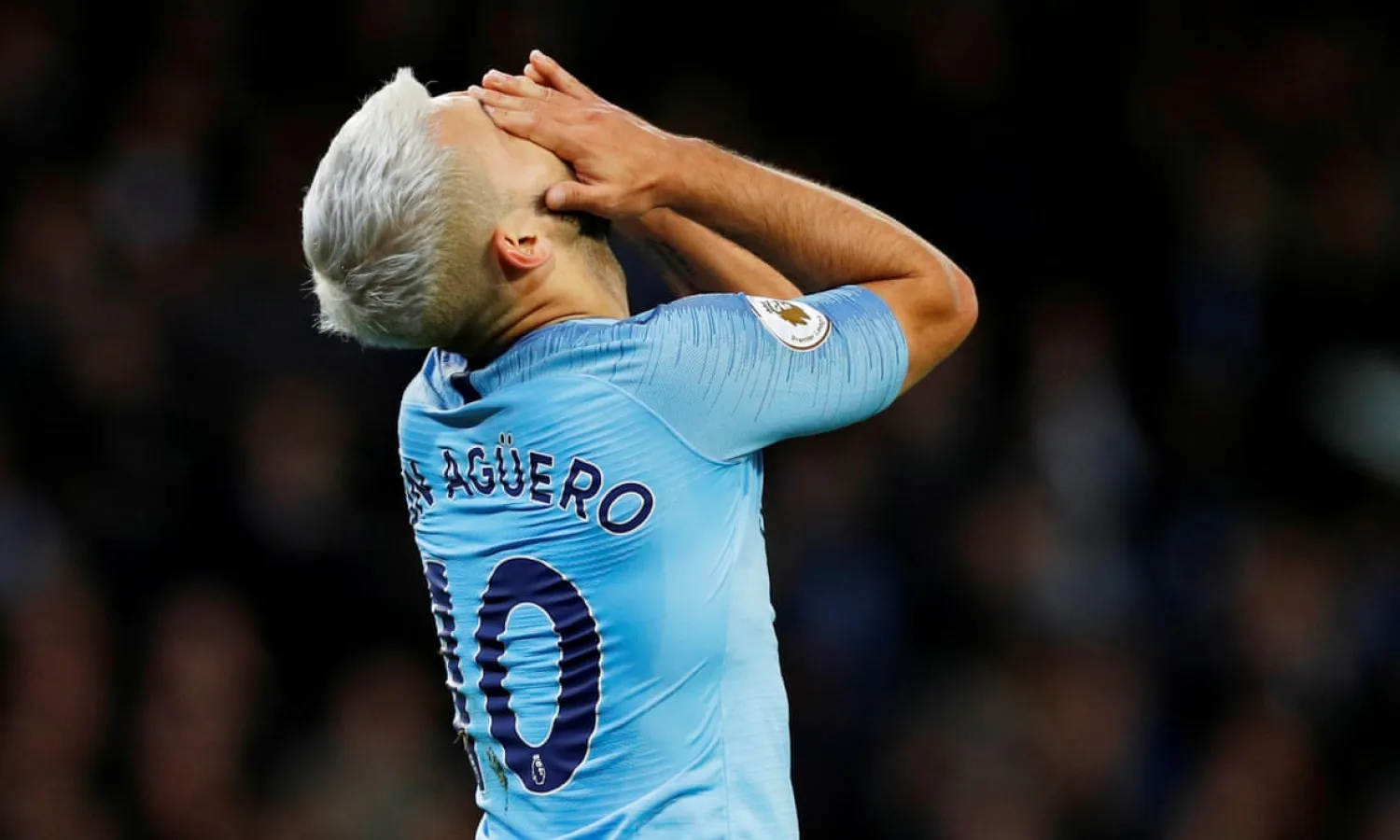
Sergio Agüero is one of a number of key Manchester City players who will be out of contract next summer. Photograph: Phil Noble/Reuters
TT

Manchester City Now Look Like a Butterfly in Danger of Having Its Wings Picked Off

Sergio Agüero is one of a number of key Manchester City players who will be out of contract next summer. Photograph: Phil Noble/Reuters

And it’s all over now, baby blue. At a stroke of Uefa’s judicial hand Manchester City have been transformed into an outlaw team. From here the future looks not just uncertain, but fraught with peril.

It is impossible to predict the endgame of Uefa’s startling decision to ban the reigning English champions from European competitions for two seasons. For City supporters the response will no doubt be one of weary defiance. Perhaps there might be some gallows consolation to be found in the fact history suggests they don’t stand to lose too much in any case.

A few desultory midweek home games. A VAR-inspired outrage, with attendant basement conspiracy theories. A quarter-final defeat to a heavyweight European power where Pep Guardiola gets the tactics wrong and sits looking sad and frail in his dugout.

At the very least the home leg against Real Madrid next month should generate a bit of atmosphere. The edicts on not booing the Uefa anthem will no doubt be strictly observed.

This feels like a much wider tipping point for European club football, for a particular model of ownership and, above all, for the management and playing personnel at the Etihad. City have been a wonderful champion team. Right now they look like a butterfly in danger of having its wings picked off.

City’s hierarchy will appeal against the ban and fine, no doubt with the same contemptuous aggression they have contested these financial charges from the start. Billionaires, let the record note, really don’t like being told what to do.

But barring some unusually rapid judicial process, it is hard to see exactly how they can hope to keep Guardiola. There has been a feeling the manager might be on his way. This is an issue that will take some time to settle. More immediate, and indeed related, is the question of how City hope to go on paying their players.

There has been something oddly reckless about this project from the start, the sense of a beautiful team running on air. Never apologize, never explain: even relative failure this season in the league has come on Guardiola’s own terms, with the refusal to go through the prosaic business of strengthening his defense, in the process also weakening his team’s midfield.

For all the good husbandry and good habits, the fine coaching, the refusal to splurge on superstars, City have still spent £340m net in transfer fees since Guardiola has been at the club, and hundreds of millions before that, all the while failing to produce a single homegrown first-team regular. Was it ever sustainable? Javier Tebas, the president of La Liga, might just have had a point all along. The numbers really don’t add up.

On one side of this equation City have the third-highest wage bill in world football at £300m. At the same time City have the fifth-largest income. Take out that self-fuelling Etihad sponsorship deal and they’re back in eighth. An inability to grow their commercial income has been the sticking point.

The grace note is the growth in broadcast income. Crucially it is here City stand to lose under the Uefa ban. Third in wages, fifth in income might look wonky but without their Uefa income the balance goes through the floor, with some estimates suggesting a loss of European football could cost between £100m-£150m per year.

This would leave an apocalyptic hole, one that makes the current squad simply unsustainable. City recently handed new deals to a rump of first-team regulars, which hardly eases the basic problem of how to keep the lights on.

Perhaps worse, a significant number of City’s most desirable assets will enter the last two years of their deals during the ban. Fernandinho, Leroy Sané, and Sergio Agüero are all out of contract in June 2021. Gabriel Jesus, Riyad Mahrez, Raheem Sterling, Kevin De Bruyne and Ilkay Gündogan are free to leave in 2023.

Good luck trying to persuade a crop of high-class, mid-career elite level players to miss two years of top-table football. Plus agents come into this. Contracts will contain force majeure clauses. Nobody wants to become cold product or to lose the bonuses associated with the Champions League.

At the same time the squad is aging. City’s best midfielder is 34, their best striker 31. This was always looking like a time to rebuild. Instead it looks like a moment of total flux.

There aren’t enough takers out there to house all of these supremely well-paid players, raising the vague threat of an unseemly jostle for the door, of expedient loans, of captive princes on draining contracts.

If the ban sticks it is hard to see past this disaster scenario. The greatest decade in Manchester City’s modern history is over. They’ll be going round this town shouting “bring out your dead”.

A little dramatic perhaps. We are some way off this. But no doubt plenty will cheer at the prospect and not only for tribal reasons. There is an argument FPP shouldn’t exist at all, the suggestion any kind of restraint or protectionism is simply pulling up the rope ladder.

Slightly absurd arguments have been made that the state-funded entity that owns City is being unfairly excluded from sport’s global elite, that it should be able to storm its way instantly to the top table simply by virtue of possessing unanswerable fossil fuel revenues. It is the kind of view you can only entertain if, at bottom, you really do like billionaires.

These arguments will be tested, by implication, at the court of arbitration for sport. City may be exonerated. For now the rules exist and City have been held to have broken them, in a notably graceless manner.

As such their success will be tainted, achievements that have out of necessity deprived others of glory, spending that has inflated the market, unsettled players, depleted opponents.

But whatever the morality here – and history will withhold its verdict for now — it is impossible not to feel a note of sadness. For all the surrounding murk and the money spent, the rules bent, the arrogance of the club hierarchy, City under Guardiola have also been the most beautiful team of the Premier League era.

Forget the stain of over-spending. We’ll always have that 100-point season. We’ll always have 15-0 across eight days against Liverpool, Feyenoord, and Watford. We’ll always have that 44-pass goal against Manchester United, almost 1,000 passes against Swansea, the way the ball seems to become a living, mischievous thing, skittering about between the light blue shapes in a shared, rotational choreography.

We’ll always have that moment at the Etihad last February against Chelsea where Agüero scored a goal so stunning – an explosive moment of skill, but also a kind of coronation for his team – that the whole ground fell silent for a second, then broke into a swell of gentle applause as the replay appeared on the big screen.

This isn’t over. Billionaires don’t like to lose. City’s statement in reply to the judgment has its own notes of vengefulness, a firm hint that this process has by no means run its course. Let’s remember the best of that City team, and with kindness too. In the most practical sense, we may not see their like again.

(The Guardian)


Shakhtar Boss Pays Ukrainian Racer $200,000 After Games Disqualification

Ukrainian President Volodymyr Zelenskiy holds helmet as he meets with a Ukrainian skeleton racer Vladyslav Heraskevych , who was disqualified from the Olympic skeleton competition over his "helmet of remembrance" depicting athletes killed since Russia's invasion and his father and coach, Mykhailo Heraskevych, amid Russia's attack on Ukraine, in Munich, Germany February 13, 2026. (Ukrainian Presidential Press Service/Handout via Reuters)
TT

Shakhtar Boss Pays Ukrainian Racer $200,000 After Games Disqualification

Ukrainian President Volodymyr Zelenskiy holds helmet as he meets with a Ukrainian skeleton racer Vladyslav Heraskevych , who was disqualified from the Olympic skeleton competition over his "helmet of remembrance" depicting athletes killed since Russia's invasion and his father and coach, Mykhailo Heraskevych, amid Russia's attack on Ukraine, in Munich, Germany February 13, 2026. (Ukrainian Presidential Press Service/Handout via Reuters)

The owner of ‌Ukrainian football club Shakhtar Donetsk has donated more than $200,000 to skeleton racer Vladyslav Heraskevych after the athlete was disqualified from the Milano Cortina Winter Games before competing over the use of a helmet depicting Ukrainian athletes killed in the war with Russia, the club said on Tuesday.

The 27-year-old Heraskevych was disqualified last week when the International Bobsleigh and Skeleton Federation jury ruled that imagery on the helmet — depicting athletes killed since Russia invaded Ukraine in 2022 — breached rules on athletes' expression at ‌the Games.

He ‌then lost an appeal at the Court ‌of ⁠Arbitration for Sport hours ⁠before the final two runs of his competition, having missed the first two runs due to his disqualification.

Heraskevych had been allowed to train with the helmet that displayed the faces of 24 dead Ukrainian athletes for several days in Cortina d'Ampezzo where the sliding center is, but the International Olympic Committee then ⁠warned him a day before his competition ‌started that he could not wear ‌it there.

“Vlad Heraskevych was denied the opportunity to compete for victory ‌at the Olympic Games, yet he returns to Ukraine a ‌true winner," Shakhtar President Rinat Akhmetov said in a club statement.

"The respect and pride he has earned among Ukrainians through his actions are the highest reward. At the same time, I want him to ‌have enough energy and resources to continue his sporting career, as well as to fight ⁠for truth, freedom ⁠and the remembrance of those who gave their lives for Ukraine," he said.

The amount is equal to the prize money Ukraine pays athletes who win a gold medal at the Games.

The case dominated headlines early on at the Olympics, with IOC President Kirsty Coventry meeting Heraskevych on Thursday morning at the sliding venue in a failed last-minute attempt to broker a compromise.

The IOC suggested he wear a black armband and display the helmet before and after the race, but said using it in competition breached rules on keeping politics off fields of play. Heraskevych also earned praise from Ukraine President Volodymyr Zelenskiy.


Speed Skating-Italy Clinch Shock Men’s Team Pursuit Gold, Canada Successfully Defend Women’s Title

 Team Italy with Davide Ghiotto, Andrea Giovannini, Michele Malfatti, celebrate winning the gold medal on the podium of the men's team pursuit speed skating race at the 2026 Winter Olympics, in Milan, Italy, Tuesday, Feb. 17, 2026. (AP)
Team Italy with Davide Ghiotto, Andrea Giovannini, Michele Malfatti, celebrate winning the gold medal on the podium of the men's team pursuit speed skating race at the 2026 Winter Olympics, in Milan, Italy, Tuesday, Feb. 17, 2026. (AP)
TT

Speed Skating-Italy Clinch Shock Men’s Team Pursuit Gold, Canada Successfully Defend Women’s Title

 Team Italy with Davide Ghiotto, Andrea Giovannini, Michele Malfatti, celebrate winning the gold medal on the podium of the men's team pursuit speed skating race at the 2026 Winter Olympics, in Milan, Italy, Tuesday, Feb. 17, 2026. (AP)
Team Italy with Davide Ghiotto, Andrea Giovannini, Michele Malfatti, celebrate winning the gold medal on the podium of the men's team pursuit speed skating race at the 2026 Winter Olympics, in Milan, Italy, Tuesday, Feb. 17, 2026. (AP)

An inspired Italy delighted the home crowd with a stunning victory in the Olympic men's team pursuit final as

Canada's Ivanie Blondin, Valerie Maltais and Isabelle Weidemann delivered another seamless performance to beat the Netherlands in the women's event and retain their title ‌on Tuesday.

Italy's ‌men upset the US who ‌arrived ⁠at the Games ⁠as world champions and gold medal favorites.

Spurred on by double Olympic champion Francesca Lollobrigida, the Italian team of Davide Ghiotto, Andrea Giovannini and Michele Malfatti electrified a frenzied arena as they stormed ⁠to a time of three ‌minutes 39.20 seconds - ‌a commanding 4.51 seconds clear of the ‌Americans with China taking bronze.

The roar inside ‌the venue as Italy powered home was thunderous as the crowd rose to their feet, cheering the host nation to one ‌of their most special golds of a highly successful Games.

Canada's women ⁠crossed ⁠the line 0.96 seconds ahead of the Netherlands, stopping the clock at two minutes 55.81 seconds, and

Japan rounded out the women's podium by beating the US in the Final B.

It was only Canada's third gold medal of the Games, following Mikael Kingsbury's win in men's dual moguls and Megan Oldham's victory in women's freeski big air.


Lindsey Vonn Back in US Following Crash in Olympic Downhill 

Milano Cortina 2026 Olympics - Alpine Skiing - Women's Downhill 3rd Official Training - Tofane Alpine Skiing Centre, Belluno, Italy - February 07, 2026. Lindsey Vonn of United States in action during training. (Reuters)
TT

Lindsey Vonn Back in US Following Crash in Olympic Downhill 

Milano Cortina 2026 Olympics - Alpine Skiing - Women's Downhill 3rd Official Training - Tofane Alpine Skiing Centre, Belluno, Italy - February 07, 2026. Lindsey Vonn of United States in action during training. (Reuters)

Lindsey Vonn is back home in the US following a week of treatment at a hospital in Italy after breaking her left leg in the Olympic downhill at the Milan Cortina Games.

“Haven’t stood on my feet in over a week... been in a hospital bed immobile since my race. And although I’m not yet able to stand, being back on home soil feels amazing,” Vonn posted on X with an American flag emoji. “Huge thank you to everyone in Italy for taking good care of me.”

The 41-year-old Vonn suffered a complex tibia fracture that has already been operated on multiple times following her Feb. 8 crash. She has said she'll need more surgery in the US.

Nine days before her fall in Cortina d'Ampezzo, Italy, Vonn ruptured the ACL in her left knee in another crash in Switzerland.

Even before then, all eyes had been on her as the feel-good story heading into the Olympics for her comeback after nearly six years of retirement.
