


The World's Largest Facility For Birds of Prey in Abu Dhabi

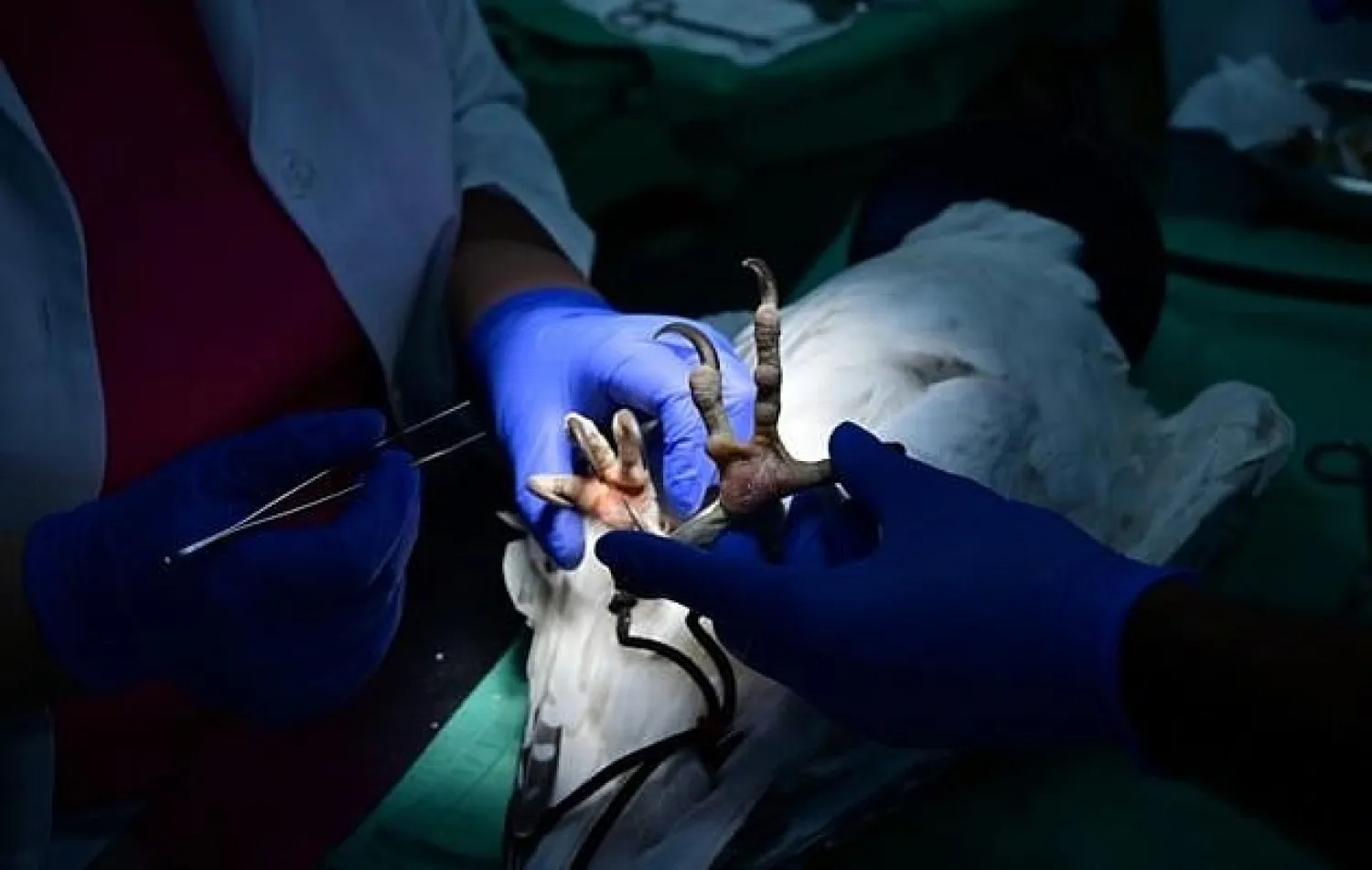
The Abu Dhabi falcon hospital performs complicated avian surgery, and routine talon trimming procedures. AFP
TT

The World's Largest Facility For Birds of Prey in Abu Dhabi

The Abu Dhabi falcon hospital performs complicated avian surgery, and routine talon trimming procedures. AFP

Eid al-Qobeissy's two birds perch majestically in the waiting room of Abu Dhabi's falcon hospital, awaiting a routine check-up ahead of their hunting trip to Azerbaijan.

Like other well-travelled residents of the United Arab Emirates, the falcons will make the journey with their devoted owner on a well-worn route from a country where the creature is both a national symbol and treasured tradition.

In 2010, UNESCO added falconry to its list of Intangible Cultural Heritage of Humanity.

"This has been a hobby of mine since 2007," said the 26-year-old, gently stroking one of the prized birds of prey, which wear leather hoods to keep them calm and quiet.

After waiting in the pristine white-marbled reception area of the animal hospital, the falcons will undergo blood tests in order to complete paperwork for the trip.

They are among about 11,000 falcons the hospital treats annually, a number that has more than doubled in the past 10 years.

"Falcons have a very special place in the heart of the Emiratis," said the hospital's director Margit Muller.

"Here, falcons are not considered birds, they are considered children of the Bedouins because, historically, falcons were used to hunt meat, allowing the Bedouin´s family to survive in this very harsh desert life."

The Abu Dhabi facility is the world's largest falcon hospital, frequented by falconers from across the Gulf region, AFP reported.

While the hospital has its own programme and facilities to breed falcons that can be purchased, most of the birds are imported to the UAE from breeders in the Americas and Europe.

"They stay with the falconer for as long as they live," Muller said. "They will not be released because they are captive-bred falcons."

Muller added that the most sought-after and expensive falcons are females, which can carry up to five times their own body weight. They are also considered the most beautiful.

"The female is usually one third bigger than the male, and more powerful," she said, adding that captive-bred female falcons can cost upwards of 100,000 euros ($108,000).

As well as check-ups and routine trimming of talons, it also conducts complicated surgery and offers a training programme for veterinary students from more than 40 countries to learn about avian medicine.

"The very complicated procedures are either broken legs or broken wings, or when a falcon has a really messy accident that results in big injuries," Muller said.

"Very long surgeries... can take up to three or four hours. That is the longest we can keep a falcon under anaesthesia."

Opportunities to take a falcon hunting are limited in the UAE, where it is only permitted in designated reserves, which means that for many birds, the hospital is an essential stop-off before heading to popular overseas hunting destinations including Morocco, Kazakhstan and Pakistan.

Emirati falconers are only legally allowed to own captive-bred birds, which must have their own passports that comply with the Convention on International Trade in Endangered Species of Wild Fauna and Flora (CITES) for transport.

Animals other than guide dogs are not usually allowed in the cabins of the UAE's main carriers, but for falcons exceptions are made.

Abu Dhabi's Etihad permits falcons in the cabin or as checked baggage, and Dubai's Emirates allows birds to travel alongside their owner to certain destinations in Pakistan.

"The most popular destination for falconers travelling with their falcons in the passenger cabin is Pakistan," an Emirates spokeswoman told AFP.

For falconer Salem al-Mansouri from Abu Dhabi, the tradition is much more than an expensive pastime -- it is a symbol of Emirati culture.

"Falcons were used to hunt, and you can say that it was the only method for hunting for survival, especially when travelling long distances hundreds of years ago," the 30-year-old told AFP.

"We inherited it from our grandfathers and fathers, who taught us, and now we teach the next generation."


In Europe First, Netherlands to Allow Teslas to Self-Drive

01 September 2025, Brandenburg, Gruenheide: The Tesla logo is seen on a vehicle at the Tesla Gigafactory Berlin-Brandenburg. (dpa)
TT

In Europe First, Netherlands to Allow Teslas to Self-Drive

01 September 2025, Brandenburg, Gruenheide: The Tesla logo is seen on a vehicle at the Tesla Gigafactory Berlin-Brandenburg. (dpa)

In a first for Europe, the Netherlands is poised to allow Tesla owners to use their car's self-driving feature -- as long as they are in the vehicle and keeping a watchful eye over it.

The country's RDW agency for roadworthiness certifications said in a statement late Friday: "Thanks to the type approval, the driver assistance system can now be used in the Netherlands, with possible future expansion to all member states of the European Union."

The move aligns the Netherlands with what is allowed in the United States, where Tesla owners can already use the Full Self-Driving (Supervised) (FSD Supervised) function in the cars.

That mode hands over driving to the Tesla's computer system, including steering, braking, route navigation and parking, all under the active supervision of the driver, who remains at the controls ready to take over if needed.

The European subsidiary of Tesla, the electric-vehicle company run by the world's richest person, Elon Musk, hailed the Netherlands' move.

"FSD Supervised has been approved in the Netherlands & will begin rolling out in the country shortly!" it said on X.

"No other vehicle can do this. We're excited to bring FSD Supervised to more European countries soon."

The Dutch RDW agency stressed the difference between FSD Supervised, with a human remaining at the controls, and full autonomous driving.

"A vehicle with FSD Supervised is not self-driving. It is a driver assistance system, and the driver remains responsible and must always maintain control," it said.

RDW's decision has to go to the European Commission for authorization, so that its national certification has EU weight.

Tesla sales have been facing headwinds in Europe -- including in the Netherlands -- in the last couple of years.

Potential clients have turned off by Musk's political activism supporting hard-right politics in the US and Germany, while the brand is also facing increased competition from Chinese electric vehicle manufacturers.


'A Perfect Mission': Artemis II Astronauts Return to Earth

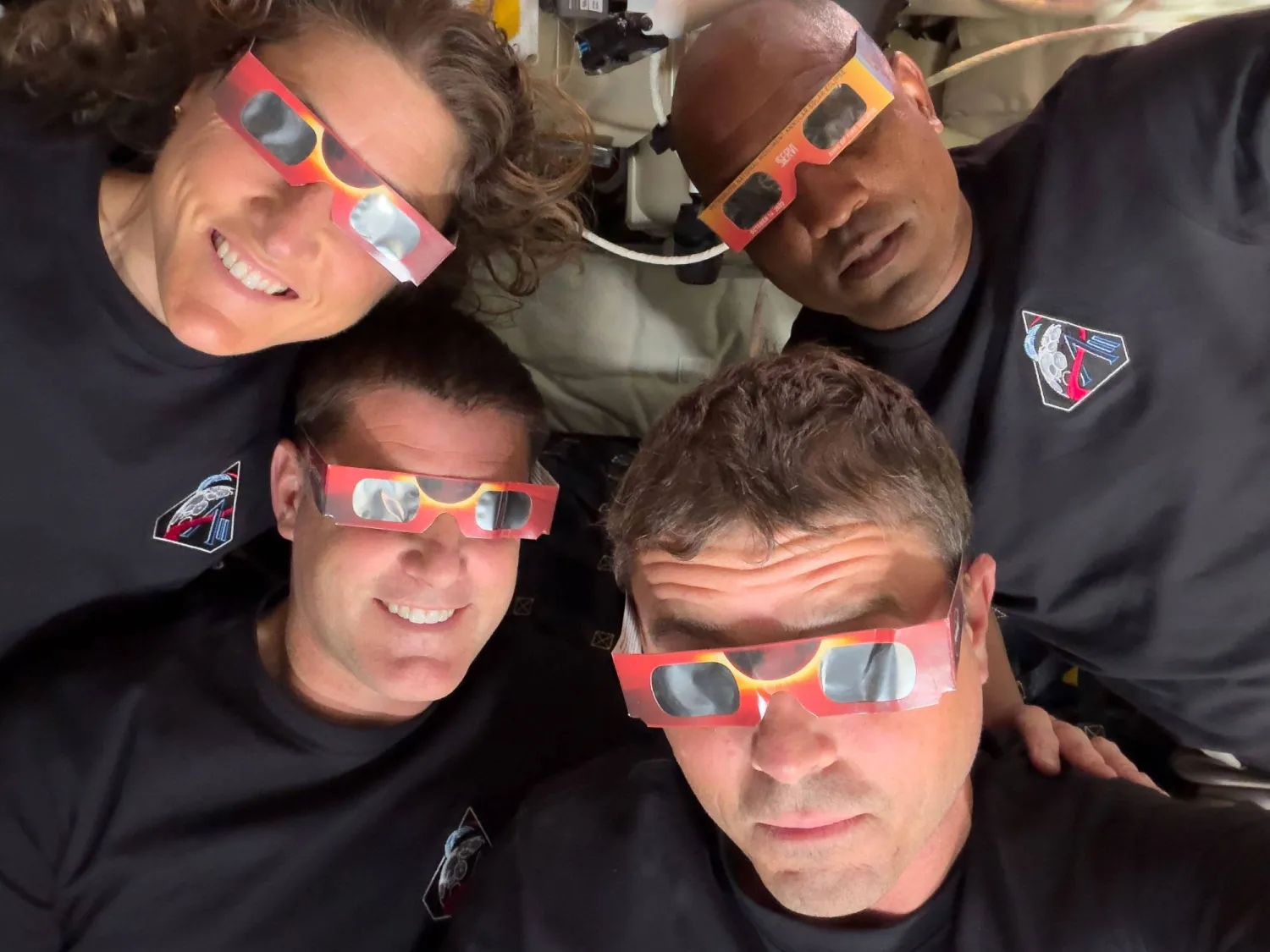
In this image provided by NASA, the Artemis II crew, counterclockwise from top left, Mission Specialist Christina Koch, Mission Specialist Jeremy Hansen, Commander Reid Wiseman, and Pilot Victor Glover pose with eclipse viewers during a lunar flyby, Monday, April 6, 2026. (NASA via AP)
TT

'A Perfect Mission': Artemis II Astronauts Return to Earth

In this image provided by NASA, the Artemis II crew, counterclockwise from top left, Mission Specialist Christina Koch, Mission Specialist Jeremy Hansen, Commander Reid Wiseman, and Pilot Victor Glover pose with eclipse viewers during a lunar flyby, Monday, April 6, 2026. (NASA via AP)

An elated NASA late Friday was celebrating its successful voyage around the Moon, after four astronauts safely returned to Earth having completed the first lunar flyby in more than 50 years.

The NASA spacecraft carrying four astronauts -- three Americans and one Canadian -- splashed down without a hitch off the California coast, capping the US space agency's crewed test mission that returned with spectacular images of the Moon, said AFP.

"What a journey," said mission commander Reid Wiseman, who reported that the crewmembers -- himself along with Christina Koch, Victor Glover and Jeremy Hansen -- were "stable" and "green."

"They're in great condition, that's what that means," said Rob Navias, the NASA public affairs official who narrated their return on the agency's livestream.

Following an expected but nerve-wracking communications blackout during their high-stakes re-entry, Wiseman's voice triggered relief that the astronauts were well on their way back home.

"We have you loud and clear," he said following a voice check from mission control in Houston.

NASA personnel and the US military helped extract the astronauts from the bobbing capsule -- to the applause of those watching from mission control.

By late Friday, helicopters had lifted the astronauts to a recovery ship off the Pacific coast near San Diego, where they all proved capable of walking unassisted.

NASA administrator Jared Isaacman called the voyage "a perfect mission."

"We're back in the business of sending astronauts to the Moon," he said, and "this is just the beginning."

- 'A great day' -

As the astronauts returned to Earth their spacecraft reached maximum speeds more than 30 times the speed of sound, and faced searing temperatures around half as hot as the surface of the Sun.

It was a key test of their heat shield, which in an earlier trial uncrewed mission had faced complications that they attempted to mitigate this time around by shifting the return trajectory.

"If you didn't have anxiety bringing this spacecraft home, you probably didn't have a pulse," said flight director Rick Henfling.

But the Artemis II re-entry was smooth sailing.

The Orion capsule will now be painstakingly examined to assess how it fared.

US President Donald Trump praised the astronauts for their "spectacular" trip and said he "could not be more proud" -- while wasting no time in looking ahead to the eventual goal of sending missions even further into space.

"Next step, Mars!" he wrote on social media.

Artemis II was the inaugural crewed mission of NASA's program aiming to install a sustained presence on the Moon, including the eventual construction of a base that could be used for further exploration including to Mars.

- 'Fresh confidence' -

From liftoff to splashdown, the trip clocked in at nine days, one hour, 31 minutes and 35 seconds -- though NASA rounds up and calls it a 10-day mission.

It began with a dramatic launch from Florida on April 1, and was studded with firsts, records and extraordinary moments.

The four astronauts become the humans to travel furthest away from the Earth, at 252,756 miles (406,771 kilometers).

While hurtling through deep space and zipping around the Moon they took thousands of photographs, amassing a stunning portfolio of images that captivated people on Earth.

They also witnessed a solar eclipse along with extraordinary meteorite strikes on the lunar surface.

Several achievements added to the voyage's historic nature: Glover was the first person of color to fly around the Moon, Koch was the first woman, and Canadian Hansen the first non-American.

Astronomer Derek Buzasi of the University of Chicago called the mission "an almost flawless success."

"I admit to having had my doubts about the Artemis program, but now I have fresh confidence in our next steps as we go back to the Moon to stay," he told AFP.

- 'Eye on the prize' -

NASA is hoping it can put boots on the lunar surface as soon as 2028 -- the final full year of Trump's second White House term.

Experts, however, have voiced skepticism that the lunar landers being developed by SpaceX and Blue Origin, companies owned by billionaires Elon Musk and Jeff Bezos respectively, will be ready in time.

China, meanwhile, is forging ahead with its own effort targeting 2030 to put astronauts on the Moon.

In the meantime, NASA is hoping to capitalize on the Artemis II mission's success to drum up excitement about space exploration.

Clayton Swope, a space policy expert at of the Center for Strategic and International Studies, told AFP that the mission stands as "proof that when America keeps its eye on the prize, it can still do very great things."


Sleepy Seal Diverts Traffic in Australian Seaside Town

This frame grab from handout video footage by Laura Ellen taken on April 10, 2026 shows traffic along a road in the seaside Australian town of Dromana, located south of Melbourne in the southern state of Victoria, that was briefly diverted after a local seal decided to take a nap. (Photo by Handout / LAURA ELLEN / AFP)
TT

Sleepy Seal Diverts Traffic in Australian Seaside Town

This frame grab from handout video footage by Laura Ellen taken on April 10, 2026 shows traffic along a road in the seaside Australian town of Dromana, located south of Melbourne in the southern state of Victoria, that was briefly diverted after a local seal decided to take a nap. (Photo by Handout / LAURA ELLEN / AFP)

Traffic in a seaside Australian town was briefly diverted on Friday when a local seal decided to take a nap on the road.

The dozy pinniped was spotted snoozing on a road in Dromana in the southern state of Victoria.

Local police placed cones around the seal -- known to some locals as Sammy -- who could be seen sunning himself with little concern for the traffic.

"You don't know where he will pop up next," local Laura Ellen, who spotted the slumbering animal, told AFP.

"He usually sleeps all day," she said.

"It made me laugh when I saw him on the road. Haven't seen him do that before."

The seal was later redirected back to the beach by wildlife rescuers and the lane was re-opened.

Seals are a common sight along Victoria's coast and it is illegal to touch or feed them, the state government says.