
Iran… And The Policies of Domination In Iraq

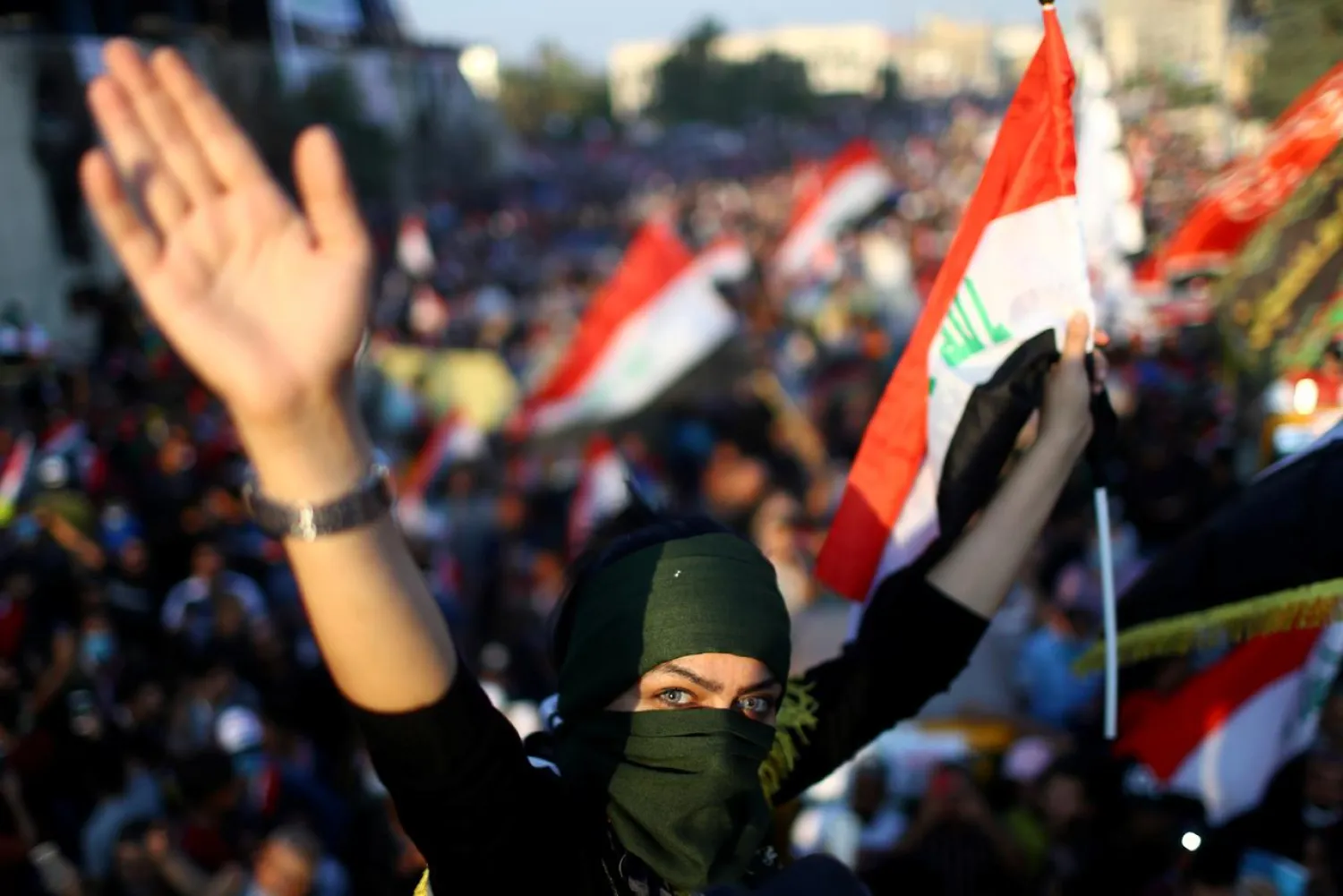
An Iraqi female demonstrator attends the ongoing anti-government protests in Baghdad, Iraq November 1, 2019. REUTERS/Ahmed Jadallah
TT

Iran… And The Policies of Domination In Iraq

An Iraqi female demonstrator attends the ongoing anti-government protests in Baghdad, Iraq November 1, 2019. REUTERS/Ahmed Jadallah

After a painful and agonizing eight-year war with Iraq, Iran worked to rebuild its industrial, economic, scientific, and military infrastructure, which the war heavily destroyed, and to engage in formulating a new strategy throughout the region, based on deterring threats from neighboring countries or the Middle East.

In other words, the Persian state sought relentlessly and thoughtfully to expand its influence in several directions, in order to prevent the recurrence of any scenario that would endanger the Islamic revolution and its ruling regime.

The country was lucky enough in 2003 when its interests converged with Washington’s decision to topple Saddam Hussein’s regime. Here, Iran had a golden opportunity to interfere in Iraqi affairs and work to consolidate Shiite influence in it.

Iran began expanding the base of the Shiite political forces inside Iraq and devoted all its political, security and financial efforts to achieving this goal. It drove on several parallel axes to influence and try to control the Iraqi decision, by engaging directly with the new Iraqi leaders who supported it when they were in the opposition.

When ISIS came out in 2014, occupied about a third of Iraq’s area and tightened its control over major cities in the north, west, and central Iraq, Tehran was quick to provide the country with weapons, equipment, experts, and advisers.

Led by General Qassem Soleimani, the commander of the Iranian Quds Force, the war against ISIS was fought by the Popular Mobilization Forces, which are mostly armed factions loyal to Tehran.

Soleimani was the spiritual father and the military and ideological commander of these factions.

When the war ended, some of these factions turned into political movements, with the aim to expand the base of Shiite sympathizers with Tehran. Those participated in the 2018 elections and won, as expected, due to two factors: the Iraqi street acknowledging their role in eliminating the threat of ISIS, and the unlimited Iranian support they received during the electoral race.

The new movement enjoyed a wide and influential representation in the Iraqi parliament, and it was not satisfied with that; rather, it hurried to form a strong coalition gathering about 45 seats. This coalition was the nucleus of a larger alliance – Al-Binaa, which is now leading the Iraqi political scene.

Obviously, Al-Binaa Alliance had a great role in choosing the speaker of parliament and naming the prime minister. It also worked on enacting a new law for a new military institution - the Popular Mobilization Authority – to which it earmarked a large budget as of 2019.

The components and factions within Al-Binaa also acquired an abundant share of ministerial seats, positions, and senior ranks in the country. This contributed greatly to strengthening economic ties with Tehran, and the volume of Iranian exports to Iraq reached about $15 billion.

When the dispute between the US and Iran intensified following the missile attack that targeted Qassem Soleimani and Vice President of the Popular Mobilization Authority, Abu Mahdi Al-Muhandis, near Baghdad International Airport, Al-Binaa Alliance adopted a parliamentary resolution calling for the exit of foreign forces from Iraq, specifically intended for US forces.

It is noteworthy that Iran has strong relations with other components, such as the Sunnis and the Kurds, and has close ties to some of the Sunni political forces and the ruling Kurdish parties. This allows it to serve its interests at the local and regional levels.

The Iranian influence equation changed after two important events: First, the unprecedented mass demonstrations erupting in Baghdad and the cities of central and southern Iraq in October 2019; second, the assassination of Soleimani and Al-Muhandis and their absence from the scene.

The repercussions of the first event reached the point of hearing loud chants from Iraqi youth in Shiite cities, foremost of which are both Najaf and Karbala, denouncing the Iranian presence and calling for its ousting.

On the other hand, the assassination of the two leaders greatly affected the strength of the Iranian presence inside the Iraqi arena, and it seemed difficult to find other figures to replace them and compensate for the significant influence they had in the Shiite and popular political circles.

Moreover, there is a difference of visions about the future of politics in Iraq, as Iran is based on the principle of Wilayat al-Faqih”- while the authority in Najaf does not agree with this approach.

Sayyed Ali Al-Sistani had previously opposed Iraq’s commitment to “Wilayat al-Faqih.” He worked hard to curb Iranian influence in Najaf and cut the way for Iraq to be implicated in Iran’s regional and international conflicts, through Friday sermons delivered by his representatives.

There is no doubt that Iran is now in the process of reviewing its regional policy, by drawing roles, identifying tools and creating new influencing factors...

More importantly, Tehran is studying how to deal with the Iraqi interior and the region in light of the ongoing conflict with the US, not to mention that the Iranian economy has become weaker than ever, and the people are suffering from both the regime policies and the repercussions of the US sanctions.

Therefore, the Iranian leadership is now reviewing its calculations - in Iraq in particular – which was reflected in its non-interference in the formation of the expected government of Muhammad Tawfiq Allawi, while its fingerprints were long seen in all successive Iraqi governments.


How the Yemeni Gov’t Handled Iran’s Sanaa Airport Escalation

Yemen’s armed forces claimed responsibility for targeting the runway at Sanaa airport to prevent the Iranian aircraft from landing. (EPA)
TT

How the Yemeni Gov’t Handled Iran’s Sanaa Airport Escalation

Yemen’s armed forces claimed responsibility for targeting the runway at Sanaa airport to prevent the Iranian aircraft from landing. (EPA)

Yemen’s leadership viewed an Iranian aircraft’s attempt to land at Sanaa airport last Monday as more than an aviation incident that could be overlooked to avoid further escalation.

It saw the attempted landing as a direct challenge to state sovereignty and an effort to impose a new political and military reality outside the country’s legitimate institutions at a time of unprecedented regional tension.

Unlike in previous crises, the government responded through a coordinated mix of calculated military action, organized political measures, and legal and diplomatic efforts. It also sought to avoid a wider confrontation that it believed Tehran wanted in order to turn Yemen once again into an arena for regional conflict.

From the first hours of the crisis, Yemen’s leadership emphasized a central message: defending sovereignty does not conflict with pursuing peace, and the state can enforce the law without abandoning its responsibility to protect civilians or preserve the prospects of a political settlement.

The targeting of Sanaa airport’s runway to prevent the Iranian aircraft from landing was therefore the final step in a long series of political and legal measures that preceded the use of force.

The government said it had exhausted all official channels to operate the airport and had offered alternatives to ensure the continuation of civilian flights via Yemenia Airways, the national carrier legally authorized to operate them.

What distinguished the government’s handling of the crisis was that it did not merely respond to the incident but also sought to shape the political narrative surrounding it.

From the outset, official statements stressed that the dispute was not over the operation of Sanaa airport or citizens’ ability to travel. It concerned an attempt to seize one of the state’s most important sovereign powers: control over its airspace and international ports of entry.

The Yemeni leadership repeatedly said the problem was not the aircraft itself, but the operation of international flights without the approval of the legitimate authorities, in violation of the Chicago Convention on International Civil Aviation and UN Security Council resolutions on Yemen.

The government also said it had proposed practical solutions before the escalation, including transporting the Houthi delegation from Tehran aboard an aircraft chartered by Yemenia Airways.

It said the group rejected the offer, strengthening the government’s argument before the international community that it had resorted to force only after exhausting other options.

Presidential Leadership Council (PLC) Chairman Rashad al-Alimi said the priority was to protect civilian lives and public property and avoid widening the confrontation in a way that would serve Iran’s goal of drawing Yemen into regional conflicts.

The message was intended to reassure the public and show that the military decision remained subject to careful political calculations rather than emotional reactions.

The government’s continuous meetings and the formation of a national crisis-management team also reflected a shift toward a unified approach combining military, political, diplomatic and media efforts.

This gave the official response greater coherence than in previous crises.

Domestic, International Support

Observers say the Yemeni government also succeeded in turning the crisis from a confrontation between itself and the Houthis into an issue concerning respect for the sovereignty of a UN member state.

Domestically, the House of Representatives, the Shura Council, the Consultation and Reconciliation Commission and the National Bloc of Political Parties and Components quickly declared their full support for the measures taken by the PLC.

They described the incident as a violation of Yemeni sovereignty rather than merely a political dispute.

The significance of this alignment was that it came from official institutions and political parties affiliated with the legitimate authorities, giving the leadership political cover against attempts to portray it as lacking internal consensus in its handling of the crisis.

Internationally, Yemen’s diplomatic efforts appeared to have preceded the UN Security Council meeting, after the government succeeded in persuading several major powers to adopt positions close to its account of the incident.

The United States described the Iranian landing as a violation of Yemeni sovereignty and linked it to the possible transfer of military experts and equipment to the Houthis, saying this would breach Security Council resolutions.

Britain said any flights conducted without the approval of the legitimate government constituted a violation of international law and called for an investigation through UN mechanisms.

France went further, linking the incident to what it described as Iran’s destabilizing conduct in the region.

It renewed its call for an end to the transfer of military equipment to the Houthis while reaffirming its support for Yemen’s unity and sovereignty.

Although the United Nations maintained its traditional call for de-escalation, it also stressed the need to respect Yemen’s unity, sovereignty and territorial integrity, giving the government additional political support in defending its position.

Multiple Messages

The legitimate Yemeni authorities’ handling of the Iranian aircraft crisis can be seen as an attempt to deliver three parallel messages.

The first was directed at Iran: Yemen was no longer an open arena where new realities could be imposed through air traffic or sovereign ports of entry, and any attempt to bypass state institutions would face practical measures, even as the government remained committed to peace.

The second message was aimed at the Houthis: using civilian suffering or Sanaa airport as political leverage would not lead to recognition of authorities operating in parallel to the state.

The government would not allow sovereign powers to be established outside its institutions.

The third message had an international dimension.

The government called on the Security Council to move from condemnation to deterrence by strictly enforcing sanctions and council resolutions, particularly resolutions 2140 and 2216.

It said continued tolerance of violations would encourage their repetition.

Despite the political and diplomatic gains achieved by the legitimate authorities, however, the crisis has not ended in practical terms.

It remains tied to the international community’s ability to translate condemnation into measures that prevent similar incidents and ensure respect for the Yemeni state’s sovereignty over all land, sea and air entry points.

The continuing efforts of UN envoy Hans Grundberg, alongside international positions supporting de-escalation, also reflect growing recognition that preserving the fragile truce requires addressing the roots of the crisis.

These include ending the Houthi coup and preventing humanitarian issues and sovereign ports of entry from being used as tools of conflict.

For the Yemeni government, observers say, the crisis was more a political test than a military one.

Through its response, it sought to establish a new equation: defending sovereignty does not contradict the pursuit of peace, and the state can combine restraint with resolve while respecting international law and asserting its authority.


How Could Growing Egypt-Türkiye Ties Shape Regional Conflicts?

Egyptian President Abdel Fattah El-Sisi and Turkish President Recep Tayyip Erdogan sign a military cooperation agreement in Cairo on Feb. 4. (Turkish Presidency)
TT

How Could Growing Egypt-Türkiye Ties Shape Regional Conflicts?

Egyptian President Abdel Fattah El-Sisi and Turkish President Recep Tayyip Erdogan sign a military cooperation agreement in Cairo on Feb. 4. (Turkish Presidency)

A series of high-level meetings between Egypt and Türkiye has culminated in the first visit by an Egyptian defense minister to Ankara in 13 years, raising questions about whether the two countries’ rapidly expanding ties could help ease conflicts across the Middle East.

The visit, which began Sunday, included the signing of a letter of intent on defense cooperation.

Experts interviewed by Asharq Al-Awsat differed, however, on the extent to which the rapprochement has translated into tangible gains. While some argued it has helped reduce tensions, particularly in Libya, others said it has yet to produce meaningful progress in the region’s major crises.

Türkiye and Egypt signed the defense cooperation letter on Monday following talks in Ankara between Turkish Defense Minister Yasar Guler and his Egyptian counterpart, Ashraf Salem Zaher.

The visit followed the conclusion of the Anatolian Eagle 2026 joint air exercise, which brought together the Egyptian, Turkish and Azerbaijani air forces, with the participation of a NATO airborne early warning aircraft. It also came after the fifth meeting of the Egyptian-Turkish Joint Military Committee.

The two countries held the inaugural meeting of their High-Level Strategic Cooperation Council during Egyptian President Abdel Fattah El-Sisi’s visit to Ankara in September 2024, after reviving the mechanism during Turkish President Recep Tayyip Erdogan’s visit to Cairo earlier that year.
A second council meeting in Cairo last February produced a joint statement highlighting closer positions on the Palestinian issue and the crises in Syria, Lebanon, Sudan, Somalia and the Sahel, as well as counterterrorism.

Bashir Abdel Fattah, a Türkiye affairs specialist at the Al-Ahram Center for Political and Strategic Studies, said the rapprochement had at least prevented confrontation in Libya, where Cairo and Ankara once backed rival interests.

He noted that the growing political understanding between the two countries has helped de-escalate the conflict and support efforts toward a political settlement that preserves Libya’s territorial integrity.

Türkiye analyst Mahmoud Alloush shared that assessment, describing Egyptian-Turkish coordination as a turning point in Libya and noting parallel efforts involving Saudi Arabia to advance a political solution.

Not everyone is convinced. Rokha Ahmed Hassan, a member of the Egyptian Council for Foreign Affairs, said expectations that Egyptian-Turkish understandings would help resolve Libya’s crisis have yet to be realized, largely because of divisions among Libyan parties.

He argued that while bilateral coordination has strengthened political dialogue across the Middle East and the Horn of Africa, it has not yet delivered concrete results.

On July 11, Egyptian Foreign Minister Badr Abdelatty and Turkish Foreign Minister Hakan Fidan agreed during a phone call to continue consultations on shared security concerns and work to prevent further military escalation in the region.

On Syria, Abdel Fattah said Cairo and Ankara agree on preserving the country’s unity despite differences over Türkiye’s military presence.

He stressed that expanding political and military coordination is creating the trust needed to address contentious issues, including Israeli actions in Syria, reconstruction and burden-sharing.

Hassan, however, said the rapprochement has yet to produce a positive impact on Syria because Cairo and Ankara continue to differ over Türkiye’s approach to Islamist groups.

The two countries are more closely aligned on Somalia. Hassan emphasized that their shared support for Somalia’s territorial integrity has had positive, albeit gradual, effects, though significant security challenges remain.

Alloush described Somalia as an example of “competitive cooperation,” arguing that managed competition between Egypt and Türkiye could ultimately strengthen stability there.

Abdel Fattah, for his part, noted that the emerging partnership provides a solid strategic framework that could help cool regional conflicts. He called for broader coordination with Saudi Arabia and Pakistan to curb destabilizing external interference and establish a regional order that better serves the interests of Middle Eastern states.

On June 21, El-Sisi called for institutionalizing the consultative mechanism bringing together Egypt, Saudi Arabia, Türkiye and Pakistan, which was launched three weeks after the outbreak of the US-Iran war in late February.


Ticking Time Bomb? Europe’s Ageing Population Brings Challenges

 A resident of a nursing home eats fruit to beat the heat in Munich, Germany, July 14, 2026. (Reuters)
A resident of a nursing home eats fruit to beat the heat in Munich, Germany, July 14, 2026. (Reuters)
TT

Ticking Time Bomb? Europe’s Ageing Population Brings Challenges

 A resident of a nursing home eats fruit to beat the heat in Munich, Germany, July 14, 2026. (Reuters)
A resident of a nursing home eats fruit to beat the heat in Munich, Germany, July 14, 2026. (Reuters)

The population of the 27-nation European Union will peak in 2029 before falling in the coming decades, according to a report published Tuesday that spotlights the major challenges the bloc faces from an ageing population.

Today there are 450.6 million people, but researchers say this will peak at 453.3 million in 2029 before a slow long-term decline.

The population will fall to 398.8 million people by 2100, an overall drop of 11.7 percent and a level that was last experienced in the 1970s.

Europeans are living longer than ever before thanks to vastly improved healthcare, and better life and social conditions.

But an ageing population poses challenges for society and the EU economy, and while migration could help, it's not the fix Europe might hope for.

The EU executive's Joint Research Center said life expectancy at birth reached 81.5 years in 2024.

By 2050, nearly one in three EU residents will be aged 65 or older, compared to one in five today, the center said.

By 2100, life expectancy could exceed 90 years for women and 86 for men.

Such trends present "significant challenges", the EU said, including labor shortages, strained public budgets, and pressure on care and education systems.

It is, however, not all negative as the report points to the rise of the "silver economy" -- a growing market for goods and services for older citizens.

- 'Migration is a necessity' -

Migration can help offset some effects of Europe's demographic change, the researchers said, but it would have a limited impact on "fully" addressing the challenges posed by an ageing population.

But as fertility rates fall, migration counterbalances the negative effects of an ageing population and labor force contraction, the report said.

"Migration is a necessity," EU commissioner Dubravka Suica told reporters.

Fewer babies are being born to each woman in Europe, a decline that has been steady since the 1960s.

The fertility rate fell to 1.34 children per woman in 2024, well below the replacement level of 2.1 needed to keep the population stable without migration.

The median age of a European was 44.9 in 2025, and there are major disparities between EU countries. Ireland is relatively young with a median age of 39.6 years while Italy's was 49.1.

"We are living longer, healthier lives than ever before -- one of our greatest achievements. But demographic change is reshaping our societies, our economies and our labor markets," Suica said in a statement.

"We must act now to turn this transformation into an opportunity," she added.

The EU insists the bloc must boost productivity and cut unemployment to offset the effects of a shrinking workforce.

Currently around 20 percent of working-age Europeans are outside the labor force, the report said, while some eight million young people are neither in employment, education nor training.

The situation is particular to Europe as the global population is not falling.

Population growth is increasingly concentrated in parts of Sub-Saharan Africa, South Asia and some Middle Eastern countries, the report said.