

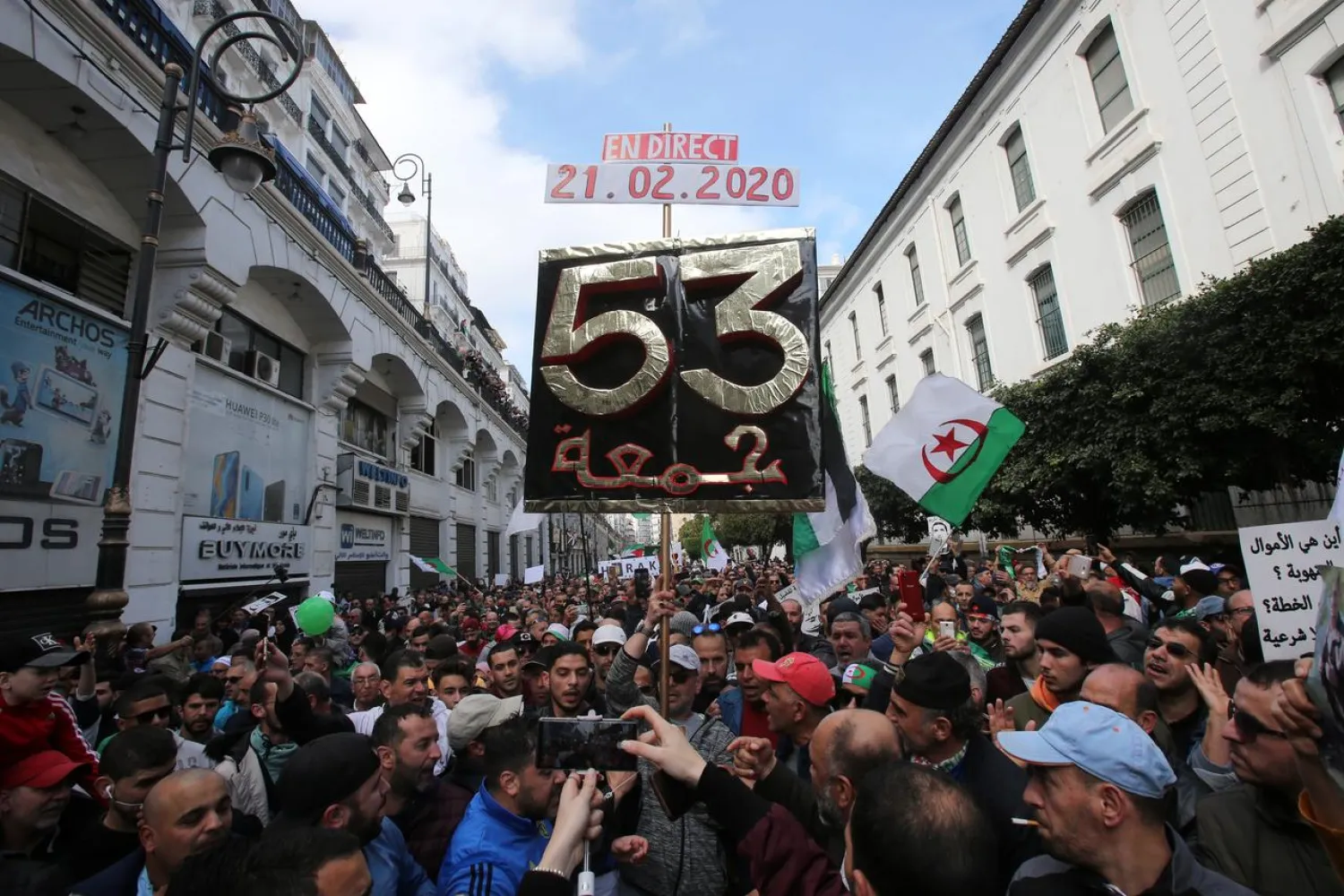

Algerians Flood Streets to Mark Protest Movement's First Birthday

A demonstrator holds up a banner during an anti-government protest in Algiers, Algeria February 21, 2020. (Reuters)
TT

Algerians Flood Streets to Mark Protest Movement's First Birthday

A demonstrator holds up a banner during an anti-government protest in Algiers, Algeria February 21, 2020. (Reuters)

Algerians flooded the capital's streets Friday to mark the first anniversary of a protest movement that has forced the president to quit but still clamors for the complete overhaul of the political system.

Protesters had called on Algerians to mobilize to "disqualify the system's agenda of self-renewal and to lay the foundations for a new republic".

A year ago on February 22, Algerians took to the streets to demonstrate against ailing president Abdelaziz Bouteflika's bid for a fifth term and have kept up their protests since.

By noon on the 53rd consecutive Friday of demonstrations, thousands of protesters, including women and children, gathered in front of the Grande Poste in central Algiers before marching in the capital.

Anti-riot police were deployed, but did not disperse the crowd, which chanted "we're not going to stop", AFP journalists reported.

A huge crowd of demonstrators linked up with the rally outside the central post office after setting off from the working class district of Bab El Oued, reporters said.

"We have not come to party, we have come to get rid of you," they chanted, in reference to politicians deemed corrupt and inefficient.

"The people want the fall of the regime."

Checkpoints were installed on roads into the city, according to social media posts, complicating access to the commemoration for Algerians outside the capital.

But this did not stop Bashir, 50, from travelling 150 kilometers (95 miles) from Ain Defla "to celebrate the first anniversary of (the protests) and to renew the movement's demands".

More demonstrations are expected on Saturday and the size of marches across the country will represent a key test of the spontaneous, leaderless and youth-dominated movement, known as "Hirak".

Protests were also taking place in major cities across Algeria, according to reports on social media.

'Continued mobilization'

Bouteflika, debilitated by a 2013 stroke, resigned in April last year less than six weeks into the protest movement after losing the support of the army amid mounting pressure from the street.

But despite hordes -- diplomats said "millions" -- turning out after he quit to demand an overhaul of the entire system, the military maintained a political stranglehold in the months that followed.

The election of Abdelmadjid Tebboune, once a prime minister under Bouteflika, as president in December appears to have reinforced the regime's hand and further stalled the protest movement.

But many boycotted the poll -- the official turnout was below 40 percent -- and demonstrators remain numerous.

On Thursday, Tebboune paid homage to the protest movement in an interview with local media, promising to implement "all of its demands" after it prevented the "total collapse" of the country.

But in a manifesto published Thursday, organizations close to the Hirak called for "continued mobilization" to force out members of the old guard, arguing that they could not oversee the process of reform.

They denounced the state taking "repressive measures" against journalists, activists and protesters.

Algerians "want their country ruled and managed with transparency" by "accountable officials, an independent judiciary and a parliament that is not a rubber stamp body", they wrote.

Challenges

Dalia Ghanem, a researcher at the Carnegie Middle East Center based in Beirut, argued little had changed in oil-rich Algeria since the presidential election.

"Soldiers have returned to their barracks, civilians are in power, so there is a democratic and constitutional facade," she said.

"Tebboune is just the civilian face of a regime that remains in the hands of the military" but "the capacity of the regime to adapt without really changing, and its resilience, will be tested in the coming years," she added.

Ghanem expected the government to dole out political handouts through limited reforms, but said an economic crisis caused by low oil prices will limit its largesse and hence its scope to maintain social peace.

The protest movement, meanwhile, has plenty of rethinking ahead, if it is to maintain momentum, analysts say.

Will it grasp Tebboune's extended hand and risk being swallowed up by the regime? Or does it need to gear up for an institutional game, with the risk of exposing its own divisions and contradictions?

Whatever the challenges ahead, the movement has already forced change on Algeria's political order in a context where real opposition was consistently hindered, gagged and co-opted during Bouteflika's two decades at the helm.

And above all, in maintaining an overwhelmingly peaceful line, the movement has "succeeded in ensuring there has been no bloody confrontation or brutal repression", said historian Karima Direche.

"A wall of fear... has been destroyed by this new, heavily politicized generation, which knows what it wants," she said.



Lebanon Says Israeli Strike Damages Hospital in Tyre as UN ‘Alarmed’ by Escalation

People gather at the site of an Israeli strike that hit near a hospital in the southern Lebanese city of Tyre on June 1, 2026. (AFP)
TT

Lebanon Says Israeli Strike Damages Hospital in Tyre as UN ‘Alarmed’ by Escalation

People gather at the site of an Israeli strike that hit near a hospital in the southern Lebanese city of Tyre on June 1, 2026. (AFP)

Lebanon said an Israeli strike hit near a hospital in the southern city of Tyre on Monday as the health ministry shared footage showing heavy damage to the facility.

The state-run National News Agency said a strike targeting an intersection near the Jabal Amel hospital "hit a building and the parking lot, resulting in a number of wounded".

The health ministry shared two videos showing damage inside a hospital ward, with rubble and debris on the ground, blown-out ceilings, blood on the floor and shattered glass, while smoke could be seen billowing from a fire at what appeared to be a heavily damaged adjacent car park.

The United Nations on Monday expressed its alarm and called for all sides to respect the ceasefire as Israel expanded its offensive into Lebanon, while negotiations to end the US-Iran war appeared in peril.

"We are deeply alarmed by the escalation in military activities across southern Lebanon and beyond," Stephane Dujarric, spokesman for UN Secretary-General Antonio Guterres, said.

"We urge all actors to respect the cessation of hostilities and avoid further escalation."


German, Norwegian Ministers in Abortive Beirut Trip

Cars sit in traffic on a highway as residents flee following an Israeli threat to strike Dahieh, Beirut's southern suburbs, Lebanon, Monday, June 1, 2026. (AP)
TT

German, Norwegian Ministers in Abortive Beirut Trip

Cars sit in traffic on a highway as residents flee following an Israeli threat to strike Dahieh, Beirut's southern suburbs, Lebanon, Monday, June 1, 2026. (AP)

Ministers from Germany and Norway had to call off a trip to Beirut on Monday as Israel continued its assault on the city, the pair's press services said.

German minister for international development Reem Alabali Radovan and Norwegian counterpart Asmund Aukrust had to abort and head back to Berlin "for military reasons" as they approached Beirut airport owing to a "rapidly worsening situation," a spokesperson for Alabali Radovan told AFP.

The ministers had hoped to make the visit to show solidarity with the Lebanese people, but their German military aircraft finally had to land in Cyprus ahead of a return to Berlin, Norwegian daily VG reported.

A Norwegian government spokesman confirmed to AFP the trip had been scrapped.

Israeli Prime Minister Benjamin Netanyahu earlier had called on the Israeli army to hit southern Beirut, saying they were going after "terrorist" targets.

On Sunday he had ordered the scaling up of Israel's Lebanon offensive with Israeli forces hitting positions of Iran-allied Hezbollah fighters.

"More than 3,000 people have been killed since March" in Israel's deepest incursion into Lebanon in two decades, Aukrust told VG by telephone.

"What is happening now makes it all the more important to show our solidarity," Aukrust added.

He said the Lebanese people "must know that where Norway is concerned we shall continue to fight for them and for international humanitarian law," he went on.

Alabali Radovan called on "all sides" to de-escalate the fighting and urged ceasefire talks.

VG reported the ministers had been scheduled to meet with Lebanese President Joseph Aoun, as well as civil society groups and displaced persons.

Iran earlier stressed a ceasefire in Lebanon remained a condition for any Mideast peace deal with the United States.


Israel Orders Strikes on South Beirut ahead of UN Meeting

 Civil defense workers inspect the site of an Israeli strike in the southern Lebanese city of Tyre on May 31, 2026. (Photo by KAWANT HAJU / AFP)
Civil defense workers inspect the site of an Israeli strike in the southern Lebanese city of Tyre on May 31, 2026. (Photo by KAWANT HAJU / AFP)
TT

Israel Orders Strikes on South Beirut ahead of UN Meeting

 Civil defense workers inspect the site of an Israeli strike in the southern Lebanese city of Tyre on May 31, 2026. (Photo by KAWANT HAJU / AFP)
Civil defense workers inspect the site of an Israeli strike in the southern Lebanese city of Tyre on May 31, 2026. (Photo by KAWANT HAJU / AFP)

Israel said Monday it would once again target Beirut's southern suburbs, a Hezbollah stronghold mostly spared heavy attacks since April, as it stages its deepest incursion into Lebanon in two decades.

The UN Security Council is expected to hold an emergency meeting later Monday on Israel expanding its operations in Lebanon, and the European Union called on Israel to "stop its military escalation".

Iran, in stalled negotiations on an end to its wider war with the United States, said a Lebanon ceasefire remains a key condition for any deal.

Israel's Prime Minister Benjamin Netanyahu and Defense Minister Israel Katz said they had ordered strikes on Beirut's usually densely populated southern suburbs, AFP reported.

"In light of the repeated violations of the ceasefire in Lebanon by the terrorist organization Hezbollah and the attacks on our cities and citizens", Netanyahu and Katz "instructed the army to strike terror targets in the Dahiyeh district of Beirut", a joint statement said.

Katz said separately there would be "no calm in Beirut" if Hezbollah attacks continued, vowing to establish a military-controlled zone in the area of south Lebanon's Litani River.

The Israeli military's Arabic-language spokesman Colonel Avichay Adraee, posting on X, urged Dahiyeh residents to evacuate "to preserve their safety".

AFP journalists saw hundreds of families fleeing the southern suburbs, some on foot or on motorbikes, others in cars packed with belongings.

Hours later, a correspondent said shops were closed and the area's streets were largely deserted.

Lebanon was dragged into the Middle East war on March 2 when Hezbollah fired rockets towards Israel in retaliation for the US-Israeli killing of Iran's supreme leader.

A truce to halt the fighting in Lebanon began on April 17, but has never been observed. Both Israel and Hezbollah accuse each other daily of violating the ceasefire, justifying their attacks by the other's alleged breaches.

- 'Vicious aggression' -

South Beirut resident Hadi, 24, said he had hoped for some stability during the truce.

"That feeling did not last long... Our fears intensified this morning after I received a series of messages about orders to bomb the southern suburbs, which caused widespread panic, and we immediately left the area," he told AFP by phone.

Iranian foreign ministry spokesman Esmaeil Baqaei told a weekly press briefing that "a ceasefire in Lebanon is an essential condition for any deal aimed at ending the war" with the US.

Lebanese President Joseph Aoun said his country was facing "a vicious and reprehensible Israeli aggression", with the two nations set to hold a fourth round of US-hosted talks on Tuesday and Wednesday.

He called the talks "the only solution to stop the war with the least possible damage".

Beirut's southern suburbs and their surroundings have been struck twice since April 8, when huge Israeli attacks across Lebanon killed hundreds in minutes.

Israel's military on Monday also issued evacuation warnings for more than a dozen south Lebanon locations.

A day earlier, Israeli troops seized Beaufort castle, which commands sweeping views of south Lebanon, as the military expands its ground operations.

Israeli forces used the castle as a base during their previous two-decade occupation of southern Lebanon that ended in 2000.