


Tyson Fury: From the Lowest of Lows to the Top of the World

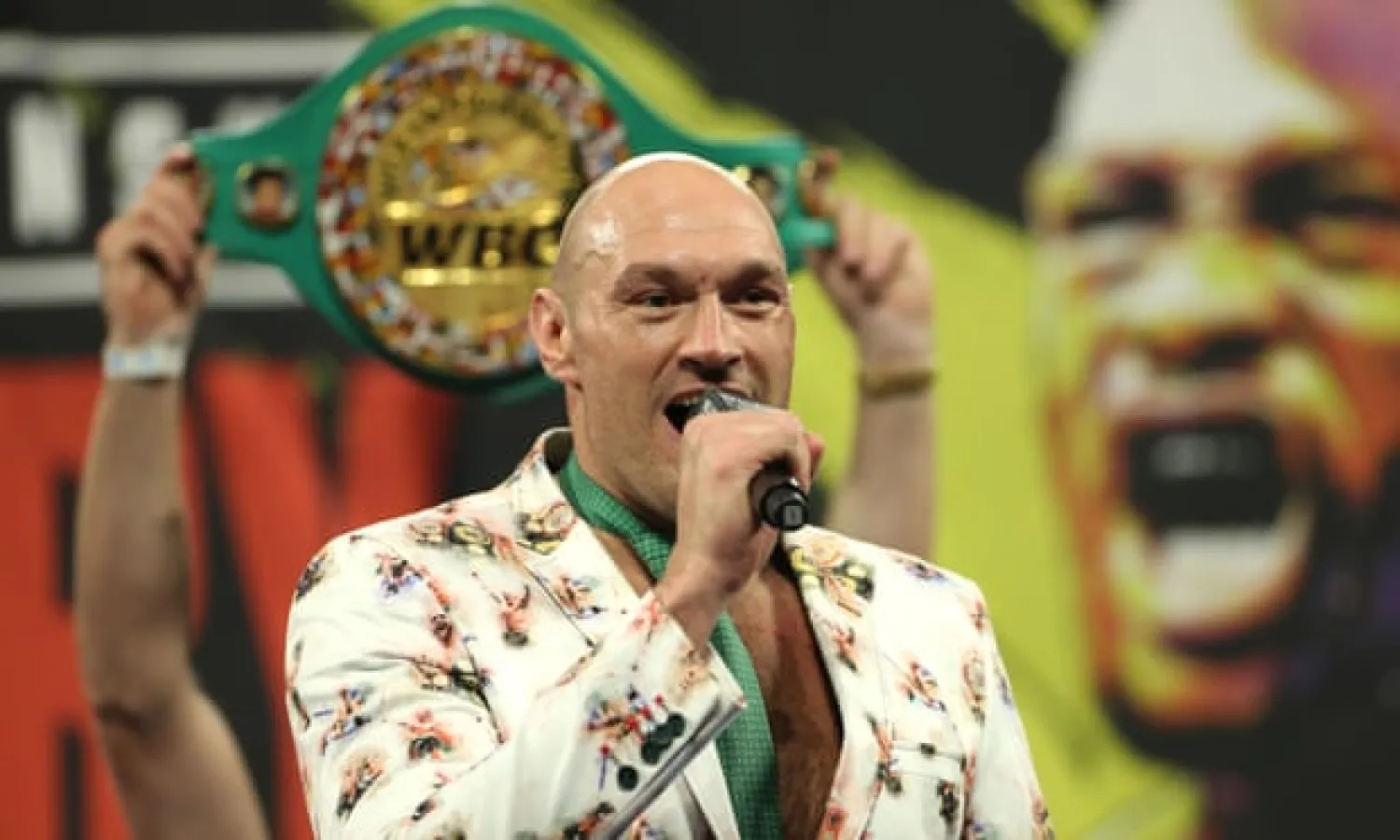
 Fury delighted fans with a spirited rendition of American Pie after his victory. Photograph: Bradley Collyer/PA
Fury delighted fans with a spirited rendition of American Pie after his victory. Photograph: Bradley Collyer/PA
TT

Tyson Fury: From the Lowest of Lows to the Top of the World

 Fury delighted fans with a spirited rendition of American Pie after his victory. Photograph: Bradley Collyer/PA
Fury delighted fans with a spirited rendition of American Pie after his victory. Photograph: Bradley Collyer/PA

For Tyson Fury it was the sweetest of redemption songs. Moments after regaining the heavyweight title in the early hours of Sunday in Las Vegas, he began serenading the 16,000-strong crowd at the MGM Grand with a boisterous two-minute rendition of Don McLean’s American Pie, beaming from ear to ear as they joined in.

It was a highly unorthodox celebration after a dazzling dismantling of the fearsome WBC champion Deontay Wilder. Then again, little in the life and times of Fury, 6ft 9in tall and 19 stone, has been conventional.

When Fury was born in 1988, nearly three months premature, he weighed less than a pound and doctors feared he would not survive. His father, John, named him Tyson after the then heavyweight champion of the world, Mike Tyson, and promised hospital staff his son would emulate his namesake.

Tyson fulfilled that prophecy in November 2015 when he stunned Wladimir Klitschko to become world champion – but then went on such a dizzying downward spiral that his friends feared for his life.

Fury became addicted to cocaine and alcohol, allowed his weight to balloon to more than 28½ stone, and had struggles with severe depression. At one point he would drink 18 pints of lager a day, follow it up with whisky and vodka, and then stop off on the way home for pizzas and kebabs. In 2017 he accepted a backdated two-year doping ban for testing positive for elevated levels of the banned substance nandrolone, an anabolic steroid, which he claimed came from uncastrated wild boar or contaminated supplements.

Now, incredibly, he is back on top of the world. “It was a good performance considering I am a fat pig and I can’t punch,” joked Fury. “I’ve had the highs and lows, but this is the icing on the cake.”

His promoter, Frank Warren, who hailed Fury’s performance as the best he had ever seen from a British fighter in his 40 years in the sport, said he hoped a reunification fight with Anthony Joshua, the Londoner who holds the WBA, IBF and WBO versions of the heavyweight title, would happen next. “It would be the biggest sporting event to take place in the UK since England won the World Cup,” said Warren. “You could not be able to get a ticket for it. The country would absolutely stop.”

Joshua’s promoter, Eddie Hearn, said his man wanted the fight: “We will never get the opportunity in this sport to do it again with two Brits. I have already spoken to AJ, he wants this fight. He has zero fear of fighting Tyson Fury and he wants to be undisputed.” There is, however, a major stumbling block: Wilder has a rematch clause in his contract with Fury, which can be activated in the next 30 days.

Such is Fury’s popularity that the bookmakers make him the early favourite to be the BBC’s Sports Personality of the Year, though perhaps no other British sports star has divided opinion more sharply than the self-proclaimed Gypsy King. For while Fury’s many fans have hailed his victory over Wilder as a joyous resurrection after his mental health and other issues, his detractors remain alarmed that someone who has failed a drugs test and made abhorrent comments on homosexuality, Judaism and women should be hailed a sporting hero.

In the past Fury has equated homosexuality and abortions with paedophilia, claimed “Zionist, Jewish people … own all the banks, all the papers, all the TV stations” and “a woman’s best place is in the kitchen and on her back”.

While Fury has apologised for some of his remarks, pointing out that as a man of Traveller heritage he has suffered bigotry and abuse all his life, some believe that he should have been more contrite.

Mark Borkowski, a PR expert who has represented Diego Maradona, Michael Jackson, Virgin and Cadbury, says major brands will still be wary of Fury’s views. “Clearly Tyson is an incredibly gifted fighter and a once-in-a-generation showman,” he says. “But he carries a whole heap of baggage that will make many brands not want to go near him.

“If Joshua had just stopped Wilder as spectacularly as Fury has just done, he would be in line to make gazillions. I don’t see that happening with Fury.”

Such concerns are unlikely to bother Fury, who made a guaranteed $25m (£19.2m) from his fight with Wilder. He also insists that he is a changed man from the last time he held the heavyweight title. Time will tell. That is one promise that everyone – be they Fury’s fans or his detractors – will be hoping holds true.

The Guardian Sport


Shakhtar Boss Pays Ukrainian Racer $200,000 After Games Disqualification

Ukrainian President Volodymyr Zelenskiy holds helmet as he meets with a Ukrainian skeleton racer Vladyslav Heraskevych , who was disqualified from the Olympic skeleton competition over his "helmet of remembrance" depicting athletes killed since Russia's invasion and his father and coach, Mykhailo Heraskevych, amid Russia's attack on Ukraine, in Munich, Germany February 13, 2026. (Ukrainian Presidential Press Service/Handout via Reuters)
TT

Shakhtar Boss Pays Ukrainian Racer $200,000 After Games Disqualification

Ukrainian President Volodymyr Zelenskiy holds helmet as he meets with a Ukrainian skeleton racer Vladyslav Heraskevych , who was disqualified from the Olympic skeleton competition over his "helmet of remembrance" depicting athletes killed since Russia's invasion and his father and coach, Mykhailo Heraskevych, amid Russia's attack on Ukraine, in Munich, Germany February 13, 2026. (Ukrainian Presidential Press Service/Handout via Reuters)

The owner of ‌Ukrainian football club Shakhtar Donetsk has donated more than $200,000 to skeleton racer Vladyslav Heraskevych after the athlete was disqualified from the Milano Cortina Winter Games before competing over the use of a helmet depicting Ukrainian athletes killed in the war with Russia, the club said on Tuesday.

The 27-year-old Heraskevych was disqualified last week when the International Bobsleigh and Skeleton Federation jury ruled that imagery on the helmet — depicting athletes killed since Russia invaded Ukraine in 2022 — breached rules on athletes' expression at ‌the Games.

He ‌then lost an appeal at the Court ‌of ⁠Arbitration for Sport hours ⁠before the final two runs of his competition, having missed the first two runs due to his disqualification.

Heraskevych had been allowed to train with the helmet that displayed the faces of 24 dead Ukrainian athletes for several days in Cortina d'Ampezzo where the sliding center is, but the International Olympic Committee then ⁠warned him a day before his competition ‌started that he could not wear ‌it there.

“Vlad Heraskevych was denied the opportunity to compete for victory ‌at the Olympic Games, yet he returns to Ukraine a ‌true winner," Shakhtar President Rinat Akhmetov said in a club statement.

"The respect and pride he has earned among Ukrainians through his actions are the highest reward. At the same time, I want him to ‌have enough energy and resources to continue his sporting career, as well as to fight ⁠for truth, freedom ⁠and the remembrance of those who gave their lives for Ukraine," he said.

The amount is equal to the prize money Ukraine pays athletes who win a gold medal at the Games.

The case dominated headlines early on at the Olympics, with IOC President Kirsty Coventry meeting Heraskevych on Thursday morning at the sliding venue in a failed last-minute attempt to broker a compromise.

The IOC suggested he wear a black armband and display the helmet before and after the race, but said using it in competition breached rules on keeping politics off fields of play. Heraskevych also earned praise from Ukraine President Volodymyr Zelenskiy.


Speed Skating-Italy Clinch Shock Men’s Team Pursuit Gold, Canada Successfully Defend Women’s Title

 Team Italy with Davide Ghiotto, Andrea Giovannini, Michele Malfatti, celebrate winning the gold medal on the podium of the men's team pursuit speed skating race at the 2026 Winter Olympics, in Milan, Italy, Tuesday, Feb. 17, 2026. (AP)
Team Italy with Davide Ghiotto, Andrea Giovannini, Michele Malfatti, celebrate winning the gold medal on the podium of the men's team pursuit speed skating race at the 2026 Winter Olympics, in Milan, Italy, Tuesday, Feb. 17, 2026. (AP)
TT

Speed Skating-Italy Clinch Shock Men’s Team Pursuit Gold, Canada Successfully Defend Women’s Title

 Team Italy with Davide Ghiotto, Andrea Giovannini, Michele Malfatti, celebrate winning the gold medal on the podium of the men's team pursuit speed skating race at the 2026 Winter Olympics, in Milan, Italy, Tuesday, Feb. 17, 2026. (AP)
Team Italy with Davide Ghiotto, Andrea Giovannini, Michele Malfatti, celebrate winning the gold medal on the podium of the men's team pursuit speed skating race at the 2026 Winter Olympics, in Milan, Italy, Tuesday, Feb. 17, 2026. (AP)

An inspired Italy delighted the home crowd with a stunning victory in the Olympic men's team pursuit final as

Canada's Ivanie Blondin, Valerie Maltais and Isabelle Weidemann delivered another seamless performance to beat the Netherlands in the women's event and retain their title ‌on Tuesday.

Italy's ‌men upset the US who ‌arrived ⁠at the Games ⁠as world champions and gold medal favorites.

Spurred on by double Olympic champion Francesca Lollobrigida, the Italian team of Davide Ghiotto, Andrea Giovannini and Michele Malfatti electrified a frenzied arena as they stormed ⁠to a time of three ‌minutes 39.20 seconds - ‌a commanding 4.51 seconds clear of the ‌Americans with China taking bronze.

The roar inside ‌the venue as Italy powered home was thunderous as the crowd rose to their feet, cheering the host nation to one ‌of their most special golds of a highly successful Games.

Canada's women ⁠crossed ⁠the line 0.96 seconds ahead of the Netherlands, stopping the clock at two minutes 55.81 seconds, and

Japan rounded out the women's podium by beating the US in the Final B.

It was only Canada's third gold medal of the Games, following Mikael Kingsbury's win in men's dual moguls and Megan Oldham's victory in women's freeski big air.


Lindsey Vonn Back in US Following Crash in Olympic Downhill 

Milano Cortina 2026 Olympics - Alpine Skiing - Women's Downhill 3rd Official Training - Tofane Alpine Skiing Centre, Belluno, Italy - February 07, 2026. Lindsey Vonn of United States in action during training. (Reuters)
TT

Lindsey Vonn Back in US Following Crash in Olympic Downhill 

Milano Cortina 2026 Olympics - Alpine Skiing - Women's Downhill 3rd Official Training - Tofane Alpine Skiing Centre, Belluno, Italy - February 07, 2026. Lindsey Vonn of United States in action during training. (Reuters)

Lindsey Vonn is back home in the US following a week of treatment at a hospital in Italy after breaking her left leg in the Olympic downhill at the Milan Cortina Games.

“Haven’t stood on my feet in over a week... been in a hospital bed immobile since my race. And although I’m not yet able to stand, being back on home soil feels amazing,” Vonn posted on X with an American flag emoji. “Huge thank you to everyone in Italy for taking good care of me.”

The 41-year-old Vonn suffered a complex tibia fracture that has already been operated on multiple times following her Feb. 8 crash. She has said she'll need more surgery in the US.

Nine days before her fall in Cortina d'Ampezzo, Italy, Vonn ruptured the ACL in her left knee in another crash in Switzerland.

Even before then, all eyes had been on her as the feel-good story heading into the Olympics for her comeback after nearly six years of retirement.
