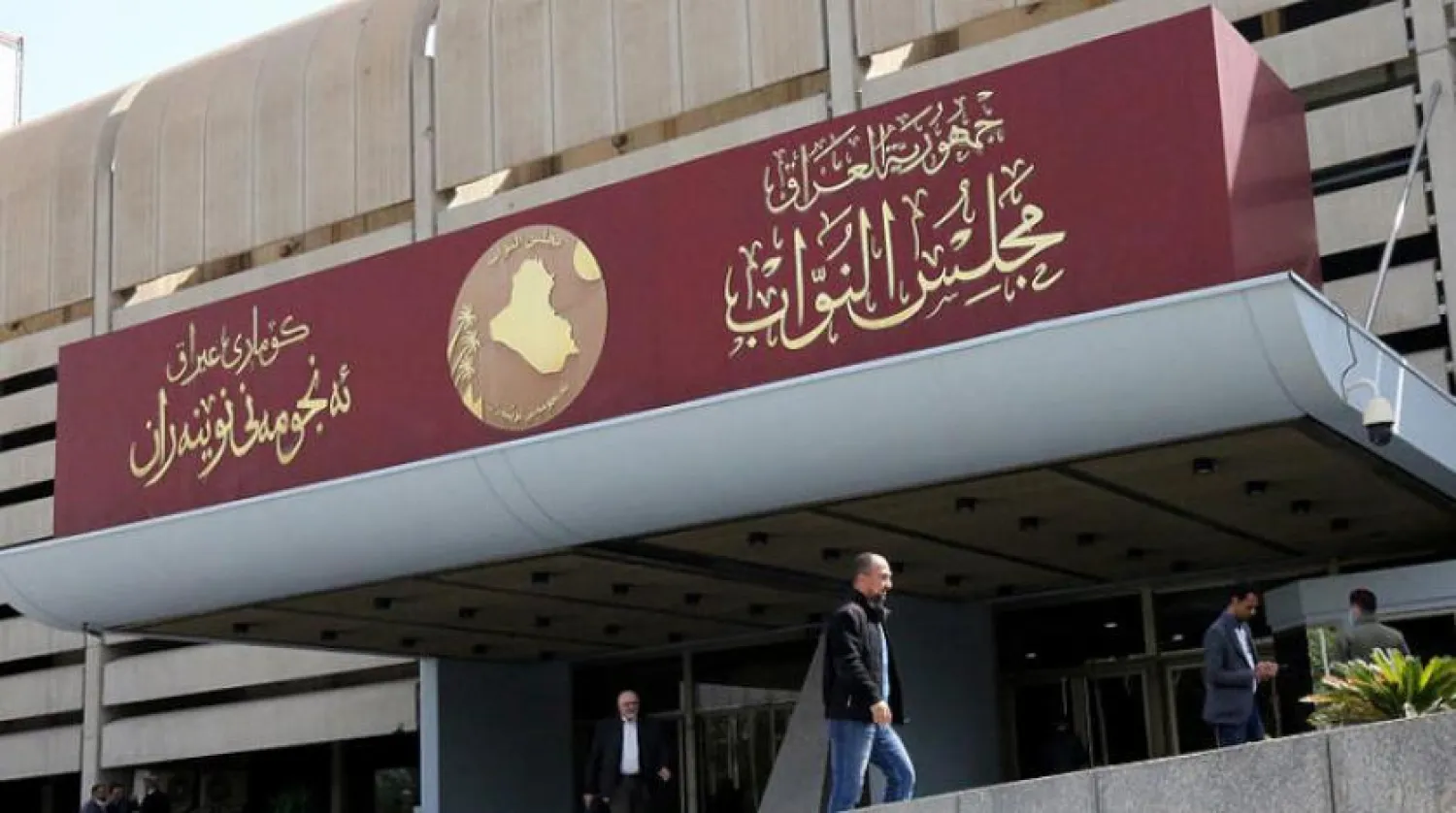
Iraq Parliament Postpones Confidence Vote Again

The entrance to the Iraqi parliament. AFP file photo
TT

Iraq Parliament Postpones Confidence Vote Again

The entrance to the Iraqi parliament. AFP file photo

Iraq's parliament postponed a vote of confidence in prime minister-designate Mohammad Allawi's government for a second time Saturday, as wrangling among rival blocs continued ahead of a looming deadline.

Speaker Mohammed al-Halbousi said that the crunch vote, which had already been delayed last week for lack of a quorum, would now be held on Sunday.

Midnight Sunday is the deadline for lawmakers to end the political vacuum and agree on a new government or see President Barham Salih designate a premier unilaterally.

Failure to go ahead with the vote could also trigger a call for mass protests from cleric Moqtada Sadr, whose supporters form the largest bloc in parliament and who has demanded that lawmakers approve Allawi's government.
Allawi is struggling to secure support from the country's Sunnis and Kurds.

Iraq has been without a government since Allawi's predecessor Adel Abdel Mahdi quit under pressure from the street two months ago.

Demonstrators have already rejected the choice of Allawi for premier, saying he is too close to the confessional political system they have rallied against for months. 


New Evidence Bolsters Theory of Mossad Role in Abduction of Retired Lebanese Officer

Israeli pilot Ron Arad, who went missing in southern Lebanon in 1986. (Israeli Air Force)
TT

New Evidence Bolsters Theory of Mossad Role in Abduction of Retired Lebanese Officer

Israeli pilot Ron Arad, who went missing in southern Lebanon in 1986. (Israeli Air Force)

A growing body of evidence from Lebanese security and judicial investigations is strengthening suspicions that Israel’s Mossad intelligence service orchestrated the luring and abduction of retired General Security captain Ahmed Shukr, whose disappearance nearly two weeks ago has raised alarm within Lebanon’s security establishment.

As investigations led by the Information Branch of the Internal Security Forces progress, officials describe what they consider to be high-quality findings, firmly placing the case in the category of a coordinated intelligence operation.

Beyond initial suspicions

Search efforts have so far failed to uncover any trace of Shukr on Lebanese territory. A senior Lebanese judicial source told Asharq Al-Awsat that “all the evidence and data collected so far point to the hypothesis of Shukr’s abduction.”

He added that investigators have “moved beyond the stage of initial suspicions and entered an in-depth analysis of the luring process, communications patterns, and field developments before and after the moment of his disappearance.”

The case is linked to suspicions over Shukr’s connection to the long-unresolved file of the disappearance of Israeli air force pilot Ron Arad in southern Lebanon in 1986, he remarked.

Key leads

Among the most significant leads bolstering this hypothesis, the judicial source said, is “precise monitoring of internal and external communications involving Shukr in the hours and days before he was lured to the Kark area near the city of Zahle in the Bekaa Valley, where he disappeared under circumstances still under investigation.”

The data revealed an unusual pattern suggesting “tight, cross-border coordination.”

Shukr belongs to the family of Fuad Shukr, a Hezbollah leader who was assassinated by Israel on July 30, 2024, in an airstrike on a building in the Haret Hreik area of Beirut’s southern suburbs.

However, Abdul Salam Shukr, Ahmed's brother, rejected any attempt to link them closely to Fuad Shukr. “No one in the town even knew Fuad Shukr,” he said.

“Since the early 1980s, he left the town and never returned, and he was distant from his relatives.”

He stressed that Ahmed Shukr, since retiring from military service, “never left the Bekaa. He stayed at home and played cards with his friends at night.”

Carefully planned operation

In a development described as highly significant, the source revealed what was termed an “important” piece of evidence from surveillance cameras.

“CCTV footage captured an image of a car in the Kark area at the time Shukr was lured and disappeared,” the source said. “The same car was seen later that night heading from Beirut toward the road leading to Beirut’s international airport, carrying a Swedish national suspected of direct involvement in the luring and abduction.”

Security agencies later verified the route by which the Swede left Lebanon. According to the judicial source, the man “traveled abroad just hours after the incident, and investigators now have sufficient information about his departure and destination.”

This, the source told Asharq Al-Awsat, is an additional indication of “prior, carefully coordinated planning that goes beyond the capabilities of conventional local networks.”

New development

The abduction of Ahmed Shukr now appears to be one of Lebanon’s most dangerous security cases, given its intelligence dimensions and the broader questions it raises about security breaches and the covert confrontation between Lebanon and Israel.

At the same time, a new development has brought renewed attention to a Lebanese man identified by his initials A.M., who resides in Kinshasa.

He had previously contacted Shukr, asking him to assist people who claimed they wanted to purchase property in the Bekaa, an approach investigators believe was central to the luring operation.

A.M. has since returned from abroad and surrendered himself to the security services.

Accounts differed over why A.M. returned to Beirut after a wanted notice had been issued against him on suspicion of a possible role in the case.

While some information suggested he was pressured by the Lebanese community abroad to return and turn himself in, sources close to the investigation said he offered a completely different account.

According to these sources, A.M. said that he too “fell victim to the same group that targeted and abducted Ahmed Shukr,” and that he came to Lebanon of his own free will “to clear his name and place the information he has at the disposal of the security services.”

Security information indicates that A.M. arrived in Beirut on Sunday evening and was initially questioned by General Security before being handed over to the Information Branch of the Internal Security Forces, at the order of Public Prosecutor Judge Jamal al-Hajjar, who is personally overseeing the investigation due to the case’s sensitivity and complexity.

Findings expected within days

Sources said the initial questioning of A.M. is expected to be completed within a maximum of three days, after which the results of the investigation will be announced, including whether his account aligns with the technical data and evidence already in the possession of security agencies.

Earlier, Asharq Al-Awsat sources had revealed that the missing officer is the brother of Hassan Shukr, a fighter who was part of the group involved in the capture of Ron Arad after his aircraft was shot down over southern Lebanon on October 16, 1986.

Responding to this, Ahmed Shukr’s brother said: “Hassan joined military service in 1979, which means he was a state employee when Arad disappeared in 1986. It is well known that state employees do not engage in political parties.”


Yemeni Presidential Adviser to Asharq Al-Awsat: Serious Efforts Underway to Enforce Rule of Law

Presidential Leadership Council Chairman Dr. Rashad al-Alimi. (Saba)
TT

Yemeni Presidential Adviser to Asharq Al-Awsat: Serious Efforts Underway to Enforce Rule of Law

Presidential Leadership Council Chairman Dr. Rashad al-Alimi. (Saba)

Engineer Badr Basalmah, an adviser to the Yemeni president, said Yemen is entering a decisive phase in which the state is attempting to reclaim control of the political landscape through what he described as a process of “reverse engineering,” backed by close regional support and aimed at restoring the authority of law and institutions.

He said the recent presidential decisions affecting the eastern provinces marked a pivotal moment with far-reaching political implications that go to the heart of the state’s survival.

Speaking to Asharq Al-Awsat, Basalmah said the decisions marked a qualitative shift by the Presidential Leadership Council (PLC) from a posture of “absorbing reactions” to one of “shaping action” and initiative, a move that he said would strengthen the centralization of sovereign decision-making and prevent the state from fragmenting.

He stressed that Saudi Arabia’s supportive stance toward Yemen’s legitimate government and its decisions represents the cornerstone of the current stability equation, noting that this support should not be read as interference in favor of one party over another, but rather as part of a strategy aimed at regulating the pace of developments and preventing a slide into uncertainty.

Basalmah said the eastern provinces, particularly Hadhramaut and al-Mahra, are undergoing a delicate political phase that could shape the future form of the Yemeni state and lay the groundwork for a future federal model.

From managing balances to institutional sovereignty

According to Basalmah, the recent decisions by PLC Chairman Dr. Rashad al-Alimi cannot be viewed merely within a routine administrative framework. He stressed that they represent a pivotal step with profound political significance tied to the core of the state’s survival.

The importance of these decisions lies in the fact that they embody a qualitative transition by the council from absorbing reactions to producing action and initiative, he explained.

He described this as a “clear political message to domestic and external audiences that the state, in its constitutional and legitimate sense, holds the final say in managing its sovereign institutions, and that it must remain a unifying national umbrella rather than a field for division or exploitation outside the framework of the comprehensive national project.”

Basalmah added that the move represents, at a deeper level, an effort to fortify centralized sovereign decision-making and prevent the state from sliding toward fragmentation or transforming into isolated administrative and security enclaves.

The Saudi role is a cornerstone

He reaffirmed that Saudi Arabia’s support for legitimacy and its decisions are the cornerstone of the current efforts to establish stability, explaining that such support reflects a strategy aimed at controlling the situation and preventing a descent into the unknown.

He said the importance of this role is evident in entrenching what he described as a “golden rule” that partnership does not mean dominance, adding that support for the PLC is intended to de-escalate tensions and prevent the imposition of fait accompli policies by force of arms, particularly in strategically sensitive areas such as Hadhramaut and Mahra.

Basalmah said Saudi Arabia, through this approach, is redrawing the red lines that ensure all parties remain under the state's umbrella, while pushing political forces toward dialogue as the only viable option, rather than what he described as reckless adventures that could threaten regional security and Yemen’s social fabric.

Eastern provinces and the shape of the future state

Basalmah said that the eastern provinces, foremost among them Hadhramaut and Mahra, have become a decisive factor in the Yemeni equation and are undergoing a political transition that could shape the country's future.

He told Asharq Al-Awsat that a closer reading of developments points to growing social and political awareness in these provinces toward rejecting absolute subordination or sharp polarization.

What is unfolding in Hadhramaut does not fall within the scope of a fleeting regional movement, but rather within the context of laying the groundwork for a future federal state model, he remarked.

These provinces are seeking to secure their rights to manage their own affairs and protect their territories through national formations, such as the Nation’s Shield Forces, under the umbrella of constitutional legitimacy, Basalmah went on to say.

Current indicators suggest that the option of forced annexation has receded in favor of a path toward a consensual formula that guarantees administrative and security autonomy for regions within a unified, federal Yemen, he stated.

Yemen is witnessing a serious attempt at “reverse engineering” the political scene, where instead of factions imposing their reality on the state, the state, with close regional support, is seeking to reclaim the initiative and impose the logic of law and institutions, he warned.

This process represents a long-term battle requiring a high degree of political wisdom, he urged, stressing that the winner will be whoever aligns with the logic of the state and the interests of citizens, backed by international legitimacy and Arab support.


Türkiye Calls Israel’s Recognition of Somaliland ‘Illegitimate’

This handout photograph taken and released by the Turkish presidential press service on December 30, 2025, shows Türkiye’s President Recep Tayyip Erdogan (R) and Somalia's President Hassan Sheikh Mohamud (L) shaking hands before their meeting in Istanbul. (Photo by Handout / Turkish Presidential Press Service / AFP)
TT

Türkiye Calls Israel’s Recognition of Somaliland ‘Illegitimate’

This handout photograph taken and released by the Turkish presidential press service on December 30, 2025, shows Türkiye’s President Recep Tayyip Erdogan (R) and Somalia's President Hassan Sheikh Mohamud (L) shaking hands before their meeting in Istanbul. (Photo by Handout / Turkish Presidential Press Service / AFP)

Türkiye’s president on Tuesday called Israel's recognition of Somaliland "illegitimate and unacceptable" as he hosted a visit by his Somali counterpart.

"Preserving the unity and integrity of Somalia in all circumstances holds special importance in our view. Israel's decision to recognize Somaliland is illegitimate and unacceptable," Turkish leader Recep Tayyip Erdogan said in a press conference alongside Somali President Hassan Sheikh Mohamud.

Israel sparked criticism last Friday when it said it was officially recognizing Somaliland -- a breakaway territory in Somalia's north.

The declaration was a first for the territory, which in 1991 had unilaterally declared secession from Somalia.

Israel's move has drawn widespread criticism from the African Union, Egypt and the European Union, which insist on war-torn Somalia's sovereignty.

Türkiye has frequently clashed with Israel over a range of issues, especially over the conflict in Gaza and Israeli obstruction of aid to the Palestinian territory.

Mohamud said Israeli Prime Minister Benjamin Netanyahu's "aggressive position, which also includes Somalia, is unacceptable".

He called Netanyahu's Somaliland declaration "a violation of international law" and "the start of insecurity and instability, especially for Somalia and the African region".