

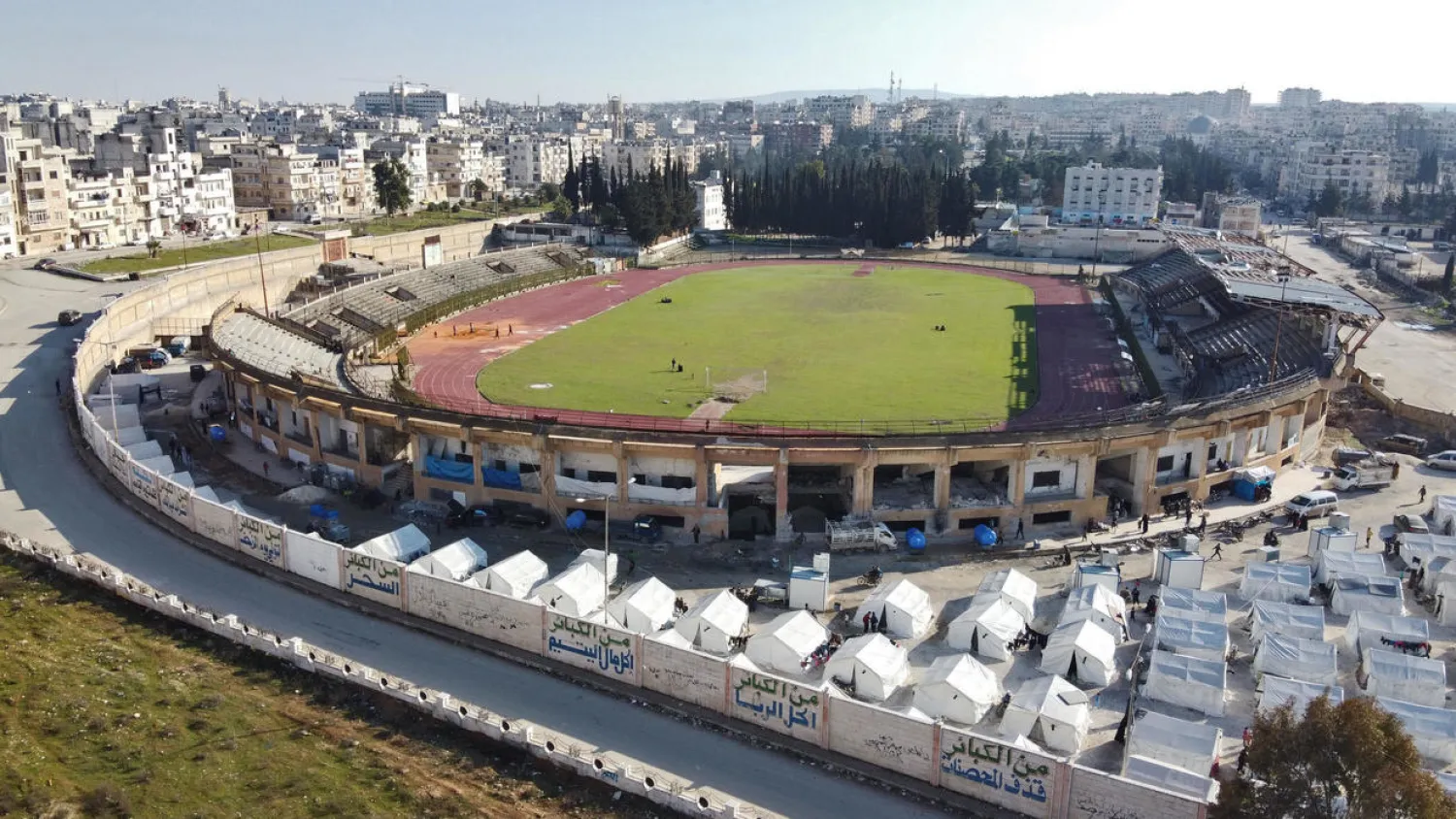

Displaced Syrians Set up Camp at Idlib Football Stadium

Displaced Syrian families are living in tents at a football stadium in Idlib city. (AFP)
TT

Displaced Syrians Set up Camp at Idlib Football Stadium

Displaced Syrian families are living in tents at a football stadium in Idlib city. (AFP)

In the car park and under the stands of a football field in Idlib city, northwestern Syria, families with nowhere to go after fleeing war live in tents.

"This is a football stadium. It's unfit for people to live in," says 32-year-old Abu Fawz, wearing a bomber jacket and red baseball cap flipped backwards.

"There's no electricity, no water and no bathrooms" apart from portable toilets, the father of three says.

"People keep coming and going," and there's no privacy.

Since December, Russia-backed regime forces have been waging a deadly offensive to retake the last major opposition bastion of Idlib in northwestern Syria.

They have clawed back dozens of towns and villages from the extremists and allied Turkey-backed opposition, sparking one of the worst humanitarian disasters of the almost nine-year-old war.

The assault has forced nearly one million people, mostly women and children, to flee their homes and shelters in the region.

Abu Fawz and his family fled bombardment on his hometown of Maaret al-Numan late last year.

"Thank God I managed to save my wife and children," he says, according to AFP.

After grabbing the bare necessities as the town emptied, they sped north to the provincial capital of Idlib city, but struggled to find a home there.

"We were stuck in the streets until we were told there was a camp at the football stadium," Abu Fawz says.

'Tragedy'

Unable to find a spot in overcrowded camps or pay for rent in town, many of those displaced in recent months have slept in fields or sought shelter in schools, mosques and unfinished buildings.

In the middle of winter, AFP correspondents have seen families forced to sleep in their cars, in underground shelters, in a cemetery hall and even an abandoned prison.

On the wet grounds of the Idlib football stadium, fresh laundry hangs out to dry outside neat rows of white tents and along the edges of the field.

A motorbike darts up to park in the shade of the bleachers, while children hurry along the pathways between their canvas homes.

Standing between the tents, 65-year-old gynecologist Umm Sanaa says she also hails from Maaret al-Numan.

After her home was bombarded four months ago, she was pulled from under the rubble and taken to hospital. When she recovered, she came to live in the camp.

"It's a tragedy," she says. "We want a peaceful solution so everyone can go home -- even if only to eat bread."

'Nothing here'

The Idlib conflict has escalated in recent weeks, with Turkey directly intervening after the killing in late February of 34 of its soldiers in an airstrike it blamed on Damascus.

Turkish President Recep Tayyip Erdogan has said he hopes a ceasefire will be established when he meets with his Russian counterpart Vladimir Putin on Thursday.

But a new report has found that fighting in northwestern Syria has rendered large parts of the region uninhabitable.

Save the Children has warned that, even in the case of an immediate ceasefire, it would take "months if not years" to rebuild destroyed civilian infrastructure and the trust for communities to return.

Standing in the terraces overlooking the green football pitch, 10-year-old Jana says she dreams of returning to a normal life -- and school.

"Children want to learn," says the girl, born a year before the start of the war, which the United Nations says has deprived some 280,000 children of an education in northwestern Syria alone.

"We need schools," she adds, standing above the running track in a blue jumper and black headscarf decorated with stars.

"There's nothing here to fill the void."


Growing Egypt-Russia Partnership Raises Alarm in Israel

The Egyptian prime minister visits the construction site of the El Dabaa Nuclear Power Plant in July 2025. (Egyptian government)
TT

Growing Egypt-Russia Partnership Raises Alarm in Israel

The Egyptian prime minister visits the construction site of the El Dabaa Nuclear Power Plant in July 2025. (Egyptian government)

Egypt’s El Dabaa Nuclear Power Plant has yet to begin operations on the country’s Mediterranean coast, but Israeli media outlets supportive of Prime Minister Benjamin Netanyahu have intensified warnings that the project could pave the way for a major Russian nuclear presence in the Middle East.

Those concerns over Egypt’s capabilities, as well as its regional partnerships, which have grown since the outbreak of the Gaza war in 2023, are unlikely to subside, according to experts interviewed by Asharq Al-Awsat.

They said that the rhetoric is tied to Israeli domestic politics, electoral competition and efforts to create new security threats for Israeli voters, while also exerting pressure on Cairo and its partners at a time when Israel is seeking to capitalize on tensions between Washington and Moscow.

Although Egypt’s nuclear program dates back to a 1956 agreement with the Soviet Union, the country’s first nuclear power project effectively began on Nov. 19, 2015, when Egypt and Russia signed an agreement to build the El Dabaa Nuclear Power Plant in the Matrouh governorate on the Mediterranean coast. The project is valued at $30 billion, including a $25 billion Russian loan that Egypt is due to begin repaying in October 2029 over a 35-year period at an annual interest rate of 3%.

The plant, which is designed to generate 4,800 megawatts of electricity, will comprise four nuclear reactors. It is expected to operate for more than 60 years and is projected to supply about 10% of Egypt’s electricity needs once its first reactor comes online, currently expected between late 2027 and mid-2028.

Israeli website Natziv.net recently claimed that El Dabaa is more than an electricity-generation project, describing it as “a potential nuclear foothold for Moscow” in the Middle East. The outlet said Russia’s financing of 85% of the project’s cost - about $25 billion - along with its responsibility for fuel supplies and nuclear waste management for 60 years, could create a “long-term strategic dependence” on Moscow.

The website also warned about plans for a Russian industrial zone near the Suez Canal, describing it as a permanent presence at a key global trade hub and a sign of Cairo’s drift away from the West toward a Russia-China axis within the BRICS group, which Egypt joined in January 2024.

Despite the project’s civilian nature, the outlet claimed that the infrastructure and expertise acquired through El Dabaa could one day provide Egypt with a shorter path toward military nuclear options or fuel enrichment capabilities.

It suggested that any radioactive leak could affect Israel’s coastline and desalination facilities, while closer Egyptian-Russian ties could narrow Israel’s strategic room for maneuver and weaken traditional US influence in the region.

Similar arguments appeared in an analysis published last week by Israel’s Yedioth Ahronoth following Russian President Vladimir Putin’s announcement that the plant’s first reactor could begin operating in 2027.

It described the notion that El Dabaa is solely an energy project as a “grave misreading,” portraying it instead as a slow-moving strategic encirclement effort in which “Israel is not incidental to the picture, but the target.”

Raouf Saad, Egypt’s former ambassador to Russia and a former assistant foreign minister, said the reports should be read within their political context. He added that Netanyahu has sought to disrupt efforts toward regional peace and has repeatedly attempted to provoke Egypt since the Gaza war, without success.

Saad dismissed the Israeli allegations as “naive and transparent” aimed at warning the United States about Russia’s return to the region, saying they reflected the weakness of Netanyahu’s position rather than any genuine security threat.

Retired Major General Samir Farag, a military and strategic analyst, said such reports are part of recurring attempts to manufacture crises and are likely to intensify as Israel approaches elections.

“Netanyahu-aligned media outlets have long tried to convince the Israeli public that Egypt seeks to acquire nuclear capabilities and pursue militarization,” Farag said, describing the claims as an effort to exploit the issue politically and divert attention from Israel’s actions in the region.

While Egypt has not officially responded to the allegations, officials and analysts continued to stress that the peaceful use of nuclear energy is a legitimate right under international law.

They noted that Egypt is fully committed to the 1968 Nuclear Non-Proliferation Treaty and that the El Dabaa project, like the country’s Inshas Nuclear Center, is subject to comprehensive oversight by the International Atomic Energy Agency.


Trump Faces G7 After Year of Trade Wrath, Diplomatic Bluster

People stand outside the Palais Lumiere ahead of the G7 summit in Evian-les-Bains, France, June 12, 2026. (Reuters)
TT

Trump Faces G7 After Year of Trade Wrath, Diplomatic Bluster

People stand outside the Palais Lumiere ahead of the G7 summit in Evian-les-Bains, France, June 12, 2026. (Reuters)

Little is known about what President Donald Trump's intentions are for the G7 summit in Evian, France next week, except maybe the obvious: the American president will impose his schedule and his mood.

The latter may depend largely on the peace agreement discussions with Iran, which were gathering steam Friday.

"It is not possible to 'manage Trump' the way it has been possible during his first term," Liana Fix, associate fellow at the Council on Foreign Relations, told AFP ahead of the summit that will bring the US face-to-face with France, Germany, Canada, Italy, Japan and the United Kingdom.

All these countries' leaders have been on the receiving end of Trump's trade wrath or diplomatic intimidation -- with the exception of Japan's Prime Minister Sanae Takaichi, who he is very fond of.

Every other leader expected on the shores of Lake Geneva has been the target of attacks, criticism or mockery from the Republican billionaire.

- 'Expect the worst' -

Neither growing unpopularity that could cost Trump control of Congress in November, nor the Supreme Court's annulment of his across-the-board tariffs is likely to soften his bruising stance toward global partners.

European leaders in particular have learned, through the Greenland episode, trade conflicts, and the Iran war, "to hope for the best but to expect the worst," Fix said.

Moreover, the US has informed Europeans of their intentions to significantly reduce the number of planes and warships made available to NATO in Europe, the New York Times reported.

"I don't think you're going to see a weakened president," Jackson James, senior fellow at German Marshall Fund of the US, told AFP.

"I think he's going to go over there and do what he always does, which is just try to bully his way through these very, very complicated issues and try to get the American agenda, as he sees it, fulfilled."

Trump "says he doesn't like these multilateral meetings," but "cannot bear for an assembly of world leaders to meet and he not being there," Victor Cha, an expert for the Center for Strategic and International Studies, said during a press conference.

"So he shows it up at these things and he leaves early," Cha said, as he did during the last G7.

- Versailles -

Still, French president Emmanuel Macron hopes to persuade the impatient American president to stay for a dinner at Versailles on Wednesday evening, playing to the 79-year-old's fascination with monarchy and ornate trappings of luxury.

France has already tried to cater to the American president by changing the dates of the summit so it would not coincide with his 80th birthday and the celebratory mixed martial arts tournament Trump will host at the White House on Sunday.

Some experts also consider it a concession to Washington that South Africa, which was being considered for participation in the G7 summit, will not be participating.

Paris insists, however, that there was no pressure to withdraw the invitation to South Africa -- a nation Trump accuses, without evidence, of broad persecution of its white population.

Several analysts say at least one issue that France has put on the table for discussion may attract Trump's interest: trade relations with China.

- Ukraine -

The balance of power has also shifted somewhat when it comes to Ukraine, where the situation has not fundamentally changed since Trump began his second term.

In 2025 "Europeans just sort of agreed that they had to bend the knee to Trump because of Ukraine" and its need for US military support, but now "we're just in a different dynamic where Ukraine is not as dependent on the United States," said Max Bergmann, a CSIS Europe expert, said at a briefing.

Ukrainian President Volodymyr Zelensky, who probably knows better than anyone how quickly a meeting with Trump can spiral out of control, has been invited to a discussion session in Evian.


Why Is a ‘Very Close’ Iran-US Deal Taking So Long?

A man walks past Iran's national flag at the Vanak Square in Tehran on June 10, 2026. (AFP)
TT

Why Is a ‘Very Close’ Iran-US Deal Taking So Long?

A man walks past Iran's national flag at the Vanak Square in Tehran on June 10, 2026. (AFP)

President Donald Trump has repeatedly declared Iran and the US are on the verge of agreeing a deal to end the Middle East war, but a litany of sticking points have delayed finalizing an accord and will complicate its implementation, analysts say.

Trump has been widely mocked in US and Iran for frequently insisting an end to the conflict was imminent even as negotiations dragged on for weeks, with US network CNN saying he had used phrases like "very close to a deal" or in the "final throes" of talks on 39 occasions.

In what has become a familiar pattern, Trump on Thursday withdrew a threat of renewed strikes on Iran and said a deal could be signed in the coming days, only for Iran's foreign ministry to respond by saying it "has not reached a final conclusion on the agreement".

Arash Azizi, lecturer at Yale University, told AFP that one reason the deal has taken so long is that the Iranian side believed "they could hold out to get better terms" after not capitulating during the conflict.

Trump, meanwhile, "could hardly stomach" releasing Iran's frozen assets -- a key demand of Tehran -- and also risked facing accusations the accord would be more favorable to Iran than the 2015 nuclear deal he pulled out of during his first term, he added.

Trump "had to accept that his initial gambit of causing an Iranian capitulation by sheer military force didn't work and he had to settle for something much less", said Azizi.

Both Iran and the United States would appear to have vested interests in ending a conflict that saw five weeks of all-out war, paused by an uneasy ceasefire on April 8.

The US-Israeli war has become increasingly unpopular in the US, even among the president's core supporters, with Trump mindful of the looming US midterm elections.

A deal could also see Tehran win the security guarantees and recognition it has long craved from the US and ensure the personal safety of its own leadership, after former supreme leader Ali Khamenei and several top officials were killed in the first phase of the war.

But any negotiation -- in this case mediated by Pakistan as well as Qatar -- between two foes who have been sworn enemies since shortly after the 1979 revolution was never going to be easy.

- 'Frozen war' with 'flare-ups' -

Iran's new leadership structure after the killing of Ali Khamenei has likely proved problematic, with the extent of the power wielded by his successor and son Mojtaba Khamenei still unclear. He is said by Iranian officials to have been wounded and has yet to appear in public.

Trump's own pronouncements have also changed with startling rapidity, most notably on Thursday when he threatened to hit Iran "very hard" before predicting that a "great settlement" was near.

Trump, in a Truth Social post Friday, appeared to again be losing patience, describing the Iranian side as "very dishonorable people to deal with".

"Trump has neither a clear strategic objective nor a credible exit strategy for extricating the United States from the war with Iran," said Ali Alfoneh, a senior fellow at the Arab Gulf States Institute (AGSI).

He said a key obstacle was Israeli Prime Minister Benjamin Netanyahu, who has opposed any Iran-US deal and on Friday again vowed "Iran will not have nuclear weapons".

The Iranian authorities, meanwhile, have "sensed Trump's reluctance to enter the midterm election season burdened by an unpopular war", and seek above all an enduring peace without US aggression, said Alfoneh.

"The conflict has already taken on the characteristics of a frozen war, punctuated by periodic flare-ups," he added.

- 'Tremendous leverage' -

Iran has always insisted that any deal include Lebanon, where Israel has been attacking the Tehran-backed group Hezbollah, which has been further weakened but not eradicated.

A White House official said on Friday that Iran had agreed to dismantle its nuclear program, which the West fears is aimed at making a nuclear weapon -- a commitment that has yet to be confirmed by Tehran.

Critical will be the reopening of the Strait of Hormuz shipping bottleneck, which Iran blockaded at the start of the war in a move that caused global energy prices to surge.

Iran "will not forget the tremendous leverage it gained by closing it," Thomas Juneau, professor at the University of Ottawa, wrote in a study for London-based think tank Chatham House.

"It will not hesitate to consider closing the Strait again if it perceives it to be necessary."
