


Manchester City's Fallibility to Fast Breaks Exploited by Solskjaer's United

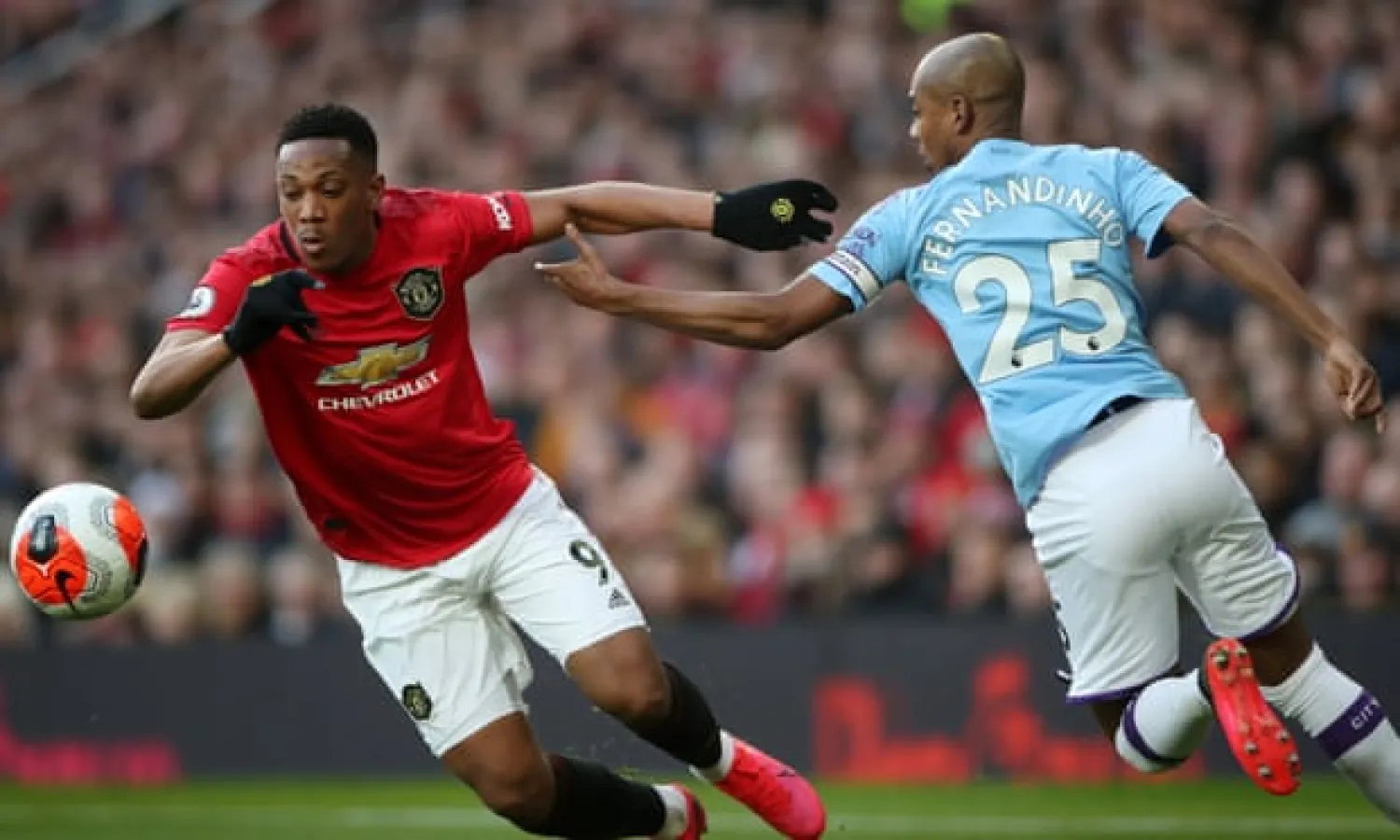
 Fernandinho’s enforced move to the back four because of injuries has cost Manchester City organisation and tactical nous further up the field. Photograph: Nick Potts/PA
Fernandinho’s enforced move to the back four because of injuries has cost Manchester City organisation and tactical nous further up the field. Photograph: Nick Potts/PA
TT

Manchester City's Fallibility to Fast Breaks Exploited by Solskjaer's United

 Fernandinho’s enforced move to the back four because of injuries has cost Manchester City organisation and tactical nous further up the field. Photograph: Nick Potts/PA
Fernandinho’s enforced move to the back four because of injuries has cost Manchester City organisation and tactical nous further up the field. Photograph: Nick Potts/PA

To an extent it doesn’t matter. Manchester City will almost certainly finish second in the Premier League and all defeat to Manchester United did on Sunday was hasten the moment at which Liverpool will be crowned champions. City’s priorities over the next few months lie in the FA Cup, the Champions League and the court of arbitration for sport. But losing to your neighbours three times in a season can never not matter, and there is the wider issue of how City, again, found themselves outmatched by a side that sat deep and countered at pace.

It’s not enough to point out that if Ederson had not made two uncharacteristic gaffes, the game would have finished level. It’s true that the goalkeeper’s mistakes were decisive – and that he got away with another one early in the second half, allowing a backpass to roll under his foot as Anthony Martial closed in – but more significant is the fact that United created opportunity after opportunity by doing little more than have players run very quickly at the gap between Nicolás Otamendi and Oleksandr Zinchenko, a route that should also have led to a penalty before half-time.

Something has gone profoundly wrong in this regard. Modern football is about the triumph of pressing over possession and for the past two seasons, City thrived with a blend of both. But this season their gegenpressing is malfunctioning badly and the result is that the vulnerability that always existed deep below the surface has been brought into the open. The theory was always there: break the press and City could be got at – which is less a criticism than a natural consequence of a style that prioritises ball-playing over defending – but the press was extremely hard to break.

City this season have already conceded 1.5 times as many shots on fast breaks as they did in the whole of last season. It’s not just United. Liverpool, Norwich, Wolves, Newcastle, Crystal Palace, Tottenham and Leicester have all troubled City with pace on the break. Real Madrid, surely, will have taken note and will wonder whether Vinícius Júnior might be able to do to City in next week’s second leg of their Champions League last-16 tie what he did to Barcelona in the clásico.

Personnel is clearly an issue. The departure of Vincent Kompany and the injuries to Aymeric Laporte have left City with a patched together back four in which Otamendi, the least guardiolista of all City players, has started 15 league games, itself an indication not only of the absences of key players but of John Stones’s indifferent form. The puzzling recruitment of full-backs – City’s first real misstep in the market for four or five years – hasn’t helped. In addition, dropping Fernandinho back into the back four means he is no longer able to do what he does best, which is to make tactical fouls in the midfield that stymie opposition counters at source.

But something is going wrong higher up the pitch as well; City have been hit by some diminution of their organisation – of perhaps their hunger. Which is understandable enough: retaining league titles, particularly for a second time, requires a monumental effort of will, as does keeping going for the final 10 weeks of the season when there is essentially nothing left to play for in the league.

When United suddenly upped the pace midway through the first half, City had no answer. Whether it was a foul by Ilkay Gündogan on Bruno Fernandes that brought the free-kick that led to the opening goal can be debated, but what was striking was City’s reaction, protesting so vehemently that Fernandinho was booked and then distracted enough to be caught out by Fernandes’s dink over Sergio Agüero.

This seemed a micro-version of the phenomenon suffered repeatedly by Guardiola sides over the past decade of conceding two or three goals in clutches, as though once the mechanism misfires and the press is breached it can take several minutes to reset. Whether the surge was a plan is unclear, but Ole Gunnar Solskjær’s greatest managerial triumph, away to Paris Saint-Germain last season, came through similar manipulation of the tempo. It’s a risk, of course, but it may be that the best way to disrupt the smooth running of the City machine is with sudden pulses.

Opponents have seen the weaknesses, and City have lost some of their focus, which is one of the reasons teams have lifespans. To say football is cyclical seems misleading as it implies an inevitability to the process, but what is true is that teams rise and teams fall – Béla Guttmann’s three-year rule – after which, in the modern game, the tendency is for the manager to go. The great dynastic managers – Bob Paisley, Alex Ferguson, Valeriy Lobanovskyi – were masters of managing that process. After four years of Guardiola, there is need for rejuvenation, which may mean nothing more than three or four signings – at least a couple of them at centre-back.

City remain a very good side. Knockout football being what it is – and few managers can be more aware than Guardiola that the best side doesn’t necessarily triumph in Europe – they may yet do a treble of League Cup, FA Cup and Champions League, but they are not quite what they were. As City chased an equaliser in the final minutes at Old Trafford on Sunday, what was striking was how the sense was less of the inevitability of a goal than of weariness.

The Guardian Sport


Shakhtar Boss Pays Ukrainian Racer $200,000 After Games Disqualification

Ukrainian President Volodymyr Zelenskiy holds helmet as he meets with a Ukrainian skeleton racer Vladyslav Heraskevych , who was disqualified from the Olympic skeleton competition over his "helmet of remembrance" depicting athletes killed since Russia's invasion and his father and coach, Mykhailo Heraskevych, amid Russia's attack on Ukraine, in Munich, Germany February 13, 2026. (Ukrainian Presidential Press Service/Handout via Reuters)
TT

Shakhtar Boss Pays Ukrainian Racer $200,000 After Games Disqualification

Ukrainian President Volodymyr Zelenskiy holds helmet as he meets with a Ukrainian skeleton racer Vladyslav Heraskevych , who was disqualified from the Olympic skeleton competition over his "helmet of remembrance" depicting athletes killed since Russia's invasion and his father and coach, Mykhailo Heraskevych, amid Russia's attack on Ukraine, in Munich, Germany February 13, 2026. (Ukrainian Presidential Press Service/Handout via Reuters)

The owner of ‌Ukrainian football club Shakhtar Donetsk has donated more than $200,000 to skeleton racer Vladyslav Heraskevych after the athlete was disqualified from the Milano Cortina Winter Games before competing over the use of a helmet depicting Ukrainian athletes killed in the war with Russia, the club said on Tuesday.

The 27-year-old Heraskevych was disqualified last week when the International Bobsleigh and Skeleton Federation jury ruled that imagery on the helmet — depicting athletes killed since Russia invaded Ukraine in 2022 — breached rules on athletes' expression at ‌the Games.

He ‌then lost an appeal at the Court ‌of ⁠Arbitration for Sport hours ⁠before the final two runs of his competition, having missed the first two runs due to his disqualification.

Heraskevych had been allowed to train with the helmet that displayed the faces of 24 dead Ukrainian athletes for several days in Cortina d'Ampezzo where the sliding center is, but the International Olympic Committee then ⁠warned him a day before his competition ‌started that he could not wear ‌it there.

“Vlad Heraskevych was denied the opportunity to compete for victory ‌at the Olympic Games, yet he returns to Ukraine a ‌true winner," Shakhtar President Rinat Akhmetov said in a club statement.

"The respect and pride he has earned among Ukrainians through his actions are the highest reward. At the same time, I want him to ‌have enough energy and resources to continue his sporting career, as well as to fight ⁠for truth, freedom ⁠and the remembrance of those who gave their lives for Ukraine," he said.

The amount is equal to the prize money Ukraine pays athletes who win a gold medal at the Games.

The case dominated headlines early on at the Olympics, with IOC President Kirsty Coventry meeting Heraskevych on Thursday morning at the sliding venue in a failed last-minute attempt to broker a compromise.

The IOC suggested he wear a black armband and display the helmet before and after the race, but said using it in competition breached rules on keeping politics off fields of play. Heraskevych also earned praise from Ukraine President Volodymyr Zelenskiy.


Speed Skating-Italy Clinch Shock Men’s Team Pursuit Gold, Canada Successfully Defend Women’s Title

 Team Italy with Davide Ghiotto, Andrea Giovannini, Michele Malfatti, celebrate winning the gold medal on the podium of the men's team pursuit speed skating race at the 2026 Winter Olympics, in Milan, Italy, Tuesday, Feb. 17, 2026. (AP)
Team Italy with Davide Ghiotto, Andrea Giovannini, Michele Malfatti, celebrate winning the gold medal on the podium of the men's team pursuit speed skating race at the 2026 Winter Olympics, in Milan, Italy, Tuesday, Feb. 17, 2026. (AP)
TT

Speed Skating-Italy Clinch Shock Men’s Team Pursuit Gold, Canada Successfully Defend Women’s Title

 Team Italy with Davide Ghiotto, Andrea Giovannini, Michele Malfatti, celebrate winning the gold medal on the podium of the men's team pursuit speed skating race at the 2026 Winter Olympics, in Milan, Italy, Tuesday, Feb. 17, 2026. (AP)
Team Italy with Davide Ghiotto, Andrea Giovannini, Michele Malfatti, celebrate winning the gold medal on the podium of the men's team pursuit speed skating race at the 2026 Winter Olympics, in Milan, Italy, Tuesday, Feb. 17, 2026. (AP)

An inspired Italy delighted the home crowd with a stunning victory in the Olympic men's team pursuit final as

Canada's Ivanie Blondin, Valerie Maltais and Isabelle Weidemann delivered another seamless performance to beat the Netherlands in the women's event and retain their title ‌on Tuesday.

Italy's ‌men upset the US who ‌arrived ⁠at the Games ⁠as world champions and gold medal favorites.

Spurred on by double Olympic champion Francesca Lollobrigida, the Italian team of Davide Ghiotto, Andrea Giovannini and Michele Malfatti electrified a frenzied arena as they stormed ⁠to a time of three ‌minutes 39.20 seconds - ‌a commanding 4.51 seconds clear of the ‌Americans with China taking bronze.

The roar inside ‌the venue as Italy powered home was thunderous as the crowd rose to their feet, cheering the host nation to one ‌of their most special golds of a highly successful Games.

Canada's women ⁠crossed ⁠the line 0.96 seconds ahead of the Netherlands, stopping the clock at two minutes 55.81 seconds, and

Japan rounded out the women's podium by beating the US in the Final B.

It was only Canada's third gold medal of the Games, following Mikael Kingsbury's win in men's dual moguls and Megan Oldham's victory in women's freeski big air.


Lindsey Vonn Back in US Following Crash in Olympic Downhill 

Milano Cortina 2026 Olympics - Alpine Skiing - Women's Downhill 3rd Official Training - Tofane Alpine Skiing Centre, Belluno, Italy - February 07, 2026. Lindsey Vonn of United States in action during training. (Reuters)
TT

Lindsey Vonn Back in US Following Crash in Olympic Downhill 

Milano Cortina 2026 Olympics - Alpine Skiing - Women's Downhill 3rd Official Training - Tofane Alpine Skiing Centre, Belluno, Italy - February 07, 2026. Lindsey Vonn of United States in action during training. (Reuters)

Lindsey Vonn is back home in the US following a week of treatment at a hospital in Italy after breaking her left leg in the Olympic downhill at the Milan Cortina Games.

“Haven’t stood on my feet in over a week... been in a hospital bed immobile since my race. And although I’m not yet able to stand, being back on home soil feels amazing,” Vonn posted on X with an American flag emoji. “Huge thank you to everyone in Italy for taking good care of me.”

The 41-year-old Vonn suffered a complex tibia fracture that has already been operated on multiple times following her Feb. 8 crash. She has said she'll need more surgery in the US.

Nine days before her fall in Cortina d'Ampezzo, Italy, Vonn ruptured the ACL in her left knee in another crash in Switzerland.

Even before then, all eyes had been on her as the feel-good story heading into the Olympics for her comeback after nearly six years of retirement.
