


The Prado Museum’s Unsung Workers Step Into the Limelight

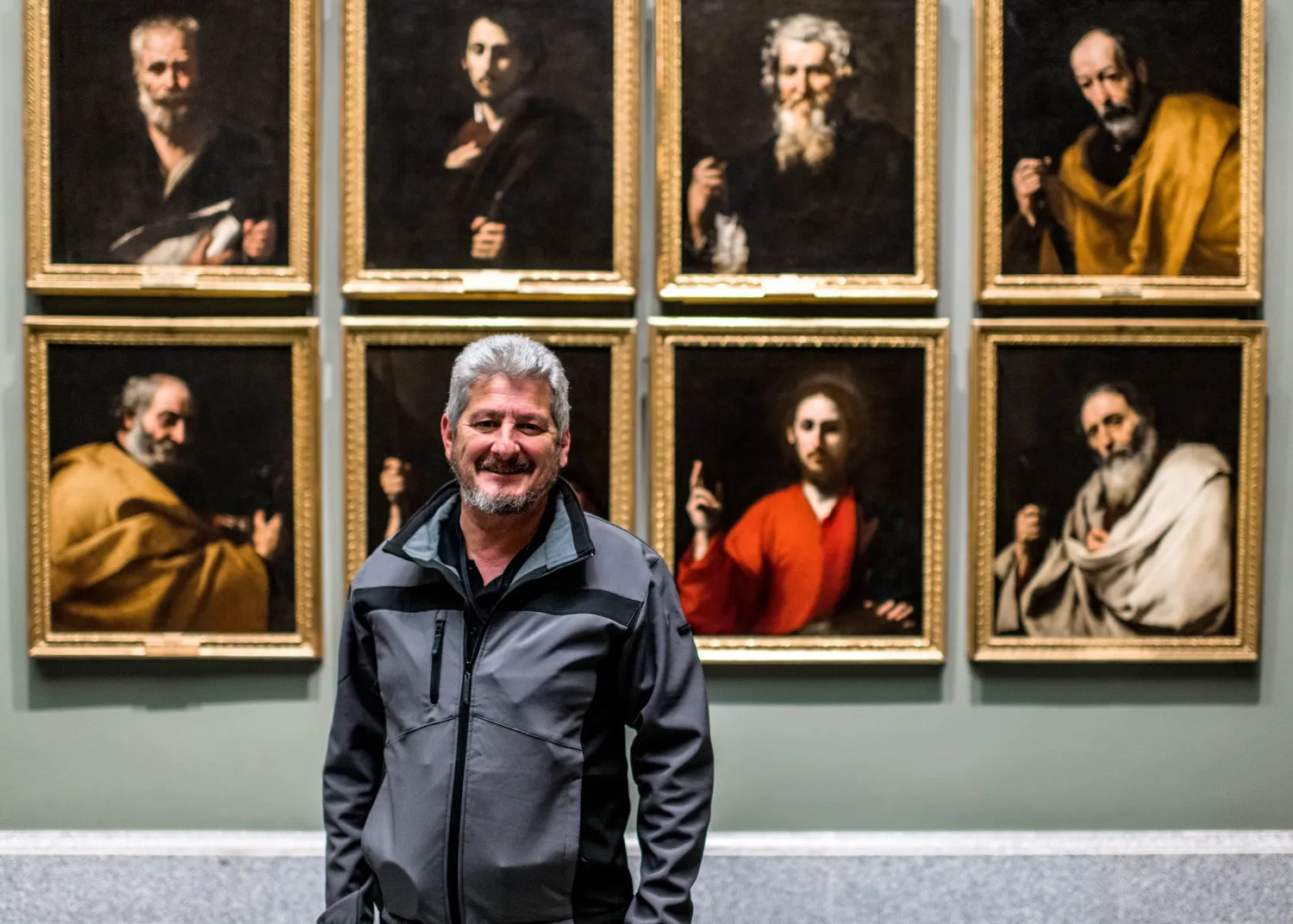
Manolo Osuna, a guard at the Prado Museum, in front of paintings by Jusepe de Ribera there in February.Credit...Emilio Parra Doiztua for The New York Times
TT

The Prado Museum’s Unsung Workers Step Into the Limelight

Manolo Osuna, a guard at the Prado Museum, in front of paintings by Jusepe de Ribera there in February.Credit...Emilio Parra Doiztua for The New York Times

Manolo Osuna lacks a formal art education, but he has spent years roaming the galleries of the Prado Museum as a guard and leader of a seven-person moving brigade that hefts national treasures by Spanish masters like Velázquez and Goya around the building.

With that homegrown background, Mr. Osuna, 56, has emerged from an invisible role at the museum to become an unlikely art critic in an Instagram video series that has become a hit. The videos, shot with a cellphone and selfie stick, have attracted a growing international following of up to nearly 100,000 daily viewers, who are fascinated by the slow-paced, decidedly un-Hollywood view of the museum, where a truly special experience is watching paint dry.

Every weekday, in the low hum of voices before the Prado, Spain’s national museum, opens, curatorial superstars and uniformed guards in red scarves are given a precious 10 minutes to talk. They focus on the works that are their familiar neighbors: the flirty 19th-century aristocrat in pale, green satin and pearls, or the Virgin Mary swooning below a crucified Christ.

For many fans, to listen to the videos has become a routine breakfast ritual, in which art specialists share equal play with the men and women who guard the galleries, restore Goya paintings or analyze medieval pigments in the museum’s lab.

About 50,000 people watched the Prado’s director, Miguel Falomir Faus, discuss a mythological renaissance painting by Titian, but slightly more listened to Mr. Osuna highlight a favorite portrait by the Spanish Baroque painter Jusepe de Ribera of a ragged Greek philosopher with a toothless grin and grimy fingernails. (“He’s like a peasant,” he explained. “Ribera’s characters are people from the street.”)

The attention to unsung employees is something of a rarity for international museums, where demoralized lower-tier staff members in recent years have banded together to form online support networks, share salary information and conduct annual surveys to gauge concerns.

“It’s great that the Prado is celebrating employees this way. It’s a model for other museums,” said Abi Godfrey, a duty manager at The Holburne Museum in Bath, England. In 2017, she helped found an online network called F.O.H. Museums, dedicated to “front of house” employees who work directly with visitors. “Those defined as back of house were more likely to say they felt valued, which contrasts greatly with the front of the house,” she said.

The creator of the Prado’s Instagram series is Javier Sainz de los Terreros, 37, who never appears on camera but whose soft, anonymous voice guides viewers through the galleries.

In a recent interview, Mr. Sainz de los Terreros conceded that his camera work had sometimes been shaky since his stabilizer broke. But the casual, unstaged nature, he said, is part of the charm.

If he misses a morning, he gets inquiries about his health from viewers. One visitor left an envelope at the museum addressed to “The Instagram Director,” with an appreciation gift. (It was a key chain of St. Teresa.) “You surprise me with your knowledge and creativity,” an Instagram user wrote on Monday, commenting on a video for International Women’s Day that featured female staff members discussing a 19th-century woman’s self-portrait.

Beginning in 2019, Mr. Sainz de los Terreros started filming works in the museum without dialogue, and each of the videos appeared on Instagram for just 24 hours. But viewers clamored for more, and so he created the longer, more detailed series of permanent videos now on view.

The videos often feature the unhurried, deliberate work of employees such as Elisa Mora, a restoration expert who has been at the Prado for 37 years and is just beginning to contemplate the renovation of a Goya portrait of the Countess of Chinchón purchased by the Prado in 2000 from descendants of the countess.

Standing beside the portrait in a cluttered studio, she pointed out old patchwork repairs on the back of the painting and explained an X-ray that revealed that Goya had actually painted the face of a man, which he erased by covering it over with the silvery folds of the woman’s dress. How long will it take to refurbish? Perhaps seven or more months, she said.

More than 99,000 people watched Ms. Mora’s video on Instagram and 260,000 on Facebook, and many comments praised the quick lesson in the makeover process. On Instagram, Julieta Varela, an Argentine artist, asked for more restoration updates, and an anonymous user called “Museum Nerd” from Colombia — with 200,000 followers — lauded the museum video as “an example of absolute best practices.”

Ms. Mora, who said that she was shy by nature, is more comfortable when facing a smartphone on a selfie stick. “We’re a little like doctors or surgeons who don’t think about fear while working, she said. “I’m more afraid to talk.”

Most of the videos are in Spanish without subtitles, but the museum is working on an alliance with the American Friends of the Prado Museum to create videos in English. About 30 percent of viewers are from Spain. The rest are spread internationally, with Italy and the United States ranked behind Spain. Museums in Málaga and Venice have sought the Prado’s advice about creating their own live Instagram videos, according to Mr. Sainz de los Terreros.

Mr. Osuna, who has figured in a few videos, said he was pleased with the positive reaction from visitors from Mexico and South America and viewers who are unable to visit the museum in person. He was unaware that more than 50,000 people had watched him introduce his favorite Ribera portrait, which he started studying more than 15 years ago when he joined the Prado. In conversations, he calls its philosopher subject his “compañero” — friend — and said he felt a special bond to the smiling man because of his hands, worn by years of labor.

“The beautiful thing is that people have learned about jobs that we do that they didn’t know anything about,” said Mr. Osuna, who is sometimes recognized in the museum by his Instagram fans. “And they learned about our challenges and our difficulties.”

(The New York Times)


17th Century Wreck Reappears from Stockholm Deep

The remains of a 17th century shipwreck is pictured after resurfacing in Stockholm, Sweden, on February 17, 2026. (Photo by Jonathan NACKSTRAND / AFP)
TT

17th Century Wreck Reappears from Stockholm Deep

The remains of a 17th century shipwreck is pictured after resurfacing in Stockholm, Sweden, on February 17, 2026. (Photo by Jonathan NACKSTRAND / AFP)

A 17th century Swedish Navy shipwreck buried underwater in central Stockholm for 400 years has suddenly become visible due to unusually low Baltic Sea levels.

The wooden planks of the ship's well-preserved hull have since early February been peeking out above the surface of the water off the island of Kastellholmen, providing a clear picture of its skeleton.

"We have a shipwreck here, which was sunk on purpose by the Swedish Navy," Jim Hansson, a marine archeologist at Stockholm's Vrak - Museum of Wrecks, told AFP.

Hansson said experts believe that after serving in the navy, the ship was sunk around 1640 to use as a foundation for a new bridge to the island of Kastellholmen.

Archeologists have yet to identify the exact ship, as it is one of five similar wrecks lined up in the same area to form the bridge, all dating from the late 16th and early 17th centuries.

"This is a solution, instead of using new wood you can use the hull itself, which is oak" to build the bridge, Hansson said.

"We don't have shipworm here in the Baltic that eats the wood, so it lasts, as you see, for 400 years," he said, standing in front of the wreck.

Parts of the ship had already broken the surface in 2013, but never before has it been as visible as it is now, as the waters of the Baltic Sea reach their lowest level in about 100 years, according to the archaeologist.

"There has been a really long period of high pressure here around our area in the Nordics. So the water from the Baltic has been pushed out to the North Sea and the Atlantic," Hansson explained.

A research program dubbed "the Lost Navy" is underway to identify and precisely date the large number of Swedish naval shipwrecks lying on the bottom of the Baltic.


China Has Slashed Air Pollution, but the ‘War’ Isn’t Over 

This picture taken on February 11, 2026 shows pedestrians walking along an overpass as traffic snarls in Beijing. (AFP)
TT

China Has Slashed Air Pollution, but the ‘War’ Isn’t Over 

This picture taken on February 11, 2026 shows pedestrians walking along an overpass as traffic snarls in Beijing. (AFP)

Fifteen years ago, Beijing's Liangma riverbanks would have been smog-choked and deserted in winter, but these days they are dotted with families and exercising pensioners most mornings.

The turnaround is the result of a years-long campaign that threw China's state power behind policies like moving factories and electrifying vehicles, to improve some of the world's worst air quality.

Pollution levels in many Chinese cities still top the World Health Organization's (WHO) limits, but they have fallen dramatically since the "airpocalypse" days of the past.

"It used to be really bad," said Zhao, 83, soaking up the sun by the river with friends.

"Back then when there was smog, I wouldn't come out," she told AFP, declining to give her full name.

These days though, the air is "very fresh".

Since 2013, levels of PM2.5 -- small particulate that can enter the lungs and bloodstream -- have fallen 69.8 percent, Beijing municipality said in January.

Particulate pollution fell 41 percent nationwide in the decade from 2014, and average life expectancy has increased 1.8 years, according to the University of Chicago's Air Quality Life Index (AQLI).

China's rapid development and heavy coal use saw air quality decline dramatically by the 2000s, especially when cold winter weather trapped pollutants close to the ground.

There were early attempts to tackle the issue, including installing desulphurization technology at coal power plants, while factory shutdowns and traffic control improved the air quality for events like the 2008 Olympics.

But the impact was short-lived, and the problem worsened.

- Action plan -

Public awareness grew, heightened by factors like the US embassy in Beijing making monitoring data public.

By 2013, several international schools had installed giant inflatable domes around sport facilities to protect students.

That year, multiple episodes of prolonged haze shrouded Chinese cities, with one in October bringing northeastern Harbin to a standstill for days as PM2.5 levels hit 40 times the WHO's then-recommended standard.

The phrase "I'm holding your hand, but I can't see your face" took off online.

Later that year, an eight-year-old became the country's youngest lung cancer patient, with doctors directly blaming pollution.

As concerns mounted, China's ruling Communist Party released a ten-point action plan, declaring "a war against pollution".

It led to expanded monitoring, improved factory technology and the closure or relocation of coal plants and mines.

In big cities, vehicles were restricted and the groundwork was laid for widespread electrification.

For the first time, "quantitative air quality improvement goals for key regions within a clear time limit" were set, a 2016 study noted.

These targets were "the most important measure", said Bluetech Clean Air Alliance director Tonny Xie, whose non-profit worked with the government on the plan.

"At that time, there were a lot of debates about whether we can achieve it, because (they were) very ambitious," he told AFP.

The policy targeted several key regions, where PM2.5 levels fell rapidly between 2013 and 2017, and the approach was expanded nationwide afterwards.

"Everybody, I think, would agree that this is a miracle that was achieved in China," Xie said.

China's success is "entirely" responsible for a decline in global pollution since 2014, AQLI said last summer.

- 'Low-hanging fruits' gone -

Still, in much of China the air remains dangerous to breathe by WHO standards.

This winter, Chinese cities, including financial hub Shanghai, were regularly among the world's twenty most polluted on monitoring site IQAir.

Linda Li, a running coach who has lived in both Beijing and Shanghai, said air quality has improved, but she still loses up to seven running days to pollution in a good month.

A top environment official last year said China aimed to "basically eliminate severe air pollution by 2025", but the government did not respond when AFP asked if that goal had been met.

Official 2025 data found nationwide average PM2.5 concentrations decreased 4.4 percent on-year.

Eighty-eight percent of days featured "good" air quality.

However, China's current definition of "good" is PM2.5 levels of under 35 micrograms per cubic meter, significantly higher than the WHO's recommended five micrograms.

China wants to tighten the standard to 25 by 2035.

The last five years have also seen pollution reduction slow.

The "low-hanging fruits" are gone, said Chengcheng Qiu from the Center for Research on Energy and Clean Air (CREA).

Qiu's research suggests pollution is shifting west as heavy industry relocates to regions like Xinjiang, and that some cities in China have seen double-digit percentage increases in PM2.5 in the last five years.

"They can't just stop all industrial production. They need to find cleaner ways to produce the output," Qiu said.

There is hope for that, given China's status as a renewable energy powerhouse, with coal generation falling in 2025.

"Cleaner air ultimately rests on one clear direction," said Qiu.

"Move beyond fossil fuels and let clean energy power the next stage of development."


Sydney Man Jailed for Mailing Reptiles in Popcorn Bags 

Investigators recovered 101 Australian reptiles from parcels destined for Hong Kong, South Korea, Sri Lanka and Romania. (AFP file)
TT

Sydney Man Jailed for Mailing Reptiles in Popcorn Bags 

Investigators recovered 101 Australian reptiles from parcels destined for Hong Kong, South Korea, Sri Lanka and Romania. (AFP file)

A Sydney man who tried to post native lizards, dragons and other reptiles out of Australia in bags of popcorn and biscuit tins has been sentenced to eight years in jail, authorities said Tuesday.

The eight-year term handed down on Friday was a record for wildlife smuggling, federal environment officials said.

A district court in Sydney gave the man, 61-year-old Neil Simpson, a non-parole period of five years and four months.

Investigators recovered 101 Australian reptiles from seized parcels destined for Hong Kong, South Korea, Sri Lanka and Romania, the officials said in a statement.

The animals -- including shingleback lizards, western blue-tongue lizards, bearded dragons and southern pygmy spiny-tailed skinks -- were posted in 15 packages between 2018 and 2023.

"Lizards, skinks and dragons were secured in calico bags. These bags were concealed in bags of popcorn, biscuit tins and a women's handbag and placed inside cardboard boxes," the statement said.

The smuggler had attempted to get others to post the animals on his behalf but was identified by government investigators and the New South Wales police, it added.

Three other people were convicted for taking part in the crime.

The New South Wales government's environment department said that "the illegal wildlife trade is not a victimless crime", harming conservation and stripping the state "and Australia of its unique biodiversity".
