


Football in Brazil Continues Despite Coronavirus

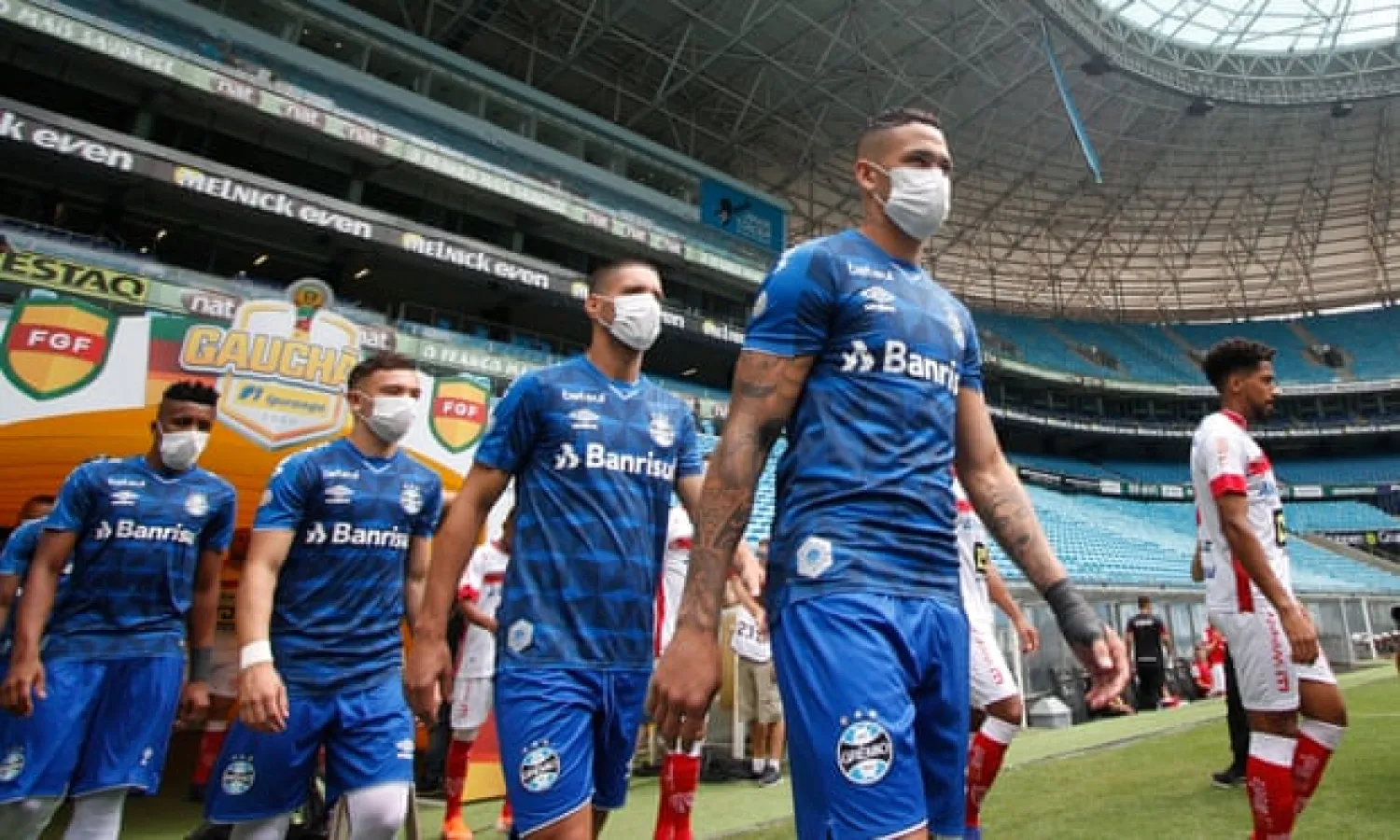
 Grêmio players wear protective masks as a protest. Photograph: Richard Ducker/AFP via Getty Images
Grêmio players wear protective masks as a protest. Photograph: Richard Ducker/AFP via Getty Images
TT

Football in Brazil Continues Despite Coronavirus

 Grêmio players wear protective masks as a protest. Photograph: Richard Ducker/AFP via Getty Images
Grêmio players wear protective masks as a protest. Photograph: Richard Ducker/AFP via Getty Images

On Sunday morning in the southern Brazilian state of Rio Grande do Sul, Grêmio players and coaching staff emerged from the tunnel at their empty stadium wearing surgical masks in protest at having to fulfil their Campeonato Gaúcho fixture against São Luiz despite the coronavirus pandemic. While many countries have brought a halt to all sporting activities, Brazilian football has been slow and inconsistent in its reaction to the pandemic.

Later on Sunday, the national football confederation, the CBF, released a statement announcing that all national competitions would be suspended indefinitely and with immediate effect. Ongoing tournaments under their jurisdiction include the first and second divisions of women’s Brazilian championship, as well as the men’s U17 national championship and men’s U20 Brazilian Cup. Yet the men’s senior game in Brazil is in the midst of the state championship season and the power to suspend those competitions rests with local federations rather than the CBF.

After meetings on Sunday and Monday, some state federations have now taken decisive action. On Sunday night, the Minas Gerais federation put games on hold indefinitely from Tuesday. On Monday, the federations in São Paulo, Paraná, Santa Catarina and Maranhão followed suit. The Alagoas, Pará, Rio Grande do Sul and Rio de Janeiro federations, meanwhile, have suspended activities for 15 days. But without consensus across the country on how to proceed, football is yet to stop in all regions.

For players, club employees and many commentators, the authorities have already taken, and in some cases continue to take, unnecessary risks. “The countries that are containing the situation are those that adopt strong measures”, said Grêmio vice-president Paulo Luz. “We must prioritise life.” Similar scenes to those at the Arena do Grêmio played out in Rio de Janeiro later on Sunday, as Vasco da Gama and Botafogo players lined up before their respective games with protective masks on their faces. Botafogo players carried a banner that pointedly read, “Coronavirus: protect yourself! This fight belongs to all of us.”

In both Rio de Janeiro and Rio Grande do Sul, matches were already being played behind closed doors as a precaution over the weekend. On Friday, Rio de Janeiro state governor Wilson Witzel said: “With closed gates, there is no agglomeration of people. On the contact between players… that’s their risk.” Vasco defender Leandro Castán responded sarcastically to Witzel, tweeting, “The risk is ours, great response, great governor, thanks for your respect with the players!!!”

Stadiums were also closed in the city of São Paulo, the centre of infections in the country. The derby between São Paulo and Santos took place in a deserted Morumbi stadium and Corinthians played Ituano at home with recordings of singing fans being played over the speaker system at high volume.

Yet, elsewhere in São Paulo state and in numerous states from Santa Catarina in the south to Mato Grosso do Sul in the west, Pará in the north and Pernambuco in the north east, games went ahead as usual, with tickets sold and fans occupying, if not entirely filling, the terraces. Authorities in many of Brazil’s 26 states are still reluctant to suspend games. In Amapá, Mato Grosso do Sul, Pernambuco and Ceará the federations have announced that the local championships will continue without the presence of fans. Others prevaricate over the situation.

André Pitta, president of the state football federation of Goiás, said on Sunday: “Our position is to maintain the championship behind closed doors. We will have a meeting with the clubs before the end of the week, without rushing, with tranquility, to evaluate the situation. The CBF’s decision is different from that with regards to the state championship.”

Brazil president Jair Bolsonaro supported Pitta’s stance and criticised the CBF’s approach in an interview with CNN on Sunday evening. “When you prohibit football matches, you are approaching hysteria,” he declared. “I don’t want that.” He said the CBF could instead “sell a percentage of the tickets, taking into account the quantity of people in the stands, and not immediately prohibit this or that, because cancelling [football] will not contain the spread. The economy cannot stop. It will generate unemployment.”

O Globo columnist Martín Fernández disagrees. “Stop everything as soon as possible,” he suggests. “That is what specialists who study the subject recommend. Playing games without fans does not make sense – the meeting up of people in the stadium or around the television is the reason the game exists. Playing without fans is encouraging people to move around and meet up. And that is an error.”

Yet the power in Brazilian football, and the jurisdiction in this matter, remains in the hands of the state federations. If they do not all, individually, see fit to suspend games, then football will continue.

While things remain up in the air, players, coaches and club directors are understandably concerned. Grêmio manager Renato Portaluppi used a post-match interview on Sunday to question those in power, saying: “Is it not the case that Brazilian football must stop? The whole world has stopped. Will we have to go on strike?” Meanwhile, the Internacional midfielder Damián Musto displayed his dismay by tweeting: “What are they waiting for? Stop everything, hijos de puta! They play with lives as if it were a video game. Stop before it is too late!”

In Ceará, the federation’s decision to maintain the football calendar was supported by the presidents of the two big local clubs, Ceará and Fortaleza. But the president of the professional footballers’ union said his members were unhappy. “Despite players being young and healthy, they are not immune from the virus,” he said. “A football match, even without a crowd, moves at least 200 people, many of an advanced age, who according to official data are the worst affected by the virus.”

Juca Kfouri, the doyen of Brazilian football writing, expressed his view in the daily paper Folha: “There is nothing that justifies playing games without fans, and even less submitting the players to the risk of coronavirus. Wash your hands, do not touch people near you, keep your distance and … gooool!!!” Brazil’s football-watching public waits to see how much longer it will take before players are no longer forced to play and commentators are no longer screaming that last word over the airwaves.

The Guardian Sport


Chelsea Injuries up 44% After Club World Cup but Report Says Event Has Had ‘Minimal’ Impact

Chelsea's Reece James, center, lifts the trophy following the Club World Cup final soccer match between Chelsea and PSG at MetLife Stadium in East Rutherford, N.J., Sunday, July 13, 2025. (AP)
TT

Chelsea Injuries up 44% After Club World Cup but Report Says Event Has Had ‘Minimal’ Impact

Chelsea's Reece James, center, lifts the trophy following the Club World Cup final soccer match between Chelsea and PSG at MetLife Stadium in East Rutherford, N.J., Sunday, July 13, 2025. (AP)

Chelsea suffered a 44% spike in injuries after competing in the supersized Club World Cup this year, according to findings published on Tuesday.

But the newly expanded tournament has so far had a “minimal impact” on injuries overall, the latest edition of the Men’s European Football Injury Index found.

There was fierce opposition to FIFA's new flagship club event when it was confirmed in 2023 that it would increase from seven to 32 teams, with players' unions warning of physical and mental burnout of players due to an ever expanding match schedule. But FIFA pressed ahead and staged the tournament in the United States in June-July.

Chelsea went on to win the inaugural competition, receiving the trophy from US President Donald Trump at MetLife Stadium and taking home prize money of around $125 million. But, according to the Index, from June-October, Chelsea picked up more injuries — 23 — than any of the nine clubs from Europe's top leagues that participated in the Club World Cup.

They included star player Cole Palmer, and was a 44% increase on the same period last year.

While Chelsea, which played 64 games over the entire 2024-25 season, saw an increase in injuries, the Index, produced by global insurance firm Howden, found that overall there was a decrease.

“In principle you would expect this increased workload to lead to an increase in the number of injuries sustained, as a possible rise in overall injury severity,” the Index report said, but added: “The data would suggest a minimal impact on overall injury figures.”

Despite the figures, the authors of the report accept it was too early to assess the full impact of the Club World Cup, with the findings only going up to October.

“We would expect to see the impact to spike in that sort of November to February period,” said James Burrows, Head of Sport at Howden. “What we’ve seen previously is that’s where the impact is seen from summer tournaments."

Manchester City has sustained 22 since the tournament, which is the highest among the nine teams from Europe's top leagues — England, Spain, Italy, Germany and France.

Those teams have recorded 146 injuries from June-October, which is down on the previous year's figure of 174.

From August-October that number is 121, the lowest for that three-month period in the previous six years of the Index.


Sunderland Worst Hit by Losing Players to African Cup of Nations 

14 December 2025, United Kingdom, London: Sunderland's Habib Diarra (L) and Leeds United's Gabriel Gudmundsson battle for the ball during the English Premier League soccer match between Brentford and Leeds United at the Gtech Community Stadium. (dpa)
TT

Sunderland Worst Hit by Losing Players to African Cup of Nations 

14 December 2025, United Kingdom, London: Sunderland's Habib Diarra (L) and Leeds United's Gabriel Gudmundsson battle for the ball during the English Premier League soccer match between Brentford and Leeds United at the Gtech Community Stadium. (dpa)

Premier League Sunderland will have to do without six players over the next few weeks and are the club worst hit as the Africa Cup of Nations takes its toll on European clubs competing over the holiday season.

Sunderland, eighth in the standings, had four of their African internationals in action when they beat Newcastle United on Sunday, but like 14 other English top-flight clubs will now lose those players to international duty.

The timing of the African championship, kicking off in Morocco on Sunday and running through to January 18, has long been an irritant for coaches, with leagues in Belgium, France, Germany, Italy, Netherlands, Portugal, and Spain also affected.

Hosting the tournament in the middle of the season impacts around 58% of the players at the Cup of Nations, though the Confederation of African Football did try to mitigate the impact by moving the start to before Christmas, so it is completed before the next round of Champions League matches.

The impact on European clubs was also lessened by allowing them to release players seven days, rather than the mandatory 14 days, before the tournament, meaning they could play for their clubs last weekend.

Sunderland's Congolese Arthur Masuaku and Noah Sadiki, plus full back Reinildo (Mozambique), midfielder Habib Diarra (Mali), and attackers Chemsdine Talbi (Morocco) and Bertrand Traore (Burkina Faso) have now departed for Morocco.

Ironically, Mohamed Salah’s absence from Liverpool to play for Egypt should lower the temperature at the club after his recent outburst against manager Arne Slot, but Manchester United will lose three players in Noussair Mazraoui, Bryan Mbeumo and Amad Diallo, who scored in Monday’s 4-4 draw with Bournemouth.

France is again the country with the most players heading to the Cup of Nations, and with 51 from Ligue 1 clubs. But their absence is much less impactful than previously as Ligue 1 broke after the weekend’s fixtures and does not resume until January 2, by which time the Cup of Nations will be into its knockout stage.

There are 21 players from Serie A clubs, 18 from the Bundesliga, and 15 from LaLiga teams among the 24 squads at the tournament in Morocco.


Rodgers Takes Charge of Saudi Team Al-Qadsiah After Departure from Celtic 

Then-Celtic head coach Brendan Rodgers greets supporters after a Europa League soccer match between Red Star and Celtic at Rajko Mitic Stadium in Belgrade, Serbia, Sept. 24, 2025. (AP)
TT

Rodgers Takes Charge of Saudi Team Al-Qadsiah After Departure from Celtic 

Then-Celtic head coach Brendan Rodgers greets supporters after a Europa League soccer match between Red Star and Celtic at Rajko Mitic Stadium in Belgrade, Serbia, Sept. 24, 2025. (AP)

Brendan Rodgers has returned to football as the coach of Saudi Arabian club Al-Qadsiah, six weeks after resigning from Scottish champion Celtic.

Al-Qadsiah, whose squad includes Italian striker Mateo Retegui and former Real Madrid defender Fernandez Nacho, is in fifth place in the Saudi Pro League in its first season after promotion.

Rodgers departed Celtic on Oct. 27 and has opted to continue his managerial career outside Britain for the first time, having previously coached Liverpool, Leicester and Swansea.

In its statement announcing the hiring of Rodgers on Tuesday, Al-Qadsiah described him as a “world-renowned coach” and said his arrival “reflects the club’s ambitious vision and its rapidly growing sporting project.”

Aramco, the state-owned Saudi oil giant, bought Al-Qadsiah in 2023 in a move that has helped to transform the club’s status.

“This is a landmark moment for the club,” Al-Qadsiah chief executive James Bisgrove said. “The caliber of his experience and track record of winning reflects our ambition and long-term vision to establish Al-Qadsiah as one of Asia’s leading clubs.”

Rodgers is coming off winning back-to-back Scottish league titles with Celtic, where he won 11 major trophies across his two spells. He also won the FA Cup with Leicester.

Al-Qadsiah's last two coaches were former Liverpool striker Robbie Fowler and former Spain midfielder Michel.
