


Football Behind Closed Doors May Tell US Much About How Home Advantage Works

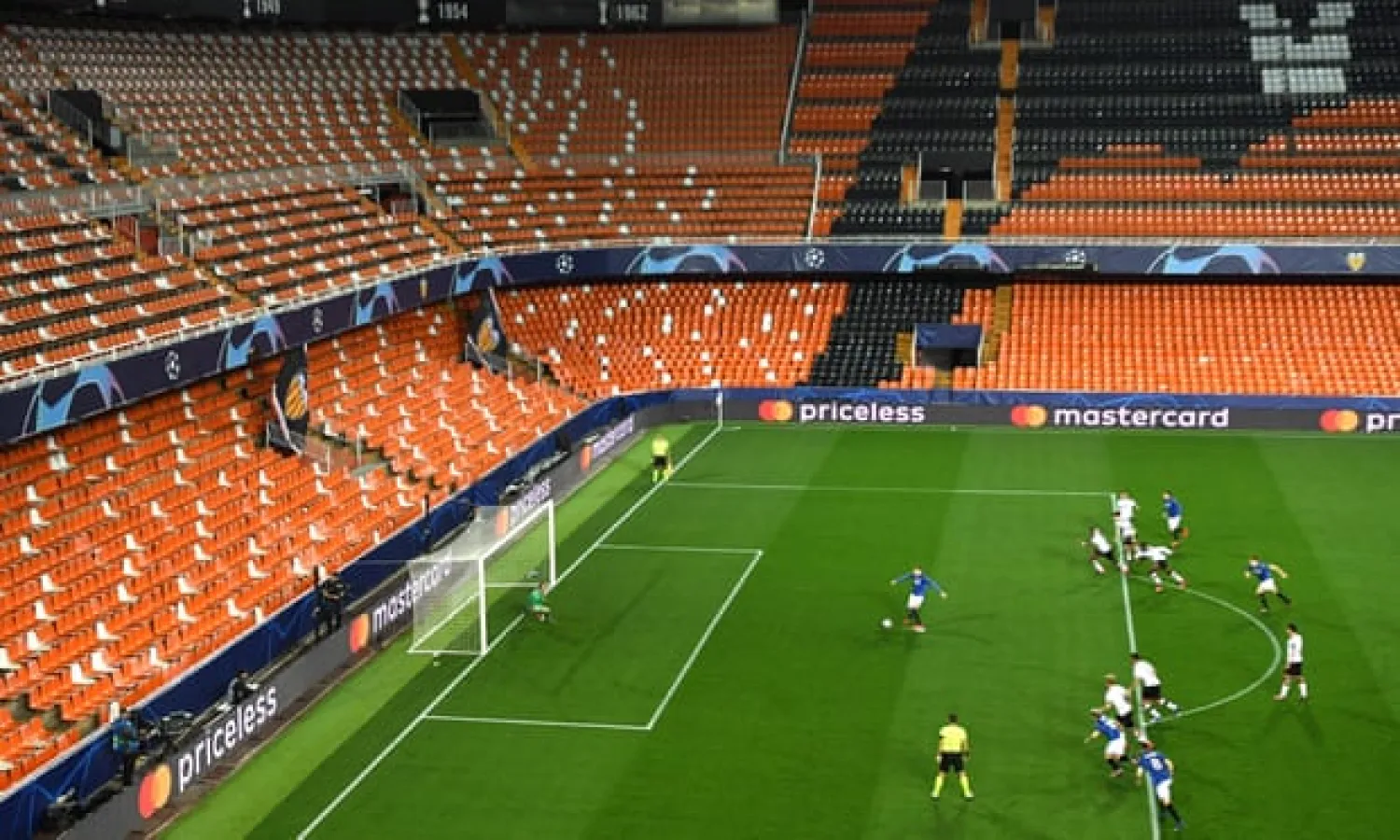
 Atalanta’s Josip Ilicic scores an early penalty in his side’s 4-3 away win against Valencia at an empty Mestalla. Photograph: UEFA/EPA
Atalanta’s Josip Ilicic scores an early penalty in his side’s 4-3 away win against Valencia at an empty Mestalla. Photograph: UEFA/EPA
TT

Football Behind Closed Doors May Tell US Much About How Home Advantage Works

 Atalanta’s Josip Ilicic scores an early penalty in his side’s 4-3 away win against Valencia at an empty Mestalla. Photograph: UEFA/EPA
Atalanta’s Josip Ilicic scores an early penalty in his side’s 4-3 away win against Valencia at an empty Mestalla. Photograph: UEFA/EPA

The Mestalla in Valencia has to be one of the most intimidating stadiums in the world for visiting football teams. Its stands, which have the pitch of a ski jump, allow home fans to create a claustrophobic wall of noise. The rabid screams of 55,000 Valencians, bouncing off the concrete foundations, have made it something of a fortress for the local team and a popular venue for Spain’s home fixtures. A while back, I watched Valencia play Barcelona at the Mestalla, and there was a febrile menace in the air that night unlike any other I have experienced in a football ground.

The vibe at the Mestalla was rather different last week, when Valencia hosted Atalanta in the second leg of the sides’ Champions League last-16 tie. If ever a team needed a boost from their 12th man, their fans, it was now: Valencia had to make up a 4-1 deficit from the first leg. But, because of the coronavirus outbreak, the fixture was played behind closed doors. Watching the match on TV was eerie: you could hear the players shouting for the ball or celebrating or appealing for a foul. At times you had to remind yourself that it wasn’t a training exercise.

The match became even more listless after just 90 seconds, when Atalanta were awarded a penalty. The Slovenian striker Josip Ilicic buried it and added three more in a 4-3 victory. “Fabulous game missed by fans at Mestalla,” Gary Lineker tweeted. “Imagine scoring all 4 goals like Ilicic has done with barely a soul in the stadium.”

On Friday, it was announced that all elite football in England and Scotland will be postponed until at least April. The Champions League and Europa League have also been suspended. What happens next is decidedly murky. There may be play‑offs to decide titles and relegation. Euro 2020 could be delayed. And there might well be more surreal spectacles like the one that played out between Valencia and Atalanta.

If more matches do have to be played in empty stadiums without fans, can we expect it to affect the results? Will Liverpool suddenly be less formidable without the Kop behind them? Home advantage is one of the immutable facts of sport, especially football – what happens when you remove the crowd from the equation?

Playing sport behind closed doors has traditionally been used as a punishment for the home team. In football, it dates back to the early 1980s, when English clubs were feared across Europe for their tenacity on the field and their brutality off it. West Ham were the first team on the receiving end. In September 1980, the Hammers played Castilla, essentially Real Madrid’s feeder team, at the Bernabéu in the European Cup Winners Cup. When they lost 3-1 in the first leg – perhaps because they were humiliated by losing to a second‑string outfit, or maybe because they just fancied a punch-up – the West Ham supporters went on the rampage. Dozens were ejected from the stadium; outside, one was run over by a bus and died.

Uefa determined that the second leg should be played in an empty Upton Park. In fact, the official attendance was 262, when you took players, staff, ball kids and media into account. But the atmosphere was unquestionably odd: the West Ham goalkeeper Phil Parkes recalled afterwards that he had to tune out commentary on the game from a radio behind the goal. It became known as “the ghost match”.

In one sense, West Ham were punished for the riot in Madrid: the club would have expected a full house of 36,000 for the second leg, so it made a hefty dent in their income. But what about on the pitch? Did West Ham suffer from not having the Upton Park faithful roaring them on?

Not especially. Back in London, West Ham tied the match 3-1 in 90 minutes; in extra time they scored two more. It was a similar story in September 1982, when Aston Villa were made to start their European campaign on a Wednesday afternoon at 2.30pm in front of 187 spectators, as a censure for rioting by their supporters the previous season in Belgium. Again, it wasn’t much of a punishment: Villa beat Besiktas 3-1. Internazionale had to play three Champions League home games behind closed doors in 2005, and they won all three.

So we’re clear: it’s not that home clubs usually perform better when forced to play behind closed doors. That’s probably not the case, and there’s not enough statistical evidence to confirm or deny it. But these matches played without supporters do make you wonder how influential fans in the stadium are to the performance of their beloved team.

Research shows home advantage is clearly and definitely a major factor in football. Taken aAcross all teams and all leagues in England, the home team invariably wins around 45% of matches, and draws 25%. Fans might believe this is down to their support but actually the size of the crowd and the intensity of their screaming does not appear to have a significant impact on the result.

Where the home crowd can sometimes have a game-changing influence, however, is on the decisions of the referee. A couple of studies have indicated that football officials – unwittingly, of course – were wary of making controversial calls against the home team because they suspected, perhaps subliminally, that the crowd would turn on them. In practice, this means fewer yellow cards, more penalties given – and the louder and more partisan the crowd, the greater the unconscious bias.

If some of the key fixtures this season do end up being decided behind closed doors, they will be intriguing to watch (obviously on a screen, not in the stands). Will referees make better decisions? Will the intensity of home players dip without the crowd to gee them up?

Or, counter-intuitively, will these players suddenly display a new sense of freedom? Joey Barton once complained that abusive Newcastle fans at St James’ Park had destroyed the confidence of the players. Likewise, there must have been times when Gary Neville was manager at Valencia in 2016 when he wished the Mestalla was empty. As thrilling as it must be when 55,000 fans are chanting your name, imagine how soul-destroying it is when they are screaming as one: “Gary, vete ya!” or “Gary, go now!”

The Guardian Sport


Ukraine's Officials to Boycott Paralympics over Russian Flag Decision

Milano Cortina 2026 Winter Olympics - Skeleton - Interview with Ukraine Youth and Sports minister Matvii Bidnyi - N H Hotel, Milan, Italy - February 12, 2026 Ukraine Youth and Sports Minister Matvii Bidnyi speaks after the disqualification of Ukrainian skeleton racer Vladyslav Heraskevych from the Winter Games. REUTERS/Kevin Coombs
TT

Ukraine's Officials to Boycott Paralympics over Russian Flag Decision

Milano Cortina 2026 Winter Olympics - Skeleton - Interview with Ukraine Youth and Sports minister Matvii Bidnyi - N H Hotel, Milan, Italy - February 12, 2026 Ukraine Youth and Sports Minister Matvii Bidnyi speaks after the disqualification of Ukrainian skeleton racer Vladyslav Heraskevych from the Winter Games. REUTERS/Kevin Coombs

Ukrainian officials will boycott the Paralympic Winter Games, Kyiv said Wednesday, after the International Paralympic Committee allowed Russian athletes to compete under their national flag.

Ukraine also urged other countries to shun next month's Opening Ceremony in Verona on March 6, in part of a growing standoff between Kyiv and international sporting federations four years after Russia invaded.

Six Russians and four Belarusians will be allowed to take part under their own flags at the Milan-Cortina Paralympics rather than as neutral athletes, the Games' governing body confirmed to AFP on Tuesday.

Russia has been mostly banned from international sport since Moscow invaded Ukraine. The IPC's decision triggered fury in Ukraine.

Ukraine's sports minister Matviy Bidny called the decision "outrageous", and accused Russia and Belarus of turning "sport into a tool of war, lies, and contempt."

"Ukrainian public officials will not attend the Paralympic Games. We will not be present at the opening ceremony," he said on social media.

"We will not take part in any other official Paralympic events," he added.

Ukrainian Foreign Minister Andriy Sybiga said he had instructed Kyiv's ambassadors to urge other countries to also shun the opening ceremony.

"Allowing the flags of aggressor states to be raised at the Paralympic Games while Russia's war against Ukraine rages on is wrong -- morally and politically," Sybiga said on social media.

The EU's sports commissioner Glenn Micallef said he would also skip the opening ceremony.

- Kyiv demands apology -

The IPC's decision comes amid already heightened tensions between Ukraine and the International Olympic Committee, overseeing the Winter Olympics currently underway.

The IOC banned Ukrainian skeleton racer Vladyslav Heraskevych for refusing to ditch a helmet depicting victims of the war with Russia.

Ukraine was further angered that the woman chosen to carry the "Ukraine" name card and lead its team out during the Opening Ceremony of the Games was revealed to be Russian.

Media reports called the woman an anti-Kremlin Russian woman living in Milan for years.

"Picking a Russian person to carry the nameplate is despicable," Kyiv's foreign ministry spokesman Georgiy Tykhy said at a briefing in response to a question by AFP.

He called it a "severe violation of the Olympic Charter" and demanded an apology.

And Kyiv also riled earlier this month at FIFA boss Gianni Infantino saying he believed it was time to reinstate Russia in international football.

- 'War, lies and contempt' -

Valeriy Sushkevych, president of the Ukrainian Paralympic Committee told AFP on Tuesday that Kyiv's athletes would not boycott the Paralympics.

Ukraine traditionally performs strongly at the Winter Paralympics, coming second in the medals table four years ago in Beijing.

"If we do not go, it would mean allowing Putin to claim a victory over Ukrainian Paralympians and over Ukraine by excluding us from the Games," said the 71-year-old in an interview.

"That will not happen!"

Russia was awarded two slots in alpine skiing, two in cross-country skiing and two in snowboarding. The four Belarusian slots are all in cross-country skiing.

The International Paralympic Committee (IPC) said earlier those athletes would be "treated like (those from) any other country".

The IPC unexpectedly lifted its suspension on Russian and Belarusian athletes at the organisation's general assembly in September.


'Not Here for Medals', Nakai Says after Leading Japanese Charge at Olympics

Ami Nakai of Japan competes during the women's short program figure skating at the 2026 Winter Olympics, in Milan, Italy, Tuesday, Feb. 17, 2026. (AP Photo/Ashley Landis)
TT

'Not Here for Medals', Nakai Says after Leading Japanese Charge at Olympics

Ami Nakai of Japan competes during the women's short program figure skating at the 2026 Winter Olympics, in Milan, Italy, Tuesday, Feb. 17, 2026. (AP Photo/Ashley Landis)

Ami Nakai entered her first Olympics insisting she was not here for medals — but after the short program at the Milano Cortina Games, the 17-year-old figure skater found herself at the top, ahead of national icon Kaori Sakamoto and rising star Mone Chiba.

Japan finished first, second, and fourth on Tuesday, cementing a formidable presence heading into the free skate on Thursday. American Alysa Liu finished third.

Nakai's clean, confident skate was anchored by a soaring triple Axel. She approached the moment with an ease unusual for an Olympic debut.

"I'm not here at this Olympics with the goal of achieving a high result, I'm really looking forward to enjoying this Olympics as much as I can, till the very last moment," she said.

"Since this is my first Olympics, I had nothing to lose, and that mindset definitely translated into my results," she said.

Her carefree confidence has unexpectedly put her in medal contention, though she cannot imagine herself surpassing Sakamoto, the three-time world champion who is skating the final chapter of her competitive career. Nakai scored 78.71 points in the short program, ahead of Sakamoto's 77.23.

"There's no way I stand a chance against Kaori right now," Nakai said. "I'm just enjoying these Olympics and trying my best."

Sakamoto, 25, who has said she will retire after these Games, is chasing the one accolade missing from her resume: Olympic gold.

Having already secured a bronze in Beijing in 2022 and team silvers in both Beijing and Milan, she now aims to cap her career with an individual title.

She delivered a polished short program to "Time to Say Goodbye," earning a standing ovation.

Sakamoto later said she managed her nerves well and felt satisfied, adding that having three Japanese skaters in the top four spots "really proves that Japan is getting stronger". She did not feel unnerved about finishing behind Nakai, who also bested her at the Grand Prix de France in October.

"I expected to be surpassed after she landed a triple Axel ... but the most important thing is how much I can concentrate on my own performance, do my best, stay focused for the free skate," she said.

Chiba placed fourth and said she felt energised heading into the free skate, especially after choosing to perform to music from the soundtrack of "Romeo and Juliet" in Italy.

"The rankings are really decided in the free program, so I'll just try to stay calm and focused in the free program and perform my own style without any mistakes," said the 20-year-old, widely regarded as the rising all-rounder whose steady ascent has made her one of Japan's most promising skaters.

All three skaters mentioned how seeing Japanese pair Riku Miura and Ryuichi Kihara deliver a stunning comeback, storming from fifth place after a shaky short program to capture Japan's first Olympic figure skating pairs gold medal, inspired them.

"I was really moved by Riku and Ryuichi last night," Chiba said. "The three of us girls talked about trying to live up to that standard."


PSG’s Mental Strength Hailed as they Come from Behind to Win at Monaco

Soccer Football - UEFA Champions League - Play Off - First Leg - AS Monaco v Paris St Germain - Stade Louis II, Monaco - February 17, 2026 Paris St Germain coach Luis Enrique reacts REUTERS/Manon Cruz
TT

PSG’s Mental Strength Hailed as they Come from Behind to Win at Monaco

Soccer Football - UEFA Champions League - Play Off - First Leg - AS Monaco v Paris St Germain - Stade Louis II, Monaco - February 17, 2026 Paris St Germain coach Luis Enrique reacts REUTERS/Manon Cruz

Paris Saint-Germain coach Luis ‌Enrique hailed the mental strength of his side in coming from two goals down to win 3-2 away at Monaco in the Champions League on Tuesday, but warned the knockout round tie was far from finished.

The first leg clash between the two Ligue 1 clubs saw Folarin Balogun score twice for the hosts in the opening 18 minutes before Vitinha had his penalty saved to compound matters.

But after Desire Doue came on for injured Ousmane Dembele, the ‌match turned ‌and defending champions PSG went on to ‌secure ⁠a one-goal advantage ⁠for the return leg.

"Normally, when a team starts a match like that, the most likely outcome is a loss,” Reuters quoted Luis Enrique as saying.

“It was catastrophic. It's impossible to start a match like that. The first two times they overcame our pressure and entered our half, they scored. They ⁠made some very good plays.

“After that, it's difficult ‌to have confidence, but we ‌showed our mental strength. Plus, we missed a penalty, so ‌it was a chance to regain confidence. In the ‌last six times we've played here, this is only the second time we've won, which shows how difficult it is.”

The 20-year-old Doue scored twice and provided a third for Achraf Hakimi, just ‌days after he had turned in a poor performance against Stade Rennais last Friday ⁠and was ⁠dropped for the Monaco clash.

“I'm happy for him because this past week, everyone criticized and tore Doue apart, but he was sensational, he showed his character. He helped the team at the best possible time.”

Dembele’s injury would be assessed, the coach added. “He took a knock in the first 15 minutes, then he couldn't run.”

The return leg at the Parc des Princes will be next Wednesday. “Considering how the match started, I'm happy with the result. But the match in Paris will be difficult, it will be a different story,” Luis Enrique warned.
