


Russia’s Shoigu Delivers ‘Firm’ Message to Assad on Idlib, East Euphrates

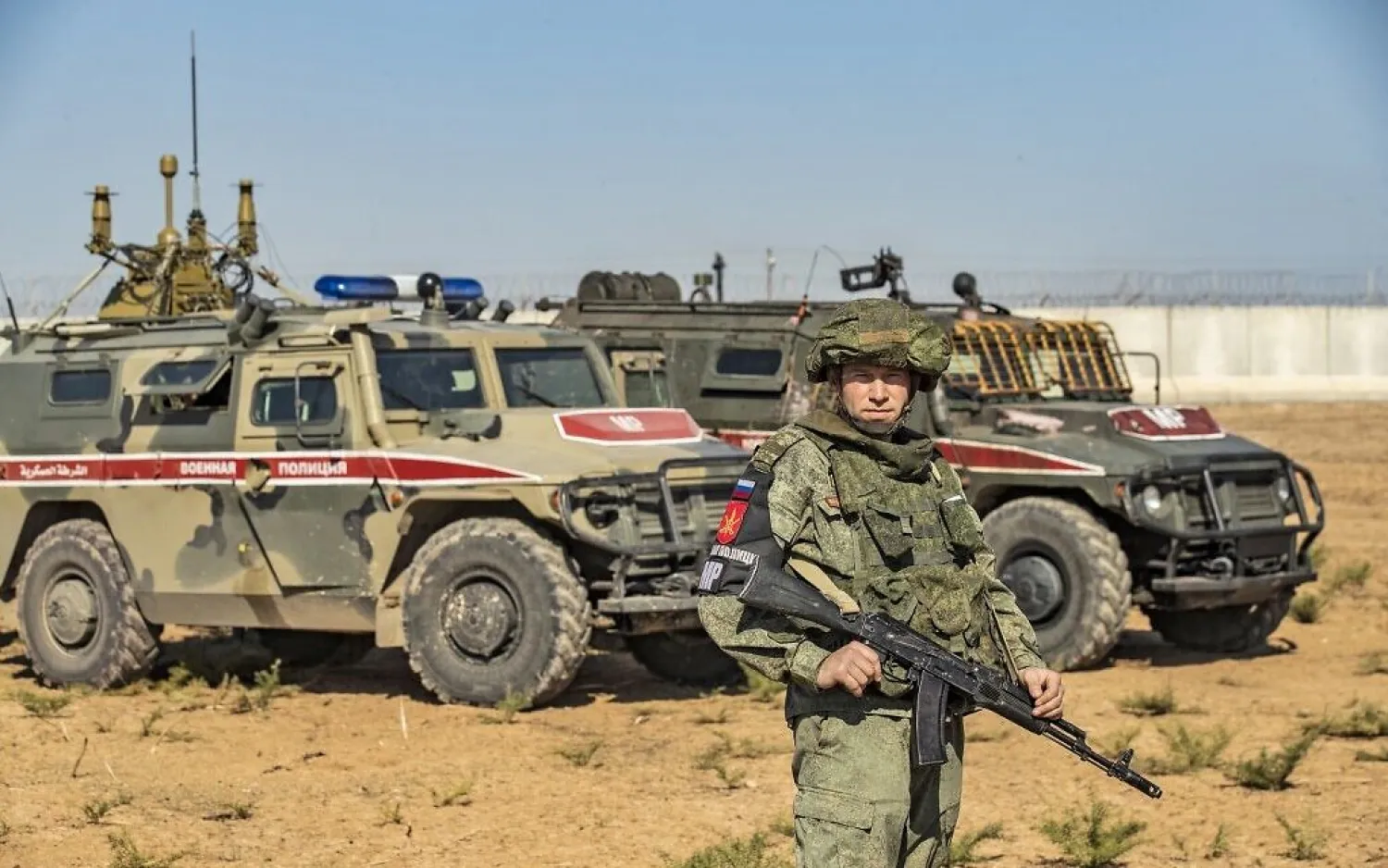
Russian military police take part in a joint Turkish-Russian army patrol near the town of Darbasiyah in Syria's northeastern Hasakeh province, November 11, 2019. (AFP)
TT

Russia’s Shoigu Delivers ‘Firm’ Message to Assad on Idlib, East Euphrates

Russian military police take part in a joint Turkish-Russian army patrol near the town of Darbasiyah in Syria's northeastern Hasakeh province, November 11, 2019. (AFP)

Russian Defense Minister Sergey Shoigu’s surprise visit to Damascus on Monday where he held talks with regime leader Bashar Assad on the Idlib ceasefire, carried several implications.

He deliberately flew to the Syrian capital escorted by Sukhoi Su-35 fighter jets, in what was seen as a message to the Americans and Israelis and Damascus and what Russia described as a “business trip.”

A defense ministry statement said he held talks with Assad on the Idlib ceasefire and mechanism to implement the Russian-Turkish agreement, but it was clear that the Russian official with direct influence in Syria was there to deliver a firm message, saying Moscow would no longer tolerate any more violations of the agreements it signed with Ankara.

This message was made clear after Damascus recently implied it would resume fighting to assume full control of the M4 highway linking Aleppo to Latakia.

Moscow is keen on avoiding a “provocation” that could threaten its joint working mechanisms with Turkey, particularly since the situation has been calm in recent days. The two sides have taken practical steps to implement the ceasefire agreements through carrying out joint patrols on the M4 highway in Idlib in the northwest.

Moreover, Russia has in recent days eased its campaign against Turkey after tensions between them in Syria threatened to bring them towards a direct clash. Tensions are now blamed on “terrorist forces that are not controlled by Turkey.”

Ankara pledged to decisively deal with these groups, while Moscow has taken it upon itself to “break the enthusiasm of the Syrian regime, which felt the euphoria of victory.”

Several experts doubted that Shoigu’s visit was simply limited to discussing Idlib, especially since it was his first visit to Damascus since March 2019. They told Asharq Al-Awsat that he most likely addressed the “post-Idlib agreement phase” with Syrian officials.

Talks did not discuss areas under Kurdish control, which would be dealt with as part of a broader agreement that pleases all sides.

“Moscow might be working on developing a new idea or proposal to push forward reconciliation between the Kurds and Damascus and to place new measures in eastern Syria that would be acceptable to Damascus, Ankara and the Russia,” the experts said.

They said Shoigu also discussed the coronavirus with Syrian officials, as Moscow fears that Damascus might be underreporting the outbreak.



Syria Arrests Members of ISIS Cell Planning Attacks

A member of the Syrian security forces stands guard along a street in Latakia, Syria March 10, 2025. (Reuters)
TT

Syria Arrests Members of ISIS Cell Planning Attacks

A member of the Syrian security forces stands guard along a street in Latakia, Syria March 10, 2025. (Reuters)

Syria said on Sunday that its forces had arrested four leaders and several members of an ISIS group cell that was planning attacks.

Security and intelligence forces "dismantled a cell affiliated with the ISIS terrorist organization that was involved in carrying out kidnappings, planting explosive devices, and assassinations", state television reported the internal security forces as saying.

"Four leaders of the cell", the statement said, were arrested in north Syria's Raqqa "alongside a number of its members in Aleppo, Idlib and Homs".

The cell was also "planning terrorist acts targeting the security and stability of the region", it said, adding that explosives, weapons and ammunition were seized in the "pre-emptive operation", with investigations ongoing.

Last year, Syria's new authorities, who ousted longtime ruler Bashar al-Assad in 2024, joined a US-led coalition against ISIS.

The authorities have faced significant security challenges, and regularly announce the arrest of ISIS commanders or members, including the capture last month of an extremist commander in the country's north.

Once in control of swathes of Syria and Iraq, ISIS was territorially defeated in Syria in 2019, but remnants of the group are still present there, particularly in the country's vast desert.

The group occasionally claims attacks, mainly targeting Syrian security forces.

Syria has blamed the extremists for bomb blasts in July during a visit by French President Emmanuel Macron. Authorities said they had arrested the cell responsible.


Israeli Minister Calls for West Bank War, Annexation of Lebanon, Gaza Areas

Far-right Israeli Finance Minister Bezalel Smotrich reviews the 'E1' settlement map in the West Bank (Archival - AFP)
TT

Israeli Minister Calls for West Bank War, Annexation of Lebanon, Gaza Areas

Far-right Israeli Finance Minister Bezalel Smotrich reviews the 'E1' settlement map in the West Bank (Archival - AFP)

Israel's far-right finance minister Bezalel Smotrich called on Sunday for the annexation of areas of south Lebanon and the Gaza Strip currently under Israeli military control and for Israeli forces to "go to war" against Palestinians in the occupied West Bank, reported AFP.

"I would like us to annex at least as far as the Yellow Line in Gaza (which demarcates the areas under Hamas and Israeli control) and as far as the Litani River in Lebanon... because if a war ends along the same lines where it began, what will deter the enemy from going to war again," Smotrich said in a podcast for Israeli news site Ynet.

"I think we need to go to war in Judea and Samaria, to dismantle the Palestinian Authority that supports terror," he added, using the biblical term for the West Bank.

Smotrich is the leader of a far-right party that advocates the annexation of the entire West Bank, which has been occupied by Israel since 1967.

The West Bank has seen a surge in violence since the outbreak of war in the Gaza Strip following Hamas's attack on Israel on October 7, 2023.

More than 500,000 Israelis live in West Bank settlements, which are illegal under international law, in the Palestinian territory among some three million Palestinians.


Libya Oil Pipeline Reopens after Being Blocked by Armed Group

Sharara oil field (Libyan News Agency)
TT

Libya Oil Pipeline Reopens after Being Blocked by Armed Group

Sharara oil field (Libyan News Agency)

Libya's national oil firm announced Saturday that an oil pipeline blocked for several days by an armed group had reopened, ending a disruption it said had cost $95 million.

The pipeline links the Al-Sharara oilfield in southwest Libya to the Zawiya export terminal on the Mediterranean coast, said AFP.

The National Oil Corporation (NOC) said in a statement that valve number seven had been reopened, allowing crude pumping through the pipeline to resume.

The pipeline is operated by Akakus, a joint venture between the NOC, Spain's Repsol, France's TotalEnergies, Austria's OMV and Norway's Equinor.

An armed group shut the valve on Monday, causing a sharp drop in production, according to the NOC. It gave no details about those responsible or their demands.

Blockades of oil and gas facilities have been common in Libya in recent years, driven by social grievances, security threats or political disputes.