


Football's Rare Pause for Thought Gives Coaches Time for Inspiration

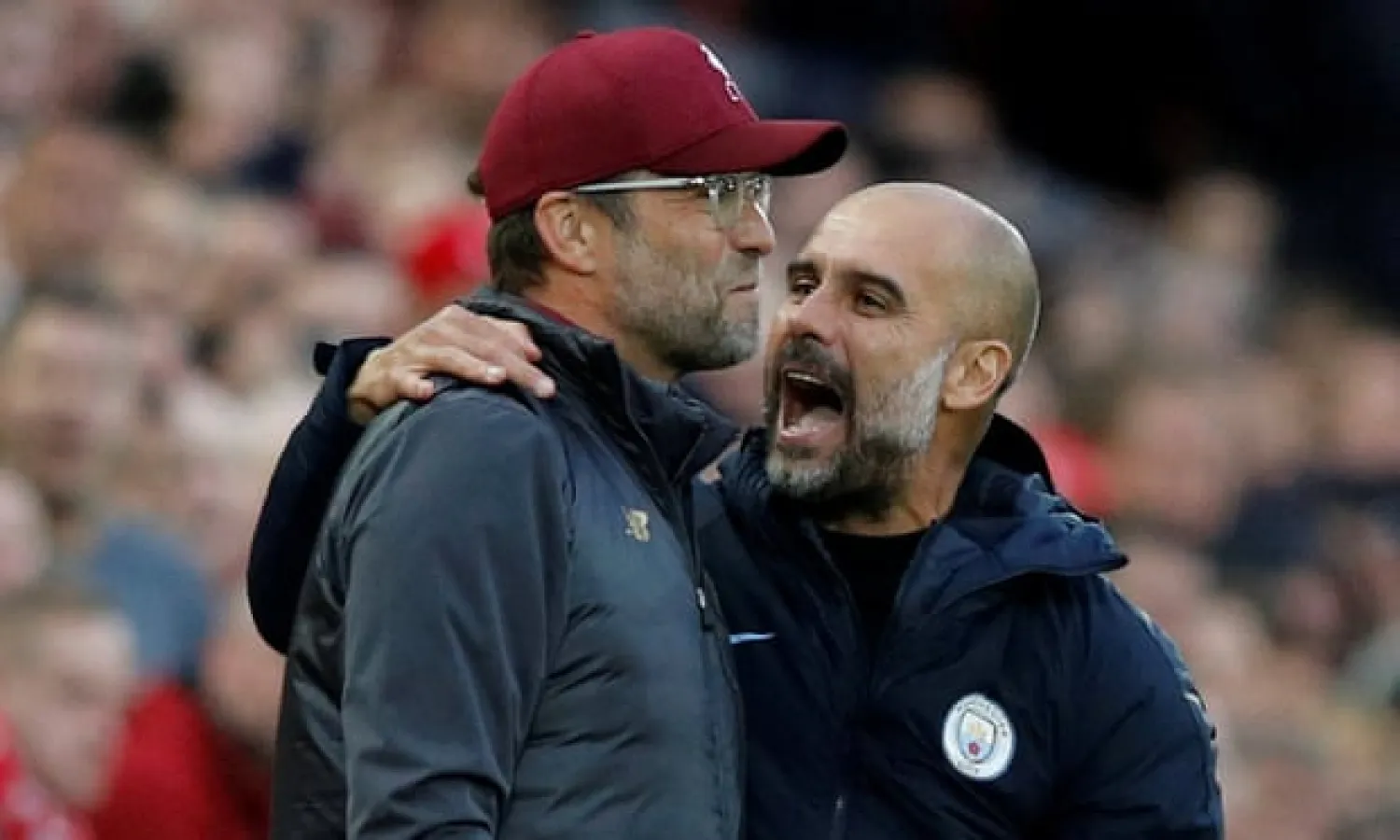
 Jürgen Klopp and Pep Guardiola, coaches with contrasting styles tweaked to combat the other’s. What will they come up with next? Photograph: Phil Noble/Reuters
Jürgen Klopp and Pep Guardiola, coaches with contrasting styles tweaked to combat the other’s. What will they come up with next? Photograph: Phil Noble/Reuters
TT

Football's Rare Pause for Thought Gives Coaches Time for Inspiration

 Jürgen Klopp and Pep Guardiola, coaches with contrasting styles tweaked to combat the other’s. What will they come up with next? Photograph: Phil Noble/Reuters
Jürgen Klopp and Pep Guardiola, coaches with contrasting styles tweaked to combat the other’s. What will they come up with next? Photograph: Phil Noble/Reuters

Marton Bukovi showed his courage in wartime Zagreb but the Hungarian also rethought football tactics. Today’s coaches should use their layoff constructively

“What did you do in the war, Mr Bukovi?” “I invented the false 9. What did you do?”

That wasn’t all Marton Bukovi did during the second world war. The Hungarian coach – quite possibly the greatest tactical mind football has known – found himself in Zagreb, coaching Gradjanski, when the conflict began. When the Ustashe seized power and began enacting antisemitic legislation, his position became insecure, given he was the son of a Jewish father and a Catholic mother. He, in as much as religion bothered him at all, seems to have identified as Christian, and there is a cross on his gravestone in the Rakoskeresztur cemetery in Budapest, but his wife, Aranka Klein, was Jewish and at least one of his sisters was a practising Jew.

Bukovi not only kept working but also helped protect the club’s groundsman, a Jewish refugee called Max Reisfeld who had fled Nazi Vienna, taking food and provisions to him and his family as they hid under a stand at the stadium where, for four years, they remained undetected and survived.

Bukovi was courageous and a man of firm principle but he was also notoriously difficult. He had his habits and was rarely minded to change them. He loved the cinema and would go every day after training, but he hated being distracted so would turn up at the box office, ask if his wife were there and, if she were, he would go on to a different cinema.

“He was a hard man,” said Marika Lantos, whose husband, Mihaly, later worked as Bukovi’s assistant at Olympiakos. “Precise, strict and consistent. He demanded order and discipline. It didn’t matter who a player was; he would always tell him what he thought of him. That might be why many didn’t love him. He could be reserved and grumpy but he had a heart of gold. He was like a bad mother-in-law: he commented on everything and always found fault. He meant well, but he couldn’t understand that he needed to make distinctions between people. He just said what he wanted to say.”

But then he was a genius, and geniuses perhaps are allowed some leeway with the social graces. When the war in Yugoslavia was over and the Communists were in control, the clubs who had played in the fascist league were disbanded and, in many cases, had their archives destroyed. Gradjanski, eventually, were reborn as Dinamo and Bukovi was persuaded to become manager.

The interim had given him time to think. He had already overseen Gradjanski’s transition from a 2-3-5 to the W-M formation but what, he wondered, if you went further? What if you withdrew the centre-forward so deep he was almost a midfielder, gave your inside-forwards licence and pulled one of the wing-halves so deep he was in effect a second central defender, turning the 3-2-2-3 of W-M into something very close to 4-2-4?

And so, in 1946, in the game against Lokomotiva that would decide the Zagreb championship, Bukovi put his theory into practice.

Gradjanski won and Bukovi was vindicated – not that he was entirely happy. “Dragutin Hripko played the role,” he said. “He played it closer to well than to poorly, but far from ideally. As a footballer he never achieved great quality, but I always spoke about him when asked about a withdrawn striker. He was my lab rat … I can clearly remember how the Lokomotiva players didn’t know how to handle him.”

Bukovi took the system with him when he returned to Budapest and by 1952 Hungary were using it to win Olympic gold, part of a four-year unbeaten run – in which they twice hammered a befuddled England – that ended with defeat by West Germany in the 1954 World Cup final.

Managers rarely get time to think. The churn of games, the routine of training, of the day-to-day dealing with players is too much. But now, during a shutdown that will last at least a couple of months, managers do have time. Football is a mature game now: huge developmental steps such as Bukovi’s are unlikely. Everything happens by increments. But what is possible? What might an enlightened manager do having been given this long period without the immediate pressure of games?

Elite-level football tends to move forward by solutions. A team is successful playing in a particular way and so a means must be found to interrupt that. The possession-heavy game of Pep Guardiola and his imitators was eventually overcome by the high-energy, highly focused press and transition game of Jürgen Klopp – to the extent that Guardiola has begun to change.

That makes sense: the way to defeat possession football is to work out a way of disrupting those patterns of passing and regaining the ball better.

So what comes next? How do you disrupt a pressing game? One way is simply to pass the ball better, in less predictable patterns. Perhaps if Guardiola’s Barcelona of 2008-11 were still around, still at their peak and still with the dribbling potency of Lionel Messi, that would be possible (it may be that what passed was less their stylistic hegemony than simply the peak of that side). But given it is not, and given the seeming impossibility of that aim, how else could hard-pressing football be circumvented?

An obvious way, which Guardiola briefly took against Klopp’s Borussia Dortmund in a German cup game, is to go over the press. Guardiola used Javi Martínez as his target man, but perhaps target men in general are due a comeback. What better way to thwart a well-deployed pressing line than by whacking it long and early at a Niall Quinn or a Joe Jordan or a Nat Lofthouse, particularly if they could be supported by a rapid poacher? How better to unsettle two central defenders picked less for their marking and battling qualities than their positioning and passing than by making them defend against a pair?

Or perhaps not. But in this time of enforced inaction, it’s perhaps worth managers asking, what would Marton Bukovi do?

The Guardian Sport


Trump All Smiles as He Wins FIFA’s New Peace Prize

Football - FIFA World Cup 2026 - FIFA World Cup 2026 Draw - John F. Kennedy Center for the Performing Arts, Washington, DC, US - December 5, 2025 US President Donald Trump wears his medal as he is awarded the FIFA Peace Prize. (Reuters)
TT

Trump All Smiles as He Wins FIFA’s New Peace Prize

Football - FIFA World Cup 2026 - FIFA World Cup 2026 Draw - John F. Kennedy Center for the Performing Arts, Washington, DC, US - December 5, 2025 US President Donald Trump wears his medal as he is awarded the FIFA Peace Prize. (Reuters)

US President Donald Trump became the first ever recipient of FIFA's new peace prize at the 2026 World Cup draw Friday -- a compensation gift for a leader whose dream of winning the Nobel remains unfulfilled.

Gianni Infantino, the head of world football's governing body and a close ally of Trump, presented the 79-year-old with the award during the ceremony at the Kennedy Center in Washington.

"Thank you very much. This is truly one of the great honors of my life. And beyond awards, Gianni and I were discussing this, we saved millions and millions of lives," Trump said.

Infantino said Trump won the award for "exceptional and extraordinary" actions to promote peace and unity around the world.

FIFA announced the annual prize in November, saying it would recognize people who bring "hope for future generations."

Its inaugural recipient was hardly a surprise.

Infantino, 55, has developed a tight relationship with Trump, visiting the White House more than any world leader since Trump's return to office in January.

The US president often insists that he deserves the Nobel Peace Prize for his role in ending what he says are eight conflicts this year, including a fragile ceasefire in Gaza.

He was snubbed by the Norwegian Nobel Committee last month as it awarded the peace prize to Venezuelan opposition leader Maria Corina Machado.

Trump has put himself at the head of a "board of peace" for war-torn Gaza -- Infantino also attended the signing of that peace deal in Egypt -- while his administration this week renamed a Washington peace institute after him.

The US leader has made the World Cup a centerpiece of his second presidency.


From Hunted to Hunter, Comeback King Verstappen Chases Fifth Title

 Red Bull Racing's Dutch driver Max Verstappen drives during the second practice session ahead of the Abu Dhabi Formula One Grand Prix at the Yas Marina Circuit in Abu Dhabi on December 5, 2025. (AFP)
Red Bull Racing's Dutch driver Max Verstappen drives during the second practice session ahead of the Abu Dhabi Formula One Grand Prix at the Yas Marina Circuit in Abu Dhabi on December 5, 2025. (AFP)
TT

From Hunted to Hunter, Comeback King Verstappen Chases Fifth Title

 Red Bull Racing's Dutch driver Max Verstappen drives during the second practice session ahead of the Abu Dhabi Formula One Grand Prix at the Yas Marina Circuit in Abu Dhabi on December 5, 2025. (AFP)
Red Bull Racing's Dutch driver Max Verstappen drives during the second practice session ahead of the Abu Dhabi Formula One Grand Prix at the Yas Marina Circuit in Abu Dhabi on December 5, 2025. (AFP)

Max Verstappen has won the Formula One title for the last four years, but it would be far from "more of the same" if he snatches a record-equaling fifth in a row at the Abu Dhabi season finale on Sunday.

The 28-year-old Red Bull driver has come back from 104 points behind McLaren's then-championship leader Oscar Piastri to 12 adrift of the Australian's teammate Lando Norris, now the frontrunner, in a span of just eight races.

As far as comebacks go, it is the greatest of the modern era in terms of reclaiming lost ground.

It could also be one for the ages, eclipsed only by some of the most heroic underdog stories, like Niki Lauda's return from a fiery crash to take the title down to the wire in 1976 before winning it in 1977.

"I think whether or not Max will win, it's probably fair to say that the world discovered an even more extraordinary Max this season, after his fourth world title," Verstappen's Red Bull team boss Laurent Mekies told reporters at the Yas Marina circuit on Friday.

"It's up to you guys to say if... (2025) will become the best of his titles.

"But for sure, in terms of whatever happens next, the scale of the comeback is something that hopefully will go in a few history books."

STAND EQUAL WITH SCHUMACHER

Regardless of where it ranks, the Dutchman's quest to become only the second driver after Ferrari great Michael Schumacher to win five titles in a row stands in stark contrast to his four other title-winning campaigns.

Then, he was more hunted than hunter, if not dominant. Even in his hard-fought battle with Lewis Hamilton in 2021, Verstappen was chased down by the Briton who drew level with him on points heading into the Abu Dhabi finale.

This year, however, he has had to fight off the back foot -- overcoming an initially uncompetitive car and navigating a Red Bull leadership reshuffle that had Christian Horner ousted as team boss.

At the same time, he has balanced his F1 responsibilities with his role as father to a baby daughter, born in May, and extracurricular pursuits like GT racing, even winning on his GT3 debut around German track Nuerburgring's fearsome Nordschleife loop.

Five of Verstappen's seven wins have come in the last eight races, all of which he has finished on the podium.

Misfortune for his McLaren rivals has also worked in his favor. But equally, every bit of his trademark tenacity and determination has been on display, as he has hunted down the McLaren pair.

Born in Belgium to an F1 racer father Jos and top-level go-karter mother Sophie Kumpen, Verstappen has been on wheels as soon as he could walk.

His speed has never been in question. But this year it has been mated to a newfound maturity and a calm confidence, making him an even more formidable competitor.

"Max is not an easy four-time world champion to knock off his perch," said McLaren chief executive Zak Brown on Friday.

"Arguably, definitely, one of the greatest ever. It's awesome racing against Max," added the American.

Verstappen still needs Norris to finish off the podium on Sunday to seal the title, even if he races to a fifth Abu Dhabi win.

But if anyone can spring an upset, Verstappen can.

"Look, this guy never gets it wrong, you know, Max just never does a mistake," said Mekies.


Norris Says F1 Title Means Everything and he Has Most to Lose Ahead of Abu Dhabi Decider

Formula One F1 - Abu Dhabi Grand Prix - Yas Marina Circuit, Abu Dhabi, United Arab Emirates - December 5, 2025 McLaren's Lando Norris arrives ahead of the Abu Dhabi Grand Prix REUTERS/Jakub Porzycki
TT

Norris Says F1 Title Means Everything and he Has Most to Lose Ahead of Abu Dhabi Decider

Formula One F1 - Abu Dhabi Grand Prix - Yas Marina Circuit, Abu Dhabi, United Arab Emirates - December 5, 2025 McLaren's Lando Norris arrives ahead of the Abu Dhabi Grand Prix REUTERS/Jakub Porzycki

Lando Norris says winning the Formula One world championship would mean everything to him, but being the frontrunner also means he has most to lose.

The Briton goes into Sunday's three-way title decider in Abu Dhabi 12 points clear of Red Bull's Max Verstappen with McLaren teammate Oscar Piastri a further four behind.

Norris could have wrapped the title up in Qatar last weekend, had results gone his way, and will do so at Yas Marina if he finishes on the podium. Anything less than that opens the door to his rivals.

"I guess in terms of position, of course, I have the most to lose because I am the one at the top," he told reporters.

"And I’ll do my best to stay there till the end of the year, a few more days. At the same time, if it doesn’t go my way, then I try again next year. It’ll hurt probably for a little while, but then, yeah, that’s life. I’ll crack on and try and do better next season."

Norris said, somewhat unconvincingly, that he had nothing to lose because it was "just" a race for the championship and he was "not too bothered". He then undermined that attempt at nonchalance by recognizing, in his answer to another question, just how much it really did matter.

"I think this has been my whole life. It's everything I've worked towards my whole life. So, it would mean the world to me," Reuters quoted him as saying.

"It would mean the world to everyone that’s supported me and pushed me for the last, what is it, like 16 years of my life in terms of trying to get to this point. So, it would mean everything. It would mean my life until now has been a success, and I’ve accomplished that dream I had when I was a kid."

Norris would be the 11th British world champion if he succeeds, while Verstappen would be adding a fifth title to his resume.

Piastri can become the first Australian in 45 years to become Formula One champion, following on from Alan Jones in 1980 and the late triple world champion Jack Brabham whose last title came in 1966.

Verstappen has said he had nothing to lose, having all but ruled out his chances as far back as August before staging an astonishing comeback, while Piastri told reporters he had the least to lose.
