


Fearing Gaza Virus Spread, Hamas Preps for Mass Quarantines

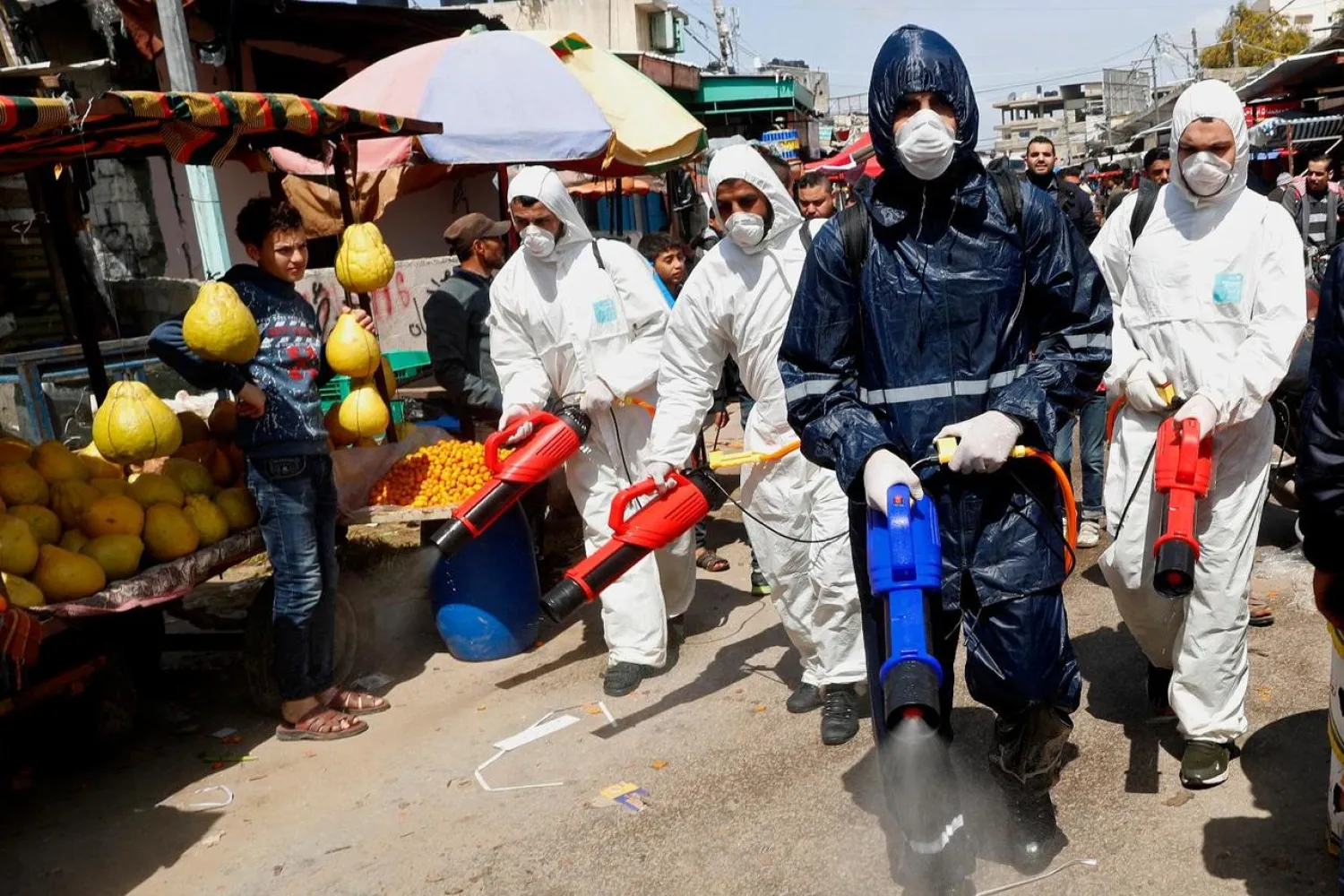
In this Thursday, March 19, 2020 file photo, workers wearing protective gear spray disinfectant as a precaution against the coronavirus, at the main market in Gaza City. (AP Photo/Adel Hana, File)
TT

Fearing Gaza Virus Spread, Hamas Preps for Mass Quarantines

In this Thursday, March 19, 2020 file photo, workers wearing protective gear spray disinfectant as a precaution against the coronavirus, at the main market in Gaza City. (AP Photo/Adel Hana, File)

When Nima Amraa returned to the Gaza Strip from neighboring Egypt earlier this month, she was surprised to learn she was being placed in a makeshift quarantine center set up by the ruling Hamas group.

But her initial jitters turned to fear when two fellow travelers in another facility tested positive for the coronavirus - the first cases to be confirmed in Gaza.

"Once there were cases of the virus spreading, we started to feel afraid and disappointed," Amraa, a 30-year-old journalist, said by phone from quarantine, where she has spent a week and a half sleeping in a room with five other women and sharing a bathroom.

The virus found a way into Gaza, even though the Mediterranean enclave has been largely cut off from the world by an Israeli blockade since Hamas militants seized it 13 years ago.

Yet the terrifying possibility of an outbreak in one of the world's most crowded territories - 2 million people squeezed into an area twice the size of Washington, D.C. -does not seem to have registered fully. Many in Gaza seem to accept Hamas assurances that the threat is contained.

In the meantime, Hamas is racing to build two massive quarantine facilities - hoping to prevent the disease from spreading and overwhelming Gaza's already shattered health system.

The construction was ordered after photos surfaced from makeshift centers - mostly schools - showing people celebrating birthday parties with visiting relatives, food being delivered by volunteers and groups of people smoking water pipes together.

Amraa said it was immediately clear that the school where she was placed was not prepared to house so many people.

"I was worried after seeing that we will sleep on mattresses on the floor and we will be six in one room," she explained. "We eat together and there is no isolation."

She said she and her roommates take precautions, such as avoiding direct contact and keeping their beds two meters apart from each other. But that might not be enough to keep the virus from spreading. Last week, seven Hamas security guards who were in the facility housing the first two cases became infected themselves.

"We have been very clear on how the quarantine facilities should look like and offer in terms of facilities and services and support," said Dr. Gerald Rockenschaub, the World Health Organization´s director in the Palestinian territories. "But this is obviously easier said than done in Gaza, where there is substantial shortage in almost everything."

Although movement in and out of Gaza has been heavily restricted since 2007, it is not cut off altogether. The first two virus cases were men who had returned from a religious conference in Pakistan, part of a wave of hundreds of returnees who were placed into quarantine.

No one knows how much farther the virus has spread. Only 20% of the roughly 1,700 people in quarantine have been tested.

Gaza's people live mainly in densely populated cities and refugee camps. The health care system is in shambles - a result of the blockade, three wars between Hamas and Israel and chronic under-funding due to infighting between Hamas and the rival Palestinian Authority in the West Bank.

Gaza has only 60 breathing machines - and all but 15 are already in use, according to the WHO. The agency has been assisting local health officials and has been working with Israeli authorities, who have no direct contact with Hamas, to import desperately-needed equipment and supplies from international donors.

Most people infected by the virus experience only mild symptoms, such as fever and cough, and recover within a few weeks. But the virus can cause severe illness and death, particularly in older patients or those with underlying health problems. High rates of obesity, smoking, and stress-related disorders appear to make Gaza´s population especially vulnerable.

Hamas has sought to beef up its quarantine efforts in recent days, opening 18 additional facilities in clinics and hotels and declaring them off-limits. It also has banned weekly street markets and shut down wedding halls, cafes, and mosques and extended quarantine periods by a week.

After seeing images of the makeshift facilities, Hamas´ leader in Gaza, Yehiyeh Sinwar, ordered the group´s military wing to build two new quarantine centers.

Situated on the territory´s northern and southern borders, they will be able to hold 1,000 people. The group expects them to be ready within a week.

The public seems to have been calmed by Health Ministry claims that all virus patients are held in quarantine centers. Despite the shutdown orders, people still walk the streets and congregate around small coffee kiosks and noodle shops.

That could change if cases begin to spread.

Last Friday, the crew for a Turkish TV station caused a panic after entering the field hospital where the nine infected people are being treated. The crew subsequently left the facility and broadcast a report the next day. Hamas quickly put the crew members into quarantine and suspended the head of its media office for allowing them access to the facility.

Elsewhere, people still held wedding parties in their homes after wedding halls closed.

Dr. Yahia Abed, an epidemiologist, said the public's apparent lack of commitment to safety precautions is worrisome and that anyone who might have been exposed to the virus must go into full and enforceable isolation.

"If, God forbid, people hid the fact that they had contact with the infected, this will be very dangerous for an area like Gaza. The epidemic will spread," said Abed, a public health professor at Al-Quds university near Jerusalem.

One factor in the small number of cases so far could be the lack of testing.

COGAT, the Israeli defense body responsible for Palestinian civilian issues, said it has coordinated the delivery of hundreds of coronavirus testing kits by the World Health Organization, as well as protective equipment, medicine, and disinfectant.

Israel, along with most Western nations, considers Hamas a terrorist group. But it likely fears the fallout from a catastrophic outbreak would spill over the frontier.

Qatar, which provides extensive humanitarian aid to Gaza, has also stepped in, pledging $150 million in aid and providing furniture, clothes and electrical appliances for the quarantine centers.

The Gaza Health Ministry says it urgently needs more than $20 million to stave off the collapse of the health system if there is a major outbreak.

Rockenschaub said there's still time to improve quarantine procedures in Gaza. "The issue is to move quickly and mobilize support to get them on the way to meet the right international standards," he said.



Egypt’s Prime Minister and FM Head to Washington for Trump Peace Council Meeting

Egyptian Foreign Minister Badr Abdelatty speaks during a joint press conference with Kenyan Prime Cabinet Secretary/Cabinet Secretary for Foreign Diaspora Affairs Musalia Mudavadi in Nairobi, Kenya, Monday, Feb. 16, 2026. (AP)
TT

Egypt’s Prime Minister and FM Head to Washington for Trump Peace Council Meeting

Egyptian Foreign Minister Badr Abdelatty speaks during a joint press conference with Kenyan Prime Cabinet Secretary/Cabinet Secretary for Foreign Diaspora Affairs Musalia Mudavadi in Nairobi, Kenya, Monday, Feb. 16, 2026. (AP)

Egypt's Prime Minister Mostafa Madbouly headed to Washington on Tuesday ‌to ‌participate in ‌the inaugural ⁠meeting of a "Board of Peace" established by US President Donald ⁠Trump, the ‌cabinet ‌said.

Madbouly is ‌attending ‌on behalf of President Abdel ‌Fattah al-Sisi and is accompanied by ⁠Foreign ⁠Minister Badr Abdelatty.

Foreign Minister Gideon Saar will represent Israel at the inaugural meeting, his office said on Tuesday.

Hamas, meanwhile, called on the newly-formed board to pressure Israel to halt what it described as ongoing violations of the ceasefire in Gaza.

The Board of Peace, of which Trump is the chairman, was initially designed to oversee the Gaza truce and the territory's reconstruction after the war between Hamas and Israel.

But its purpose has since morphed into resolving all sorts of international conflicts, triggering fears the US president wants to create a rival to the United Nations.

Saar will first attend a ministerial level UN Security Council meeting in New York on Wednesday, and on Thursday he "will represent Israel at the inaugural session of the board, chaired by Trump in Washington DC, where he will present Israel's position", his office said in a statement.

It was initially reported that Prime Minister Benjamin Netanyahu might attend the gathering, but his office said last week that he would not.

Ahead of the meeting, Hamas spokesman Hazem Qassem told AFP that the Palestinian movement urged the board's members "to take serious action to compel the Israeli occupation to stop its violations in Gaza".

"The war of genocide against the Strip is still ongoing -- through killing, displacement, siege, and starvation -- which have not stopped until this very moment," he added.

He also called for the board to work to support the newly formed Palestinian technocratic committee meant to oversee the day-to-day governance of post-war Gaza "so that relief and reconstruction efforts in Gaza can commence".

Announcing the creation of the board in January, Trump also unveiled plans to establish a "Gaza Executive Board" operating under the body.

The executive board would include Turkish Foreign Minister Hakan Fidan and Qatari diplomat Ali Al-Thawadi.

Netanyahu has strongly objected to their inclusion.

Since Trump launched his "Board of Peace" at the World Economic Forum in Davos in January, at least 19 countries have signed its founding charter.


Palestinian Child Dies After Stepping on Mine in West Bank

Israeli troops conduct a military raid in the village of Al-Yamoun, west of Jenin, West Bank, 17 February 2026. (EPA)
TT

Palestinian Child Dies After Stepping on Mine in West Bank

Israeli troops conduct a military raid in the village of Al-Yamoun, west of Jenin, West Bank, 17 February 2026. (EPA)

A Palestinian child died after stepping on a mine near an Israeli military camp in the occupied West Bank on Tuesday, the Palestinian Red Crescent said, with an Israeli defense ministry source confirming the death.

"Our crews received the body of a 13-year-old child who was killed after a mine exploded in one of the old camps in Jiftlik in the northern Jordan Valley," the Red Crescent said in a statement.

A source at COGAT, the Israeli defense ministry's agency in charge of civilian matters in the Palestinian territories, confirmed the death to AFP and identified the boy as Mohammed Abu Dalah, from the village of Jiftlik.

Israel's military had previously said in a statement that three Palestinians were injured "as a result of playing with unexploded ordnance", without specifying their ages.

It added that the area of the incident, Tirzah, is "a military camp in the area of the Jordan Valley", near Jiftlik and close to the Jordanian border.

"This area is a live-fire zone and entry into it is prohibited," the military said.

Jiftlik village council head Ahmad Ghawanmeh told AFP that three children, the oldest of whom was 16, were collecting herbs near the military base when they detonated a mine.

Jiftlik as well as the nearby Tirzah base are located in the Palestinian territory's Area C, which falls under direct Israeli control.

Israel has occupied the West Bank since 1967.

Much of the area near the border with Jordan -- which Israel signed a peace deal with in 1994 -- remains mined.

In January, Israel's defense ministry said it had begun demining the border area as part of construction works for a new barrier it says aims to stem weapons smuggling.


Hezbollah Rejects Disarmament Plan and Government’s Four-Month Timeline

29 July 2024, Iran, Tehran: Then Hezbollah deputy leader Sheikh Naim Qassem is pictured during a meeting in Tehran. (Iranian Presidency/dpa)
TT

Hezbollah Rejects Disarmament Plan and Government’s Four-Month Timeline

29 July 2024, Iran, Tehran: Then Hezbollah deputy leader Sheikh Naim Qassem is pictured during a meeting in Tehran. (Iranian Presidency/dpa)

Hezbollah rejected on Tuesday the Lebanese government's decision to grant the army at least four months to advance the second phase of a nationwide disarmament plan, saying it would not accept what it sees as a move serving Israel.

Lebanon's cabinet tasked the army in August 2025 with drawing up and beginning to implement a plan to bring all armed groups' weapons under state control, a bid aimed primarily at disarming Hezbollah after its devastating ‌war with ‌Israel in 2024.

In September 2025 the cabinet formally ‌welcomed ⁠the army's plan to ⁠disarm the Iran-backed Shiite party, although it did not set a clear timeframe and cautioned that the military's limited capabilities and ongoing Israeli strikes could hinder progress.

Hezbollah Secretary-General Sheikh Naim Qassem said in a speech on Monday that "what the Lebanese government is doing by focusing on disarmament is a major mistake because this issue serves the goals of Israeli ⁠aggression".

Lebanon's Information Minister Paul Morcos said during a press ‌conference late on Monday after ‌a cabinet meeting that the government had taken note of the army's monthly ‌report on its arms control plan that includes restricting weapons in ‌areas north of the Litani River up to the Awali River in Sidon, and granted it four months.

"The required time frame is four months, renewable depending on available capabilities, Israeli attacks and field obstacles,” he said.

Hezbollah lawmaker Hassan ‌Fadlallah said, "we cannot be lenient," signaling the group's rejection of the timeline and the broader approach to ⁠the issue of ⁠its weapons.

Hezbollah has rejected the disarmament effort as a misstep while Israel continues to target Lebanon, and Shiite ministers walked out of the cabinet session in protest.

Israel has said Hezbollah's disarmament is a security priority, arguing that the group's weapons outside Lebanese state control pose a direct threat to its security.

Israeli officials say any disarmament plan must be fully and effectively implemented, especially in areas close to the border, and that continued Hezbollah military activity constitutes a violation of relevant international resolutions.

Israel has also said it will continue what it describes as action to prevent the entrenchment or arming of hostile actors in Lebanon until cross-border threats are eliminated.