

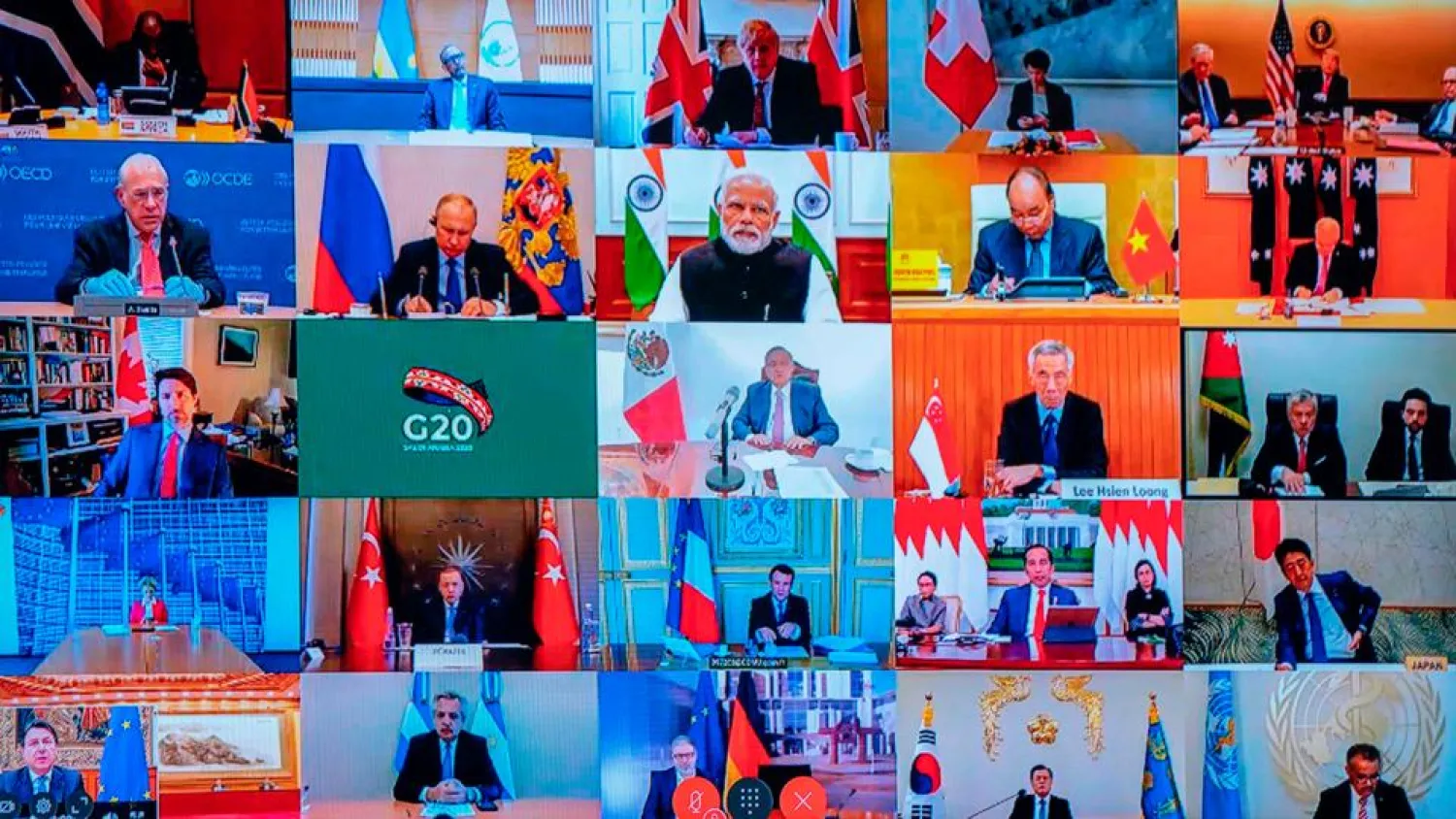

G20 Trade Ministers Pledge Focus on Free, Fair Trade in Virus Response

This photo of a television screen taken and handout by the press office of Palazzo Chigi on March 26, 2020 shows the G20 video conference. (AFP)
TT

G20 Trade Ministers Pledge Focus on Free, Fair Trade in Virus Response

This photo of a television screen taken and handout by the press office of Palazzo Chigi on March 26, 2020 shows the G20 video conference. (AFP)

Trade ministers from the Group of 20 major economies agreed on Monday to keep their markets open and ensure the continued flow of vital medical supplies, equipment, and other essential goods as the world battles the deadly coronavirus pandemic.

G20 leaders pledged last week to inject over $5 trillion into the global economy to limit job and income losses caused by border closures and sweeping shutdowns aimed at halting the spread of the disease.

The G20 Trade and Investment ministers' extraordinary meeting under Saudi Arabia Presidency pledged to take “immediate necessary measures” to facilitate trade in essential goods and incentivize additional production of equipment and drugs, according to a joint statement issued after a videoconference.

"The pandemic is a global challenge and requires a coordinated global response,” the ministerial statement said.

“Now more than ever is the time for the international community to step up cooperation and coordination to protect human life and lay the foundations for a strong economic recovery and a sustainable, balanced, and inclusive growth after this crisis,” it added.

The ministers also said they had started monitoring and assessing the impact of the pandemic on trade as per the task entrusted to them by G20 leaders.

“We are actively working to ensure the continued flow of vital medical supplies and equipment, critical agricultural products, and other essential goods and services across borders, for supporting the health of our citizens. Consistent with national requirements, we will take immediate necessary measures to facilitate trade in those essential goods,” the statement added.

“We will support the availability and accessibility of essential medical supplies and pharmaceuticals at affordable prices, on an equitable basis, where they are most needed, and as quickly as possible, including by encouraging additional production through incentives and targeted investment, according to national circumstances. We will guard against profiteering and unjustified price increases,” the ministers said.

“We will ensure our collective response is supportive of micro, small and medium-sized enterprises, and recognize the importance of strengthening international investment,” according to the ministerial statement.

They emphasized, “The importance of transparency in the current environment and our commitment to notify the WTO of any trade-related measures taken, all of which will enable global supply chains to continue to function in this crisis, while expediting the recovery that will follow."

“As we fight the pandemic both individually and collectively and seek to mitigate its impacts on international trade and investment, we will continue to work together to deliver a free, fair, non- discriminatory, transparent, predictable and stable trade and investment environment, and to keep our markets open,” the statement added.

They went on saying, “We will ensure smooth and continued operation of the logistics networks that serve as the backbone of global supply chains. We will explore ways for logistics networks via air, sea and land freight to remain open, as well as ways to facilitate essential movement of health personnel and businesspeople across borders, without undermining the efforts to prevent the spread of the virus."

“We will continue monitoring and assessing the impact of the pandemic on trade. We call on the international organizations to provide an in-depth analysis of the impact of COVID-19 on world trade, investment, and global value chains.

We will continue working with them to establish coordinated approaches and collect and share good practices to facilitate flows of essential goods and services," the statement added.



Skydiving Plane Crash Kills 11 in France

Emergency services at the scene of the crash near Nancy in north-eastern France. Photograph: Christian Hartmann/Reuters
TT

Skydiving Plane Crash Kills 11 in France

Emergency services at the scene of the crash near Nancy in north-eastern France. Photograph: Christian Hartmann/Reuters

A skydiving plane crashed Sunday in eastern France, killing all 11 people on board, local authorities said, in one of the country's deadliest ever light aircraft accidents.

The crash in the town of Tomblaine killed five instructors, five students, and the pilot, said Yves Seguy, the prefect of the Meurthe-et-Moselle department.

The students were a group of nurses, according to a source close to the case and confirmed by the head of Meurthe-et-Moselle's nursing council, Thierry Pechey.

"They were colleagues who had decided to go on a first skydiving jump, no doubt to unwind, as we're going through a difficult time with the heatwave," he said.

Mayor of the nearby city of Nancy, Mathieu Klein, said the victims "died in full view of their loved ones, who were preparing to film the tandem skydives".

Medical and psychological support teams were caring for relatives of the victims who were present, as well as other witnesses, according to local authorities.

The aircraft, registered in Germany, crashed in a grassy area near the runway of the Nancy-Essey aerodrome, close to a residential area and two roads, an AFP journalist reported.

"It's tragic, but it could have been even worse," said Klein, noting the plane crashed "just a few metres from homes".

Tomblaine mayor Herve Feron said the plane fell "in a completely unexplained manner ...during the ascent", describing it as crashing "straight down".

The aircraft had been "chartered for the occasion, for the skydiving weekend, as is regularly done", he added.

The cause of the incident was not immediately clear and a technical investigation had been opened, said Amaury Lacote, deputy public prosecutor in the eastern city of Nancy.

Police urged people on the social media platform X to "strictly avoid" the area around the airport to allow emergency services access.

French Interior Minister Laurent Nunez and Transport Minister Philippe Tabarot are expected to visit the scene of the accident later this afternoon.


France Records 1,000 Excess Deaths During Record-breaking Heatwave

Tourists with umbrellas walk in Paris during a heat wave, Saturday, June 27, 2026. (AP Photo/Aurelien Morissard)
TT

France Records 1,000 Excess Deaths During Record-breaking Heatwave

Tourists with umbrellas walk in Paris during a heat wave, Saturday, June 27, 2026. (AP Photo/Aurelien Morissard)

France has recorded 1,000 excess deaths during the blistering heatwave sweeping Europe, the public health agency said on Sunday, warning that the true figure was likely to be higher.

Detailing its preliminary count of excess deaths, Sante Publique said most of the fatalities involved older people and that it expected the mortality rate to rise as more information became available about ⁠deaths in residential ⁠care and homes.

Europeans have been enduring blistering conditions during a heatwave that has been linked to dozens of deaths - shattering records, disrupting power generation and damaging infrastructure.

Scientists have said the heatwave, which ⁠began on June 20, was the worst recorded in Europe, where the climate is changing faster than the global average.

The heatwave has been moving east. But while France's weather agency said the extreme heat had diminished in most parts of the country, some areas in the northeast were still under a ⁠heatwave ⁠advisory, Reuters reported.

Rooftops are seen during a heat wave in Lyon, central France, Saturday, June 27, 2026. (AP Photo/Laurent Cipriani)

Health Minister Stephanie Rist told La Tribune newspaper that the impact of the heatwave could linger for as long as 10 days after the weather had ebbed.

"The episode is not finished," she told broadcaster BFM.

Most of the deaths involved people aged 65 and older, though the health effects of the extreme heat affected all categories of the population, Sante Publique said.


Trump's Iran Deal Faces Wide Criticism and Some Fear it Could Cost Republicans the Midterm

A sign protesting the Iran war and its impact on gas prices is seen during a protest outside of the US Capitol (AFP)
TT

Trump's Iran Deal Faces Wide Criticism and Some Fear it Could Cost Republicans the Midterm

A sign protesting the Iran war and its impact on gas prices is seen during a protest outside of the US Capitol (AFP)

US President Donald Trump’s interim agreement to end the war with Iran has dragged down his approval rating and garnered criticism across the political spectrum — even from his own supporters.

Recent interviews with 18 Americans who voted for Trump in 2024, a group that Reuters has interviewed monthly since he returned to office, show that most have doubts about the deal, which has reopened the Strait of Hormuz while temporarily lifting US oil sanctions on Iran and authorizing a $300 billion fund for its reconstruction.

“We need to truly weaken the Iranian regime instead of this, ‘beat them up a little bit and then step back and let them rebuild’,” said Terry Alberta, 65, a pilot in Michigan.

Overall, only a quarter of Americans believe the war with Iran was worth the costs, and a majority worry that the truce with Tehran is unlikely to last, according to the latest Reuters/Ipsos poll.

Many of the Trump voters feared his unpopular concessions to Iran would make it harder for Republicans to retain control of Congress in November's midterm elections, although those most critical of the deal had already begun to lose faith in the president before the war.

Six in the group believed he still had plans to bring down the Iranian government.

The group largely supported the war during its early days, believing US strikes were necessary to deplete Iran's stockpile of long-range missiles and cripple its nuclear program.

Lack of Trust in Tehran

Nearly four months later, with Iran politically emboldened and many of its military capabilities still intact, 14 of the voters criticized some aspects of the memorandum of understanding announced on June 14.

Most were skeptical that Tehran could be trusted to honor any agreement and dismayed by the prospect of granting it billions of dollars to rebuild.

The $300 billion fund will be a private investment vehicle rather than a government-funded plan, though exact details have not been released.

Juan Rivera, 26, said Trump “criticized his predecessors about negotiating with terrorists, and he’s basically done the same exact thing.”

Trump’s Midterm Endorsement now ‘Kiss of Death?’

Rivera still plans to support mostly Republican candidates in the midterms. But he said that when he volunteered recently to canvass Latino voters in his community near San Diego, many fellow Trump supporters were so disappointed by the president's handling of the war, among other issues, that they felt unmotivated to back his party in November.

“A lot of people say: ‘Why should I vote when the president's not doing what he promised?’” Rivera recalled.

Asked for comment, a White House spokesperson told Reuters that Trump's achievement “on the battlefield and at the negotiating table is nothing short of remarkable and will strengthen American security for many years.”

Steve Egan, 65, a promotional product distributor in Tampa, soured on Trump in early 2025 after tariff-triggered price hikes hurt his business. From the outset, Egan was skeptical of the president's rationale for the war and upset that it further jacked up the price of gas and other goods.

“Right now it doesn't seem like it's been worth it to go through all that,” he said, noting that the stated goal of regime change “didn't happen.”

His opinion of the president is now so low, Egan said, that Trump's endorsement would be “the kiss of death” for him when deciding which candidates to vote for in the midterms.

Brandon Neumeister, 37, a Pennsylvania state corrections worker and former National Guardsman, said the conflict seemed only to have benefited oil companies. Even before the war, though, Neumeister said he was unlikely to vote in November because he was disgusted with politics.

Robert Billups, 35, of ⁠Washington state, was cautiously optimistic the peace deal would hold. But he believed the war had spawned more hostility toward the United States rather than making the country safer.

Vice President JD Vance, tasked with leading US negotiations with Iran, has fallen in his esteem, and Billups said he no longer feels preferential toward Republican candidates. Come November, “whoever has a better strategy this time, I'm gonna vote for them regardless of their party,” he said.

‘A Bigger Plan’

Though Trump has been adamant about wanting to end the war, six ⁠of his more loyal voters expressed hope that he still had secret plans to bring Iran to heel.

Kate Mottl, 63, a secretary at a municipal office in the Chicago suburbs, said that “destroying” the regime in Tehran seemed like the only way to avert future conflict.

It would be “very disappointing” if Trump refrained from further military intervention, Mottl said, adding that she believed “there’s a bigger plan here.”

Rich Somora, 62, an engineer in North Carolina, agreed that Trump probably had more aggressive ⁠plans up his sleeve. “I can't imagine that he would have gone through all this and not found out a way to get rid of those mullahs,” he said.

According to diplomats and analysts, however, the war has only strengthened the grip of Iran’s clerical rulers. If they remain in power for another month, Somora said, he'll start to worry.

In Prescott, Arizona, 74-year-old retiree Joyce Kenney said she supported lifting sanctions and believed restoring Iran's ability to trade with other countries would ensure its leaders honored the truce.

But the reconstruction fund was a bridge too far: “That's not our responsibility,” she said.