


What Premier League Clubs Would Change

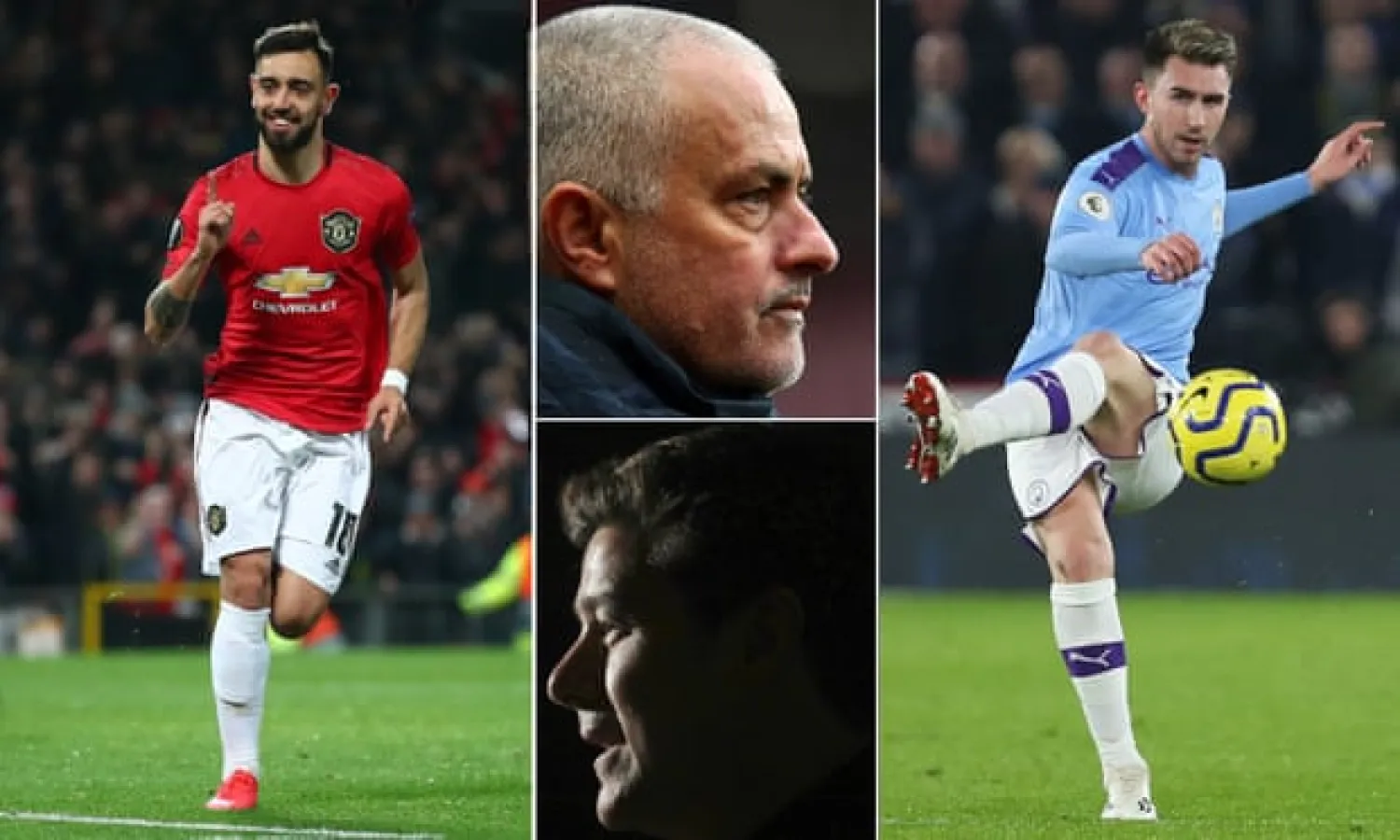
 Clockwise from left: Bruno Fernandes, José Mourinho Aymeric Laporte and Mauricio Pochettino. Composite: Getty Images; AMA/Getty Images; ProSports/Shutterstock; AP
Clockwise from left: Bruno Fernandes, José Mourinho Aymeric Laporte and Mauricio Pochettino. Composite: Getty Images; AMA/Getty Images; ProSports/Shutterstock; AP
TT

What Premier League Clubs Would Change

 Clockwise from left: Bruno Fernandes, José Mourinho Aymeric Laporte and Mauricio Pochettino. Composite: Getty Images; AMA/Getty Images; ProSports/Shutterstock; AP
Clockwise from left: Bruno Fernandes, José Mourinho Aymeric Laporte and Mauricio Pochettino. Composite: Getty Images; AMA/Getty Images; ProSports/Shutterstock; AP

The season must be completed. The season must be abandoned now. As the arguments gabble on, only occasionally acknowledging their own hypothetical nature given how little we know about how the virus will proceed, how long the lockdown may last and whether there may be a second wave of infections when it is lifted, it’s tempting t o dip into another hypothetical. What if this were like a game of Football Manager? What if we could quit without saving and go back and start again last summer? What would Premier League clubs, given their time over, do differently?

Let’s start with the obvious one: Tottenham’s decision to sack Mauricio Pochettino and replace him with José Mourinho. Once a path has been embarked on, there is perhaps some logic in pursuing it to its conclusion, but would Daniel Levy really take that road again? Tottenham are without a win in their past six games. They’ve gone out of the FA Cup and Champions League. They’re seven points adrift of fourth. They’ve kept three clean sheets in 26 games under Mourinho. For Spurs, this season has been a shambles.

Injuries haven’t helped, while Mourinho loyalists point to a creaking and jaded squad. But if the squad is an excuse for Mourinho, why was it not for Pochettino? It’s not as though he wasn’t aware of its failings, not as though he hadn’t been campaigning for two years for greater transfer spending.

Levy, given the choice between replacing the manager or the bulk of the squad, went for the manager, but it looks as if he will end up having to replace the bulk of the squad as well. And when it comes down to it, which would you rather have: a thrusting manager with a point to prove and a recent history of team-building on a budget or a weary former great who has come increasingly to deal in big transfers and whose ideas have begun to look outmoded?

In terms of other managerial comings and goings, Watford may think they could have sacked Javi Gracia in the summer rather than waiting until September and they certainly wouldn’t bother again with the 12 games under Quique Sánchez Flores. Everton, Arsenal and West Ham, perhaps, will think that they could have acted more swiftly to arrest seasons that were drifting.

In terms of the top of the table, Liverpool would presumably change very little, although they might perhaps look at what happened around the winter break and wonder if something in their schedule led to the slight loss of rhythm in February and early March. Given how the Atlético game turned out, they might also look at upgrading their reserve goalkeeper.

For Manchester City, though, there is one clear problem that they would surely take steps to address: the lack of cover at centre-back. The departure of Vincent Kompany inevitably risked leaving a vacuum of leadership, but there was no need for there also to be a vacuum of defensive nous. With Nicolás Otamendi always a slightly rash and clumsy figure, the least obviously Guardiolista player in the squad, and John Stones’s form uncertain, City were left extremely dependent on Aymeric Laporte. That he has started seven league games this season is the major reason the gap to Liverpool is so vast, not only because of his absence but because Fernandinho has been lost to the midfield as he has been forced to drop back as an emergency central defender.

Manchester United’s case is intriguing. Given their improvement after the arrival of Bruno Fernandes – they have won six and drawn three games since signing him at the end of January – they would presumably try to land him in the summer. Harry Maguire, assuming United still deemed him worth the £80m fee, would probably have been signed earlier in the summer to give him more time to adjust to his new teammates; the attempt to drive down the fee by drawing out negotiations simply did not work.

Given that Paul Pogba has started five league games this season and none since September, offloading him last summer presumably would be a priority; surely nobody now, even at United, thinks a positive future still awaits him at the club? And there are those, too, who would argue that Ole Gunnar Solskjær should have been replaced when Pochettino became available, although recent form has perhaps begun to soften the concerns about the Norwegian’s long-term suitability for the job.

What about signings that clubs would now avoid? Would City spend £58.5m on João Cancelo, who has started eight league games? Newcastle, surely, would not spend £40m on Joelinton, a forward wholly unsuited to the isolated frontman role he has been asked to fulfil. Spurs might still splash out £54m on Tanguy Ndombele, but not if they still planned to bring in Mourinho. Aston Villa, perhaps, would rethink their entire transfer strategy: they spent £140m to no great effect. While the injury to Wesley was unfortunate, only Tyrone Mings has been a clear success. West Ham would probably reconsider their transfer policy, but it’s hard to think of the last season when that wouldn’t have been the case.

Leicester and Chelsea presumably wouldn’t change too much, although Frank Lampard might start using Olivier Giroud earlier given the opportunity. But perhaps the most interesting case of a club with little to fix is Norwich. It is easy to say that they should have spent more, that a splurge on a couple of high-class players might make the difference for them.

But given the financial constraints under which they operate, it’s not clear how much more they could have done. Daniel Farke is a consistently engaging coach whose young team play attractive, bright football. It wouldn’t have taken much to have gone differently for them not to be adrift at the bottom.

That, perhaps, is the key: the league table doesn’t lie, but it cannot be considered without context. And that’s where asking, given context, what might reasonably have been improved feels useful. No audit can look only at results.

The Guardian Sport


Shakhtar Boss Pays Ukrainian Racer $200,000 After Games Disqualification

Ukrainian President Volodymyr Zelenskiy holds helmet as he meets with a Ukrainian skeleton racer Vladyslav Heraskevych , who was disqualified from the Olympic skeleton competition over his "helmet of remembrance" depicting athletes killed since Russia's invasion and his father and coach, Mykhailo Heraskevych, amid Russia's attack on Ukraine, in Munich, Germany February 13, 2026. (Ukrainian Presidential Press Service/Handout via Reuters)
TT

Shakhtar Boss Pays Ukrainian Racer $200,000 After Games Disqualification

Ukrainian President Volodymyr Zelenskiy holds helmet as he meets with a Ukrainian skeleton racer Vladyslav Heraskevych , who was disqualified from the Olympic skeleton competition over his "helmet of remembrance" depicting athletes killed since Russia's invasion and his father and coach, Mykhailo Heraskevych, amid Russia's attack on Ukraine, in Munich, Germany February 13, 2026. (Ukrainian Presidential Press Service/Handout via Reuters)

The owner of ‌Ukrainian football club Shakhtar Donetsk has donated more than $200,000 to skeleton racer Vladyslav Heraskevych after the athlete was disqualified from the Milano Cortina Winter Games before competing over the use of a helmet depicting Ukrainian athletes killed in the war with Russia, the club said on Tuesday.

The 27-year-old Heraskevych was disqualified last week when the International Bobsleigh and Skeleton Federation jury ruled that imagery on the helmet — depicting athletes killed since Russia invaded Ukraine in 2022 — breached rules on athletes' expression at ‌the Games.

He ‌then lost an appeal at the Court ‌of ⁠Arbitration for Sport hours ⁠before the final two runs of his competition, having missed the first two runs due to his disqualification.

Heraskevych had been allowed to train with the helmet that displayed the faces of 24 dead Ukrainian athletes for several days in Cortina d'Ampezzo where the sliding center is, but the International Olympic Committee then ⁠warned him a day before his competition ‌started that he could not wear ‌it there.

“Vlad Heraskevych was denied the opportunity to compete for victory ‌at the Olympic Games, yet he returns to Ukraine a ‌true winner," Shakhtar President Rinat Akhmetov said in a club statement.

"The respect and pride he has earned among Ukrainians through his actions are the highest reward. At the same time, I want him to ‌have enough energy and resources to continue his sporting career, as well as to fight ⁠for truth, freedom ⁠and the remembrance of those who gave their lives for Ukraine," he said.

The amount is equal to the prize money Ukraine pays athletes who win a gold medal at the Games.

The case dominated headlines early on at the Olympics, with IOC President Kirsty Coventry meeting Heraskevych on Thursday morning at the sliding venue in a failed last-minute attempt to broker a compromise.

The IOC suggested he wear a black armband and display the helmet before and after the race, but said using it in competition breached rules on keeping politics off fields of play. Heraskevych also earned praise from Ukraine President Volodymyr Zelenskiy.


Speed Skating-Italy Clinch Shock Men’s Team Pursuit Gold, Canada Successfully Defend Women’s Title

 Team Italy with Davide Ghiotto, Andrea Giovannini, Michele Malfatti, celebrate winning the gold medal on the podium of the men's team pursuit speed skating race at the 2026 Winter Olympics, in Milan, Italy, Tuesday, Feb. 17, 2026. (AP)
Team Italy with Davide Ghiotto, Andrea Giovannini, Michele Malfatti, celebrate winning the gold medal on the podium of the men's team pursuit speed skating race at the 2026 Winter Olympics, in Milan, Italy, Tuesday, Feb. 17, 2026. (AP)
TT

Speed Skating-Italy Clinch Shock Men’s Team Pursuit Gold, Canada Successfully Defend Women’s Title

 Team Italy with Davide Ghiotto, Andrea Giovannini, Michele Malfatti, celebrate winning the gold medal on the podium of the men's team pursuit speed skating race at the 2026 Winter Olympics, in Milan, Italy, Tuesday, Feb. 17, 2026. (AP)
Team Italy with Davide Ghiotto, Andrea Giovannini, Michele Malfatti, celebrate winning the gold medal on the podium of the men's team pursuit speed skating race at the 2026 Winter Olympics, in Milan, Italy, Tuesday, Feb. 17, 2026. (AP)

An inspired Italy delighted the home crowd with a stunning victory in the Olympic men's team pursuit final as

Canada's Ivanie Blondin, Valerie Maltais and Isabelle Weidemann delivered another seamless performance to beat the Netherlands in the women's event and retain their title ‌on Tuesday.

Italy's ‌men upset the US who ‌arrived ⁠at the Games ⁠as world champions and gold medal favorites.

Spurred on by double Olympic champion Francesca Lollobrigida, the Italian team of Davide Ghiotto, Andrea Giovannini and Michele Malfatti electrified a frenzied arena as they stormed ⁠to a time of three ‌minutes 39.20 seconds - ‌a commanding 4.51 seconds clear of the ‌Americans with China taking bronze.

The roar inside ‌the venue as Italy powered home was thunderous as the crowd rose to their feet, cheering the host nation to one ‌of their most special golds of a highly successful Games.

Canada's women ⁠crossed ⁠the line 0.96 seconds ahead of the Netherlands, stopping the clock at two minutes 55.81 seconds, and

Japan rounded out the women's podium by beating the US in the Final B.

It was only Canada's third gold medal of the Games, following Mikael Kingsbury's win in men's dual moguls and Megan Oldham's victory in women's freeski big air.


Lindsey Vonn Back in US Following Crash in Olympic Downhill 

Milano Cortina 2026 Olympics - Alpine Skiing - Women's Downhill 3rd Official Training - Tofane Alpine Skiing Centre, Belluno, Italy - February 07, 2026. Lindsey Vonn of United States in action during training. (Reuters)
TT

Lindsey Vonn Back in US Following Crash in Olympic Downhill 

Milano Cortina 2026 Olympics - Alpine Skiing - Women's Downhill 3rd Official Training - Tofane Alpine Skiing Centre, Belluno, Italy - February 07, 2026. Lindsey Vonn of United States in action during training. (Reuters)

Lindsey Vonn is back home in the US following a week of treatment at a hospital in Italy after breaking her left leg in the Olympic downhill at the Milan Cortina Games.

“Haven’t stood on my feet in over a week... been in a hospital bed immobile since my race. And although I’m not yet able to stand, being back on home soil feels amazing,” Vonn posted on X with an American flag emoji. “Huge thank you to everyone in Italy for taking good care of me.”

The 41-year-old Vonn suffered a complex tibia fracture that has already been operated on multiple times following her Feb. 8 crash. She has said she'll need more surgery in the US.

Nine days before her fall in Cortina d'Ampezzo, Italy, Vonn ruptured the ACL in her left knee in another crash in Switzerland.

Even before then, all eyes had been on her as the feel-good story heading into the Olympics for her comeback after nearly six years of retirement.
