Tripoli Residents Suffer from Power and Water Cuts
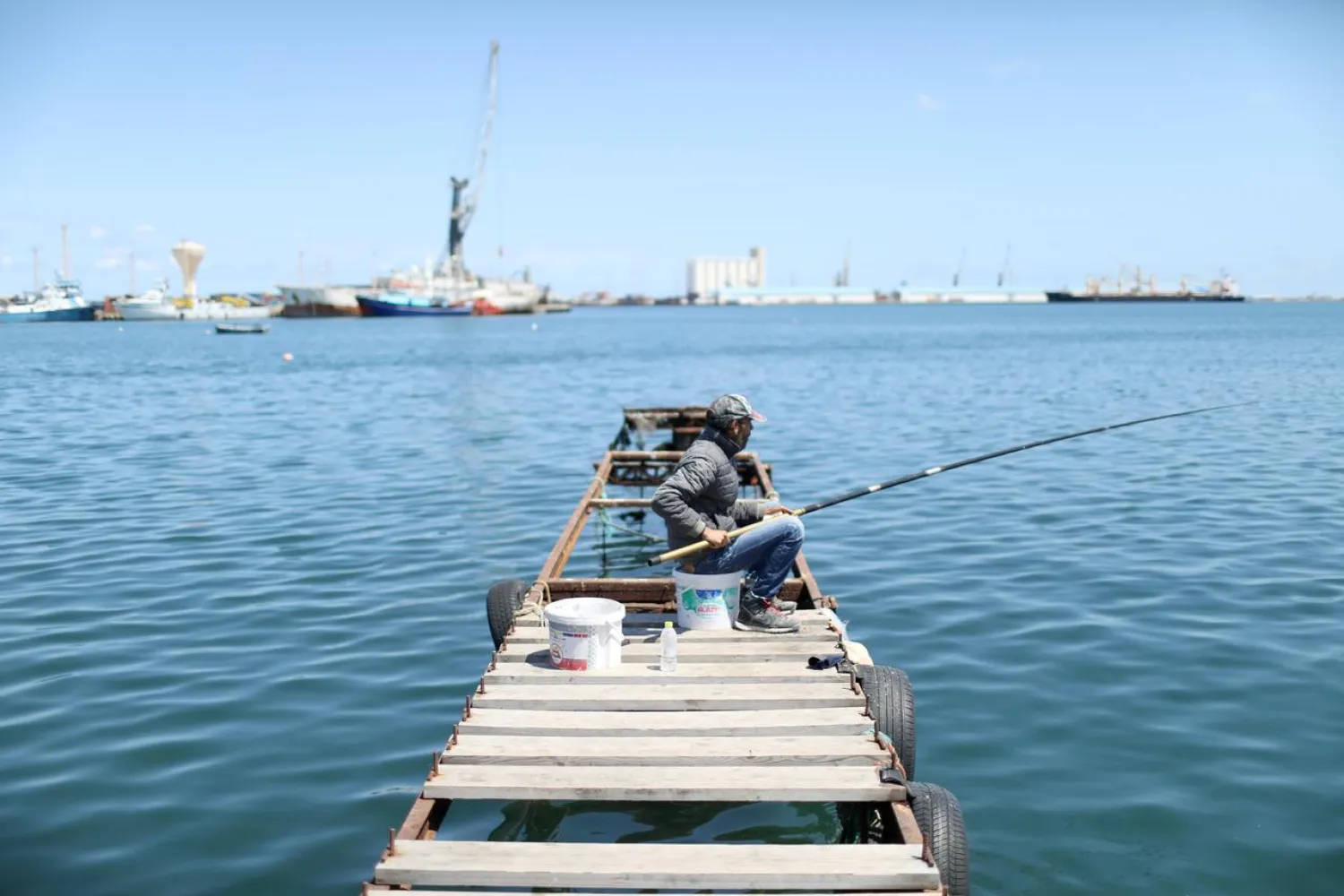
A Libyan man fish at the coast of the Mediterranean Sea in Tripoli, Libya April 12, 2019. REUTERS/Ahmed Jadallah
Residents of the Libyan capital, Tripoli, were this week interrupted from watching news of the war and the sporadic sound of shelling, to buy gallons of drinking water after it was cut off from their homes.
In addition, the majority of areas in the city suffered a total blackout at a time when the threat of the spread of the coronavirus looms in the country.
There was a total blackout in both the western and southern regions of the country.
Operation Volcano of Rage that is affiliated with Fayez al-Sarraj’s Government of National Accord accused what it called the “Haftar militias”, referring to the Commander of the Libyan National Army, of “shutting the gas pipe in the Sidi al-Sayeh area which feeds the western region with electricity days after closing the gas pipes in the Great Man Made River which also feeds the area.”
The Operation says the LNA did so to punish citizens, after it also halted the production and export of oil, incurring 4 billion dollars in losses.
Abdel-Moneim al-Hor, the Secretary-General of the Arab Organization for Human Rights, residing in al-Khums, a city east of the capital, told Asharq Al-Awsat, “We have been suffering from a cut in water and electricity supplies for days. Today I bought water and emptied it in the underground tanker of my home."
The General Electricity Company clarified two days ago that “an unknown group had shut down the gas pipe in the Sidi al-Sayeh area.”
It warned that “continuing to close it will cause a massive shortage in electricity production in the area and that manual loads will be resorted to in order to maintain the safety and stability of the electric grid”.
In addition to the power cut, Tripoli and the majority of cities in western Libya have suffered from water cuts for two days, in an operation that Sarraj’s forces see as deliberately depriving people of drinking water by the LNA as a tactic of war.
Despite the Great Man Made River administration announcing that drinking water supply has partially returned to some areas, it expects that “it will be cut off again in the capital over the continued raids by armed men of the control room.
The western Libyan cities also suffered the same fate, as citizens there complained of drinking water and electricity cuts, deepening their years-long crisis coupled with a rise in the price of fuel and cooking gas.
Ali Imlimdi, a lawyer who works and lives in the city of Sabha in the south, said that in addition to power cuts, people there “are facing a rise in the prices of cooking gas and fuel.”
He clarified that there was power rationing of up to nine hours a day . . . and once the Tripoli station is shut down, the Awbari gas station in turn also shuts down because it cannot withstand the pressure.
Hezbollah Says Reinforced Fighters in South Lebanon Despite Disarmamenthttps://english.aawsat.com/arab-world/5268590-hezbollah-says-reinforced-fighters-south-lebanon-despite-disarmament
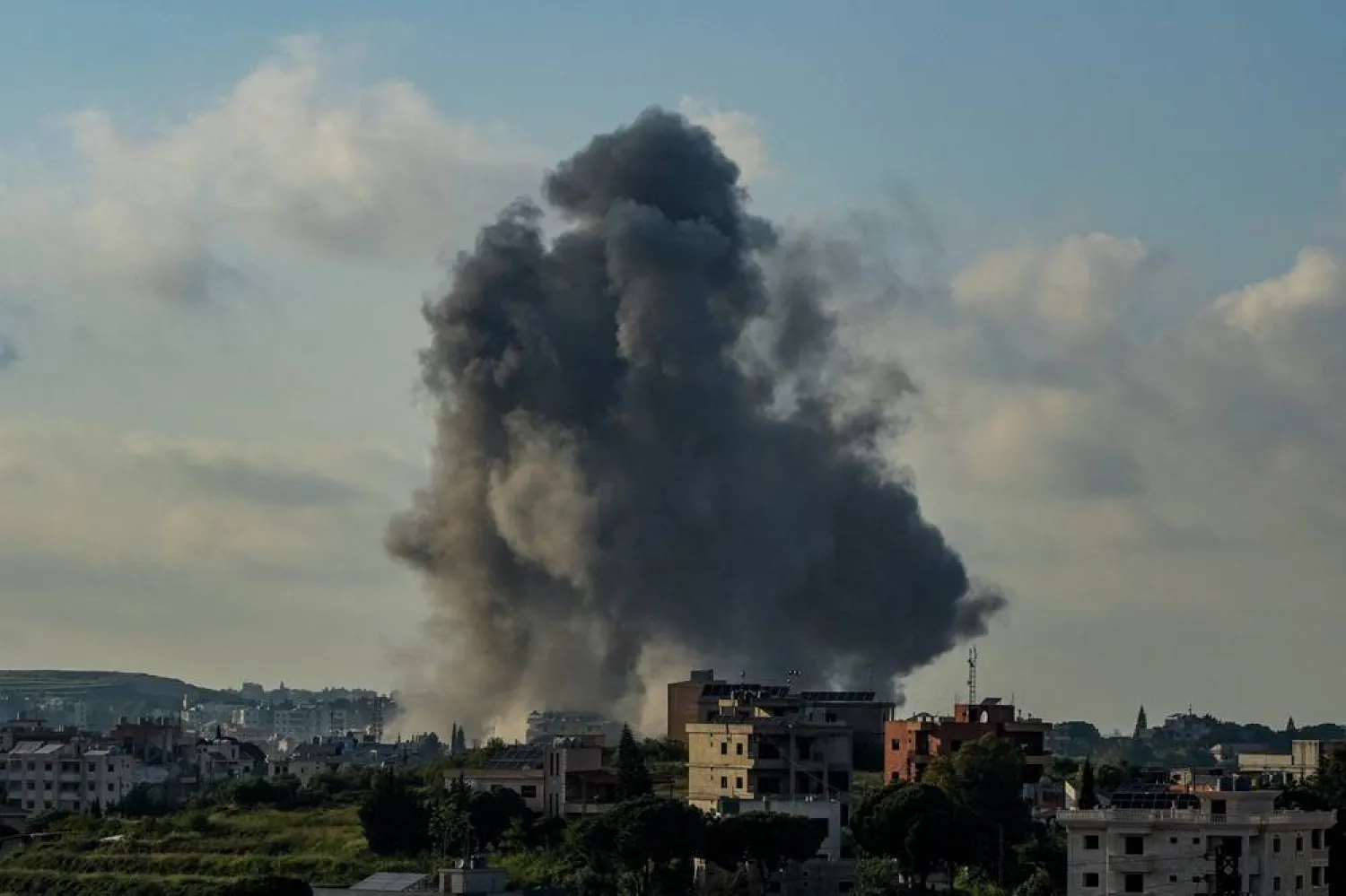
Smoke rises in Habboush, Nabatiyeh Governorate, in southern Lebanon, following Israeli strikes, Lebanon, May 1, 2026. (Reuters)
TT
TT
Hezbollah Says Reinforced Fighters in South Lebanon Despite Disarmament
Smoke rises in Habboush, Nabatiyeh Governorate, in southern Lebanon, following Israeli strikes, Lebanon, May 1, 2026. (Reuters)
Lebanese group Hezbollah has brought reinforcements and weapons to the south of the country since the start of the war with Israel on March 2, the organization's director of media relations said on Friday.
The Lebanese army said in January it had finished disarming the group near the Israeli border in southern Lebanon, the scene of multiple wars between Israel and Hezbollah, the most recent of which was brought to a halt on April 17 by a ceasefire.
The army had been enacting a plan that it drew up after a 2024 ceasefire agreement that ended the last war between the two.
Speaking during an interview with a group of journalists including from AFP, Youssef Al Zein said the group had been able to "introduce forces and arms in the course of the battle" with Israel.
Zein said the reinforcements did not use roads controlled by the Lebanese army.
"We are convinced that the army is a national army" that "will not enter into a confrontation with Hezbollah", he said.
He said that if Israel had been able to penetrate deeper into Lebanese territory it was because Hezbollah had been disarmed south of the Litani River, which runs around 30 kilometers (20 miles) from the border, and its infrastructure there, including tunnels, destroyed.
Nevertheless, he insisted that Hezbollah was able to "reconstitute its forces" after the last war with Israel, and that it was "prepared for a long battle".
Israel announced on April 7 that it had completed the deployment of its ground forces in southern Lebanon and would maintain a 10-kilometer-deep "security zone".
Asked about Hezbollah's recent use of cheap one-way attack drones controlled via fiber-optic cable against Israeli forces, Zein said it was one of the group's tactics.
"We are aware of the enemy's superiority, but at the same time we are exploiting its weak points," he said.
The use of such drones which, unlike radio-controlled UAVs, can't be electronically jammed and are hard to track, was popularized by the Ukraine conflict.
Zein, whose predecessor Mohammed Afif was killed in Israeli strikes on Beirut during the 2024 war, said the drones were "manufactured in Lebanon".
Attacks using such drones have killed two Israeli soldiers and a civilian contractor in under a week, according to the Israeli military.
Hezbollah dragged Lebanon into the wider regional war started by US-Israeli attacks on Iran, when it launched rockets at Israel.
Israel's retaliation has killed more than 2,600 people, with its strikes on Lebanon continuing despite the truce.
Smoke rises in Habboush following Israeli strikes, as seen from Nabatiyeh, Lebanon, May 1, 2026. (Reuters)
Lebanon's health ministry said six people including a woman and a child were killed Friday in two Israeli strikes on a southern town where Israel's army had issued an evacuation order despite a ceasefire.
The ministry statement said eight other people including a woman and a child were wounded in the strikes on Habboush, where the state-run National News Agency had reported casualties after Israeli warplanes "launched a series of heavy strikes... less than an hour after warning" residents there to evacuate.
Meanwhile, the Hezbollah group said it fired rockets and drones, including one that crashed in northern Israel and wounded two soldiers.
Israel’s military and Hezbollah kept up their attacks despite a ceasefire in place since April 17.
Israel’s military on Friday afternoon urged residents of the village of Habboush near the southern city of Nabatiyeh to evacuate, warning that those close to Hezbollah’s facilities would be putting their lives in danger if they stay.
Friday’s exchanges came after paramedics recovered the bodies of five people, including a man and his three sons, from under rubble in the village of Kfar Rumman, also near Nabatiyeh, a day after they were killed.
The NNA reported that the five were killed in an airstrike late Thursday on Kfar Rumman. The agency identified those whose bodies were recovered as Malek Hamza and his sons, Ali, Fadel and Hamza. It said the strike also killed a Lebanese soldier. The Lebanese army confirmed that a soldier, Ali Jaber, was killed in the strike.
By Friday afternoon, Hezbollah had issued six statements saying it launched drones and rockets at Israeli military positions.
The Israeli military confirmed that Hezbollah launched an explosive drone that fell in northern Israel near the border with Lebanon.
Israeli media reported a drone strike near Margaliot in northern Israel, saying it caused a localized fire, and that two soldiers were lightly wounded in a separate Hezbollah drone impact in the area.
Despite the war, residents have continued to return to homes in southern Lebanon after being displaced for weeks because of the hostilities.
One of them was Umm Ali Khodor, whose apartment in the southern port city of Tyre was damaged during the previous Israel-Hezbollah war in 2024 and again in the current conflict.
“We were displaced, we rented a house, but as you know the situation is very difficult,” the woman said. “We could not continue so we returned to our home.”
The latest war between Israel and Hezbollah began on March 2, when Hezbollah fired rockets into northern Israel two days after the United States and Israel launched a war on its main backer, Iran. Israel has since carried out hundreds of airstrikes and launched a ground invasion of southern Lebanon, capturing dozens of towns and villages along the border.
Since then, Lebanon and Israel have held their first direct talks in more than three decades. The two countries have formally been in a state of war since the founding of the state of Israel in 1948.
A 10-day ceasefire declared in Washington went into effect on April 17. The ceasefire was later extended by three weeks.
The Health Ministry said Friday that the war's death toll reached 2,618 while 8,094 were wounded.
Berri to Asharq Al-Awsat: No Point Negotiating with Israel Under Firehttps://english.aawsat.com/arab-world/5268551-berri-asharq-al-awsat-no-point-negotiating-israel-under-fire
FILE PHOTO: Lebanese Parliament Speaker Nabih Berri meets with Italian Prime Minister Giorgia Meloni (not seen) in Beirut, Lebanon October 18, 2024. REUTERS/Mohamed Abd El Ghany/File Photo
Berri to Asharq Al-Awsat: No Point Negotiating with Israel Under Fire
FILE PHOTO: Lebanese Parliament Speaker Nabih Berri meets with Italian Prime Minister Giorgia Meloni (not seen) in Beirut, Lebanon October 18, 2024. REUTERS/Mohamed Abd El Ghany/File Photo
In his first comment on the statement issued by the US Embassy in Beirut, which called on President Joseph Aoun to hold a direct meeting with Israeli Prime Minister Benjamin Netanyahu, Parliament Speaker Nabih Berri told Asharq Al-Awsat that the statement “speaks for itself, and I have nothing to add.”
He added that his response to the president “came in reply to what he said while receiving economic bodies” (in reference to Aoun’s remarks about full coordination with Berri regarding negotiations). This, he said, explains his apology for not attending the meeting that had been scheduled with President Aoun and Prime Minister Nawaf Salam at the presidential palace.
Berri also addressed the extension of the truce for three weeks, brokered by US President Donald Trump, asking: “Where is this truce?” Has Israel stopped leveling towns, demolishing homes, shedding the blood of children, women and the elderly, preventing rescue teams from saving the wounded and transporting them to hospitals, or retrieving those trapped under rubble until they died?
He also pointed to the targeting of medical bodies and paramedics, which led to the killing of dozens of them, questioning whether all these victims were part of Hezbollah’s military infrastructure, as Israel claims to justify the destruction of southern towns.
He said the so-called truce has allowed Israel to press ahead with its aggression and commit unprecedented massacres, without US intervention to compel it to halt hostilities and entrench a ceasefire, particularly since Washington was behind securing the truce extension.
This, he added, obliges it to honor its commitment to the Lebanese and the international community. Otherwise, what is the point of negotiations under Israeli fire? And what would be said to the families of those killed in what he described as Israeli treachery in the south?
Aoun and Berri: divergence, not a rupture
In this context, a parliamentary source following presidential relations said the emerging dispute between Aoun and Berri remains within the bounds of differing interpretations of the US State Department statement.
The source told Asharq Al-Awsat that mediators intervened to cool tensions between the two sides, ruling out any rupture given the difficult and delicate circumstances Lebanon is going through, which require collective efforts, starting with the presidents, to compel Israel to cease fire and entrench it before asking Lebanon to enter direct negotiations, even if indirect talks would be preferable, as the US administration is expected to pursue.
The source added that as long as the three presidents agree on the necessity of halting hostilities ahead of any negotiation track with Israel, the recalibration of positions on the sidelines of the cabinet session helped ease tensions between Aoun and Berri, opening the way for renewed momentum in presidential relations. None of the presidents, the source said, has an interest in the absence of consultation, which is essential to reach a roadmap for handling the negotiations matter.
The source noted that there is no alternative to renewed coordination among the three presidents as long as they adhere to national constants and do not compromise them, as a prerequisite for launching negotiations that cannot be held without being paired with a firmly established ceasefire. This, he said, calls on Trump to intervene with Israel to stop it from escalating its aggression.
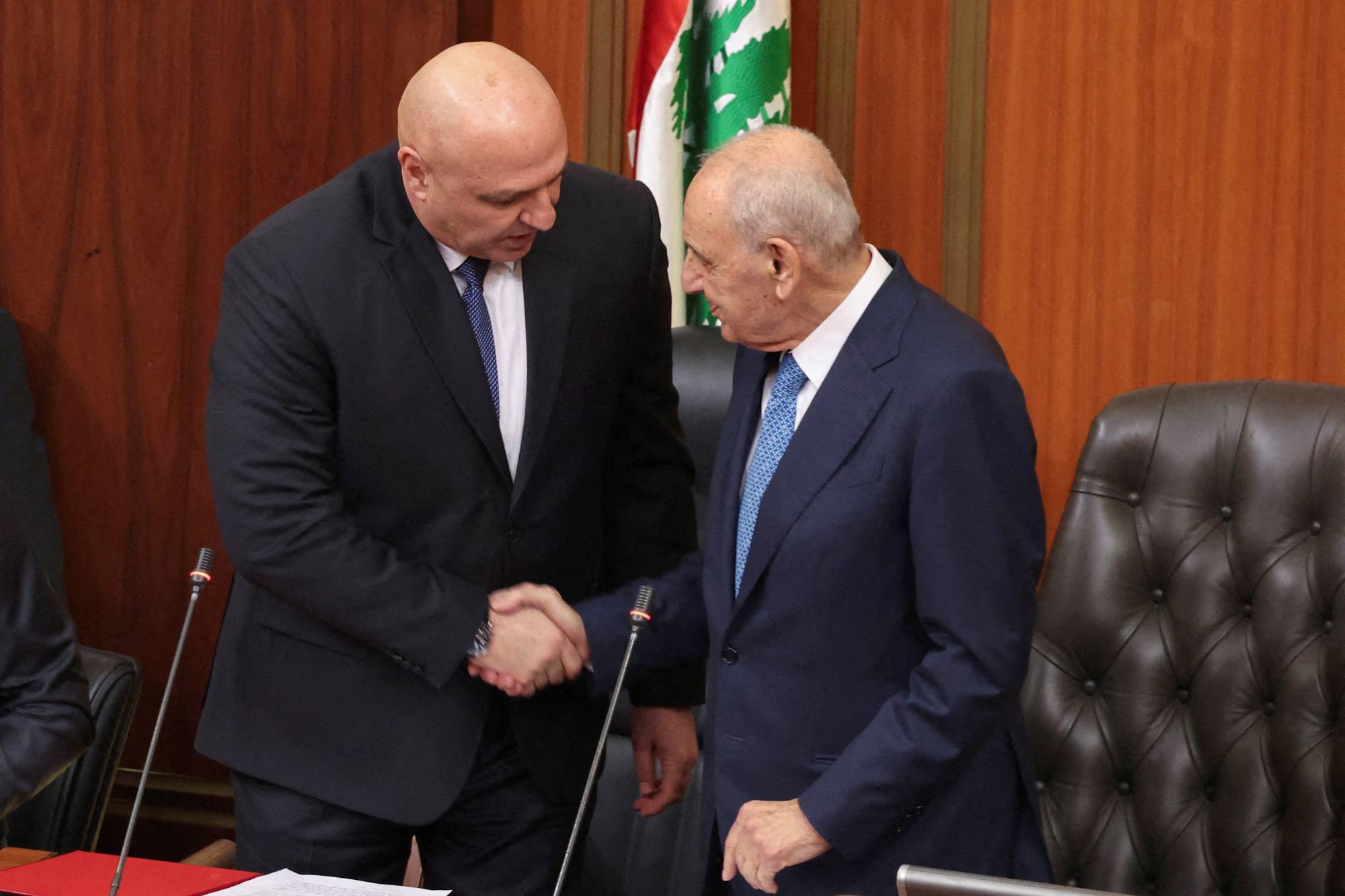
FILE PHOTO: Lebanese Parliament Speaker Nabih Berri shakes hands with Lebanon's army chief Joseph Aoun after he is elected as the country's President at the parliament building in Beirut, Lebanon, January 9, 2025. REUTERS/Mohamed Azakir/File Photo
Berri’s stance on negotiations
The parliamentary source defended Berri’s position, questioning why the US administration has not intervened to compel Israel to implement the ceasefire agreement it sponsored in coordination with France in 2024, which never came into force. Instead, it allowed Israel to continue violating it by expanding its aggression beyond the south to Beirut’s southern suburbs and towns in the Bekaa.
He confirmed that Hezbollah responded to Berri’s position and adhered, to the fullest extent, to the cessation of hostilities, playing, with the party’s authorization, a role in reaching it with the then US mediator Amos Hochstein, under US and French sponsorship. This came, he said, while Israel was given free rein to continue its aggression under the pretext of self-defense through preemptive strikes against what it claims are threats to its northern settlements.
The source said Hezbollah’s commitment to the ceasefire for 15 months, contrasted with Israel’s insistence on violating it, placed it in a difficult position, especially with Washington refraining from pressuring Israel to halt its breaches, leading to an expanded offensive, despite prior commitments to synchronized steps by both sides as a condition for implementing the agreement.
He added that Nawaf Salam’s government, while primarily betting on a diplomatic track to compel Israel to withdraw from the south, faced Israeli defiance of the agreement and continued pressure through fire to force Lebanon to accept its terms.
The three-week truce
The source said the three-week truce remained ink on paper, enabling Israel to turn the south into an open military operations zone, continuing systematic destruction across areas south and north of the Litani River, displacing residents under pressure to evacuate their towns.
He expressed confidence that President Aoun remains committed to his position that securing a ceasefire must come first as a prerequisite for launching direct negotiations between the two countries under US sponsorship, without compromising national constants regardless of pressure.
This position, he added, aligns with his understanding with Berri and Salam, and was reaffirmed in the latest cabinet session when Aoun said negotiations have not yet begun, meaning he rejects any negotiation track before Israel halts its military pressure on Lebanon.
Securing a ceasefire
The source stressed that Aoun will not agree to begin negotiations unconditionally, foremost without a secured ceasefire. From his perspective, US pressure to urgently arrange a meeting with Netanyahu could inflame the domestic atmosphere and raise tensions amid growing disagreements if such pressure is met without guarantees for Lebanon, primarily a ceasefire and the return of displaced people to their villages.
He confirmed his support for Aoun’s preference not to rush into a meeting with Netanyahu, considering the timing premature. Such a meeting, he said, should come as the culmination of an agreement that responds to the national constants upheld by the president, in exchange for ending the state of war between the two countries, with subsequent steps to be addressed later.
He also questioned why the call for Aoun to meet Netanyahu was issued by the US Embassy in Beirut rather than the White House, noting that Aoun raised this matter during his meeting with US Ambassador to Beirut Michel Issa, who had recently returned from Washington, to clarify the reasons behind issuing the statement from the embassy, which he described as unprecedented in the history of relations between the two countries.
لم تشترك بعد
انشئ حساباً خاصاً بك لتحصل على أخبار مخصصة لك ولتتمتع بخاصية حفظ المقالات وتتلقى نشراتنا البريدية المتنوعة