


Premier League Critics Should Recognize Football Cannot Wait Forever

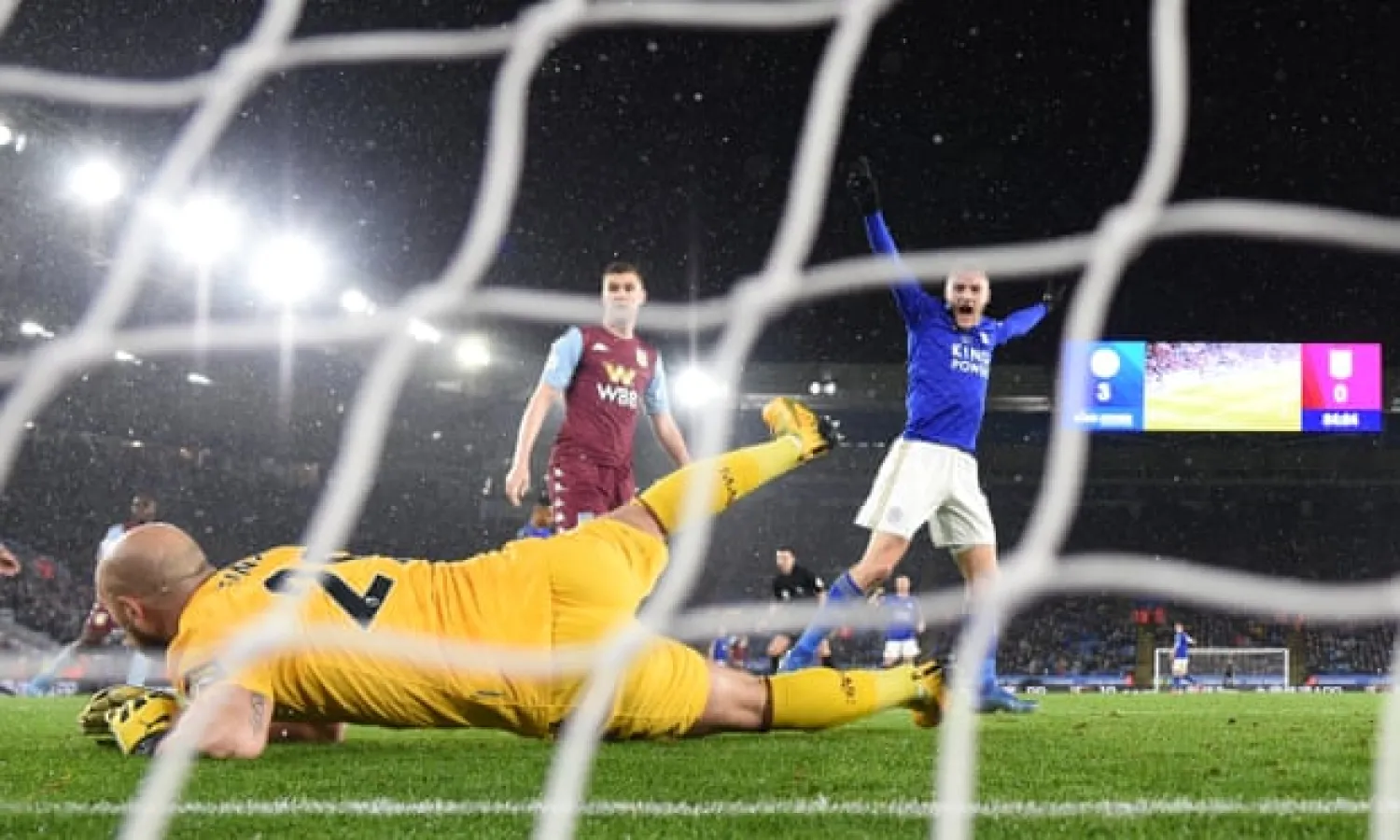
 Jamie Vardy celebrates Leicester’s fourth, scored by Harvey Barnes, against Aston Villa on 9 March. It was the last goal scored in the Premier League before shutdown. Photograph: Michael Regan/Getty Images
Jamie Vardy celebrates Leicester’s fourth, scored by Harvey Barnes, against Aston Villa on 9 March. It was the last goal scored in the Premier League before shutdown. Photograph: Michael Regan/Getty Images
TT

Premier League Critics Should Recognize Football Cannot Wait Forever

 Jamie Vardy celebrates Leicester’s fourth, scored by Harvey Barnes, against Aston Villa on 9 March. It was the last goal scored in the Premier League before shutdown. Photograph: Michael Regan/Getty Images
Jamie Vardy celebrates Leicester’s fourth, scored by Harvey Barnes, against Aston Villa on 9 March. It was the last goal scored in the Premier League before shutdown. Photograph: Michael Regan/Getty Images

With each week the plans become a little more refined and with each week any final decision is pushed back. Football may return, and this is how it may look if it does, but nobody is sure, and any proposed date can only be provisional. Which is as it should be. In an age that often favours decisiveness over the decision itself, there is something vaguely comforting about a process that accepts the wisdom of waiting.

But in the background there is a crucial, nagging voice, and what it is saying is this: if football isn’t prepared to return, at least initially, in a form very different to the one it took before the virus, it may not return for a very long time – and for many clubs that means never.

Various fan bodies, particularly in Germany, have protested about the prospect of football returning behind closed doors. The stand-out proposal from Friday’s Premier League meeting is for matches to be played at neutral grounds. The accusation is of the authorities and clubs acting not for reasons of sport but finance, a tension that has existed since the advent of professionalism 140 years ago. At some point, though, the two intersect.

Football long ago abased itself before the capitalist altar and, while it would be preferable if more than lip service were paid to the idea the game has a community role, that it is not merely a business and didn’t exist simply to make the rich even richer, equally there has to be some realism.

Clubs, however socially responsible, need revenue to survive. In Europe’s big five leagues, a high proportion of that revenue is derived from broadcasting rights and to generate that games need to be played.

One of the reasons Dutch clubs seem to have reacted with relative equanimity to their government’s decision to ban all public events until at least 1 September is that the pressure from broadcasters in the Netherlands is nowhere near as intense. The outcry in France after a similar decision would almost certainly have been louder – and various clubs are considering their legal options – had a new, far more lucrative television deal not been beginning next season.

There has also been a quasi-moral argument raised, that there is something distasteful about plotting a return to live sport when people are still dying in their hundreds by the day. And perhaps there is; it’s easy to imagine how modern football’s combination of glitz and pettiness could jar with a general mood of sombreness.

But it’s not to diminish the unique nature of the coronavirus crisis or the tragedy of those deaths to observe that all life goes on all the time against a background of mortality. At some point, as the risk of contagion recedes, lockdown will ease and some version of some variant of life will begin again.

Judging that point is, of course, enormously difficult, and where football should lie on the list of priorities can be debated. But the two principal factors in making a decision must be safety and resources.

What is clear is the clubs have no desire to make any call without official support and that there is no appetite on the part of the government to institute the sort of ban seen in the Netherlands and France. That football could be considering a return in Germany, Italy, Spain and England while suspended in two ostensibly similar neighbouring countries is bewildering, but given the easing of lockdown is necessarily a gradual process, perhaps it is only natural that different countries should have different concerns and take different steps first.

Germany looks the country closest to a return, though the revelation of three positive tests at Cologne may affect those plans, perhaps before the end of this month.

That at least gives the Premier League an example of what football may look like, that minimising the risk to players will be complicated and require sacrifice and discipline is clear. To a layman, frankly, the processes look baffling and overwhelming, and it is entirely understandable that players should be concerned – and fully involved in any decision – but it may be their acceptance is the only way football can return without a wait of several months that could devastate clubs.

Then there is the matter of resources. The guidance suggests players should be tested two or three times a week. Even if the tests are sourced privately, that clearly should not happen until staff in hospitals and other key positions – in shops, on public transport, in schools – are being tested regularly.

Equally, there will have to be medical and security staff on duty at stadiums. Again, that cannot happen if they would be better deployed elsewhere. Those are matters on which football can only wait.

Using eight-to-10 neutral stadiums would seem a way of making the process more efficient: fewer arenas to adapt to the guidelines and keep clean, less risk of fans congregating. It is far from ideal but these are compromises that may have to be accepted for football to get under way again.

And the vital point, perhaps, is this: that these measures may be necessary not only for this season but for next as well. Ending 2019-20 now, whatever method is used to determine positions and titles, promotion and relegation and European qualification, may resolve certain issues regarding contracts that are set to expire on 30 June, may allow prize money to be distributed (although probably not without legal challenges) and may answer some perceived need to be seen to be decisive, but the fundamental will remain: the virus will still be there.

Whether football returns in June or September, or later even than that, it will be a long time before it is played in stadiums packed with crowds of tens of thousands, without players having to undertake complex social distancing measures. Normal isn’t coming back any time soon.

The Guardian Sport


Shakhtar Boss Pays Ukrainian Racer $200,000 After Games Disqualification

Ukrainian President Volodymyr Zelenskiy holds helmet as he meets with a Ukrainian skeleton racer Vladyslav Heraskevych , who was disqualified from the Olympic skeleton competition over his "helmet of remembrance" depicting athletes killed since Russia's invasion and his father and coach, Mykhailo Heraskevych, amid Russia's attack on Ukraine, in Munich, Germany February 13, 2026. (Ukrainian Presidential Press Service/Handout via Reuters)
TT

Shakhtar Boss Pays Ukrainian Racer $200,000 After Games Disqualification

Ukrainian President Volodymyr Zelenskiy holds helmet as he meets with a Ukrainian skeleton racer Vladyslav Heraskevych , who was disqualified from the Olympic skeleton competition over his "helmet of remembrance" depicting athletes killed since Russia's invasion and his father and coach, Mykhailo Heraskevych, amid Russia's attack on Ukraine, in Munich, Germany February 13, 2026. (Ukrainian Presidential Press Service/Handout via Reuters)

The owner of ‌Ukrainian football club Shakhtar Donetsk has donated more than $200,000 to skeleton racer Vladyslav Heraskevych after the athlete was disqualified from the Milano Cortina Winter Games before competing over the use of a helmet depicting Ukrainian athletes killed in the war with Russia, the club said on Tuesday.

The 27-year-old Heraskevych was disqualified last week when the International Bobsleigh and Skeleton Federation jury ruled that imagery on the helmet — depicting athletes killed since Russia invaded Ukraine in 2022 — breached rules on athletes' expression at ‌the Games.

He ‌then lost an appeal at the Court ‌of ⁠Arbitration for Sport hours ⁠before the final two runs of his competition, having missed the first two runs due to his disqualification.

Heraskevych had been allowed to train with the helmet that displayed the faces of 24 dead Ukrainian athletes for several days in Cortina d'Ampezzo where the sliding center is, but the International Olympic Committee then ⁠warned him a day before his competition ‌started that he could not wear ‌it there.

“Vlad Heraskevych was denied the opportunity to compete for victory ‌at the Olympic Games, yet he returns to Ukraine a ‌true winner," Shakhtar President Rinat Akhmetov said in a club statement.

"The respect and pride he has earned among Ukrainians through his actions are the highest reward. At the same time, I want him to ‌have enough energy and resources to continue his sporting career, as well as to fight ⁠for truth, freedom ⁠and the remembrance of those who gave their lives for Ukraine," he said.

The amount is equal to the prize money Ukraine pays athletes who win a gold medal at the Games.

The case dominated headlines early on at the Olympics, with IOC President Kirsty Coventry meeting Heraskevych on Thursday morning at the sliding venue in a failed last-minute attempt to broker a compromise.

The IOC suggested he wear a black armband and display the helmet before and after the race, but said using it in competition breached rules on keeping politics off fields of play. Heraskevych also earned praise from Ukraine President Volodymyr Zelenskiy.


Speed Skating-Italy Clinch Shock Men’s Team Pursuit Gold, Canada Successfully Defend Women’s Title

 Team Italy with Davide Ghiotto, Andrea Giovannini, Michele Malfatti, celebrate winning the gold medal on the podium of the men's team pursuit speed skating race at the 2026 Winter Olympics, in Milan, Italy, Tuesday, Feb. 17, 2026. (AP)
Team Italy with Davide Ghiotto, Andrea Giovannini, Michele Malfatti, celebrate winning the gold medal on the podium of the men's team pursuit speed skating race at the 2026 Winter Olympics, in Milan, Italy, Tuesday, Feb. 17, 2026. (AP)
TT

Speed Skating-Italy Clinch Shock Men’s Team Pursuit Gold, Canada Successfully Defend Women’s Title

 Team Italy with Davide Ghiotto, Andrea Giovannini, Michele Malfatti, celebrate winning the gold medal on the podium of the men's team pursuit speed skating race at the 2026 Winter Olympics, in Milan, Italy, Tuesday, Feb. 17, 2026. (AP)
Team Italy with Davide Ghiotto, Andrea Giovannini, Michele Malfatti, celebrate winning the gold medal on the podium of the men's team pursuit speed skating race at the 2026 Winter Olympics, in Milan, Italy, Tuesday, Feb. 17, 2026. (AP)

An inspired Italy delighted the home crowd with a stunning victory in the Olympic men's team pursuit final as

Canada's Ivanie Blondin, Valerie Maltais and Isabelle Weidemann delivered another seamless performance to beat the Netherlands in the women's event and retain their title ‌on Tuesday.

Italy's ‌men upset the US who ‌arrived ⁠at the Games ⁠as world champions and gold medal favorites.

Spurred on by double Olympic champion Francesca Lollobrigida, the Italian team of Davide Ghiotto, Andrea Giovannini and Michele Malfatti electrified a frenzied arena as they stormed ⁠to a time of three ‌minutes 39.20 seconds - ‌a commanding 4.51 seconds clear of the ‌Americans with China taking bronze.

The roar inside ‌the venue as Italy powered home was thunderous as the crowd rose to their feet, cheering the host nation to one ‌of their most special golds of a highly successful Games.

Canada's women ⁠crossed ⁠the line 0.96 seconds ahead of the Netherlands, stopping the clock at two minutes 55.81 seconds, and

Japan rounded out the women's podium by beating the US in the Final B.

It was only Canada's third gold medal of the Games, following Mikael Kingsbury's win in men's dual moguls and Megan Oldham's victory in women's freeski big air.


Lindsey Vonn Back in US Following Crash in Olympic Downhill 

Milano Cortina 2026 Olympics - Alpine Skiing - Women's Downhill 3rd Official Training - Tofane Alpine Skiing Centre, Belluno, Italy - February 07, 2026. Lindsey Vonn of United States in action during training. (Reuters)
TT

Lindsey Vonn Back in US Following Crash in Olympic Downhill 

Milano Cortina 2026 Olympics - Alpine Skiing - Women's Downhill 3rd Official Training - Tofane Alpine Skiing Centre, Belluno, Italy - February 07, 2026. Lindsey Vonn of United States in action during training. (Reuters)

Lindsey Vonn is back home in the US following a week of treatment at a hospital in Italy after breaking her left leg in the Olympic downhill at the Milan Cortina Games.

“Haven’t stood on my feet in over a week... been in a hospital bed immobile since my race. And although I’m not yet able to stand, being back on home soil feels amazing,” Vonn posted on X with an American flag emoji. “Huge thank you to everyone in Italy for taking good care of me.”

The 41-year-old Vonn suffered a complex tibia fracture that has already been operated on multiple times following her Feb. 8 crash. She has said she'll need more surgery in the US.

Nine days before her fall in Cortina d'Ampezzo, Italy, Vonn ruptured the ACL in her left knee in another crash in Switzerland.

Even before then, all eyes had been on her as the feel-good story heading into the Olympics for her comeback after nearly six years of retirement.
