


How English Football Responded to the Second World War

 An air raid warden watches for enemy planes at a match between Charlton and Arsenal in London in 1940. Photograph: Hulton Deutsch/Corbis via Getty Images
An air raid warden watches for enemy planes at a match between Charlton and Arsenal in London in 1940. Photograph: Hulton Deutsch/Corbis via Getty Images
TT

How English Football Responded to the Second World War

 An air raid warden watches for enemy planes at a match between Charlton and Arsenal in London in 1940. Photograph: Hulton Deutsch/Corbis via Getty Images
An air raid warden watches for enemy planes at a match between Charlton and Arsenal in London in 1940. Photograph: Hulton Deutsch/Corbis via Getty Images

When the 1939-40 Football League season kicked off on Saturday 26 August 1939, players were wearing numbered shirts for the first time. Bigger changes were to come. Germany invaded Poland the following Friday and the four divisions and FA Cup were halted once war was declared on 3 September. The action stopped after three rounds of fixtures, with Blackpool boasting the only 100% record in the top flight and Leeds bottom of the table having failed to score a goal.

Clubs arranged some friendlies but, when the threatened bombings did not materialise, the thirst for competitive football resurfaced and the Home Office agreed to a restructured football programme. Aston Villa and Derby County were among half a dozen clubs who withdrew, principally because many of their players were enlisting for the armed forces.

The remaining 82 Football League clubs were distributed into 10 regional leagues and football started again on 28 October. The only hiccup that day came at Grimsby, where their game with Mansfield was delayed by 30 minutes because of an air raid warning. A 50-mile radius was imposed for each game and crowds were limited to 8,000, although these restrictions were relaxed over time.

Alongside the various leagues, the War Cup was introduced in April 1940. In a tremendous feat of organisation, the competition squeezed 137 games into just nine weeks. Restriction on crowd sizes were lifted for later rounds, giving 42,399 people the chance to see West Ham beat Blackburn 1-0 in the final at Wembley. The game kicked off at 6.30pm on 8 June, a few days after the evacuation from Dunkirk had been completed. Quite a few soldiers who had been rescued from northern France attended the match, which gave the nation a much-needed fillip.

1940-41

By the beginning of the 1940-41 season, the Battle of Britain was raging in the air and the Blitz was causing major damage and loss of life on the ground. Coventry and Sheffield were targeted towards the end of 1940, with Highfield Road damaged so badly that Coventry City had to withdraw from the league. Sheffield United had to play at Hillsborough after Bramall Lane was put out of action.

This was not the only enforced groundshare. Highbury was turned into an Air Raid Precautions stronghold, which meant that Arsenal had to play at White Hart Lane – a reversal of what had happened in the first world war. Manchester United also had to move in with their neighbours. Old Trafford was damaged extensively in March 1941 and did not host football for another eight and a half years. The club’s biggest attendance for a home league game is still the crowd of 83,260 that watched them play Arsenal at Maine Road in January 1948.

Despite their big fanbases, neither United nor City could keep up with Preston in the 1940-41 season. The Football League was divided into north and south regions and, given that clubs played different numbers of games, the tables were arranged by goal average rather than points. Preston ended up winning the league even though Chesterfield (who had played six more games) picked up more points.

Preston went on to complete a double by beating Arsenal in the War Cup final. Tom Finney and Bill Shankly both played for the Lilywhites, with the Compton brothers both in the Arsenal team. Although 60,000 were at Wembley for that Preston v Arsenal game and an impressive 78,000 watched England beat Scotland at Hampden Park, attendances were in decline and the aggregate of 2.8 million was well below the 5.4 million who had watched the previous season.

The War Cup was not the only new competition. In January 1941 a dozen clubs started the London War Cup, much to the chagrin of the league and other southern clubs, such as Portsmouth, who were excluded. Bizarrely, Reading were included and they ended up winning it, beating Brentford in the final.

1941-42

Having set up a breakaway cup, the London clubs decided to go it alone with a London league in the 1941-42 season, which did include Portsmouth this time. The rebel clubs were expelled by the Football League. Arsenal won the league and Brentford won the London Cup final in front of nearly 70,000 fans at Wembley. Their victory earned them a place in the newly formed Cup Winners’ Cup with Wolves, who had beaten Sunderland in the Football War Cup.

1942-43

By 1942-43, the Football League regained its control of the football calendar. The London clubs were re-admitted and formed part of the 18-club southern league, which also included a few amateur teams. The season was split in two, with the first title contested from August to Christmas Day and the second starting on Boxing Day and finishing in May. Liverpool won the northern league in the spring of 1943, but it was the runners-up who provided the sweetest story of wartime football.

The emergence of a team of workers from a sweet factory in Newport was extraordinary, but they were no flash in the pan. Lovell’s Athletic had won the western league and cup the previous season, so were a real force to be reckoned with. Lovell’s finished above both Manchester clubs and Aston Villa in the 1943 season and also reached the west’s cup final, which they lost 7-6 to Swansea Town over two legs.

1943-44

Another amateur side outdid Lovell’s achievement the following season. Bath City won the northern league in spring 1944, finishing level on points with Wrexham but above them on goal average. For Bath, who had been trying to join the Football League for many years, this was some sort of redemption. They also won the last Football League West Cup in 1945 but, once the war ended, both clubs’ reward for their achievements was to be jettisoned back to non-league. Lovell’s eventually disbanded in 1969.

Crowds kept rising, with 85,000 at Wembley to watch Charlton beat Chelsea 3-1 in the Southern War Cup – including guest of honour Dwight Eisenhower, the army general who would be elected US president within the next decade. Eisenhower did not know who to support. “I started cheering for the blues but, when I saw the Reds winning, well, then I had to go on cheering for them,” he told reporters after the game. Eisenhower was not the only military leader to take in a big game. General Montgomery was among the 133,000 crowd at Hampden Park to watch England beat Scotland in April 1945.

1944-45

In what proved to be the last wartime season, in 1944-45, attendances rose significantly, reaching 10.3 million overall. The various cup finals drew huge crowds, with the northern cup final between Manchester United and Bolton attracting more than 98,000 over two legs and the southern final at Wembley between Millwall and Chelsea drawing in 90,000 fans – the largest single wartime crowd for a club match.

The Cup Winners’ Cup between Bolton and Chelsea was played in June, several weeks after VE Day. Bolton’s 2-1 victory made them the last winners of the War Cup, yet it was a celebration for everyone at Stamford Bridge that day.

1945-46

The Football League returned to something approaching normality in time for the 1945-46 season, although the league was still being run on a regional basis, with 22 clubs in each of the southern and northern divisions. The third tier was even split into four regions – east, west and north and south of the Thames. The FA Cup was also re-introduced.

Crowds continued to grow and really boomed after the war. By 1948-49, attendances were at 41 million, the peak for the Football League. To put that in some context, the total attendance for the Premier League and EFL last season was just under 33 million. Finally, in an encouraging precedent for Liverpool fans, when the old structure of four divisions that had begun in 1939-40 was re-introduced for the 1946-47 season, the Reds pipped Manchester United to the First Division title by a point.

The Guardian Sport
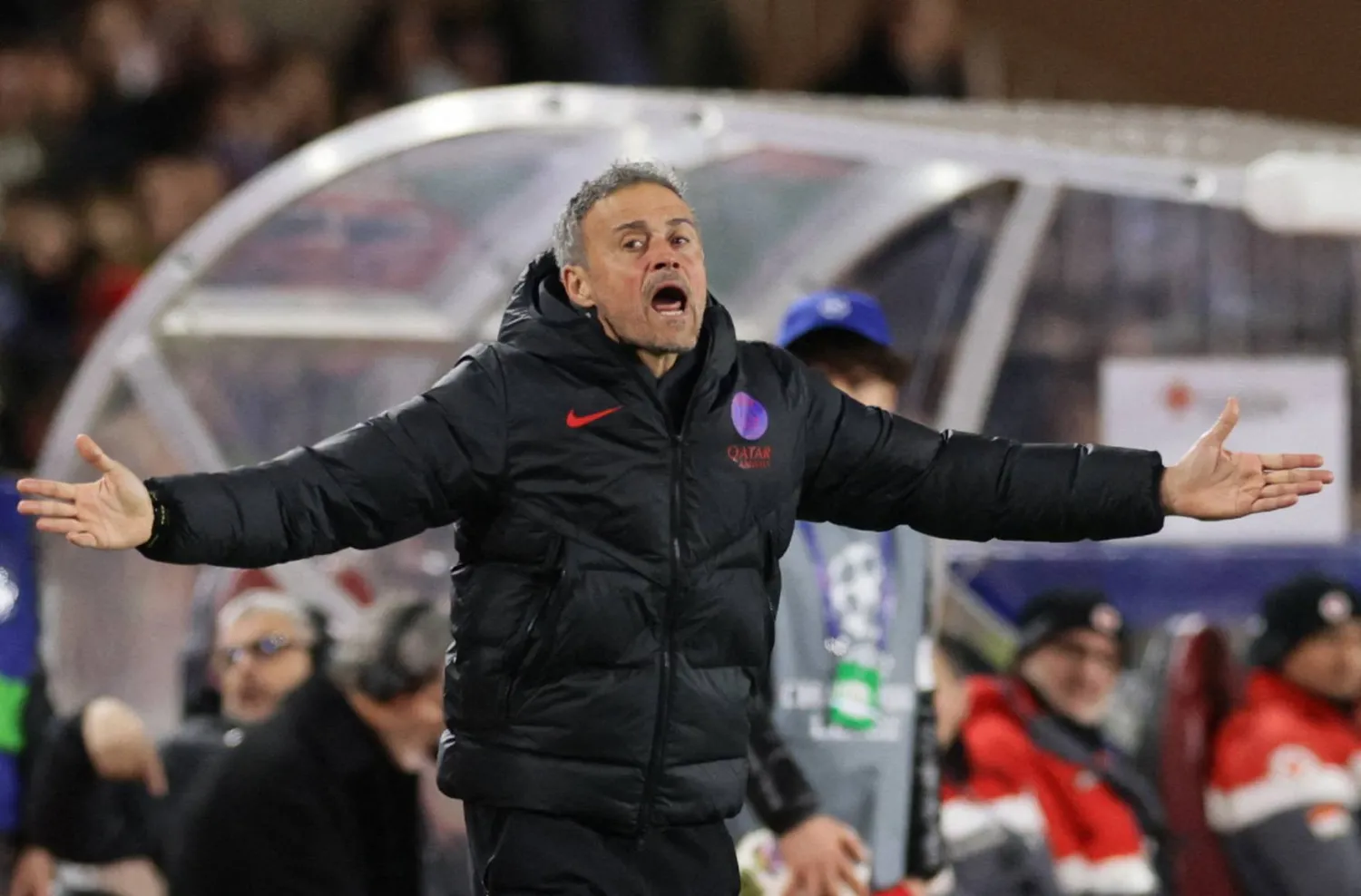


PSG’s Mental Strength Hailed as they Come from Behind to Win at Monaco

Soccer Football - UEFA Champions League - Play Off - First Leg - AS Monaco v Paris St Germain - Stade Louis II, Monaco - February 17, 2026 Paris St Germain coach Luis Enrique reacts REUTERS/Manon Cruz
TT

PSG’s Mental Strength Hailed as they Come from Behind to Win at Monaco

Soccer Football - UEFA Champions League - Play Off - First Leg - AS Monaco v Paris St Germain - Stade Louis II, Monaco - February 17, 2026 Paris St Germain coach Luis Enrique reacts REUTERS/Manon Cruz

Paris Saint-Germain coach Luis ‌Enrique hailed the mental strength of his side in coming from two goals down to win 3-2 away at Monaco in the Champions League on Tuesday, but warned the knockout round tie was far from finished.

The first leg clash between the two Ligue 1 clubs saw Folarin Balogun score twice for the hosts in the opening 18 minutes before Vitinha had his penalty saved to compound matters.

But after Desire Doue came on for injured Ousmane Dembele, the ‌match turned ‌and defending champions PSG went on to ‌secure ⁠a one-goal advantage ⁠for the return leg.

"Normally, when a team starts a match like that, the most likely outcome is a loss,” Reuters quoted Luis Enrique as saying.

“It was catastrophic. It's impossible to start a match like that. The first two times they overcame our pressure and entered our half, they scored. They ⁠made some very good plays.

“After that, it's difficult ‌to have confidence, but we ‌showed our mental strength. Plus, we missed a penalty, so ‌it was a chance to regain confidence. In the ‌last six times we've played here, this is only the second time we've won, which shows how difficult it is.”

The 20-year-old Doue scored twice and provided a third for Achraf Hakimi, just ‌days after he had turned in a poor performance against Stade Rennais last Friday ⁠and was ⁠dropped for the Monaco clash.

“I'm happy for him because this past week, everyone criticized and tore Doue apart, but he was sensational, he showed his character. He helped the team at the best possible time.”

Dembele’s injury would be assessed, the coach added. “He took a knock in the first 15 minutes, then he couldn't run.”

The return leg at the Parc des Princes will be next Wednesday. “Considering how the match started, I'm happy with the result. But the match in Paris will be difficult, it will be a different story,” Luis Enrique warned.


Mbappe Calls for Prestianni Ban over Alleged Racist Slur at Vinicius

TOPSHOT - Real Madrid's French forward #10 Kylian Mbappe talks with SL Benfica's Portuguese head coach Jose Mourinho during the UEFA Champions League knockout round play-off first leg football match between SL Benfica and Real Madrid CF at Estadio da Luz in Lisbon on February 17, 2026. (Photo by PATRICIA DE MELO MOREIRA / AFP)
TT

Mbappe Calls for Prestianni Ban over Alleged Racist Slur at Vinicius

TOPSHOT - Real Madrid's French forward #10 Kylian Mbappe talks with SL Benfica's Portuguese head coach Jose Mourinho during the UEFA Champions League knockout round play-off first leg football match between SL Benfica and Real Madrid CF at Estadio da Luz in Lisbon on February 17, 2026. (Photo by PATRICIA DE MELO MOREIRA / AFP)

Real Madrid forward Kylian Mbappe said Benfica's Gianluca Prestianni should be banned from the Champions League after the Argentine was accused of directing a racist slur at Vinicius Jr during the Spanish side's 1-0 playoff first-leg win on Tuesday.

Denying the accusation, Prestianni said the Brazilian misheard him.

The incident occurred shortly after Vinicius had curled Real into the lead five minutes into the second half in Lisbon.

Television footage showed the Argentine winger covering his mouth with his shirt before making a comment that Vinicius and nearby teammates interpreted as a racial ‌slur against ‌the 25-year-old, with referee Francois Letexier halting the match for ‌11 ⁠minutes after activating ⁠FIFA's anti-racism protocols.

The footage appeared to show an outraged Mbappe calling Prestianni "a bloody racist" to his face, Reuters reported.

The atmosphere grew hostile after play resumed, with Vinicius and Mbappe loudly booed by the home crowd whenever they touched the ball. Despite the rising tensions, the players were able to close out the game without further interruptions.

"I want to clarify that at no time did I direct racist insults to Vini Jr, ⁠who regrettably misunderstood what he thought he heard," Prestianni wrote ‌on his Instagram account.

"I was never racist with ‌anyone and I regret the threats I received from Real Madrid players."

Mbappe told reporters he ‌heard Prestianni direct the same racist remark at Vinicius several times, an allegation ‌also levelled by Real's French midfielder Aurelien Tchouamen.

Mbappe said he had been prepared to leave the pitch but was persuaded by Vinicius to continue playing.

"We cannot accept that there is a player in Europe's top football competition who behaves like this. This guy (Prestianni) doesn't ‌deserve to play in the Champions League anymore," Mbappe told reporters.

"We have to set an example for all the children ⁠watching us at ⁠home. What happened today is the kind of thing we cannot accept because the world is watching us.

When asked whether Prestianni had apologized, Mbappe laughed.

"Of course not," he said.

Vinicius later posted a statement on social media voicing his frustration.

"Racists are, above all, cowards. They need to cover their mouth with their shirt to show how weak they are. But they have the protection of others who, theoretically, have an obligation to punish them. Nothing that happened today is new in my life or my family's life," Vinicius wrote.

The Brazilian has faced repeated racist abuse in Spain, with 18 legal complaints filed against racist behavior targeting Vinicius since 2022.

Real Madrid and Benfica will meet again for the second leg next Wednesday at the Bernabeu.


Second Season of ‘Kings League–Middle East' to Kick off in March in Riyadh 

The second season of the Kings League-Middle East will kick off in Riyadh on March 27. (Kings League-Middle East on X)
TT

Second Season of ‘Kings League–Middle East' to Kick off in March in Riyadh 

The second season of the Kings League-Middle East will kick off in Riyadh on March 27. (Kings League-Middle East on X)

The Kings League-Middle East announced that its second season will kick off in Riyadh on March 27.

The season will feature 10 teams, compared to eight in the inaugural edition, under a format that combines sporting competition with digital engagement and includes the participation of several content creators from across the region.

The Kings League-Middle East is organized in partnership with SURJ Sports Investments, a subsidiary of the Public Investment Fund (PIF), as part of efforts to support the development of innovative sports models that integrate football with digital entertainment.

Seven teams will return for the second season: DR7, ABO FC, FWZ, Red Zone, Turbo, Ultra Chmicha, and 3BS. Three additional teams are set to be announced before the start of the competition.

Matches of the second season will be held at Cool Arena in Riyadh under a single round-robin format, with the top-ranked teams advancing to the knockout stages, culminating in the final match.

The inaugural edition recorded strong attendance and wide digital engagement, with approximately a million viewers following the live broadcasts on television and digital platforms.
