


Nine Skiers Missing, Six Rescued after California Avalanche

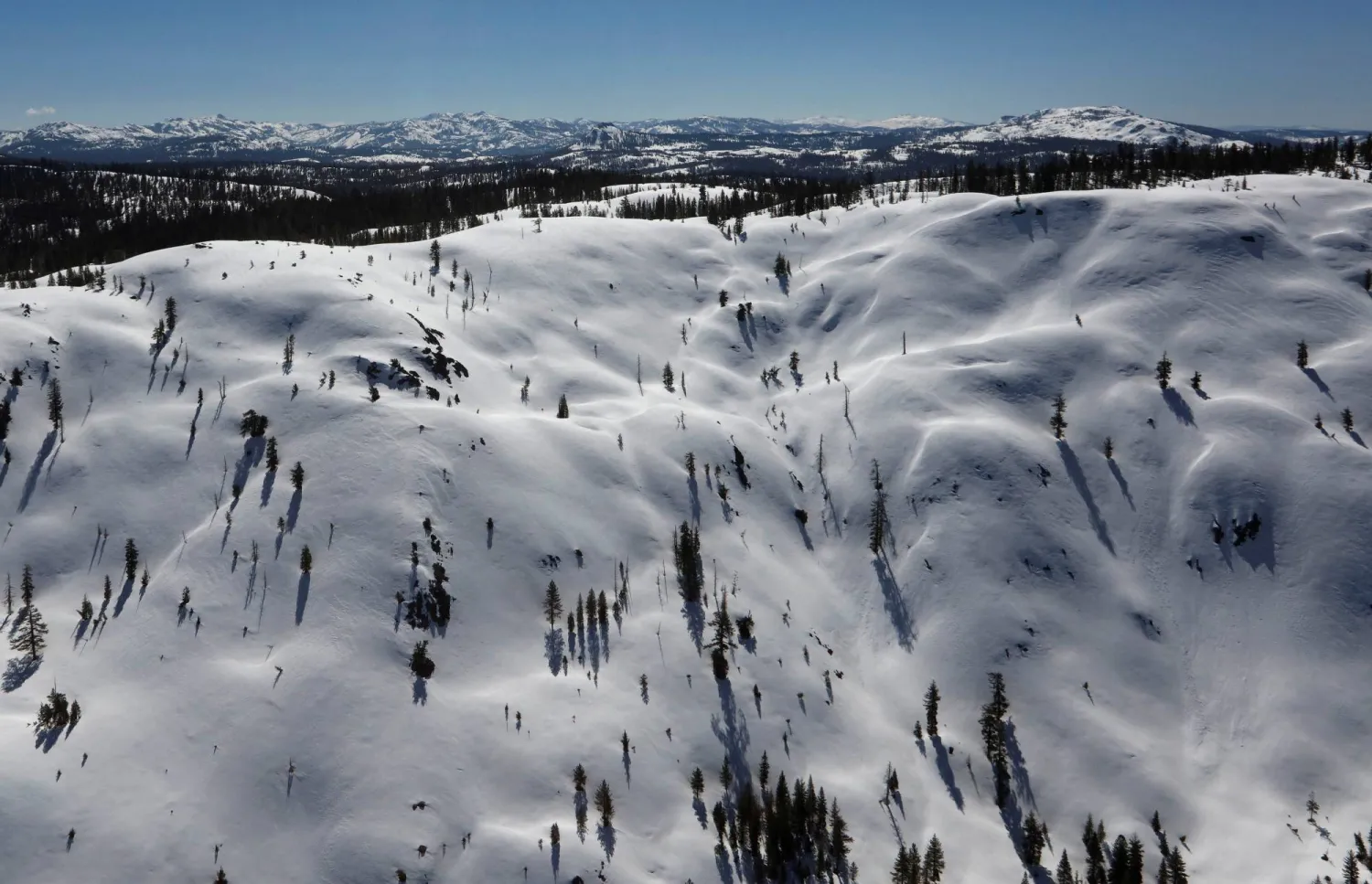
FILE PHOTO: The snow-covered Sierra Nevada Mountains are seen from the air during a Pacific Gas and Electric snowpack survey near Nevada City, California, US April 3, 2017.  REUTERS/Bob Strong/File Photo
FILE PHOTO: The snow-covered Sierra Nevada Mountains are seen from the air during a Pacific Gas and Electric snowpack survey near Nevada City, California, US April 3, 2017. REUTERS/Bob Strong/File Photo
TT

Nine Skiers Missing, Six Rescued after California Avalanche

FILE PHOTO: The snow-covered Sierra Nevada Mountains are seen from the air during a Pacific Gas and Electric snowpack survey near Nevada City, California, US April 3, 2017.  REUTERS/Bob Strong/File Photo
FILE PHOTO: The snow-covered Sierra Nevada Mountains are seen from the air during a Pacific Gas and Electric snowpack survey near Nevada City, California, US April 3, 2017. REUTERS/Bob Strong/File Photo

Nine skiers were missing after an avalanche in California's Sierra Nevada mountains on Tuesday, but six others, who had been stranded, have since been rescued, authorities said.

The avalanche swept the Castle Peak area of Truckee, California, about 10 miles north of Lake Tahoe, at about 11:30 a.m. Pacific time, engulfing a group of skiers, according to a Facebook statement posted by the Nevada County Sheriff's Office.

Those rescued have varying injuries and two were ‌sent to a hospital ‌for treatment.

The sheriff's office revised the number of ‌people ⁠in the group to ⁠15 from an earlier estimate of 16, adding that no further updates were expected on Tuesday evening.

If all nine of the missing skiers should perish, the incident would rank among the deadliest single avalanches on record in the United States. The Colorado Avalanche Information Center has tallied six US avalanche fatalities so far this season.

Avalanches have claimed an average of 27 lives ⁠each winter in the United States over the past ‌decade, the center reported.

A winter storm warning ‌was in effect for much of northern California on Tuesday, with heavy snow ‌forecast in the upper elevations of the Sierra Nevada.

The Sierra Avalanche Center ‌had posted an alert before dawn on Tuesday, warning of a "high avalanche danger" in the ski region, the sheriff's statement said.

"I don't think it was a wise choice," Greene said of the decision of a ski tour company to take paying ‌customers out into the backcountry under such conditions, adding, "but we don't know all the details yet." He declined to ⁠name the company involved.

Rescue ⁠ski teams were dispatched to the avalanche zone from the Boreal Mountain Ski Resort and Tahoe Donner's Alder Creek Adventure Center.

The survivors had taken refuge in a makeshift shelter, constructed partly from tarpaulin sheets and communicated with rescuers via radio beacon and text messaging.

Greene declined to say how many of the ski guides and how many of their customers were among the missing.

Weather conditions remained hazardous in the Sierra backcountry slopes, with additional avalanche activity expected through Tuesday night and into Wednesday, according to the sheriff's statement.

California Governor Gavin Newsom was briefed on the avalanche, and state authorities were "coordinating an all-hands search-and-rescue effort" in conjunction with local emergency teams, his office said in a posting on X.



North Korea and China to Resume Passenger Train Service After Six-Year Gap

A North Korean flag flutters from a train believed to be carrying North Korean leader Kim Jong Un, as it arrives in Beijing, China, September 2, 2025. (Reuters)
TT

North Korea and China to Resume Passenger Train Service After Six-Year Gap

A North Korean flag flutters from a train believed to be carrying North Korean leader Kim Jong Un, as it arrives in Beijing, China, September 2, 2025. (Reuters)

South ‌Korea's Unification Ministry said on Tuesday that passenger train services between Pyongyang and Beijing are set to resume this week, marking the end of a six-year suspension caused by the COVID-19 pandemic.

The resumption restores a critical transport link between North Korea and its primary economic ally, after ‌years of ‌strict border closures that began ‌in ⁠early 2020.

China's state ⁠railway told the Yonhap News Agency that the Pyongyang–Beijing train will begin the round-trip service on March 12, operating four times a week.

Only the last two carriages will ⁠initially carry passengers, mainly diplomats or ‌others on ‌official business, with ticket sales to the general ‌public possible if seats are ‌available, Yonhap quoted a railway official as saying.

North Korea remains closed to most foreign tourism, with limited exceptions largely for ‌Russian tour groups under restricted arrangements, according to travel agencies organizing trips ⁠to ⁠the country.

Before the pandemic, Chinese visitors made up the largest share of foreign tourists to North Korea, the agencies said.

Tour organizers said on Monday that North Korea had cancelled next month's Pyongyang Marathon for unspecified reasons. The race is one of the few events that has been open to international participants in the isolated state.


Former Fukushima Worker Devotes Life to Abandoned Pets

This picture taken on March 5, 2026 shows former nuclear plant worker Toru Akama playing with a cat during an interview with AFP at his animal shelter in Namie, Fukushima prefecture. (AFP)
TT

Former Fukushima Worker Devotes Life to Abandoned Pets

This picture taken on March 5, 2026 shows former nuclear plant worker Toru Akama playing with a cat during an interview with AFP at his animal shelter in Namie, Fukushima prefecture. (AFP)

Not far from the Fukushima nuclear disaster site, former plant worker Toru Akama tends to dozens of pets abandoned after the catastrophe 15 years ago, work he sees as part of his quest for redemption.

Meows and barks break the silence of the countryside, once an evacuation zone, as the 63-year-old brings food to the animals left behind when their owners fled the triple disaster of March 11, 2011: earthquake, tsunami, and nuclear accident.

"It's because of this plant, where we worked for years, that these animals ended up like this," Akama told AFP at his home in northern Japan, surrounded by cats.

"They should have been able to go on living their lives as pets, but because of this accident they were abandoned.

"I felt it was my duty to protect them," he said.

Akama will never forget what he saw in the wake of the disaster, caused by Japan's strongest earthquake on record.

The tsunami it unleashed killed or left missing 18,500 people, and a wall of water crashed into the Fukushima nuclear plant on the northeast coast causing a devastating meltdown.

A day later, residents were ordered to evacuate and an unbroken line of cars formed on the national highway that runs past Akama's house.

"Then the dogs started wandering in search of something to eat -- least those that weren't chained up," he recalled.

"There was no one left, just my wife and me handing out food."

-'Outrage'-

Akama then began taking the animals into his home: first 40 dogs, then 50.

A decade and a half later, he has found adoptive families for more than 1,000 animals and continues to take in new pets who have been abandoned for other reasons.

He says he has "felt outrage" at the pet owners, who have sometimes left their animals in front of his house.

Some "are remorseful, but others simply do it because the animals have become a nuisance", he said.

In difficult moments, "of course... people's priority is human beings, but animals are living beings too, members of the family. It's as if people were abandoning their own children".

After the nuclear disaster, some residents had to flee by bus, and animals were not allowed aboard.

"There were elderly people in tears, asking if someone could take their pet," he recalled.

A month after the disaster Akama also had to leave, but he returned every day for his work at the plant and to look after his charges.

"Because they had known hunger, I absolutely wanted to give them a good life. Sometimes we went without ourselves in order to buy them quality food," he said.

-They 'watch over me'-

Over the past 15 years, Akama says he has spent almost all of the compensation he received after the plant accident on the animals, and he continues to cover most of their care and food costs.

"I don't have time to deal with collections or crowdfunding campaigns," he explained, although he has received some donations.

Akama's days are structured around cleaning the cages where new arrivals spend their first days, feeding, walking the dogs, and taking in new residents, leaving him little respite.

"It never stops. To be honest, I feel like my old job was easier," he said.

"But thanks to them I've never fallen ill: they force me to stay active. Maybe it's their way of thanking me, of watching over me in their own way."

At first, he kept the ashes of the deceased animals in his house, but he eventually had to build a grave outside to hold the remains of around 30 dogs and even more cats, beneath the inscription "rest in peace".

Akama's brother took over his subcontracting business for the plant, allowing him to devote himself full time to the 47 cats and seven dogs with whom he currently shares his life.

"If I'm still able to keep going today, it's because I carry within me the distress these animals experienced. That's what keeps me going."

He would nevertheless like to find a successor.

"That's my biggest concern right now, because I too am starting to get older," he said.

"But I'd like to keep going like this until the end."


February Fifth Warmest on Record, Extreme Rain in Europe, Says EU Monitor

The sun rises over Panama Bay in Panama City on March 7, 2026. (AFP)
TT

February Fifth Warmest on Record, Extreme Rain in Europe, Says EU Monitor

The sun rises over Panama Bay in Panama City on March 7, 2026. (AFP)

The world logged its fifth hottest February on record, with western Europe drenched by extreme rainfall and widespread flooding, the European Union's climate monitor said on Tuesday.

Global temperatures last month were 1.49C above pre-industrial times, defined as the 1850-1900 period before large-scale fossil fuel use drove climate change.

Temperatures and precipitation varied widely in Europe.

The average temperature in Europe was among the three coldest in the past 14 years at -0.07C.

But western, southern and southeast Europe experienced above-average temperatures, according to the Copernicus Climate Change Service.

Colder conditions were experienced in northwest Russia, Baltic countries, Finland and its Scandinavian neighbors.

"Wet and dry conditions across the continent showed a pronounced contrast: much of western and southern Europe was wetter than average, whereas the rest of the continent... was mostly drier than average," the service said in its monthly report.

The United States, northeast Canada, the Middle East, Central Asia and east Antarctica had warmer-than-average temperatures.

- Need for global action -

Sea surface temperatures were the second highest for the month of February.

In the Arctic, the average sea ice extent was at its third lowest level for the month at five percent below average.

In the Antarctic, the monthly sea ice extent was close to average for February -- a "sharp contrast to the much below-average" levels observed over the past four years, Copernicus said.

"The extreme events of February 2026 highlight the growing impacts of climate change and the pressing need for global action," said Samantha Burgess, strategic lead for climate at the European Center for Medium-Range Weather Forecasts, which operates Copernicus.

"Europe experienced stark temperature contrasts," Burgess said.

"Exceptional atmospheric rivers -- narrow bands of very moist air -- brought record rainfall and widespread flooding to western and southern Europe," she said.

Human-driven climate change intensified torrential downpours that killed dozens and forced thousands of people from their homes across Spain, Portugal and Morocco between January and February, according to the World Weather Attribution (WWA) network of climate scientists.