


Is the Gravity-Defying Manchester United Brand Facing a Fall Back to Earth?

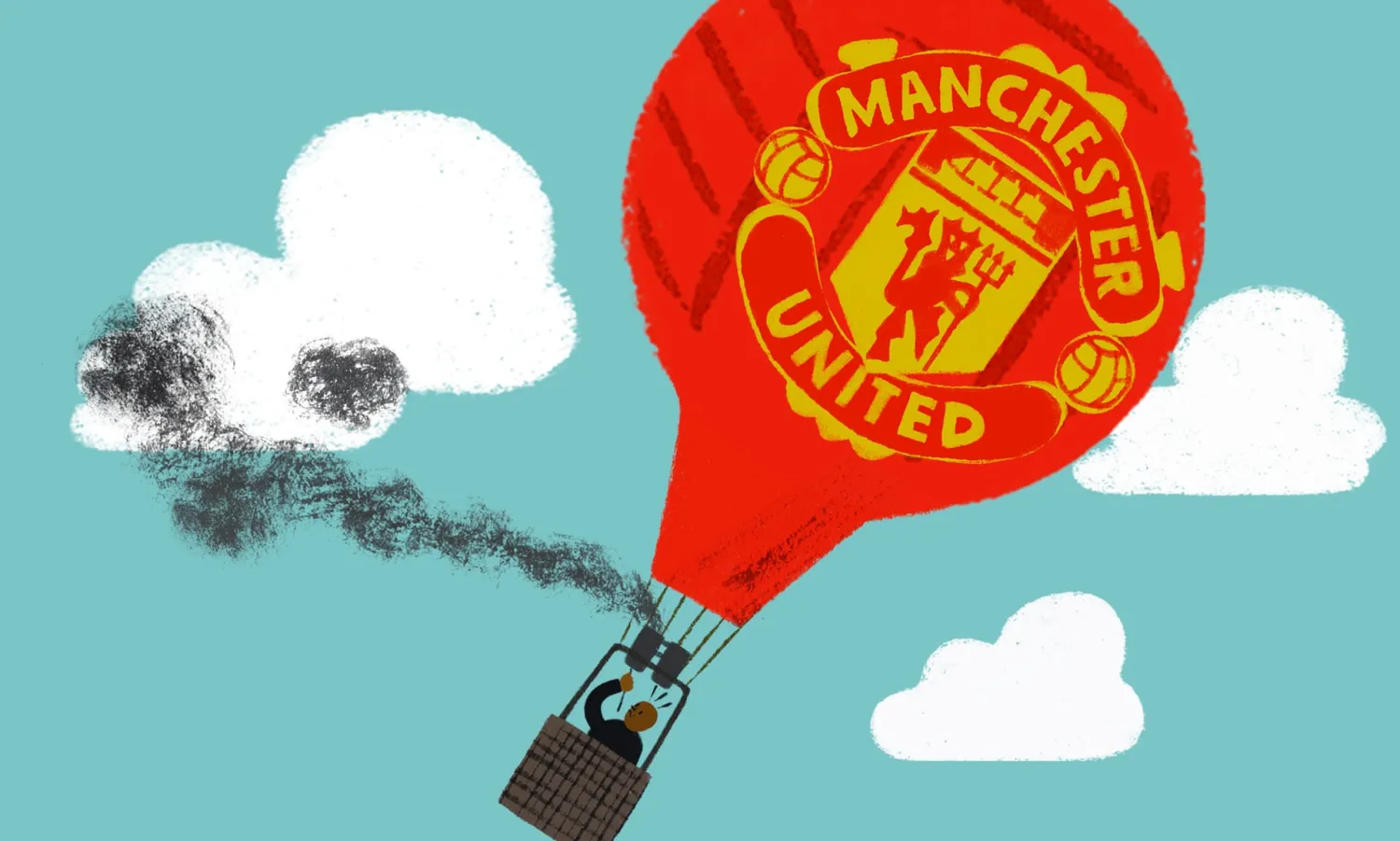
‘Manchester United’s commercial arm has been hanging on to a rising balloon.’
Illustration: Robin Hursthouse/The Guardian
‘Manchester United’s commercial arm has been hanging on to a rising balloon.’ Illustration: Robin Hursthouse/The Guardian
TT

Is the Gravity-Defying Manchester United Brand Facing a Fall Back to Earth?

‘Manchester United’s commercial arm has been hanging on to a rising balloon.’
Illustration: Robin Hursthouse/The Guardian
‘Manchester United’s commercial arm has been hanging on to a rising balloon.’ Illustration: Robin Hursthouse/The Guardian

What’s your favorite bit of non-football-football so far? In my opinion the best new sub-genre to emerge is pictures of José Mourinho delivering vegetables.

You don’t have to go looking for them. They just turn up on your social media feed or on the click-bar beneath a news story. Handsome, crinkly José carrying a box of lettuce across the tenement threshold. José in a surgical mask distributing radishes to elderly war heroes. José off-camera giving a secret briefing against the fucking artichoke guy who isn’t pulling his weight (premium content: subscribers only).

It is a wonderful piece of casting against type, and our good fortune that this keeps happening in places where photographers are present. Perhaps in time an Inspirational José charity calendar could be produced. José, shirtless, delivers a baby calf. José laughs with orphans on a seaside teacup ride. José poses in a landmine helmet, England’s rose steering us through these dark, unmonetized, content-poor times.

Probably this is just me. But in fairness, it has been slim pickings out there. The suspension of the match program is one thing. The most notable co-casualty of the plague times is the absence of the endless football-style content that rides alongside: the lifestyle, the brand, the lucrative sense of belonging, a definition of football that has allowed certain Premier League clubs to state, with supporting commercial evidence, that they have a billion fans around the world, that they are in fact too big to fail.

It is easy to forget this side of the business has also been scythed off at the knees. Right now eyeballs are no longer eyeballing. Clicks are unclicked. Needs, desires and disposable income are focused elsewhere. And the absence of this shadow industry is perhaps just as significant, at least for those clubs that rely on it to an unusual degree.

At which point, enter Manchester United. Or rather, enter “Manchester United”. For the past seven years the endless growth of the United brand has been one of sport’s gravity-defying miracles, a marvel of the age. How do you kill this thing? How do you stop it rising and spreading? Throw what you like at it. A full season of migraine-inducing Mourinho death-ball. A foul-tempered home defeat to a peppy Southampton on a freezing afternoon inside a clanky rain-drenched stadium followed by a half an hour of finger-jabbing post-match bile. It makes no difference. Switch the channel and Manchester United plc are still announcing record revenues, still bathing in an apparently insatiable appetite for its red-shirted commercial voodoo.

And yet, there are no miracles really. Nobody really knows what the short-, medium- or long-term future might hold. What is certain is this is a stress test of something unprecedented. United’s commercial arm has been breathtakingly successful at monetizing the era-building of the previous 20 years. They have been hanging on to a rising balloon, £400m in debt but still clawing in cash to keep the engines thrumming forward.

No other club is set up quite like this. It is a model predicated on constant growth, constant momentum. What happens when it crashes? More to the point, does this actually have to be a bad thing? So far there have been attempts to suggest large debts and reduced income isn’t a problem. Perhaps correctly so. It has been pointed out by people who know this world that United have such ready access to credit they can simply borrow more without it being a problem. There is also a suggestion the reliance on commercial income actually puts them in a better place than other clubs. This version of the future states that the Official Brassiere Partner model is a huge advantage, a diversification of income to insulate the club against the absence of actual football.

Does this sound convincing? The mathematics are certainly fascinating. One detailed projection in the Daily Mail has United losing £116m in commercial, TV and matchday revenue if the season is canceled now, the most of any club. But why not more?

The notion sponsors will keep propping this up is untested. There is already talk elsewhere of discounts. United’s “partners” are taking huge hits of their own. Those contracts will have force majeure clauses, or be open to frustration principles under common law. The Glazer family’s own main business is based on vast areas of physical retail space in the US. Good luck with that one. Excess commercial deals, endless sloshing cash: this just isn’t going to be there any more.

This is an industry-wide problem. But United are the most extreme debt-loaded commercial model out there, a buy-to-let landlord in the middle of a rent revolt. Wages topped £300m last year. Encouragingly, debt repayments are a mere £26m. But still: extend the match-staging restrictions into next season and the losses start to become vertiginous. Ever wondered why there is such an urgency to resume playing? Why we have Project Restart looming, a strangely menacing prospect that sounds less like a “festival of football”, more like a doomed 1980s burglar rehabilitation initiative. The clubs need the money.

Who knows, some kind of correction might be a good thing. It is no secret the Glazers are terrible owners from one perspective. Fantastic for the commercial operation, yes, but there is no love here, no sense of sporting soul, no real interest in the intangible things – collectivism, sporting culture, coherent long-term planning – that built this super-club in the first place.

This is an ownership that has ridden a rising tide, squatting on the shoulders of a grand old footballing institution. Many have wondered how United will ever escape this cycle of vampiric, debt-loaded ownership. In practice the only way is to become less attractive, less endlessly fecund. Contraction, brand collapse, revolution: whatever happens there will always be a Manchester United. In the meantime, here’s your earthquake.

(The Guardian)


Shakhtar Boss Pays Ukrainian Racer $200,000 After Games Disqualification

Ukrainian President Volodymyr Zelenskiy holds helmet as he meets with a Ukrainian skeleton racer Vladyslav Heraskevych , who was disqualified from the Olympic skeleton competition over his "helmet of remembrance" depicting athletes killed since Russia's invasion and his father and coach, Mykhailo Heraskevych, amid Russia's attack on Ukraine, in Munich, Germany February 13, 2026. (Ukrainian Presidential Press Service/Handout via Reuters)
TT

Shakhtar Boss Pays Ukrainian Racer $200,000 After Games Disqualification

Ukrainian President Volodymyr Zelenskiy holds helmet as he meets with a Ukrainian skeleton racer Vladyslav Heraskevych , who was disqualified from the Olympic skeleton competition over his "helmet of remembrance" depicting athletes killed since Russia's invasion and his father and coach, Mykhailo Heraskevych, amid Russia's attack on Ukraine, in Munich, Germany February 13, 2026. (Ukrainian Presidential Press Service/Handout via Reuters)

The owner of ‌Ukrainian football club Shakhtar Donetsk has donated more than $200,000 to skeleton racer Vladyslav Heraskevych after the athlete was disqualified from the Milano Cortina Winter Games before competing over the use of a helmet depicting Ukrainian athletes killed in the war with Russia, the club said on Tuesday.

The 27-year-old Heraskevych was disqualified last week when the International Bobsleigh and Skeleton Federation jury ruled that imagery on the helmet — depicting athletes killed since Russia invaded Ukraine in 2022 — breached rules on athletes' expression at ‌the Games.

He ‌then lost an appeal at the Court ‌of ⁠Arbitration for Sport hours ⁠before the final two runs of his competition, having missed the first two runs due to his disqualification.

Heraskevych had been allowed to train with the helmet that displayed the faces of 24 dead Ukrainian athletes for several days in Cortina d'Ampezzo where the sliding center is, but the International Olympic Committee then ⁠warned him a day before his competition ‌started that he could not wear ‌it there.

“Vlad Heraskevych was denied the opportunity to compete for victory ‌at the Olympic Games, yet he returns to Ukraine a ‌true winner," Shakhtar President Rinat Akhmetov said in a club statement.

"The respect and pride he has earned among Ukrainians through his actions are the highest reward. At the same time, I want him to ‌have enough energy and resources to continue his sporting career, as well as to fight ⁠for truth, freedom ⁠and the remembrance of those who gave their lives for Ukraine," he said.

The amount is equal to the prize money Ukraine pays athletes who win a gold medal at the Games.

The case dominated headlines early on at the Olympics, with IOC President Kirsty Coventry meeting Heraskevych on Thursday morning at the sliding venue in a failed last-minute attempt to broker a compromise.

The IOC suggested he wear a black armband and display the helmet before and after the race, but said using it in competition breached rules on keeping politics off fields of play. Heraskevych also earned praise from Ukraine President Volodymyr Zelenskiy.


Speed Skating-Italy Clinch Shock Men’s Team Pursuit Gold, Canada Successfully Defend Women’s Title

 Team Italy with Davide Ghiotto, Andrea Giovannini, Michele Malfatti, celebrate winning the gold medal on the podium of the men's team pursuit speed skating race at the 2026 Winter Olympics, in Milan, Italy, Tuesday, Feb. 17, 2026. (AP)
Team Italy with Davide Ghiotto, Andrea Giovannini, Michele Malfatti, celebrate winning the gold medal on the podium of the men's team pursuit speed skating race at the 2026 Winter Olympics, in Milan, Italy, Tuesday, Feb. 17, 2026. (AP)
TT

Speed Skating-Italy Clinch Shock Men’s Team Pursuit Gold, Canada Successfully Defend Women’s Title

 Team Italy with Davide Ghiotto, Andrea Giovannini, Michele Malfatti, celebrate winning the gold medal on the podium of the men's team pursuit speed skating race at the 2026 Winter Olympics, in Milan, Italy, Tuesday, Feb. 17, 2026. (AP)
Team Italy with Davide Ghiotto, Andrea Giovannini, Michele Malfatti, celebrate winning the gold medal on the podium of the men's team pursuit speed skating race at the 2026 Winter Olympics, in Milan, Italy, Tuesday, Feb. 17, 2026. (AP)

An inspired Italy delighted the home crowd with a stunning victory in the Olympic men's team pursuit final as

Canada's Ivanie Blondin, Valerie Maltais and Isabelle Weidemann delivered another seamless performance to beat the Netherlands in the women's event and retain their title ‌on Tuesday.

Italy's ‌men upset the US who ‌arrived ⁠at the Games ⁠as world champions and gold medal favorites.

Spurred on by double Olympic champion Francesca Lollobrigida, the Italian team of Davide Ghiotto, Andrea Giovannini and Michele Malfatti electrified a frenzied arena as they stormed ⁠to a time of three ‌minutes 39.20 seconds - ‌a commanding 4.51 seconds clear of the ‌Americans with China taking bronze.

The roar inside ‌the venue as Italy powered home was thunderous as the crowd rose to their feet, cheering the host nation to one ‌of their most special golds of a highly successful Games.

Canada's women ⁠crossed ⁠the line 0.96 seconds ahead of the Netherlands, stopping the clock at two minutes 55.81 seconds, and

Japan rounded out the women's podium by beating the US in the Final B.

It was only Canada's third gold medal of the Games, following Mikael Kingsbury's win in men's dual moguls and Megan Oldham's victory in women's freeski big air.


Lindsey Vonn Back in US Following Crash in Olympic Downhill 

Milano Cortina 2026 Olympics - Alpine Skiing - Women's Downhill 3rd Official Training - Tofane Alpine Skiing Centre, Belluno, Italy - February 07, 2026. Lindsey Vonn of United States in action during training. (Reuters)
TT

Lindsey Vonn Back in US Following Crash in Olympic Downhill 

Milano Cortina 2026 Olympics - Alpine Skiing - Women's Downhill 3rd Official Training - Tofane Alpine Skiing Centre, Belluno, Italy - February 07, 2026. Lindsey Vonn of United States in action during training. (Reuters)

Lindsey Vonn is back home in the US following a week of treatment at a hospital in Italy after breaking her left leg in the Olympic downhill at the Milan Cortina Games.

“Haven’t stood on my feet in over a week... been in a hospital bed immobile since my race. And although I’m not yet able to stand, being back on home soil feels amazing,” Vonn posted on X with an American flag emoji. “Huge thank you to everyone in Italy for taking good care of me.”

The 41-year-old Vonn suffered a complex tibia fracture that has already been operated on multiple times following her Feb. 8 crash. She has said she'll need more surgery in the US.

Nine days before her fall in Cortina d'Ampezzo, Italy, Vonn ruptured the ACL in her left knee in another crash in Switzerland.

Even before then, all eyes had been on her as the feel-good story heading into the Olympics for her comeback after nearly six years of retirement.
