


Israeli Officials: Annexation Plan Facing Challenges

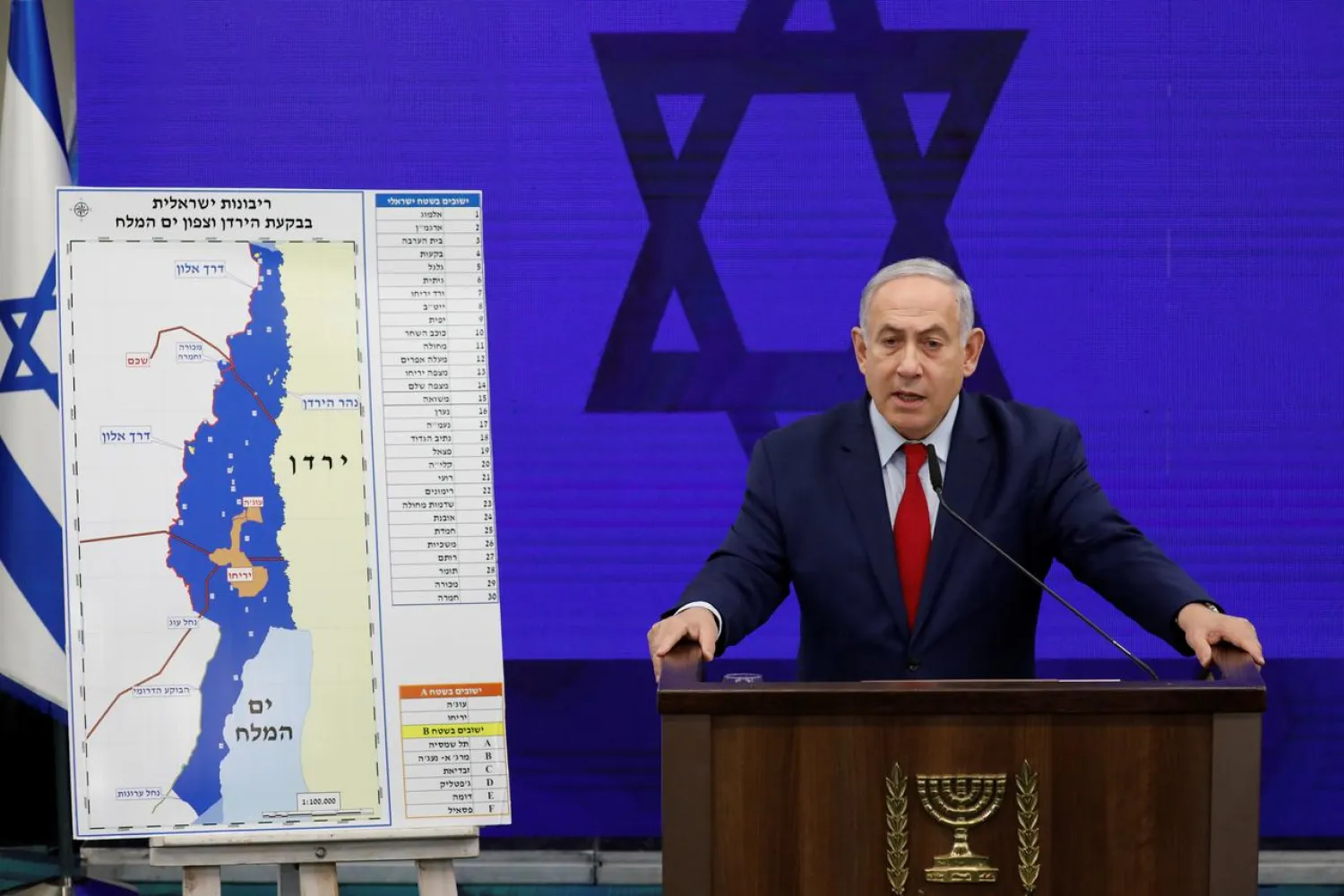
Israeli Prime Minister Benjamin Netanyahu delivers a statement on the annexation plan (File photo: Reuters)
TT

Israeli Officials: Annexation Plan Facing Challenges

Israeli Prime Minister Benjamin Netanyahu delivers a statement on the annexation plan (File photo: Reuters)

Israel’s measures to legislate the process of imposing Israeli sovereignty over the Jordan Valley and settlements in the West Bank will begin in early July, but requires few weeks to be approved, according to an Israeli official.

The head of the Governmental Coalition in Israel, Mickey Zohar, revealed that the government will approve the draft law, and then it will be submitted to the Knesset for voting and approval.

Zohar announced that the concerned authorities are currently working on drawing up the maps that will help in reaching an understanding with the US administration about the areas that Israel will impose its sovereignty over.

The official opposes the demand for establishing a Palestinian state in exchange for the annexation, expressing his conviction that Israel will not give up the annexation in any case.

Earlier, Prime Minister Benjamin Netanyahu confirmed Israel will not miss a “historic opportunity” to extend its sovereignty to parts of the West Bank.

The Israeli security services at this stage oppose the annexation and the occupation army believes that applying Israeli sovereignty to parts of the West Bank will not be possible on the ground, given the short period of time in the face of a possible deterioration of the security situation.

The Hebrew Walla website quoted security officials as saying that the army estimates the field response to the annexation may be unexpected, and depends on the Palestinians acceptance of the step.

The report indicated that Netanyahu might only give a statement on July 1, but delay the annexation process for few months, giving the security establishment time to prepare for an escalation by Palestinians.

Coordinator for Government Activities in the Territories (COGAT) Maj.-Gen. Kamil Abu-Rukun warned that if the government implements its plan to unilaterally annex portions of the West Bank and Jordan Valley, there will be a wave of violence.

Abu-Rukun told Defense Minister Benny Gantz that annexation could lead to a “shattering of security coordination and a wave of violence.”

Palestinians could cancel all aspects of security coordination, and the Authority security officers might turn their weapons on Israel, he warned.

Hebrew newspaper Israel Hayom monitored the paths of “applying sovereignty” and internal and external challenges that might face Israel. The newspaper said that Netanyahu faces multiple paths, including securing a majority in either the Knesset or government in favor of the move.

According to the daily, Netanyahu has taken all the necessary steps to implement the annexation process, but he has not decided on the path yet, which will be crucial for the approval.

It indicated that the areas in which sovereignty will be applied have been precisely defined through a joint US-Israeli committee, but many ministers and members of the Knesset have still not been informed about details of the plan.

The newspaper pointed out that the Israeli decision regarding the application of sovereignty involves some domestic and foreign challenges, especially that Netanyahu has not yet submitted the final map.

Hayom says that some of Likud hardline ministers, such as Zeev Elkin or Tzipi Hotovely, may oppose or abstain from voting, while Prime Minister-designate Benny Gantz has not yet decided whether to allow members of his party to vote freely on the issue.

Another challenge facing Netanyahu can be described as the political and security risks that will affect the ministers’ stance, especially given the great opposition of the international community.

Meanwhile, the Fatah movement called on the Palestinians to be vigilant and cautious in these difficult and crucial times, stressing the need for solidarity and unity.



Lebanon FM Urges Iran to Find ‘New Approach’ on Hezbollah Arms

Iranian Foreign Minister Abbas Araghchi (L) shakes hands with Lebanese Minister of Foreign Affairs and Emigrants Youssef Raggi (R) at the Foreign Ministry in downtown Beirut, Lebanon, 09 January 2026. (EPA)
TT

Lebanon FM Urges Iran to Find ‘New Approach’ on Hezbollah Arms

Iranian Foreign Minister Abbas Araghchi (L) shakes hands with Lebanese Minister of Foreign Affairs and Emigrants Youssef Raggi (R) at the Foreign Ministry in downtown Beirut, Lebanon, 09 January 2026. (EPA)

Lebanese Foreign Minister Youssef Raggi on Friday urged his visiting Iranian counterpart to find a "new approach" to the thorny issue of disarming the Iran-backed Hezbollah group.

Lebanon is under heavy US pressure to disarm Hezbollah, which was heavily weakened in more than a year of hostilities with Israel that largely ended with a November 2024 ceasefire, but Iran and the group have expressed opposition to the move.

Iran has long wielded substantial influence in Lebanon by funding and arming Hezbollah, but as the balance of power shifted since the recent conflict, officials have been more critical towards Tehran.

"The defense of Lebanon is the sole responsibility of the Lebanese state", which must have a monopoly on weapons, Raggi told Iranian Foreign Minister Abbas Araghchi, a Lebanese foreign ministry statement said.

Raggi called on Iran to engage in talks with Lebanon to find "a new approach to the issue of Hezbollah's weapons, drawing on Iran's relationship with the party, so that these weapons do not become a pretext for weakening Lebanon".

He asked Araghchi "whether Tehran would accept the presence of an illegal armed organization on its own territory".

Last month, Raggi declined an invitation to visit Iran and proposed meeting in a neutral third country.

Lebanon's army said Thursday that it had completed the first phase of disarming Hezbollah, doing so in the south Lebanon area near the border with Israel, which called the efforts "far from sufficient".

Araghchi also met President Joseph Aoun on Friday and was set to hold talks with several other senior officials.

After arriving on Thursday, he visited the mausoleum of former Hezbollah leader Hassan Nasrallah, who was killed in a massive Israeli air strike on south Beirut in September 2024.

Last August, Lebanese leaders firmly rejected any efforts at foreign interference during a visit by Iran's security chief Ali Larijani, with the prime minister saying Beirut would "tolerate neither tutelage nor diktat" after Tehran voiced opposition to plans to disarm Hezbollah.


Hamas Says Israeli Strikes on Gaza ‘Cannot Happen without American Cover’

 Palestinians inspect damaged tents at a displacement camp following an Israeli strike in Gaza City, Friday, Jan. 9, 2026. (AP)
Palestinians inspect damaged tents at a displacement camp following an Israeli strike in Gaza City, Friday, Jan. 9, 2026. (AP)
TT

Hamas Says Israeli Strikes on Gaza ‘Cannot Happen without American Cover’

 Palestinians inspect damaged tents at a displacement camp following an Israeli strike in Gaza City, Friday, Jan. 9, 2026. (AP)
Palestinians inspect damaged tents at a displacement camp following an Israeli strike in Gaza City, Friday, Jan. 9, 2026. (AP)

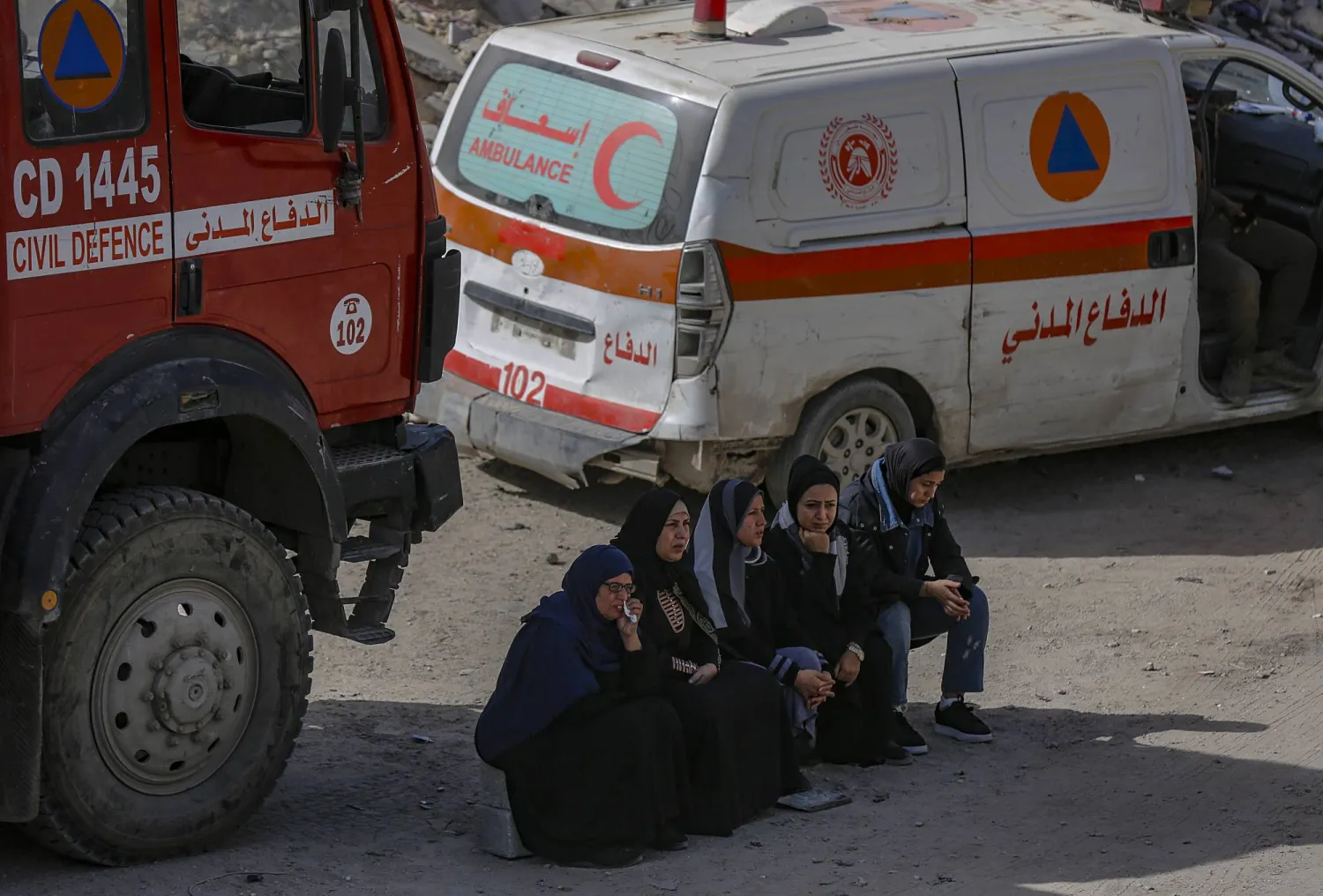
A Hamas official said Friday that Israeli strikes on Gaza "cannot happen without American cover", the day after Israeli attacks killed at least 13 people according to the Palestinian territory's civil defense agency.

Since October 10, a fragile US-sponsored truce in Gaza has largely halted the fighting between Israeli forces and Hamas, but both sides have alleged frequent violations.

Gaza's civil defense agency -- which operates as a rescue force under Hamas authority -- said Israeli attacks across the territory on Thursday killed at least 13 people, including five children.

In a statement on Friday morning, the Israeli military said it "precisely struck Hamas terrorists and terror infrastructure" in response to a "failed projectile" launch.

"Just yesterday, 13 people were killed in different areas of the Strip on fabricated pretexts, in addition to the hundreds of killed and wounded who preceded them after the ceasefire," Hamas political bureau member, Bassem Naim, wrote on Telegram.

"This cannot happen without American cover or a green light."

Israeli forces have killed at least 439 Palestinians in Gaza since the ceasefire took effect, according to the health ministry in the Hamas-run territory.

The Israeli military said gunmen have killed three of its soldiers during the same period.

Media restrictions in Gaza and difficulties in accessing many areas mean AFP is unable to independently verify the tolls and details provided by both sides.

Naim also accused Israeli Prime Minister Benjamin Netanyahu of "evading his commitments and escalating in order to sabotage the agreement and return to war".

He said the Palestinian movement had "complied with all its obligations under the agreement" and was "ready to engage positively and constructively with the next steps of the plan".

Israel has previously said it is awaiting the return of the last hostage body held in Gaza before beginning talks on the second phase of the ceasefire and has insisted that Hamas disarm.

Hamas officials told AFP that search operations for the remains of deceased hostage Ran Gvili resumed on Wednesday after a two-week pause due to bad weather.


Germany Calls on Israel to Halt E1 Settlement Plan

A view of Israeli settlement of Maale Adumim, in the West Bank, Sunday, June 18, 2023. (AP)
TT

Germany Calls on Israel to Halt E1 Settlement Plan

A view of Israeli settlement of Maale Adumim, in the West Bank, Sunday, June 18, 2023. (AP)

Germany calls on Israel to halt its controversial ​E1 settlement project, said a foreign ministry spokesperson in Berlin on Friday, warning that construction carries the risk of ‌creating more ‌instability in the ‌West ⁠Bank ​and ‌the region.

"The plans for the E1 settlement project, it must be said, are part of a comprehensive ⁠intensification of settlement policy in ‌the West Bank, ‍which ‍we have recently ‍observed," said the spokesperson at a regular government press conference.

"It carries the ​risk of creating even more instability, as it ⁠would further restrict the mobility of the Palestinian population in the West Bank," as well as jeopardize the prospects of a two-state solution, the spokesperson added.