


Premier League Will Be Allowed to Ride Shotgun Into Unknown Frontier

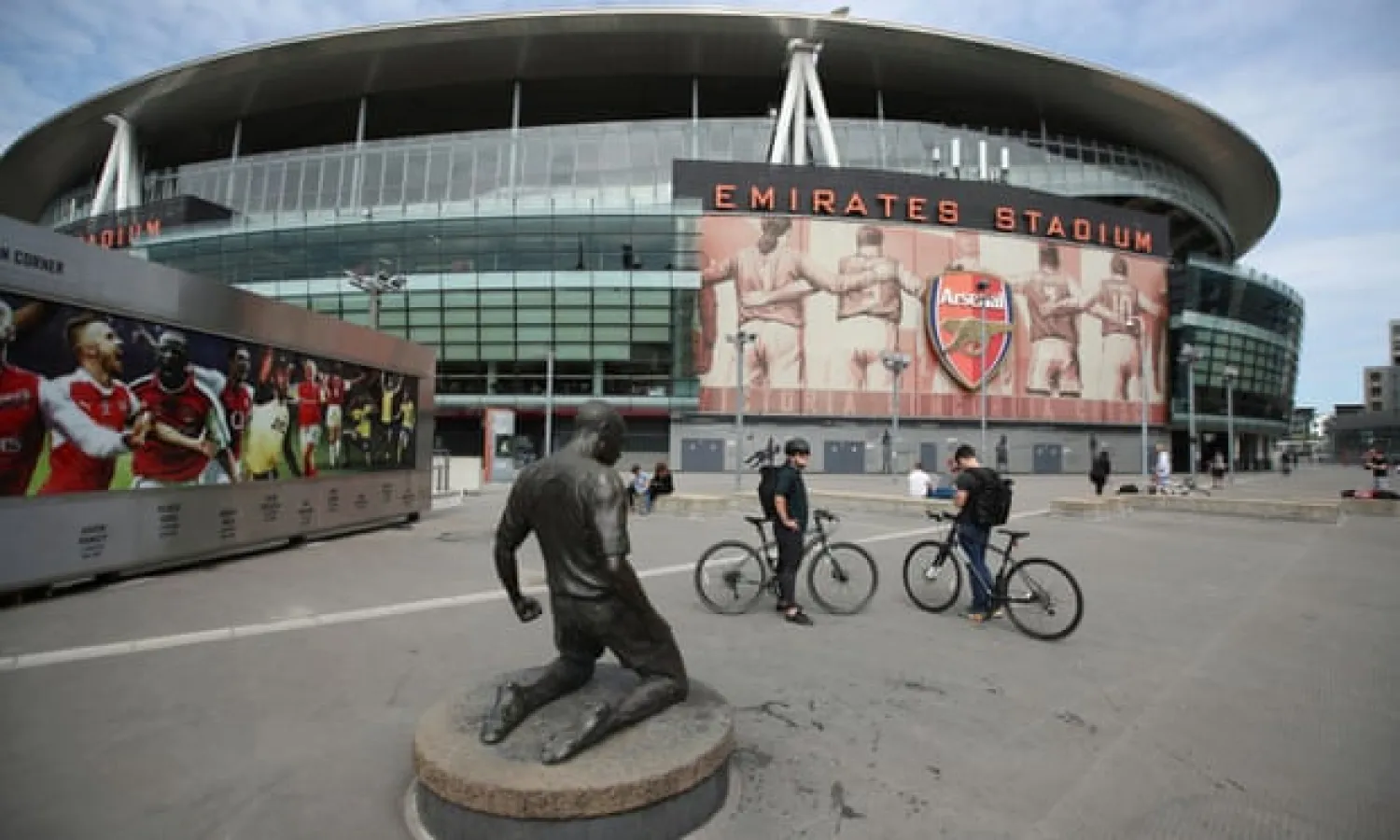
 Premier League clubs will vote on players being allowed to train in bigger groups next week. Photograph: Peter Cziborra/Reuters
Premier League clubs will vote on players being allowed to train in bigger groups next week. Photograph: Peter Cziborra/Reuters
TT

Premier League Will Be Allowed to Ride Shotgun Into Unknown Frontier

 Premier League clubs will vote on players being allowed to train in bigger groups next week. Photograph: Peter Cziborra/Reuters
Premier League clubs will vote on players being allowed to train in bigger groups next week. Photograph: Peter Cziborra/Reuters

And we’re off. Project Refund: Phase One is now operational. Although in the interests of accuracy the plan to complete the Premier League season would perhaps be better restyled as Project No Refund, given the only reason anyone wants to play professional football right now – never mind the cant about national morale and (spare me) “sporting integrity” – is to avoid repaying the broadcasters.

There is no shame in this, or need to pretend otherwise. Clubs are cultural assets. Their good health is important. Football supports a large associated workforce outside the better-off elite players. But it is also in everyone’s interest to be clear on the sense of commercial urgency that lies behind every decision taken along the way, including those successfully voted through at Monday’s Premier League meeting.

It is a gentle first step. As of Tuesday afternoon clubs can return to carefully managed individual training, the same process England’s cricketers will shortly begin, and the same kind of thing that is happening in parks all around the country.

The next phase will involve training in groups of up to six, possibly from next week. Finally clubs will look to agree 11-versus-11 training, presumably with the kind of token restrictions seen in the Bundesliga over the weekend, with masks for substitutes and prim attempts to enforce physical distancing.

After which the Premier League will look to restart close to, on, or slightly after its current flag in the sand, 15 June.

There will of course be extreme reactions to this process. Understandably so: we are in an extreme situation. The first of these is the obvious response that it is unsafe to consider playing professional football right now, and that all attempts to do so will put lives at risk.

The other main objection is that the football produced will be a shabby, synthetic imitation, a shotgun wedding before an empty congregation; and that it will therefore be unfair on those who stand to lose (ie experience relegation) given the skewed sporting environment.

Both of these objections are unarguably valid. At the same time both are, in some sense, immaterial to what is about to happen.

Firstly, on risk. There is no doubt that football’s return will be hurried through ahead of what can be deemed absolutely safe, and that thanks to its clout and profile the Premier League will be allowed to ride shotgun into this unknown frontier.

The Bundesliga may have returned successfully last weekend, but there are good reasons for this. Germany has a quarter of the UK death toll to date. Germany has six times fewer new cases of Covid-19 diagnosed every day. Germany has a mature, competent leadership with a clear and transparent plan.

The Bundesliga itself still has its 51% ownership rule, still retains a community aspect at the top level, and still seems able to act in a climate of general good faith. Germany has earned its place at the front of this queue, although even then there are plenty with misgivings about the resumption.

These include some medical professionals. There are concerns Covid-19 remains essentially a mystery disease, one whose long-term effects on the body are unknown. Footballers often have brittle immune systems due to the high intensity of their training. What is certain is that English football is a ruthless business that will push its component parts as far as they can go. Would you trust its opinion on your pre-scandal asbestos roof, or the smoking “health-scare”? Would you trust it with a trunk full of plutonium?

It is also worth being clear about who exactly is most at risk from the Premier League resuming. According to official figures the highest death rate from Covid-19 up to 20 April was among men working in low-skilled leisure and service occupations; or in other words those on the periphery, those who make the industry work as opposed to those making the decisions.

Cleaners, carpenters, electricians, manual workers, security guards, transport drivers: these are the people who have died in large numbers with this disease, not CEOs or athletes. These are the people football will vote to put further at risk as the return to action approaches.

And yet, at the same time it is self-evident that this is going to happen. And that in pressing forward the Premier League is simply following the tide of British society’s governing and corporate classes. Every decision taken right now involves an appalling balancing act, between virus control and total economic collapse. Every decision is by definition pragmatic and flawed.

Against this background it would be absurd to expect English football and the Premier League to make sense of it all, to set some noble and self-sacrificing example. This is a league whose members, we hear via noises off, are concerned their fraternal brothers in arms will lie about infection rates to get matches cancelled (the Maya Angelou quote about believing someone when they tell you who they are springs to mind).

This is an organisation lashed together by shared self-interest, whose members have spent the last two months scrabbling for handholds like the doomed ship’s crew on the Raft of the Medusa as it slips beneath the waves. Don’t expect caution or selflessness when these are scarcely present elsewhere in society. And perhaps, who knows, there is something to be said for simply ploughing ahead when all is uncertain.

Against this background it seems absurd to object that the rejigged season’s end will be either artificial or unfair. This may well be the case, but on the other hand the basic stitching of society is also coming apart, so there’s that too.

And let’s face it, elite level football is already unfair. Football isn’t unfair because of an absence of home fans for a few rescheduled matches. It’s skewed because of its ludicrous finances, because the rich can dominate and get richer. This is not a function of an unexpected bat virus.

At which point, with best wishes and fingers crossed for all involved, it is now all systems go for Phase One. A few things seem certain at this point. It’s going to be divisive, messy and worrying in so many ways. Or in other words, it’s going to be quite a lot like football.

The Guardian Sport


Shakhtar Boss Pays Ukrainian Racer $200,000 After Games Disqualification

Ukrainian President Volodymyr Zelenskiy holds helmet as he meets with a Ukrainian skeleton racer Vladyslav Heraskevych , who was disqualified from the Olympic skeleton competition over his "helmet of remembrance" depicting athletes killed since Russia's invasion and his father and coach, Mykhailo Heraskevych, amid Russia's attack on Ukraine, in Munich, Germany February 13, 2026. (Ukrainian Presidential Press Service/Handout via Reuters)
TT

Shakhtar Boss Pays Ukrainian Racer $200,000 After Games Disqualification

Ukrainian President Volodymyr Zelenskiy holds helmet as he meets with a Ukrainian skeleton racer Vladyslav Heraskevych , who was disqualified from the Olympic skeleton competition over his "helmet of remembrance" depicting athletes killed since Russia's invasion and his father and coach, Mykhailo Heraskevych, amid Russia's attack on Ukraine, in Munich, Germany February 13, 2026. (Ukrainian Presidential Press Service/Handout via Reuters)

The owner of ‌Ukrainian football club Shakhtar Donetsk has donated more than $200,000 to skeleton racer Vladyslav Heraskevych after the athlete was disqualified from the Milano Cortina Winter Games before competing over the use of a helmet depicting Ukrainian athletes killed in the war with Russia, the club said on Tuesday.

The 27-year-old Heraskevych was disqualified last week when the International Bobsleigh and Skeleton Federation jury ruled that imagery on the helmet — depicting athletes killed since Russia invaded Ukraine in 2022 — breached rules on athletes' expression at ‌the Games.

He ‌then lost an appeal at the Court ‌of ⁠Arbitration for Sport hours ⁠before the final two runs of his competition, having missed the first two runs due to his disqualification.

Heraskevych had been allowed to train with the helmet that displayed the faces of 24 dead Ukrainian athletes for several days in Cortina d'Ampezzo where the sliding center is, but the International Olympic Committee then ⁠warned him a day before his competition ‌started that he could not wear ‌it there.

“Vlad Heraskevych was denied the opportunity to compete for victory ‌at the Olympic Games, yet he returns to Ukraine a ‌true winner," Shakhtar President Rinat Akhmetov said in a club statement.

"The respect and pride he has earned among Ukrainians through his actions are the highest reward. At the same time, I want him to ‌have enough energy and resources to continue his sporting career, as well as to fight ⁠for truth, freedom ⁠and the remembrance of those who gave their lives for Ukraine," he said.

The amount is equal to the prize money Ukraine pays athletes who win a gold medal at the Games.

The case dominated headlines early on at the Olympics, with IOC President Kirsty Coventry meeting Heraskevych on Thursday morning at the sliding venue in a failed last-minute attempt to broker a compromise.

The IOC suggested he wear a black armband and display the helmet before and after the race, but said using it in competition breached rules on keeping politics off fields of play. Heraskevych also earned praise from Ukraine President Volodymyr Zelenskiy.


Speed Skating-Italy Clinch Shock Men’s Team Pursuit Gold, Canada Successfully Defend Women’s Title

 Team Italy with Davide Ghiotto, Andrea Giovannini, Michele Malfatti, celebrate winning the gold medal on the podium of the men's team pursuit speed skating race at the 2026 Winter Olympics, in Milan, Italy, Tuesday, Feb. 17, 2026. (AP)
Team Italy with Davide Ghiotto, Andrea Giovannini, Michele Malfatti, celebrate winning the gold medal on the podium of the men's team pursuit speed skating race at the 2026 Winter Olympics, in Milan, Italy, Tuesday, Feb. 17, 2026. (AP)
TT

Speed Skating-Italy Clinch Shock Men’s Team Pursuit Gold, Canada Successfully Defend Women’s Title

 Team Italy with Davide Ghiotto, Andrea Giovannini, Michele Malfatti, celebrate winning the gold medal on the podium of the men's team pursuit speed skating race at the 2026 Winter Olympics, in Milan, Italy, Tuesday, Feb. 17, 2026. (AP)
Team Italy with Davide Ghiotto, Andrea Giovannini, Michele Malfatti, celebrate winning the gold medal on the podium of the men's team pursuit speed skating race at the 2026 Winter Olympics, in Milan, Italy, Tuesday, Feb. 17, 2026. (AP)

An inspired Italy delighted the home crowd with a stunning victory in the Olympic men's team pursuit final as

Canada's Ivanie Blondin, Valerie Maltais and Isabelle Weidemann delivered another seamless performance to beat the Netherlands in the women's event and retain their title ‌on Tuesday.

Italy's ‌men upset the US who ‌arrived ⁠at the Games ⁠as world champions and gold medal favorites.

Spurred on by double Olympic champion Francesca Lollobrigida, the Italian team of Davide Ghiotto, Andrea Giovannini and Michele Malfatti electrified a frenzied arena as they stormed ⁠to a time of three ‌minutes 39.20 seconds - ‌a commanding 4.51 seconds clear of the ‌Americans with China taking bronze.

The roar inside ‌the venue as Italy powered home was thunderous as the crowd rose to their feet, cheering the host nation to one ‌of their most special golds of a highly successful Games.

Canada's women ⁠crossed ⁠the line 0.96 seconds ahead of the Netherlands, stopping the clock at two minutes 55.81 seconds, and

Japan rounded out the women's podium by beating the US in the Final B.

It was only Canada's third gold medal of the Games, following Mikael Kingsbury's win in men's dual moguls and Megan Oldham's victory in women's freeski big air.


Lindsey Vonn Back in US Following Crash in Olympic Downhill 

Milano Cortina 2026 Olympics - Alpine Skiing - Women's Downhill 3rd Official Training - Tofane Alpine Skiing Centre, Belluno, Italy - February 07, 2026. Lindsey Vonn of United States in action during training. (Reuters)
TT

Lindsey Vonn Back in US Following Crash in Olympic Downhill 

Milano Cortina 2026 Olympics - Alpine Skiing - Women's Downhill 3rd Official Training - Tofane Alpine Skiing Centre, Belluno, Italy - February 07, 2026. Lindsey Vonn of United States in action during training. (Reuters)

Lindsey Vonn is back home in the US following a week of treatment at a hospital in Italy after breaking her left leg in the Olympic downhill at the Milan Cortina Games.

“Haven’t stood on my feet in over a week... been in a hospital bed immobile since my race. And although I’m not yet able to stand, being back on home soil feels amazing,” Vonn posted on X with an American flag emoji. “Huge thank you to everyone in Italy for taking good care of me.”

The 41-year-old Vonn suffered a complex tibia fracture that has already been operated on multiple times following her Feb. 8 crash. She has said she'll need more surgery in the US.

Nine days before her fall in Cortina d'Ampezzo, Italy, Vonn ruptured the ACL in her left knee in another crash in Switzerland.

Even before then, all eyes had been on her as the feel-good story heading into the Olympics for her comeback after nearly six years of retirement.
