Egypt Prepares to ‘Coexist’ with COVID-19 Despite Warnings of Increased Cases

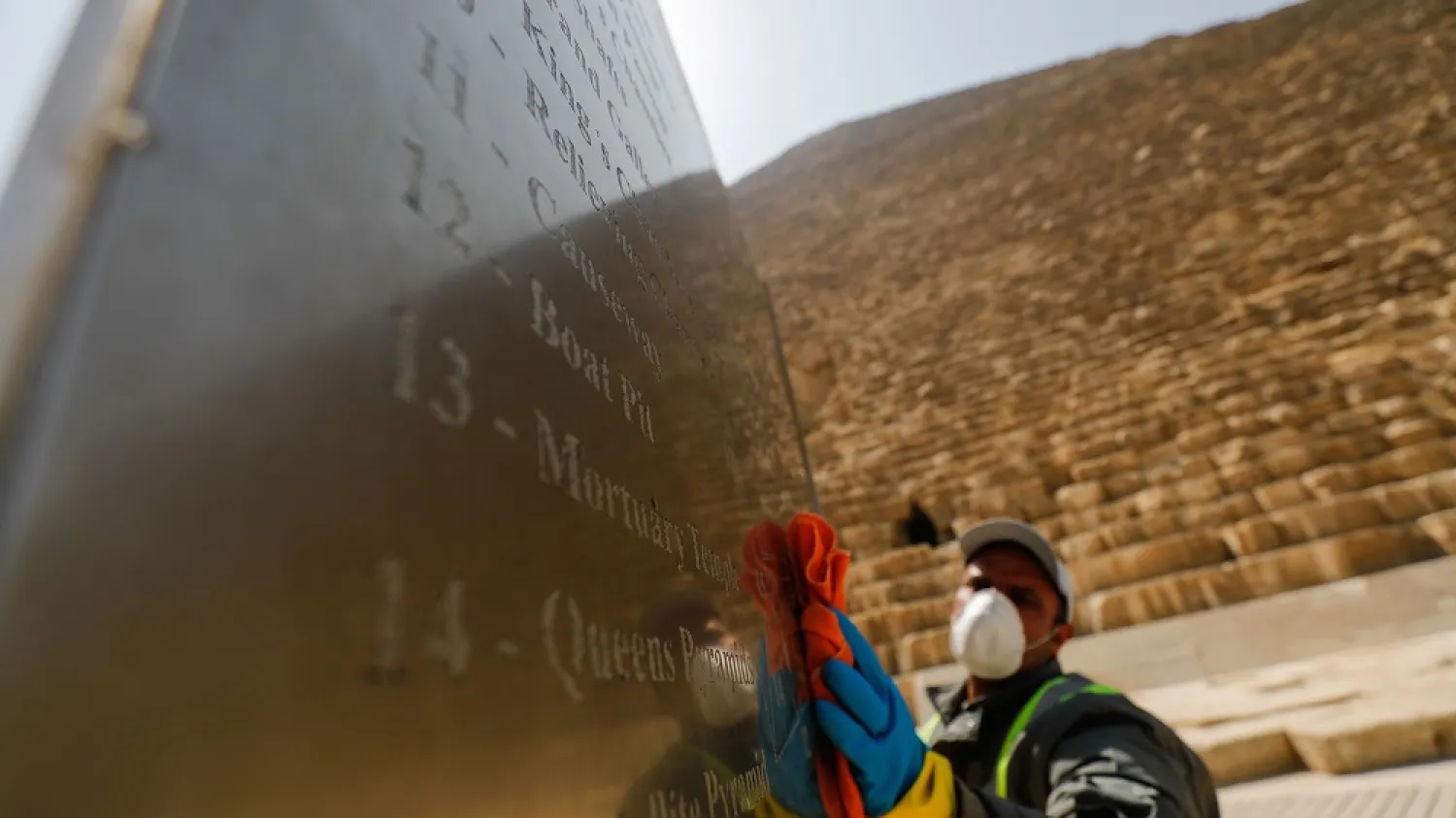
A member of the medical team sprays disinfectant amid concerns over the coronavirus at the Great Pyramids, Giza, on the outskirts of Cairo, Egypt, March 25, 2020.  (Reuters)
A member of the medical team sprays disinfectant amid concerns over the coronavirus at the Great Pyramids, Giza, on the outskirts of Cairo, Egypt, March 25, 2020. (Reuters)
TT

Egypt Prepares to ‘Coexist’ with COVID-19 Despite Warnings of Increased Cases

A member of the medical team sprays disinfectant amid concerns over the coronavirus at the Great Pyramids, Giza, on the outskirts of Cairo, Egypt, March 25, 2020.  (Reuters)
A member of the medical team sprays disinfectant amid concerns over the coronavirus at the Great Pyramids, Giza, on the outskirts of Cairo, Egypt, March 25, 2020. (Reuters)

The Egyptian government is preparing for coexistence with the coronavirus and resumption of services, despite official warnings that infections will increase significantly during the next two weeks.

Egypt has reported 27,536 infections, 7,642 recoveries and 1,052 deaths.

However, Minister of Higher Education Khaled Abdel-Ghaffar said that the actual number of infections surpasses the declared cases, and “the most pessimistic scenario puts the figures at over 117,000.”

Prime Minister Mostafa Madbouly discussed Tuesday the plan to resume the international flights and tourism.

He said the higher committee for coronavirus crisis management will be consulted on the issue before any decision is taken in this regard, including reopening places of worship.

Cabinet spokesperson Nader Saad said the government is reviewing measures for the gradual resumption of flights which might take place during the second half of June or first half of July.

Minister of Tourism and Antiquities, Khaled el-Anany, said that several promotional campaigns and short films have been prepared to promote tourism in Egypt.

During the cabinet meeting, he presented general procedures for receiving tourists, as well as the requirements before their arrival and during their stay in Egypt.

He also reviewed the measures for operating facilities, whether airports or restaurants, in addition to visits to archaeological sites.

Minister of Civil Aviation Mohamed Enaba presented the preparations and procedures that have been implemented at various airports to resume flights, saying they are the same as international measures. A number of domestic flights are being operated at high efficiency.

In related news, Cairo International Airport received seven flights from Dammam, Jeddah, Riyadh, and Kuwait carrying about 1,200 Egyptians who have been stranded abroad due to the pandemic.


Video of Visually Impaired Palestinian Boy Draws Global Attention

Ayoub holding his damaged glasses on 2 June. Photograph: Anadolu/Getty Images
TT

Video of Visually Impaired Palestinian Boy Draws Global Attention

Ayoub holding his damaged glasses on 2 June. Photograph: Anadolu/Getty Images

A video of a seven-year-old Palestinian boy in Gaza who suffers from a severe visual impairment crying over his shattered glasses has drawn widespread attention across social and international media, Britain’s the Guardian reported on Thursday.

The footage of Ayoub Junaid has shone a light on the plight of the many visually impaired children in Gaza who, because of Israel’s blockade and the devastation caused by the war, have been unable to access eye examinations, corrective lenses or specialist ophthalmic surgery.

After the clip was viewed by tens of millions of people, Ayoub received a new pair of glasses. This good news, however, does not solve the underlying problem, as he urgently needs surgery.

Ayoub’s mother, Eman Junaid, 30, displaced in the Gaza City port area, tells the Guardian her son’s problem began when he was two.

“Ayoub suffers from very severe nearsightedness after having a fever illness,” she says. A doctor told Junaid that Ayoub’s vision would gradually improve as he got older, but the opposite happened – the prescription he required increased and the lenses he now needs are not available in Gaza.

“We were preparing to travel for treatment, but the war started and everything stopped,” she adds.

Ayoub rarely leaves his tent, Junaid says. When he wants to play with his siblings or other children, he clings tightly to his glasses and moves with extreme caution. He does not run, jump or move freely. The doctors warned the family not to let him engage in strenuous activities because any fall or blow could cause further damage to his retinas.

Ayoub used to ask his mother why he was different from other children. He often asks her: “Why don’t the other children wear glasses like me? Why can’t I move like them? Why can’t I go to school like them?”

“At the end of April, while walking with a family member along a road strewn with rubble, he fell and struck his face on the ground, breaking the glasses,” his mother says. “He burst into tears, rolled on the ground and desperately tried to piece them back together. For Ayoub, those glasses were everything. Even with them, he cannot see clearly and often has to hold objects just inches from his face. But without them, he can barely move around at all.”

His family says the time Ayoub spent without glasses was particularly distressing. For three or four days, he rarely left a corner of the tent and was unable to move around without assistance. When he tried to walk on his own, he would crouch close to the ground, bringing his eyes near the floor in an effort to make out his surroundings.

Relatives said they repeatedly tried to repair his glasses, but the damaged lenses could not be fixed.

“The video I shared was filmed after we reached the tent,” his mother says. “In the street, he was crying even more and saying he wanted to fix his glasses because he could not see without them. After the video spread, donors helped us and we were able to get a new pair of glasses, but it is still not the correct prescription he needs.”

According to his family, Ayoub’s emotional state has shown signs of improvement. In recent days, he has appeared more willing to interact with visitors and those offering support. While the change remains modest, his family say it has brought them a sense of relief and hope.

Health officials in Gaza say the war has devastated eye care services, leaving thousands of visually impaired patients without treatment amid severe shortages of medical equipment and surgical supplies.

Hospitals are lacking key items including surgical microscopes and phaco machines. Officials say more than 2,800 patients are currently waiting for cataract surgery alone, while the total backlog for eye procedures, including corneal transplants, glaucoma operations and reconstructive surgery, exceeds 4,000 cases.

In addition to this, Israeli bombardment around medical facilities has forced the temporary shutdown of Gaza City’s Government Eye Hospital, the only public eye care center in the territory.

“The current situation clearly shows a shortage in all medical consumables and surgical tools,” says Dr. Hussam Dawoud, a senior consultant in ophthalmology and eye surgery and the director of the hospital. “Currently, we are providing services at around 60% of what we used to offer before the war. The main reason is that Israel is preventing the entry of medical equipment and surgical instruments.”

Doctors have also reported a sharp rise in severe corneal infections, which they attribute to overcrowded living conditions, poor sanitation and limited access to medication, with some patients suffering permanent vision loss.


Cairo to Host Fourth Quadrilateral Meeting on Iran War

The foreign ministers of Saudi Arabia, Egypt, Türkiye and Pakistan during a meeting to discuss the progress of US-Iran negotiations (Egyptian Foreign Ministry handout). 
TT

Cairo to Host Fourth Quadrilateral Meeting on Iran War

The foreign ministers of Saudi Arabia, Egypt, Türkiye and Pakistan during a meeting to discuss the progress of US-Iran negotiations (Egyptian Foreign Ministry handout). 

Egypt is preparing to host the fourth meeting of the Quadrilateral Mechanism comprising Saudi Arabia, Egypt, Türkiye and Pakistan, as the four countries continue consultations aimed at easing tensions stemming from the conflict involving Iran.

Egyptian Foreign Minister Badr Abdelatty and Pakistan’s Deputy Prime Minister and Foreign Minister Mohammad Ishaq Dar discussed arrangements for the meeting during a phone call, according to a statement issued by Egypt’s Foreign Ministry on Thursday.

The ministers agreed on the importance of maintaining close coordination among the four countries amid what the statement described as dangerous developments in the region. They also discussed efforts to support the US-Iran negotiating track.

The first meeting of the mechanism was held in Riyadh on March 20, followed by a second meeting in Pakistan on March 29. The third meeting took place in the Turkish city of Antalya on April 17 on the sidelines of the Antalya Diplomacy Forum.

According to Egypt’s Foreign Ministry, participants at the latest meeting discussed ways to strengthen coordination in response to fast-moving regional developments, follow the course of US-Iran negotiations, and continue efforts to de-escalate tensions and contain the conflict.

They also discussed prospects for restoring regional security and stability and the future of the regional order after the current conflict.

The meeting brought together Abdelatty, Saudi Foreign Minister Prince Faisal bin Farhan Al Saud, Turkish Foreign Minister Hakan Fidan and Pakistan’s Ishaq Dar.

The ministers exchanged assessments of the conflict’s impact on the global economy and discussed ways to mitigate disruptions to international shipping, supply chains, food security, energy security, and oil prices.

Egyptian Foreign Ministry spokesman Tamim Khallaf said Abdelatty and Dar also exchanged views during their latest call on regional developments and stressed the importance of continued political and diplomatic efforts to contain the current escalation.

The two ministers also emphasized the importance of prioritizing diplomatic solutions to prevent the conflict from widening and to contain the current escalation, citing the serious security, economic and geopolitical consequences of the conflict for the region and the wider world, according to the ministry.


Egypt Holds Military Exercises with Türkiye, Oman

The joint Egyptian Turkish air exercise on Thursday (from the Egyptian Military Spokesperson’s Facebook page). 
TT

Egypt Holds Military Exercises with Türkiye, Oman

The joint Egyptian Turkish air exercise on Thursday (from the Egyptian Military Spokesperson’s Facebook page). 

Egypt has conducted military exercises with both Türkiye and the Sultanate of Oman aimed at “exchanging training expertise and unifying operational concepts.”

The Egyptian-Turkish air exercise saw the participation of a number of multirole fighter aircraft. The drills are being carried out over several days at multiple air bases across Egypt.

According to a statement issued Thursday by the country’s military spokesperson, the first phase of the exercise included a series of theoretical lectures designed to standardize combat concepts and facilitate the exchange of training experience among participating personnel. The phase also featured a number of operational training sorties intended to coordinate efforts and enhance the two sides’ ability to operate jointly.

The exercise aims to “refine the skills of the participating forces to achieve the highest levels of efficiency and readiness to carry out joint air missions effectively under various conditions,” the military spokesperson said.

In September 2025, Egypt and Türkiye resumed their joint military exercise Sea of Friendship in the eastern Mediterranean after a 13-year hiatus, as part of efforts to develop bilateral relations and strengthen interoperability.

Türkiye’s Ministry of National Defense also announced that Turkish and Egyptian special forces conducted joint training in Ankara between April 21-29, 2025.

In a statement posted at the time on X, the ministry said the drills included urban warfare training, sniper exercises, medical training, parachute operations, and helicopter-based exercises involving assault operations, fast-roping insertion, medical evacuation, special reconnaissance missions, and other designated tasks.

Meanwhile, the Egyptian-Omani exercise Mountain Fortress 2 (Qal’at al-Jabal 2) is being held with the participation of members from Egypt’s Saaqa (Thunderbolt) Forces and Oman’s special forces. The drills are taking place over several days at combat training ranges worked by Egypt’s Saaqa Forces Command.

According to the Egyptian military spokesman, the first phase of the exercise focused on unifying operational concepts and fostering integration and cohesion among participating personnel.

The exercise is also expected to include a range of practical activities and field events designed to meet planned training objectives, facilitate the exchange of tactical expertise, and maximize the benefit to participating forces, according to the spokesman.