


Bundesliga's Virtual Crowd Gives a Game Context for the TV Onlooker

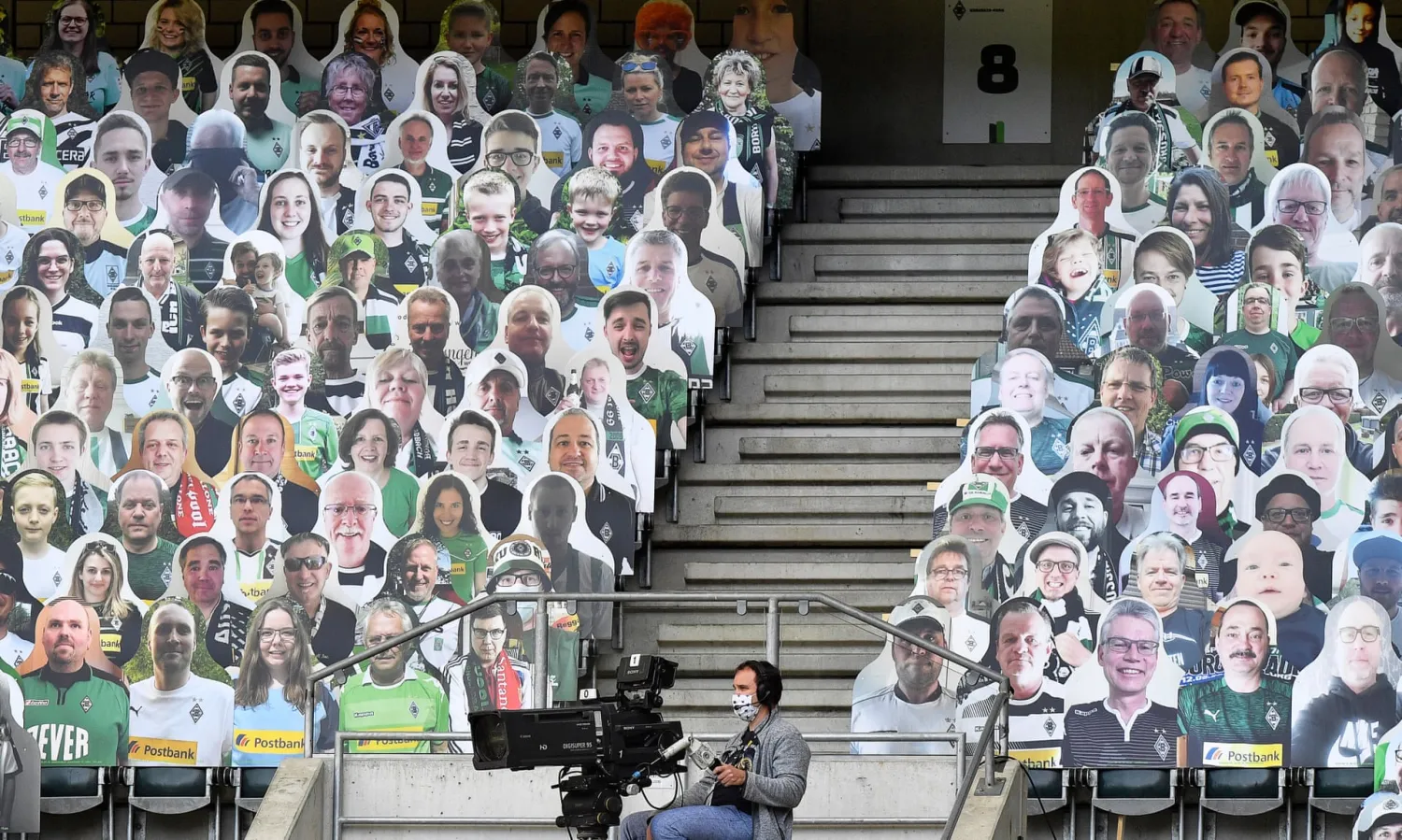
A TV cameraman wearing a face mask is physically distanced as he sits in front of the cutouts of fans during the match between Borussia Mönchengladbach and Union Berlin in May.
Photograph: Martin Meissner/EPA
A TV cameraman wearing a face mask is physically distanced as he sits in front of the cutouts of fans during the match between Borussia Mönchengladbach and Union Berlin in May. Photograph: Martin Meissner/EPA
TT

Bundesliga's Virtual Crowd Gives a Game Context for the TV Onlooker

A TV cameraman wearing a face mask is physically distanced as he sits in front of the cutouts of fans during the match between Borussia Mönchengladbach and Union Berlin in May.
Photograph: Martin Meissner/EPA
A TV cameraman wearing a face mask is physically distanced as he sits in front of the cutouts of fans during the match between Borussia Mönchengladbach and Union Berlin in May. Photograph: Martin Meissner/EPA

As football takes tentative steps into its new normal, the Bundesliga continues to lead. Germany’s cavernous empty stadiums took some getting used to and there have been subtle changes to the football. Home advantage barely exists, there has been an increase in injuries and the ball stays in play longer.

BT Sport audiences in the UK were treated to another innovation over the weekend: the piped-in crowd noise that had been available in Germany and the US since the Bundesliga’s reboot in mid-May. Judging by a social-media straw poll, the reaction was largely positive. As enlightening as it has been to hear players and coaches barking at each other, the sound of the crowd, faked as it might be, added a warmly familiar ambience.

Those watching Borussia Dortmund’s 1-0 home defeat of Hertha Berlin were treated to the greatest hits of the Westfalenstadion’s Yellow Wall. The sound mixer, operating from Sky Germany’s studio in Munich, conducted a knowledgeable if partisan crowd.

As Dortmund’s Emre Can stepped from defence to clear up some first-half danger, he was the recipient of applause, and when Hertha’s defender Dedryck Boyata appeared to have handled in the penalty area, the “fans” bayed for VAR before booing when the claim was denied by the officials.

For the viewer there was the comforting embrace of context. Watching a game played behind closed doors requires extra concentration. The ebbs and flows of crowd noises can tell the viewer when they need to pay closer attention.

During Dortmund’s first game back, their 4-0 defeat of Schalke, the most audible sound in the Westfalenstadion was the throb of the electrics required to power a stadium built to hold 81,000 people. The Hertha game, though it produced a far less satisfactory performance from Dortmund, felt a superior viewing experience.

The return of the Premier League will see a similar service offered for viewers of the remaining 92 matches. For those interested in who of James Milner or Jordan Henderson does more talking or how much invective Chris Wilder launches at his Sheffield United players, there will be the option to hear the sound as it’s heard in the stadium.

Otherwise, there is the option of a sound mix produced in an outside-broadcast truck or from a TV studio gallery if a game is “off-tube” because health and safety measures mean it must be covered remotely. The broadcasters have league-approved use of a system that means audio can be weighted in favor of the home team to try to give a more authentic feel.

Sky, showing 64 matches, promises “a range of bespoke and team-specific crowd noises and chants to bring the vibrant atmosphere of the Premier League” as part of a package that includes an interactive revival of Fanzone, where groups of pals have “the chance to chat about the match and influence the crowd noise they hear on screen”.

On BT there will be a “dynamic noise feature” available via the red button. The BBC will offer audiences “crowd or no crowd” noise to suit individual taste via red button or a different iPlayer stream. Amazon Prime, showing four matches, is expected to offer something similar.

The pressure, then, is on, for the broadcasters to try to produce accurate replications of the Anfield atmosphere, the Emirates Stadium’s indifference or Goodison Park’s groans.

It is unlikely to be a perfect viewing experience and is not meeting full approval in Germany where certain ultra groups are dissatisfied that a “pandemic league” is being played without them, let alone broadcast using fake crowd noise. But, like so much else during the coronavirus crisis – conducting social occasions via Zoom, or takeaway pints – it will have to do for the moment.

(The Guardian)


Shakhtar Boss Pays Ukrainian Racer $200,000 After Games Disqualification

Ukrainian President Volodymyr Zelenskiy holds helmet as he meets with a Ukrainian skeleton racer Vladyslav Heraskevych , who was disqualified from the Olympic skeleton competition over his "helmet of remembrance" depicting athletes killed since Russia's invasion and his father and coach, Mykhailo Heraskevych, amid Russia's attack on Ukraine, in Munich, Germany February 13, 2026. (Ukrainian Presidential Press Service/Handout via Reuters)
TT

Shakhtar Boss Pays Ukrainian Racer $200,000 After Games Disqualification

Ukrainian President Volodymyr Zelenskiy holds helmet as he meets with a Ukrainian skeleton racer Vladyslav Heraskevych , who was disqualified from the Olympic skeleton competition over his "helmet of remembrance" depicting athletes killed since Russia's invasion and his father and coach, Mykhailo Heraskevych, amid Russia's attack on Ukraine, in Munich, Germany February 13, 2026. (Ukrainian Presidential Press Service/Handout via Reuters)

The owner of ‌Ukrainian football club Shakhtar Donetsk has donated more than $200,000 to skeleton racer Vladyslav Heraskevych after the athlete was disqualified from the Milano Cortina Winter Games before competing over the use of a helmet depicting Ukrainian athletes killed in the war with Russia, the club said on Tuesday.

The 27-year-old Heraskevych was disqualified last week when the International Bobsleigh and Skeleton Federation jury ruled that imagery on the helmet — depicting athletes killed since Russia invaded Ukraine in 2022 — breached rules on athletes' expression at ‌the Games.

He ‌then lost an appeal at the Court ‌of ⁠Arbitration for Sport hours ⁠before the final two runs of his competition, having missed the first two runs due to his disqualification.

Heraskevych had been allowed to train with the helmet that displayed the faces of 24 dead Ukrainian athletes for several days in Cortina d'Ampezzo where the sliding center is, but the International Olympic Committee then ⁠warned him a day before his competition ‌started that he could not wear ‌it there.

“Vlad Heraskevych was denied the opportunity to compete for victory ‌at the Olympic Games, yet he returns to Ukraine a ‌true winner," Shakhtar President Rinat Akhmetov said in a club statement.

"The respect and pride he has earned among Ukrainians through his actions are the highest reward. At the same time, I want him to ‌have enough energy and resources to continue his sporting career, as well as to fight ⁠for truth, freedom ⁠and the remembrance of those who gave their lives for Ukraine," he said.

The amount is equal to the prize money Ukraine pays athletes who win a gold medal at the Games.

The case dominated headlines early on at the Olympics, with IOC President Kirsty Coventry meeting Heraskevych on Thursday morning at the sliding venue in a failed last-minute attempt to broker a compromise.

The IOC suggested he wear a black armband and display the helmet before and after the race, but said using it in competition breached rules on keeping politics off fields of play. Heraskevych also earned praise from Ukraine President Volodymyr Zelenskiy.


Speed Skating-Italy Clinch Shock Men’s Team Pursuit Gold, Canada Successfully Defend Women’s Title

 Team Italy with Davide Ghiotto, Andrea Giovannini, Michele Malfatti, celebrate winning the gold medal on the podium of the men's team pursuit speed skating race at the 2026 Winter Olympics, in Milan, Italy, Tuesday, Feb. 17, 2026. (AP)
Team Italy with Davide Ghiotto, Andrea Giovannini, Michele Malfatti, celebrate winning the gold medal on the podium of the men's team pursuit speed skating race at the 2026 Winter Olympics, in Milan, Italy, Tuesday, Feb. 17, 2026. (AP)
TT

Speed Skating-Italy Clinch Shock Men’s Team Pursuit Gold, Canada Successfully Defend Women’s Title

 Team Italy with Davide Ghiotto, Andrea Giovannini, Michele Malfatti, celebrate winning the gold medal on the podium of the men's team pursuit speed skating race at the 2026 Winter Olympics, in Milan, Italy, Tuesday, Feb. 17, 2026. (AP)
Team Italy with Davide Ghiotto, Andrea Giovannini, Michele Malfatti, celebrate winning the gold medal on the podium of the men's team pursuit speed skating race at the 2026 Winter Olympics, in Milan, Italy, Tuesday, Feb. 17, 2026. (AP)

An inspired Italy delighted the home crowd with a stunning victory in the Olympic men's team pursuit final as

Canada's Ivanie Blondin, Valerie Maltais and Isabelle Weidemann delivered another seamless performance to beat the Netherlands in the women's event and retain their title ‌on Tuesday.

Italy's ‌men upset the US who ‌arrived ⁠at the Games ⁠as world champions and gold medal favorites.

Spurred on by double Olympic champion Francesca Lollobrigida, the Italian team of Davide Ghiotto, Andrea Giovannini and Michele Malfatti electrified a frenzied arena as they stormed ⁠to a time of three ‌minutes 39.20 seconds - ‌a commanding 4.51 seconds clear of the ‌Americans with China taking bronze.

The roar inside ‌the venue as Italy powered home was thunderous as the crowd rose to their feet, cheering the host nation to one ‌of their most special golds of a highly successful Games.

Canada's women ⁠crossed ⁠the line 0.96 seconds ahead of the Netherlands, stopping the clock at two minutes 55.81 seconds, and

Japan rounded out the women's podium by beating the US in the Final B.

It was only Canada's third gold medal of the Games, following Mikael Kingsbury's win in men's dual moguls and Megan Oldham's victory in women's freeski big air.


Lindsey Vonn Back in US Following Crash in Olympic Downhill 

Milano Cortina 2026 Olympics - Alpine Skiing - Women's Downhill 3rd Official Training - Tofane Alpine Skiing Centre, Belluno, Italy - February 07, 2026. Lindsey Vonn of United States in action during training. (Reuters)
TT

Lindsey Vonn Back in US Following Crash in Olympic Downhill 

Milano Cortina 2026 Olympics - Alpine Skiing - Women's Downhill 3rd Official Training - Tofane Alpine Skiing Centre, Belluno, Italy - February 07, 2026. Lindsey Vonn of United States in action during training. (Reuters)

Lindsey Vonn is back home in the US following a week of treatment at a hospital in Italy after breaking her left leg in the Olympic downhill at the Milan Cortina Games.

“Haven’t stood on my feet in over a week... been in a hospital bed immobile since my race. And although I’m not yet able to stand, being back on home soil feels amazing,” Vonn posted on X with an American flag emoji. “Huge thank you to everyone in Italy for taking good care of me.”

The 41-year-old Vonn suffered a complex tibia fracture that has already been operated on multiple times following her Feb. 8 crash. She has said she'll need more surgery in the US.

Nine days before her fall in Cortina d'Ampezzo, Italy, Vonn ruptured the ACL in her left knee in another crash in Switzerland.

Even before then, all eyes had been on her as the feel-good story heading into the Olympics for her comeback after nearly six years of retirement.
