

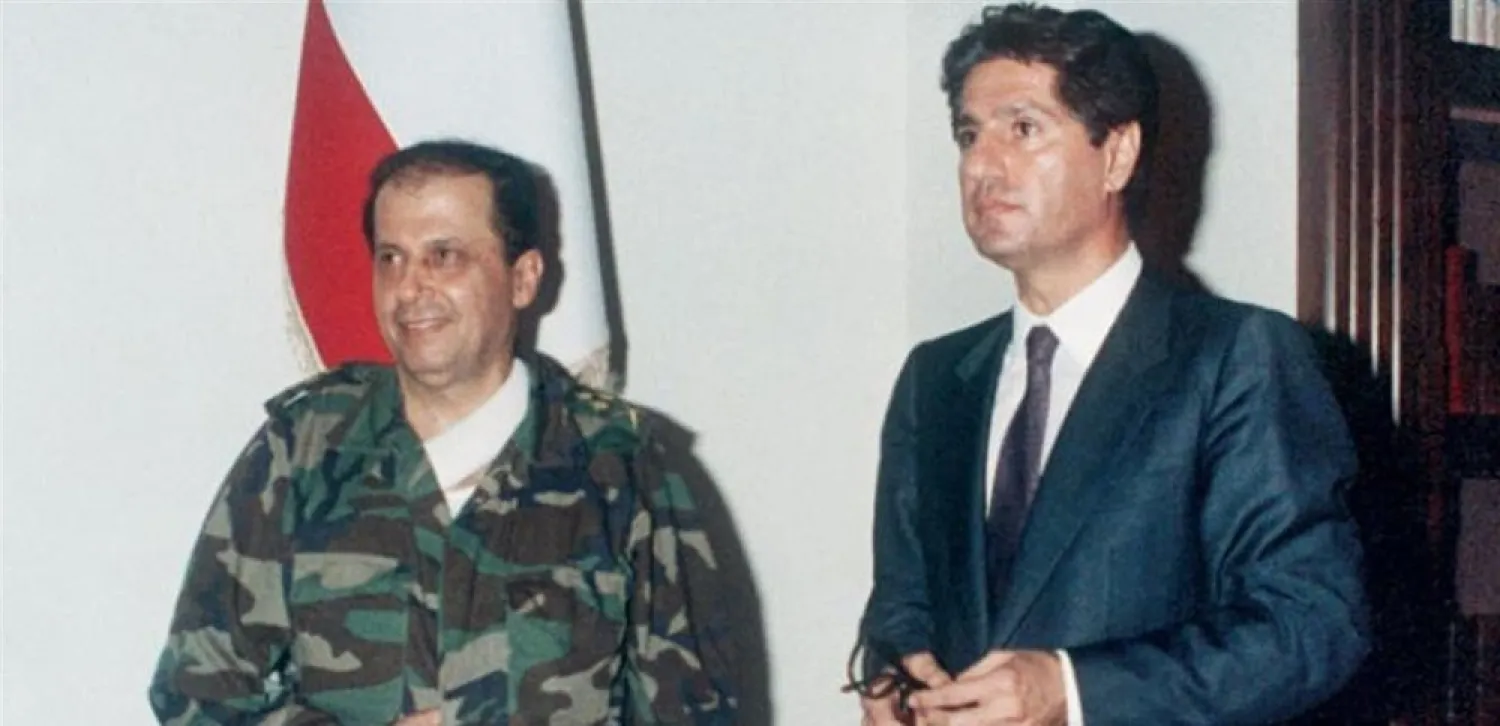

Amin Gemayel: I Overcame My Reservations against Aoun and Appointed him Head of Military Govt.

Asharq Al-Awsat releases excerpts from the former Lebanese president’s memoirs

Amin Gemayel (R) seen at the Baabda presidential palace after Michel Aoun was named head of a military government. (Getty Images)
TT

Amin Gemayel: I Overcame My Reservations against Aoun and Appointed him Head of Military Govt.

Amin Gemayel (R) seen at the Baabda presidential palace after Michel Aoun was named head of a military government. (Getty Images)

In the second part of his memoirs, excerpts of which are exclusively being published by Asharq Al-Awsat, former Lebanese President Amin Gemayel recalls the final day of his term in office on September 22, 1988. With Lebanon in the throes of its 1975-90 civil war, he spoke of the difficulties he encountered in forming a transitional government that would be tasked with preparing for the election of a new president after parliament had failed to do so.

Gemayel recounted how he saw in the military council, headed by then-army commander Michel Aoun, as the best choice in leading the country. He even received the approval of all six of its members for the task before later receiving a shock from Syrian media that reported the resignation of its three Muslim officers. He was not even informed of their decision beforehand. Below is part two of three of Gemayel’s memoirs:

After a tumultuous night, dawn finally broke on September 22, 1988, my final day in office in what has been a difficult term. I had breakfast alone in my office as I wrestled with my concerns and bitterness. I was left to tackle my final constitutional duty: the formation of a transitional government. Hussein al-Husseini was strongly pressing for parliament to elect Mikhael al-Daher. It seemed unlikely that he would garner the necessary quorum. At noon, the issue resolved itself: only ten MPs showed up at Nijmeh Square and the session was adjourned to 10:30 am the next day.

Salim al-Hoss had informed me that he was going back from his resignation from a government he was not even heading. He was serving as acting prime minister after the assassination of outgoing Premier Rashid Karami. He had assumed an official role in violation of the constitution. I could not accept this, which therefore demanded that I form a new government in line with the constitution and Lebanese traditions.

I thought of naming president Charles Helou as prime minister of a draft government lineup I had prepared in case such a day would come when we would be confronted with potential vacuum. I contacted him and explained my reasoning for naming him. I told him he alone could run the transitional period until my successor could be elected. He agreed.

He was a wise and moderate man, who knew to the core the sensitivity of the national equation. He had experienced its importance firsthand during two very critical times in our nation’s history. He was above conflicts and could hold dialogue with all sides. He was widely respected and can bring together all Lebanese. I could find no one else with these qualities.

I did not want to reach such a crossroads of issuing a decree for the formation of a transitional government that would replace the president. I had followed the example of President Bechara al-Khoury, who on September 18, 1952 had resigned from his position and tasked a Maronite to head a transitional government to succeed a president whose term had ended without the election of a successor. During such cases of vacuum, the jurisdiction of the president is transferred, according to the constitution, to an interim government. Since the vacant position is that of a Maronite official, I had to keep such jurisdiction in the hands of that sect and appoint a Maronite head of government, which would play the role of president. The cabinet would then act as a guarantor of our national norms. That is why I first thought of Charles Helou for the task.

At 9 am on September 22, I summoned him to the Baabda palace for consultations. He apologized, saying he could not accept the task, citing his and his wife’s poor health. Taking care of her at all times would prevent him from taking on the “massive responsibility,” he told me. I believed that he knew that he would have been forced to strike agreements that would have been uneasy for him. He suggested to me an alternative, who enjoys the suitable qualities: a Maronite, open-minded and enjoys good relations with all Muslim and Christian parties.

“He is also a Helou,” he added.

He named Pierre Helou.

I thought about it and did not make up my mind. Pierre Helou had been an MP from Aley since 1972. He was a former minister and a patriot to the core. He was also an old friend of both Kamal Jumblatt and Imam Moussa al-Sadr. A moderate, he would not have provoked any of the parties.

I summoned him to the presidential palace at 11:30 am, just after meeting with the army commander. He agreed without hesitation to form a government, expressing his understandable fears over the extreme difficulty of the task.

He kicked off his consultations to form a new government from the Baabda presidential palace. He wanted it to include main effective parties - Muslim and Christian alike - and therefore summoned them to discuss their participation.

He was met with one veto after another. Some Sunni figures, including some of the most moderate, refused to take part in a transitional government that includes Michel Aoun and Samir Geagea. For one reason or another, they held them responsible for the assassination of Sunni PM Rashid Karami.

Parties on the other end believed that forming a cabinet without Aoun and Geagea would render it unbalanced. Such a government would seem biased and representative of some parties without others. It would not be able to rule or last long.

I had received from Aoun and Geagea their serious insistence on being part of the transitional government, rejecting any solution that would keep them out. They warned that not being part of cabinet would force them to take firm stances. Even the grand mufti, who has rarely ever been accused of taking a hardline, had informed Pierre Helou that none of the Sunnis would take part in a “flawed government that includes those two men.”

By the afternoon, Pierre Helou had failed in forming a government team that would support his new task. He finally chose to apologize from accepting his naming as premier, taking in the advice of his friends, Michel Edde and Khalil Abou Hamad.

With Pierre Helou hitting a dead end, as I challenged fate by going against traditions, I tasked Dany Chamoun with inquiring with Salim al-Hoss, his friend since their college days at the American University of Beirut, about forming a transitional government that would include all political powers, including the Lebanese Forces. He insisted instead that the current outgoing cabinet lineup be preserved. He relented to some amendments: appointing Dany Chamoun as minister to succeed his father Camille, Omar Karami to succeed his brother Rashid, and expanding it to include four more ministers. He proposed George Saadeh and Joseph Skaff as potential candidates. He accepted the appointment of two deputy prime ministers: Abdullah al-Rassi, an Orthodox Christian, and Dany Chamoun, a Maronite. Hoss adamantly rejected however, Aoun and Geagea’s inclusion in cabinet even though it did include other political leaders and militia chiefs, most notably Damascus allies Walid Jumblatt and Nabih Berri. He also insisted that the government keep holding its meetings at its West Beirut headquarters in Sanayeh.

Hoss’ proposal would have been in line with that of [Syrian Vice President] Abdul Halim Khaddam to [US Assistant Secretary of State] Richard Murphy on September 3, 1988. This meant Hoss would retain his government team and would keep cabinet meetings being held in strict Syrian areas of influence.

If I had accepted Hoss’ proposal to Chamoun, I would have handed Lebanon to Syria on a silver platter. I refused. There was no way I would sign a decree that I viewed as unbalanced. There was no way I would accept the formation of a government of Damascus allies, who, for whatever reason, have no room to maneuver except under Syria’s influence. In Christian majority East Beirut, political and military forces would not have recognized the authority of an unbalanced government that would have been formed under direct Syrian influence. This would have inevitably led to the country’s division.

Since September 21 after my return from Damascus to Bkirki and then to the Baabda presidential palace, I held a series of consultations with my aides and MPs. The meetings stretched long passed midnight. We received an unencouraging cable from Archbishop of New York John O'Connor, addressed to Lebanon’s Christians, urging them to “save the republic”. Our options were narrowing and we had to make difficult choices: we could either hold elections, but without any serious signs that a president would be elected, or contend with chaos, which Murphy had warned us of.

Rene Mouawad told me: “If elections are not held, then we will be held responsible by the United States, Vatican and Europe. Instead of helping us, the Americans have reiterated the Syrian demand.”

Last choice

Pierre Helou and Salim al-Hoss were now out of the picture. I had no choice but to reveal my last card. I had failed in my attempt to form an expanded and balanced political government that includes all effective players. I had to resort to another option: forming a non-political government that would at the same time represent Lebanon’s national fabric and assume its responsibilities.

The only options were handing power to a state institution: either the higher judicial council or the military council. The judicial council was headed by Maronite Sheikh Amin Nassar, an open-minded and dutiful official who had contacts with all sides. The military council was headed by another Maronite, army commander Michel Aoun. Both officials were dedicated to the unity the country, but I ultimately leaned more towards the military council. It alone could protect itself and institutions. It could protect the country’s security and confront any unrest and defuse tensions. A government of judges would not have withstood such challenges.

I relied in my reasoning on Bechara al-Khoury, who prior to the end of his term in 1952 had asked army commander Fuad Chehab, a Maronite, to head a transitional government. I therefore, turned to the army and military council, which was formed according to the balance of power that emerged in 1984. It reflected the diversity of Lebanon’s various sects whereby six of its members represented the six main sects. They were named by the government and were not opponents of Syria or any other side.

In order to avoid any criticism and doubts, I kept the council as it was with no amendments. I also overcame all of my reservations against its chief, Michel Aoun, because the country’s interest demanded it. Some of my aides suggested that I include civilian ministers to the council, such as a foreign minister who would be affiliated to me and maintain international contacts, but I refused to create any hole in the new government. The cabinet would be bound with one duty stipulated by the constitution and that is to elect a new president, nothing more. It had no other responsibilities because it was an interim transitional government chosen to carry out an urgent task that is not preceded by any other. Article 62 of the constitution stipulates that the jurisdiction of the president would be transferred to the transitional council and that its members would all rule collectively. This way I would have appointed a military council government, not a Michel Aoun government.

That day, parliament was supposed to convene at the Nejmeh Square to elect a president at the invitation of Hussein al-Husseini and under mounting Syrian pressure. Only 13 lawmakers showed up. He issued another invitation for September 23, a day after my term ends.

Transforming the military council into a government was the least damaging solution. I was left with the task of personally contacting all six of its members to ensure that they would not step down soon after their appointment. Before issuing my final presidential decree, I contacted them all and none of them refused the mission. They thanked me for entrusting them with the duty. However, we were all surprised when just after midnight on September 22 with the announcement that the three Muslim officers had resigned. Syria was the first to make the announcement through its radio, while none of the officers – Mahmoud Tay Abou Dargham, Nabil Qoreitem and Lotfi Jaber – had submitted their written resignation, which ultimately never came.

I had sought to consult spiritual and political leaders ahead of making my announcement. Just before midnight on September 22, I contacted [Maronite] Patriarch Nasrallah Sfeir. He was asleep and I asked that he be awakened so that I could inform him of my final choice.

“We have held today a long marathon meeting with all brothers, lawmakers, Lebanese Forces and the army. We proposed all possible solutions to avoid constitutional vacuum. We had three choices: A government headed by Hoss with a majority that is allied to him, but ultimately in an unbalanced cabinet that cannot rule. The second was an expanded government that would include all parties, but in the end would be left with its Christian members because its Muslims, even the moderates, would walk away from it.”

Sfeir said: “I heard the news. It appears that the mufti and Shamseddine had warned against it.”

“The third choice is the military council, headed by General Aoun, that boasts all sects and parties,” I added. “We have opted for the third solution. General Aoun is next to me and we are discussing the issue. The problem is very dangerous. At least we wouldn’t be handing over affairs without knowing where the situation is headed? … I was forced to take this decision.”

“It may be the best. God willing. It’s imperative that the situation does not deteriorate,” he said.

“At any rate, we must remain vigilant. We are headed towards unpredictable political developments,” I remarked.

“It seems that the Americans have not changed their position,” he said.

“Yes,” I replied.

“Unfortunately,” he added.

I should inform Geagea of the new decision. He arrived at the presidential palace and showed great disappointment when he found out that he was not part of the new proposal. He requested some time to think it over. He held talks alone with General Aoun, who was at the palace. He then came back to inform me of his approval before quickly leaving my office. He informed the media that he supports the new cabinet and its head, describing it as an “independence” government.

I later learned that during their brief talks at the palace, Aoun had asked for Geagea’s conditional support in return for allowing the Lebanese Forces free reign in Christian areas where Syrian troops were not deployed. He also received a pledge that the army would not intervene in disputes within the LF.

Minutes before midnight on September 22, 1988, the moment my term end, I signed – with great bitterness and yet an easy conscience – my last presidential decree (number 5,387), which calls for the formation of a transitional government headed by General Aoun. The majority of Arab and foreign governments immediately announced their support. [French President] Francois Mitterrand telephoned George Bush, who was recently elected US president. Bush declared his support for the Lebanese government and said he would ask the Russians to do the same.

My desk seemed empty that night. It used to be loaded with files. I felt burdened by exhaustion and tribulations, but proud that I had completed my duties to the end.

Part three continues on Sunday.



What Egypt’s Red Lines Mean for Sudan’s War

Egyptian President Abdel Fattah al-Sisi holds talks with Sudan’s army chief Abdel Fattah al-Burhan in Cairo on Thursday (Egyptian Presidency)
TT

What Egypt’s Red Lines Mean for Sudan’s War

Egyptian President Abdel Fattah al-Sisi holds talks with Sudan’s army chief Abdel Fattah al-Burhan in Cairo on Thursday (Egyptian Presidency)

In unusually blunt language, and following a visit by Sudan’s Sovereignty Council Chairman and army chief Abdel Fattah al-Burhan to Cairo, the Egyptian presidency issued a statement on the war in Sudan outlining three points it described as red lines.

It said Egypt would not allow any of them to be crossed or compromised, as they directly affect Egypt’s national security, which it said is inseparable from Sudan’s national security.

The reference to activating the joint defense agreement between the two countries was seen as a signal that Egypt could bring its military, political, and diplomatic weight to bear in support of the Sudanese army.

Joint defense agreement

In March 2021, Egypt signed a military cooperation agreement with Sudan that covers training, border security, and the confrontation of shared threats. That agreement followed a joint defense pact signed in 1976 during the presidencies of Sudan’s Gaafar Nimeiry and Egypt’s Anwar Sadat.

Articles One and Two of the pact stipulate that any attack on one party is considered an attack on the other, and require immediate consultation, including the use of armed force to repel aggression. The agreement also commits both sides to coordinating their defense and military policies on matters related to their national security.

After the fall of Nimeiry’s regime in the 1985 popular uprising, then Prime Minister Sadiq al-Mahdi informed the Egyptian leadership of his desire to cancel the joint defense agreement. Instead, the two sides signed what became known as the Brotherhood Charter in 1987. While it did not explicitly cancel the 1976 agreement, its mechanisms have not been discussed or activated since then.

Regional and international messages

Sudanese journalist Osman Mirghani, editor-in-chief of Al-Tayar newspaper, said the Egyptian statements amounted to regional and international messages linked to recent developments and what he described as serious security threats facing Sudan.

He pointed to the expansion of the Rapid Support Forces in the Darfur and Kordofan regions in a way that threatens shared Sudanese and Egyptian national security, warning of risks of geographic fragmentation that could endanger Sudan’s unity.

Speaking to Asharq Al-Awsat, Mirghani said Egypt was, for the first time, using direct and tough language and signaling the possibility of intervention under international law in Sudan’s conflict. He said this reflected the level of Egyptian concern over the situation in Sudan.

Mirghani added that the reference to red lines was a message directed at all parties, noting that there are many influential players in Sudan.

The red lines

The first red line cited by Cairo was the preservation of Sudan’s unity and territorial integrity, preventing any tampering with its resources or those of the Sudanese people, and rejecting the secession of any part of the country. Egypt reiterated its categorical refusal to the establishment or recognition of any parallel entities, saying such moves would undermine Sudan’s unity and territorial integrity.

The statement also stressed the need to preserve Sudanese state institutions and prevent any harm to them. Egypt affirmed its full right to take all necessary measures permitted under international law, including activating the joint defense agreement between the two brotherly countries, to ensure these red lines are not crossed.

Timing of the visit

Former Sudanese Foreign Minister Ali Youssef noted the timing of Burhan’s visit to Cairo, stating that it occurred after his trip to Saudi Arabia earlier this week and following a visit by Saudi Crown Prince Mohammed bin Salman to the United States.

Youssef said the trip was part of efforts to end the war in Sudan through the Quartet mechanism, which includes Saudi Arabia, the United Arab Emirates, Egypt, and the United States.

Speaking to Asharq Al-Awsat, Youssef said Burhan briefed Egyptian President Abdel Fattah al-Sisi on the outcomes of his Saudi visit and the latest developments in Sudan.

He stated that the visit did not follow the usual ceremonial protocol and was a result of developments in the war, noting that Egypt’s security is linked to Sudan’s security. He added that Egypt is part of the Quartet, which seeks to end a war that is approaching its third year.

Military implications

Sudanese military expert Al-Muatasim Abdel Qader said activating the joint agreement would imply Egyptian intervention in various forms, including supplying weapons and ammunition or direct military involvement.

He said the provisions of the agreement obligate each army to defend the other, adding that the red lines outlined by the Egyptian presidency represented a significant step and carried major implications for the Sudanese state.

In remarks to Asharq Al-Awsat, Abdel Qader described mutual protection between the two countries as a historically rooted matter, dating back to wars Egypt fought in the last century in which Sudanese armed forces took part.

Rapid Support Forces response

Basha Tabiq, an adviser to the commander of the Rapid Support Forces, said in posts on X that Egypt’s position amounted to blatant interference, bias toward one party, and a colonial mindset that views Sudan as a backyard.

Another source aligned with the RSF said accusations against Egypt of backing the Sudanese army have persisted since the early days of the war. The source pointed to the presence of Egyptian forces at Merowe air base in northern Sudan at the start of the conflict, when several Egyptian soldiers and officers were captured before later being handed over to Cairo.

The source also cited accusations by RSF leader Mohamed Hamdan Dagalo, known as Hemedti, who said in October 2024 that the Egyptian army had carried out air strikes against his forces and supplied the Sudanese army with drones and training.

He said Hemedti renewed those accusations last June, alleging that Cairo supported the Sudanese army with aircraft flown by Egyptian pilots that bombed areas under his forces’ control, and supplied weapons and aviation fuel. Hemedti described this as a blatant aggression against the Sudanese people.

The source, who requested anonymity, said Egypt has been intervening in the war from the outset and that activating the joint defense agreement would merely formalize an existing reality.

No time to spare

Sudanese ambassador Al-Sadiq al-Maqli said Egypt is working with Saudi Arabia and the international Quartet, in coordination with the United States, to give fresh momentum to efforts on Sudan.

He said Washington is currently using soft power rather than force, which he described as an option deferred until shuttle diplomacy by US President’s senior adviser Massad Boulos is exhausted.

Speaking to Asharq Al-Awsat, Maqli said the United States fully understands the influence of Saudi Arabia and Egypt and their ability to persuade and soften the stance of Sudan’s government, which has rejected the latest US initiative.

He said Burhan currently has no time to spare, as what is unfolding in Sudan represents the world’s worst humanitarian disaster, according to the international community.

Maqli noted that Egypt, represented by Foreign Minister Badr Abdelatty, has been almost fully dedicated to making the Quartet mechanism succeed, given that the continuation of the current situation in Sudan poses a threat to Egypt’s national security.

He described Burhan’s visits to Riyadh and Cairo as short but necessary steps toward accepting the Quartet initiative, saying the Saudi visit marked a qualitative shift in the Sudanese government’s official position.

He added that Sudan’s foreign ministry later expressed Port Sudan’s readiness to cooperate with President Donald Trump, his secretary of state, and Boulos in efforts to achieve peace in Sudan, predicting imminent developments that could lead to a major breakthrough in the crisis.


Iraq Negotiates New Coalition Under US Pressure

Election workers count ballots as they close a polling station, during the parliamentary elections in Baghdad, Iraq, Nov. 11, 2025. (AP)
TT

Iraq Negotiates New Coalition Under US Pressure

Election workers count ballots as they close a polling station, during the parliamentary elections in Baghdad, Iraq, Nov. 11, 2025. (AP)

More than a month after Iraq's parliamentary elections, the country's top leaders remain locked in talks to form a government while facing pressure from Washington to exclude Tehran-backed armed groups.

Amid seismic changes in the Middle East, where new alliances are forming and old powers waning, Iraqi leaders face a daunting task: navigating relations with US-blacklisted pro-Iranian factions.

The US has held significant sway over Iraqi politics since leading the 2003 invasion that ousted long-time ruler Saddam Hussein.

But another specter also haunts Iraq's halls of power: Washington's arch-foe, Iran.

Iraq has long been caught between the two, with successive governments negotiating a delicate balance.

Now, after November's election, Washington has demanded the eventual government must exclude Iran-backed armed groups and instead move to dismantle them, Iraqi officials and diplomats told AFP.

A State Department spokesperson, speaking on condition of anonymity, said: "Iraqi leaders well know what is and is not compatible with a strong US-Iraq partnership".

Washington, the spokesperson said, "will continue to speak plainly to the urgency of dismantling Iran-backed militias".

But some of these groups have increased their presence in the new chamber and have joined the Coordination Framework, an alliance of Shiite parties with varying ties to Iran and which holds the majority.

For weeks, the Coordination Framework has been embroiled in talks to nominate the next prime minister.

"The US has put conditions that armed factions should not be part of the new government," a senior Iraqi official said. The factions must disarm and "sever ties with Iran's Revolutionary Guard," he added.

In recent tweets, the US special envoy to Iraq, Mark Savaya said that Iraqi leaders are at a "crossroads".

Their decision "will send a clear and unmistakable signal to the United States... that Iraq is ready to claim its rightful place as a stable and respected nation in the new Middle East.

"The alternative is equally clear: economic deterioration, political confusion, and international isolation," Savaya said.

The US has blacklisted as "terrorist organizations" several armed groups from within the pro-Iran Popular Mobilization Forces, a former paramilitary alliance now integrated into the armed forces.

They are also part of the Iran-backed so-called "Axis of Resistance" and have called for the withdrawal of US troops -- deployed in Iraq as part of an anti-ISIS coalition -- and launched attacks against them.

Most of these groups hold seats in parliament and have seen their political and financial clout increase.

The Asaib Ahl al-Haq faction, led by Qais al-Khazali, who is a key figure in the Coordination Framework, won 27 seats in the latest election, making it harder to exclude it from the government.

A potential compromise is to deny it a key portfolio, as in the current government.

"The US has turned a blind eye before, so they might after all engage with the government as a whole but not with ministries held by armed groups," a former Iraqi official said.

Other blacklisted groups are:

+ Kataeb Hezbollah, one of the most powerful armed groups, supports a parliamentary bloc (six seats).

+ Kataeb Sayyid al-Shuhada, Kataeb Imam Ali and Harakat Ansar Allah al-Awfiya.

+ The al-Nujaba movement is the only group that has steered clear of elections.

Iraq has its economic growth to worry about.

After decades of turmoil, it has only begun to regain a sense of normalcy in recent years.

Washington has already imposed sanctions on several Iraqi entities and banks, accusing them of helping Tehran evade sanctions.

But Iraqi leaders hope for greater foreign investments and support partnerships with US companies.

The most striking endorsement came from Khazali, an opponent of the US military presence who now argues that it would be in Baghdad's interest for major US companies to invest.

Since the Israel's war with Hamas in Gaza began in October 2023, Iraq has remained relatively unscathed by the turmoil engulfing the Middle East.

Iraqi armed groups did launch attacks on US troops and largely unsuccessful ones on Israel. Washington responded with heavy strikes, and the attacks have long since halted.

Iraq remained the only close regional ally of Iran to stay out of Israel's crosshairs.

So far, the US has acted as a buffer, helping to prevent an Israeli attack, but Iraqis have been warned of strikes against the armed groups, multiple sources said.

But as the presence of American forces dwindles, fears are growing.


Bethlehem Camp's 'Lifeline' Football Field Faces Israeli Demolition

 Displaced Palestinian youths take part in a training session at the Aida Refugee Camp's football pitch, next to the separation wall outside Bethlehem in the occupied West Bank, on December 16, 2025, a few weeks after an Israeli military decision to demolish the field. (AFP)
Displaced Palestinian youths take part in a training session at the Aida Refugee Camp's football pitch, next to the separation wall outside Bethlehem in the occupied West Bank, on December 16, 2025, a few weeks after an Israeli military decision to demolish the field. (AFP)
TT

Bethlehem Camp's 'Lifeline' Football Field Faces Israeli Demolition

 Displaced Palestinian youths take part in a training session at the Aida Refugee Camp's football pitch, next to the separation wall outside Bethlehem in the occupied West Bank, on December 16, 2025, a few weeks after an Israeli military decision to demolish the field. (AFP)
Displaced Palestinian youths take part in a training session at the Aida Refugee Camp's football pitch, next to the separation wall outside Bethlehem in the occupied West Bank, on December 16, 2025, a few weeks after an Israeli military decision to demolish the field. (AFP)

Earlier this month a group of Palestinian boys turned out to train at their local football pitch in the shadow of the wall separating Israel from the West Bank's Aida refugee camp -- and found a note at the gate.

The children took the ominous message from Israeli authorities to Muhannad Abu Srour, sports director at the Aida Youth Center in the camp near Bethlehem, and the news was not good.

"We were shocked to discover that it was a decision to demolish Aida camp's football field," Abu Srour told AFP, adding that more than 500 children regularly train on the field roughly half the size of a regulation soccer pitch.

"The football field is the only open space we have. If the field is taken away, the children's dream is taken away," Abu Srour said.

The planned destruction of the Aida field is one of many points of contention in the occupied West Bank, but it is a particularly painful one for young Palestinians yearning for a better future.

One of the older members, 18-year-old Abdallah al-Ansurur, hopes to make it into the national Palestinian team, and, like many other youth at Aida camp, took his first steps in the game on the pitch flanked by the eight-meter concrete Israeli wall.

"I started when I was about 13 years old. This field gave me a real opportunity to train," said Ansurur, who was born and raised in Aida camp, one of the smallest in the West Bank.

Ansurur, who trains to be a goalkeeper, calls the astroturf-covered piece of land a "lifeline".

"Without this field, I wouldn't have had this chance. If it didn't exist, we'd be playing in the streets -- or not playing at all," he said.

Israel has occupied the West Bank since 1967 and frequently demolishes Palestinian homes or infrastructure, arguing they were built without permits.

AFP was shown the note from COGAT, the Israeli defense ministry body in charge of Palestinian civilian affairs, which says the field was not authorized.

But Anton Salman, who was mayor of adjacent Bethlehem when the field was built in 2021, told AFP the construction was legal.

Salman said his municipality leased the land from the Armenian Church authorities to whom it belongs, before allowing Aida camp's popular committee to manage it for the benefit of residents.

Saeed al-Azzeh, head of the popular committee, confirmed the information, calling the space, "the only breathing space" for camp residents.

"Today, more than 7,000 people live on the same piece of land. Streets are narrow, alleys are cramped -- there is nowhere else," Azzeh said, referring to the camp.

Like other Palestinian refugee camps, Aida was built to accommodate some of the hundreds of thousands of people who either fled their homes or were forced out during the creation of Israel in 1948.

With time, tents gave way to concrete buildings, with the football field representing one of the few open spaces in the camp's dense patchwork.

Abu Srour is proud of what came out of the field, with youth sports delegations able to travel abroad to play, a welcome escape from the West Bank's myriad restrictions.

This is because checkpoints, a fixture of the West Bank since the start of Israel's occupation, have multiplied since the start of the war in Gaza.

Abu Srour mentioned that bringing a local team to Ramallah, a city 20 kilometers (12.5 miles) away as the crow flies, took six hours recently, instead of one hour in the past.

Restricted mobility is a major issue for most Palestinian athletes as it makes it nearly impossible for athletes of similar levels from different cities to train together.

Waseem Abu Sal, who was the first Palestinian boxer to participate in the Olympics, told AFP he frequently sparred with athletes of different levels or weight categories for lack of mobility.

Taking a short break from running a practice for 50 excited five- to 10-year-old boys, coach Mahmud Jandia told AFP he hoped the field would remain.

"Yes, the wall is there -- it feels like a prison -- but despite that, the most important thing is that the field remains and the children keep playing."

"If the field is demolished, all the children's dreams will be demolished with it."