


Don't Be Tempted to Think Klopp's Blueprint Has Superseded Guardiola's

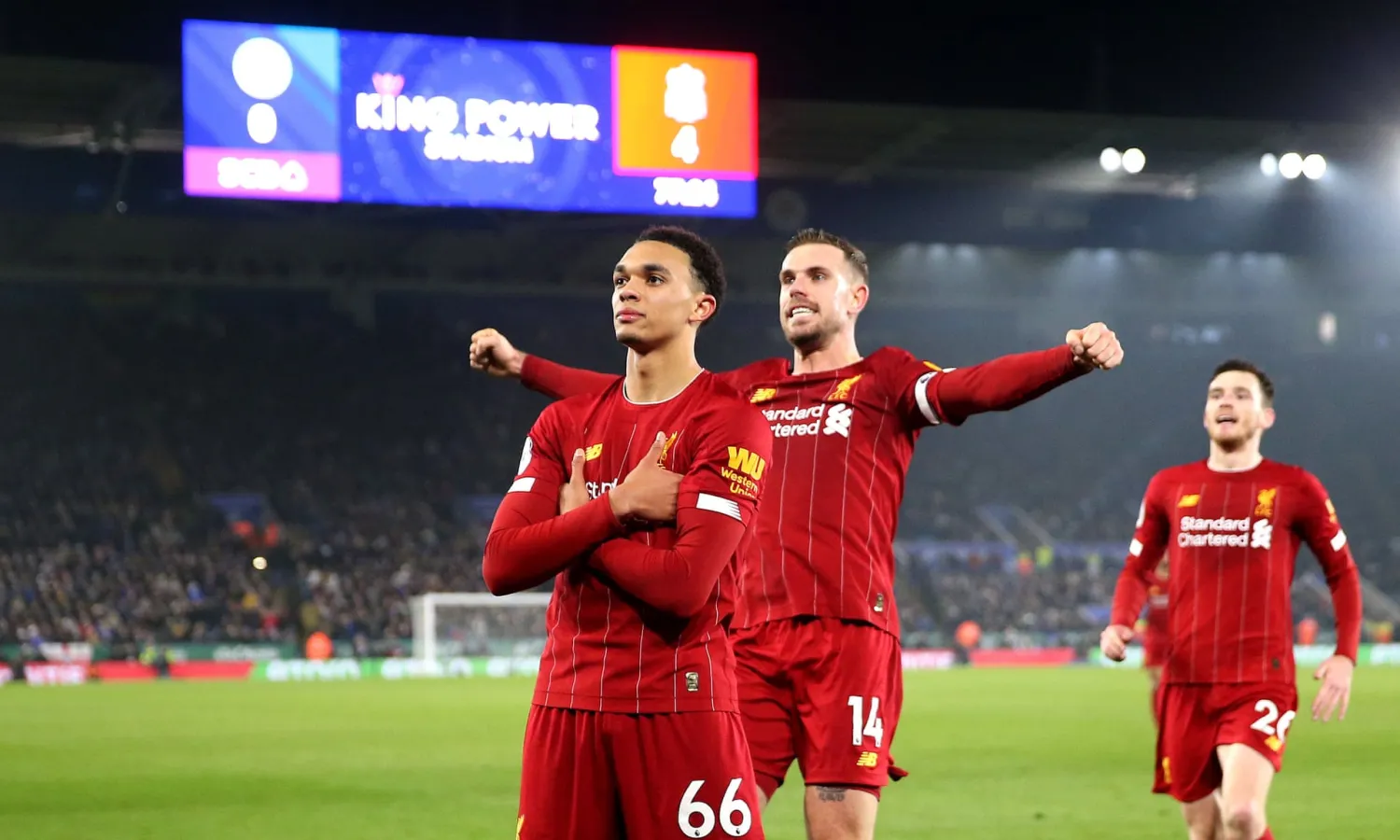
Trent Alexander-Arnold celebrates scoring Liverpool’s fourth goal against Leicester on Boxing Day. | Alex Pantling/Getty Images
TT

Don't Be Tempted to Think Klopp's Blueprint Has Superseded Guardiola's

Trent Alexander-Arnold celebrates scoring Liverpool’s fourth goal against Leicester on Boxing Day. | Alex Pantling/Getty Images

It is a measure of what an astonishing season this has been from Liverpool that if Manchester City had won every match they played since 8 October, when they lost 2-0 at home to Wolves in their eighth game of the season, they would still have been second right now.

Jürgen Klopp’s side have maintained their extraordinary form of last season when they finished a point behind City with the third-highest total in history, perhaps even improved; City have not. The danger is to become numb to such relentlessness, to think it is normal. It is not, not even as football’s self‑destructive economics stretch the gap from the top of the table to the bottom.

The days since the restart have offered a reminder of how good City are with the ball, even if their defensive fallibility was clear at Chelsea on Thursday. Liverpool have not streaked away from a league of mediocrities. City remain a formidable side capable of idiosyncratically brilliant football. The temptation would be to suggest Klopp’s football has superseded that of Pep Guardiola, that the great tactical wheel has turned again, but it’s nowhere near so straightforward.

Trust, patience and hard work: how Jürgen Klopp transformed Liverpool
Read more
Guardiola’s Barcelona presented the world with a level of possession football that had never been seen (in part taking advantage of a changing environment with better pitches and equipment, a crackdown on intimidatory fouling and a new interpretation of the offside law that increased the effective playing area).

That set the rest of football a problem. You could try to copy the Barcelona approach, although without the traditions of La Masia, or you could try to challenge it. In essence, then, the question was simple: they have lots of the ball; what is the best way to get it back? The answer to that isn’t complex, although the theory is extremely difficult to put into practice: you press.

Even by 2010, it had become apparent there were two ways to take on Barça. Opponents either sat deep, went into the bunker and tried to restrict the number and quality of chances Barça had (as Internazionale and Chelsea did in the 2010 and 2012 Champions League semi-finals); or they pressed high and tried to disrupt Barça’s possession at source.

It is a high-risk approach but it is also the one Klopp saw as being at least to an extent controllable. As he has said, sitting deep against a Guardiola side is essentially hoping to win a lottery in that it accepts them having a (significantly) greater number of chances and relies on them failing to take advantage.

Tactical evolution can be understood as a series of interlocking dialectics: proactivity against reactivity, art against pragmatism, individuality against the team. The most relevant here is technique against physique. Guardiola’s Barcelona were so technically good that it did not matter their five most advanced players had an average height of 5ft 6½in; bigger teams couldn’t get close enough to take advantage. The challenge was to devise a way of pressing that was so good that bigger and more aggressive players could bring their physical advantages to the battle. That has been the underlying logic of tactical development over the past decade.

In the broadest terms, football – and Liverpool – have been here before. As the 60s yielded to the 70s, total football supplanted catenaccio, hard pressing and attacking displacing man-marking and caution. But then total football mutated. The German model, as practised by the national side, Bayern Munich and Borussia Mönchengladbach, was still about possession and the interchange of positions but it lost the pressing element that had made the Dutch school so radical. It was then overwhelmed in the late 70s by the pragmatic pressing of Liverpool and Nottingham Forest, technically accomplished sides who overpowered opponents but were also extremely defensively capable.

In that regard a comment Klopp made after a diligent Bayern had held them to a 0-0 draw at Anfield in February last season seems significant. “Something,” he said, “changed in the world of football – everyone adapted to it and we have to make sure we adapt.” He was talking about the largely forgotten art of defending. City have scored seven more league goals than Liverpool this season but, vitally, Liverpool have conceded 12 fewer.

But of course it is nothing like as simple as a recapitulation of the pattern of 40 years ago, or of Klopp seeking a solution to the challenge set by Guardiola and finding it this season. For one thing, Guardiola has evolved after leaving the microclimate of the Camp Nou. He changed in Germany and his football at City, particularly in his second and third seasons in the job, showed further shifts away from the Barcelona model to something (relatively) more direct.

Last season there was a hair’s breadth between them (or rather 11.7mm). This season City have faltered, largely it seems because of failures of defensive recruitment. The verdict of the court of arbitration for sport has the potential to inflict serious damage on the club but if City’s appeal is upheld – and quite possibly even if it is not – there is no reason to assume Liverpool will necessarily win a race against City next season, particularly given the front three are all 28 and some sort of transition will have to begin at some point. There cannot be an assumption that Klopp has found a tactical formula that will dominate Guardiola in perpetuity.

Klopp’s pressing, well-organized and relentless as it is, clearly causes City problems, which is why he has by far the best head-to-head record against Guardiola of any manager who has faced him a meaningful number of times, but the idea that his style has surpassed Guardiola’s is misleading. Rather, Liverpool have come to play a form of football that has repeatedly challenged City’s and this season outstripped them, while influencing an evolution Guardiola was already undergoing.

Guardiola a decade ago established a hegemonic style of possess and press. What Klopp has done is to emphasize the pressing aspect, to shift the balance from technique back towards physique.

(The Guardian)


Shakhtar Boss Pays Ukrainian Racer $200,000 After Games Disqualification

Ukrainian President Volodymyr Zelenskiy holds helmet as he meets with a Ukrainian skeleton racer Vladyslav Heraskevych , who was disqualified from the Olympic skeleton competition over his "helmet of remembrance" depicting athletes killed since Russia's invasion and his father and coach, Mykhailo Heraskevych, amid Russia's attack on Ukraine, in Munich, Germany February 13, 2026. (Ukrainian Presidential Press Service/Handout via Reuters)
TT

Shakhtar Boss Pays Ukrainian Racer $200,000 After Games Disqualification

Ukrainian President Volodymyr Zelenskiy holds helmet as he meets with a Ukrainian skeleton racer Vladyslav Heraskevych , who was disqualified from the Olympic skeleton competition over his "helmet of remembrance" depicting athletes killed since Russia's invasion and his father and coach, Mykhailo Heraskevych, amid Russia's attack on Ukraine, in Munich, Germany February 13, 2026. (Ukrainian Presidential Press Service/Handout via Reuters)

The owner of ‌Ukrainian football club Shakhtar Donetsk has donated more than $200,000 to skeleton racer Vladyslav Heraskevych after the athlete was disqualified from the Milano Cortina Winter Games before competing over the use of a helmet depicting Ukrainian athletes killed in the war with Russia, the club said on Tuesday.

The 27-year-old Heraskevych was disqualified last week when the International Bobsleigh and Skeleton Federation jury ruled that imagery on the helmet — depicting athletes killed since Russia invaded Ukraine in 2022 — breached rules on athletes' expression at ‌the Games.

He ‌then lost an appeal at the Court ‌of ⁠Arbitration for Sport hours ⁠before the final two runs of his competition, having missed the first two runs due to his disqualification.

Heraskevych had been allowed to train with the helmet that displayed the faces of 24 dead Ukrainian athletes for several days in Cortina d'Ampezzo where the sliding center is, but the International Olympic Committee then ⁠warned him a day before his competition ‌started that he could not wear ‌it there.

“Vlad Heraskevych was denied the opportunity to compete for victory ‌at the Olympic Games, yet he returns to Ukraine a ‌true winner," Shakhtar President Rinat Akhmetov said in a club statement.

"The respect and pride he has earned among Ukrainians through his actions are the highest reward. At the same time, I want him to ‌have enough energy and resources to continue his sporting career, as well as to fight ⁠for truth, freedom ⁠and the remembrance of those who gave their lives for Ukraine," he said.

The amount is equal to the prize money Ukraine pays athletes who win a gold medal at the Games.

The case dominated headlines early on at the Olympics, with IOC President Kirsty Coventry meeting Heraskevych on Thursday morning at the sliding venue in a failed last-minute attempt to broker a compromise.

The IOC suggested he wear a black armband and display the helmet before and after the race, but said using it in competition breached rules on keeping politics off fields of play. Heraskevych also earned praise from Ukraine President Volodymyr Zelenskiy.


Speed Skating-Italy Clinch Shock Men’s Team Pursuit Gold, Canada Successfully Defend Women’s Title

 Team Italy with Davide Ghiotto, Andrea Giovannini, Michele Malfatti, celebrate winning the gold medal on the podium of the men's team pursuit speed skating race at the 2026 Winter Olympics, in Milan, Italy, Tuesday, Feb. 17, 2026. (AP)
Team Italy with Davide Ghiotto, Andrea Giovannini, Michele Malfatti, celebrate winning the gold medal on the podium of the men's team pursuit speed skating race at the 2026 Winter Olympics, in Milan, Italy, Tuesday, Feb. 17, 2026. (AP)
TT

Speed Skating-Italy Clinch Shock Men’s Team Pursuit Gold, Canada Successfully Defend Women’s Title

 Team Italy with Davide Ghiotto, Andrea Giovannini, Michele Malfatti, celebrate winning the gold medal on the podium of the men's team pursuit speed skating race at the 2026 Winter Olympics, in Milan, Italy, Tuesday, Feb. 17, 2026. (AP)
Team Italy with Davide Ghiotto, Andrea Giovannini, Michele Malfatti, celebrate winning the gold medal on the podium of the men's team pursuit speed skating race at the 2026 Winter Olympics, in Milan, Italy, Tuesday, Feb. 17, 2026. (AP)

An inspired Italy delighted the home crowd with a stunning victory in the Olympic men's team pursuit final as

Canada's Ivanie Blondin, Valerie Maltais and Isabelle Weidemann delivered another seamless performance to beat the Netherlands in the women's event and retain their title ‌on Tuesday.

Italy's ‌men upset the US who ‌arrived ⁠at the Games ⁠as world champions and gold medal favorites.

Spurred on by double Olympic champion Francesca Lollobrigida, the Italian team of Davide Ghiotto, Andrea Giovannini and Michele Malfatti electrified a frenzied arena as they stormed ⁠to a time of three ‌minutes 39.20 seconds - ‌a commanding 4.51 seconds clear of the ‌Americans with China taking bronze.

The roar inside ‌the venue as Italy powered home was thunderous as the crowd rose to their feet, cheering the host nation to one ‌of their most special golds of a highly successful Games.

Canada's women ⁠crossed ⁠the line 0.96 seconds ahead of the Netherlands, stopping the clock at two minutes 55.81 seconds, and

Japan rounded out the women's podium by beating the US in the Final B.

It was only Canada's third gold medal of the Games, following Mikael Kingsbury's win in men's dual moguls and Megan Oldham's victory in women's freeski big air.


Lindsey Vonn Back in US Following Crash in Olympic Downhill 

Milano Cortina 2026 Olympics - Alpine Skiing - Women's Downhill 3rd Official Training - Tofane Alpine Skiing Centre, Belluno, Italy - February 07, 2026. Lindsey Vonn of United States in action during training. (Reuters)
TT

Lindsey Vonn Back in US Following Crash in Olympic Downhill 

Milano Cortina 2026 Olympics - Alpine Skiing - Women's Downhill 3rd Official Training - Tofane Alpine Skiing Centre, Belluno, Italy - February 07, 2026. Lindsey Vonn of United States in action during training. (Reuters)

Lindsey Vonn is back home in the US following a week of treatment at a hospital in Italy after breaking her left leg in the Olympic downhill at the Milan Cortina Games.

“Haven’t stood on my feet in over a week... been in a hospital bed immobile since my race. And although I’m not yet able to stand, being back on home soil feels amazing,” Vonn posted on X with an American flag emoji. “Huge thank you to everyone in Italy for taking good care of me.”

The 41-year-old Vonn suffered a complex tibia fracture that has already been operated on multiple times following her Feb. 8 crash. She has said she'll need more surgery in the US.

Nine days before her fall in Cortina d'Ampezzo, Italy, Vonn ruptured the ACL in her left knee in another crash in Switzerland.

Even before then, all eyes had been on her as the feel-good story heading into the Olympics for her comeback after nearly six years of retirement.
