


Hospitals in Syria's Opposition Area Reduce Services amid Virus

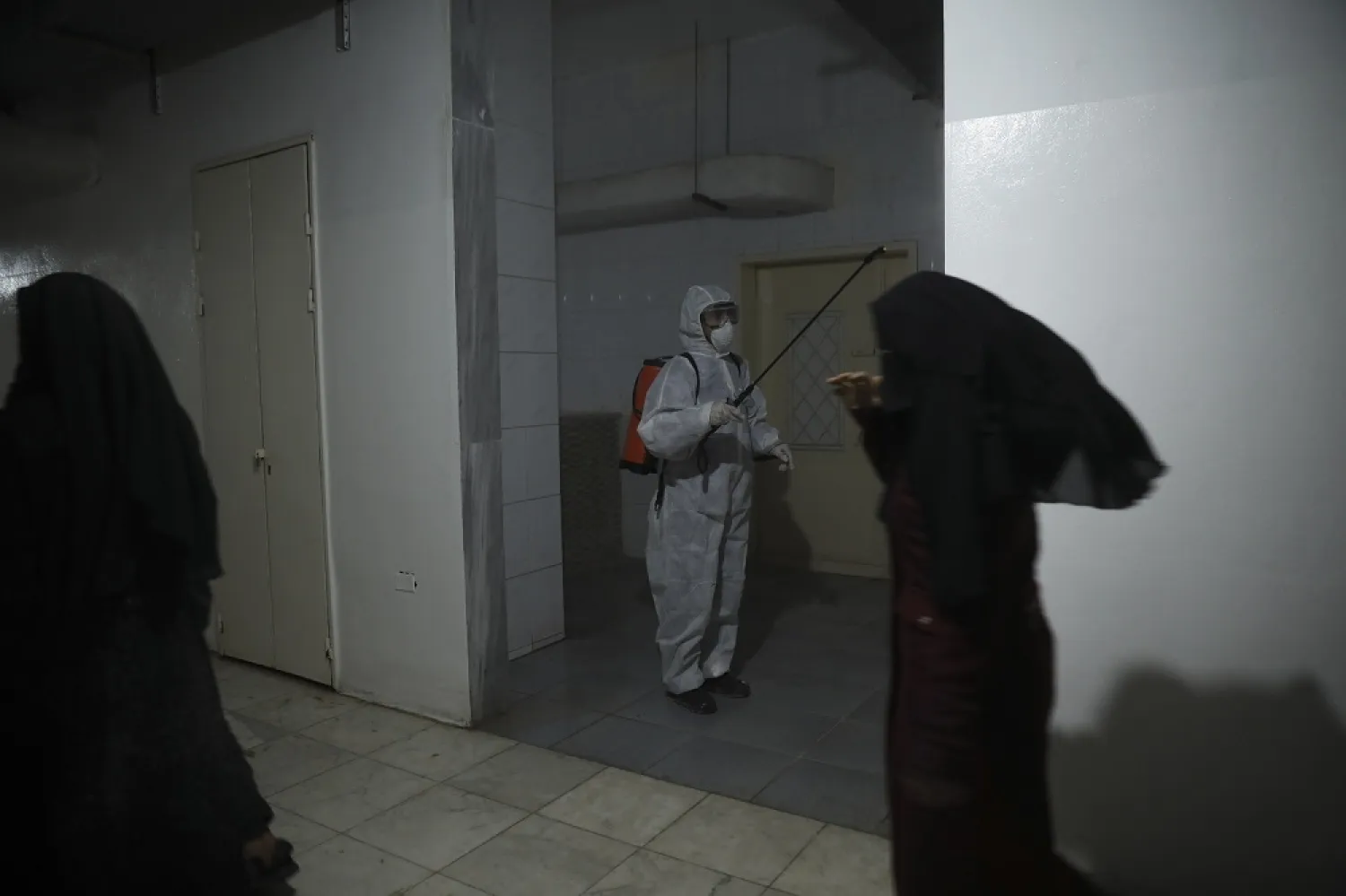
In this March 19, 2020 file photo, a member of a humanitarian aid agency disinfects inside Ibn Sina Hospital as prevention against the coronavirus in Idlib, Syria. (AP)
TT

Hospitals in Syria's Opposition Area Reduce Services amid Virus

In this March 19, 2020 file photo, a member of a humanitarian aid agency disinfects inside Ibn Sina Hospital as prevention against the coronavirus in Idlib, Syria. (AP)

Hospitals in Syria's overcrowded opposition-held enclave are suspending non-emergency procedures and outpatient services following the detection of the first case of coronavirus, a leading doctor in the area said Friday.

The regional education department also announced it was closing all schools.

The first case of COVID-19, a doctor in the area, was reported on Thursday in Idlib province, the last opposition-held part of Syria in a sliver of land bordering Turkey. The doctor was isolated and the hospital he worked in was shut down. The patients and medical staff he came in contact with have been quarantined.

There have been major concerns of an outbreak in northwestern Syria, an area packed with more than 3 million people, many of them living in tents and encampments, and where health facilities have been devastated by Syria's long war.

The first virus case in Idlib comes as moves by Russia, a major ally of the Syrian regime, and China vetoed resolution that would determine the fate of two border crossings with the enclave.

Aid groups and residents of the enclave have warned of dire consequences of limiting or reducing UN cross-border aid to the area, already devastated by displacement and destruction from frequent government attacks.

Western nations are pushing to keep the two existing ones open.

On Friday, hours before the initial Security Council resolution on the aid was to expire, 31 trucks carrying medicine and other supplies crossed into northwestern Syria from Turkey through the crossing Russia wants to shut down. UN agencies have been stocking up aid and relief supplies in the enclave in recent few weeks, a sign of nervousness over continued access.

As the trucks were crossing into Syria, UN Deputy Regional Humanitarian Coordinator Mark Cutts said 5,000 trucks had crossed the border in the last six years, monitored by the United Nations, and expressed hope the aid flow would continue.

“It is crucial that we keep this aid operation going,” he said in a video message. He later told reporters that the first case of COVID-19 in the opposition enclave “is a very big worry for us.”

“This has been a vital lifeline that has kept thousands and thousands of civilians alive for the last few years. This is not the time for us to be reducing the aid operations. We have to increase the access not reduce it,” Cutts said. He said 11 of the trucks were carrying medical aid.

Munzer Khalil, the head of the Idlib health directorate, said the measures to suspend non-emergency procedures and reduce services in Idlib were taken to raise the medical staff's level of readiness and show the public how serious the matter is. The measures will last at least a week.

The doctor diagnosed with the virus is a 39-year old who works in both Idlib and rural areas in neighboring Aleppo province. He had seen several patients, so contact tracing and testing is underway, Khalil said.

Fadi Hakim, of the Syrian American Medical Society, said the infected doctor is in isolation in Bab al-Hawa hospital but his symptoms remain mild.

Schools in the area will close as of Saturday until further notice, suggesting a return to remote learning, which had been in place until earlier this month.

Testing has been a major issue in the aid-dependent region, where one lab is in charge of carrying out virus tests. Some testing has been also done through Turkey, which has troops inside the enclave.

In regime-held areas in Syria, authorities have recorded 394 cases, including 16 virus-related deaths. In Kurdish-held areas in Syria’s northeast, where testing facilities are limited, about half a dozen cases have been reported.

“People have been lax" when it comes to taking precautions, Khalil said of the area's residents. “We want to use this period to raise awareness and to show how serious it is and to finish the preparedness of hospitals."



Egypt’s Prime Minister and FM Head to Washington for Trump Peace Council Meeting

Egyptian Foreign Minister Badr Abdelatty speaks during a joint press conference with Kenyan Prime Cabinet Secretary/Cabinet Secretary for Foreign Diaspora Affairs Musalia Mudavadi in Nairobi, Kenya, Monday, Feb. 16, 2026. (AP)
TT

Egypt’s Prime Minister and FM Head to Washington for Trump Peace Council Meeting

Egyptian Foreign Minister Badr Abdelatty speaks during a joint press conference with Kenyan Prime Cabinet Secretary/Cabinet Secretary for Foreign Diaspora Affairs Musalia Mudavadi in Nairobi, Kenya, Monday, Feb. 16, 2026. (AP)

Egypt's Prime Minister Mostafa Madbouly headed to Washington on Tuesday ‌to ‌participate in ‌the inaugural ⁠meeting of a "Board of Peace" established by US President Donald ⁠Trump, the ‌cabinet ‌said.

Madbouly is ‌attending ‌on behalf of President Abdel ‌Fattah al-Sisi and is accompanied by ⁠Foreign ⁠Minister Badr Abdelatty.

Foreign Minister Gideon Saar will represent Israel at the inaugural meeting, his office said on Tuesday.

Hamas, meanwhile, called on the newly-formed board to pressure Israel to halt what it described as ongoing violations of the ceasefire in Gaza.

The Board of Peace, of which Trump is the chairman, was initially designed to oversee the Gaza truce and the territory's reconstruction after the war between Hamas and Israel.

But its purpose has since morphed into resolving all sorts of international conflicts, triggering fears the US president wants to create a rival to the United Nations.

Saar will first attend a ministerial level UN Security Council meeting in New York on Wednesday, and on Thursday he "will represent Israel at the inaugural session of the board, chaired by Trump in Washington DC, where he will present Israel's position", his office said in a statement.

It was initially reported that Prime Minister Benjamin Netanyahu might attend the gathering, but his office said last week that he would not.

Ahead of the meeting, Hamas spokesman Hazem Qassem told AFP that the Palestinian movement urged the board's members "to take serious action to compel the Israeli occupation to stop its violations in Gaza".

"The war of genocide against the Strip is still ongoing -- through killing, displacement, siege, and starvation -- which have not stopped until this very moment," he added.

He also called for the board to work to support the newly formed Palestinian technocratic committee meant to oversee the day-to-day governance of post-war Gaza "so that relief and reconstruction efforts in Gaza can commence".

Announcing the creation of the board in January, Trump also unveiled plans to establish a "Gaza Executive Board" operating under the body.

The executive board would include Turkish Foreign Minister Hakan Fidan and Qatari diplomat Ali Al-Thawadi.

Netanyahu has strongly objected to their inclusion.

Since Trump launched his "Board of Peace" at the World Economic Forum in Davos in January, at least 19 countries have signed its founding charter.


Palestinian Child Dies After Stepping on Mine in West Bank

Israeli troops conduct a military raid in the village of Al-Yamoun, west of Jenin, West Bank, 17 February 2026. (EPA)
TT

Palestinian Child Dies After Stepping on Mine in West Bank

Israeli troops conduct a military raid in the village of Al-Yamoun, west of Jenin, West Bank, 17 February 2026. (EPA)

A Palestinian child died after stepping on a mine near an Israeli military camp in the occupied West Bank on Tuesday, the Palestinian Red Crescent said, with an Israeli defense ministry source confirming the death.

"Our crews received the body of a 13-year-old child who was killed after a mine exploded in one of the old camps in Jiftlik in the northern Jordan Valley," the Red Crescent said in a statement.

A source at COGAT, the Israeli defense ministry's agency in charge of civilian matters in the Palestinian territories, confirmed the death to AFP and identified the boy as Mohammed Abu Dalah, from the village of Jiftlik.

Israel's military had previously said in a statement that three Palestinians were injured "as a result of playing with unexploded ordnance", without specifying their ages.

It added that the area of the incident, Tirzah, is "a military camp in the area of the Jordan Valley", near Jiftlik and close to the Jordanian border.

"This area is a live-fire zone and entry into it is prohibited," the military said.

Jiftlik village council head Ahmad Ghawanmeh told AFP that three children, the oldest of whom was 16, were collecting herbs near the military base when they detonated a mine.

Jiftlik as well as the nearby Tirzah base are located in the Palestinian territory's Area C, which falls under direct Israeli control.

Israel has occupied the West Bank since 1967.

Much of the area near the border with Jordan -- which Israel signed a peace deal with in 1994 -- remains mined.

In January, Israel's defense ministry said it had begun demining the border area as part of construction works for a new barrier it says aims to stem weapons smuggling.


Hezbollah Rejects Disarmament Plan and Government’s Four-Month Timeline

29 July 2024, Iran, Tehran: Then Hezbollah deputy leader Sheikh Naim Qassem is pictured during a meeting in Tehran. (Iranian Presidency/dpa)
TT

Hezbollah Rejects Disarmament Plan and Government’s Four-Month Timeline

29 July 2024, Iran, Tehran: Then Hezbollah deputy leader Sheikh Naim Qassem is pictured during a meeting in Tehran. (Iranian Presidency/dpa)

Hezbollah rejected on Tuesday the Lebanese government's decision to grant the army at least four months to advance the second phase of a nationwide disarmament plan, saying it would not accept what it sees as a move serving Israel.

Lebanon's cabinet tasked the army in August 2025 with drawing up and beginning to implement a plan to bring all armed groups' weapons under state control, a bid aimed primarily at disarming Hezbollah after its devastating ‌war with ‌Israel in 2024.

In September 2025 the cabinet formally ‌welcomed ⁠the army's plan to ⁠disarm the Iran-backed Shiite party, although it did not set a clear timeframe and cautioned that the military's limited capabilities and ongoing Israeli strikes could hinder progress.

Hezbollah Secretary-General Sheikh Naim Qassem said in a speech on Monday that "what the Lebanese government is doing by focusing on disarmament is a major mistake because this issue serves the goals of Israeli ⁠aggression".

Lebanon's Information Minister Paul Morcos said during a press ‌conference late on Monday after ‌a cabinet meeting that the government had taken note of the army's monthly ‌report on its arms control plan that includes restricting weapons in ‌areas north of the Litani River up to the Awali River in Sidon, and granted it four months.

"The required time frame is four months, renewable depending on available capabilities, Israeli attacks and field obstacles,” he said.

Hezbollah lawmaker Hassan ‌Fadlallah said, "we cannot be lenient," signaling the group's rejection of the timeline and the broader approach to ⁠the issue of ⁠its weapons.

Hezbollah has rejected the disarmament effort as a misstep while Israel continues to target Lebanon, and Shiite ministers walked out of the cabinet session in protest.

Israel has said Hezbollah's disarmament is a security priority, arguing that the group's weapons outside Lebanese state control pose a direct threat to its security.

Israeli officials say any disarmament plan must be fully and effectively implemented, especially in areas close to the border, and that continued Hezbollah military activity constitutes a violation of relevant international resolutions.

Israel has also said it will continue what it describes as action to prevent the entrenchment or arming of hostile actors in Lebanon until cross-border threats are eliminated.